
Susan Pendergrass, Patrick Ishmael and Jakob Puckett join Zach Lawhorn to discuss Missouri’s newly-signed COVID liability legislation, MO DESE’s application for American Rescue Plan funds and Jakob’s recently published report on tolling in Missouri.
Major K-12 Teachers Union Endorses Teaching Critical Race Theory

The National Education Association (NEA) made some big news at its annual meeting last week, endorsing the teaching of critical race theory (CRT) to K-12 students and calling on members to “fight back” against those that oppose it. The union also committed to providing:
an already-created, in-depth, study that critiques empire, white supremacy, anti-Blackness, anti-Indigeneity, racism, patriarchy, cisheteropatriarchy, capitalism, ableism, anthropocentrism, and other forms of power and oppression at the intersections of our society, and that we oppose attempts to ban critical race theory and/or The 1619 Project. [Emphasis mine]
I’ll let readers unpack for themselves what all those other terms mean. But not only do we know that CRT is already in K-12 classrooms around the country and here in Missouri, but its instruction is now officially supported by one of the biggest teachers unions in the United States.
Is your school in an “NEA district”? Maybe.
The Missouri NEA’s website offers the most current list of the group’s 300 or so affiliates in Missouri, but thanks to our Show-Me CBAs Project, we also know that there are a lot of Missouri districts that had formalized and active working relationships with the Missouri NEA in recent years. That list includes:
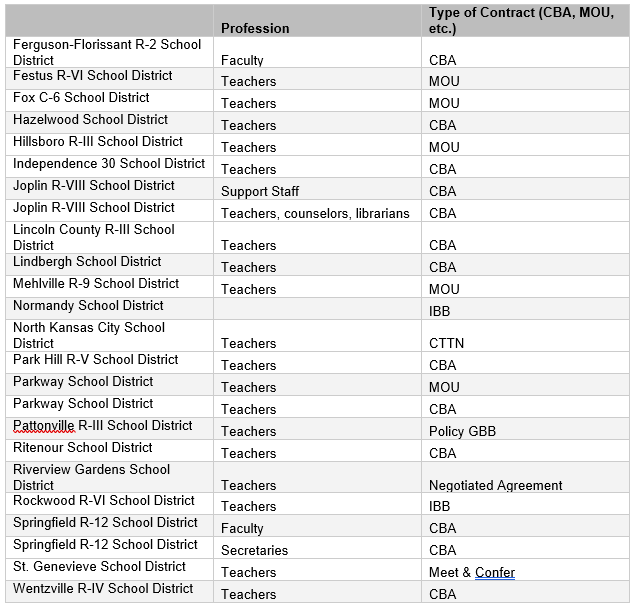
You can find our full CBA report here.
It might not be coincidental, then, that several of the districts on these lists have been less than open about what they’re teaching kids in response to our Show-Me Curricula inquiries. Taking the cake so far is Springfield, whose public schools want nearly $2,000 to produce documents relating to what they’re teaching their kids. If the district’s partners in the NEA are any indication, I can imagine why they might be reluctant to hand over these public documents.
The NEA’s endorsement of CRT reaffirms how important it is for Missouri schools to be honest with parents and the public about what’s being taught in their classrooms. Hopefully, those districts currently resisting our transparency requests will relent in their effort to evade what’s required of them under the Sunshine Law. We certainly won’t relent in pursuing those documents.
Does the Gas Tax Bill Violate the Constitution?

Supporters of this year’s gas tax bill presumably don’t think they passed something that would violate Missouri’s constitution, but as my colleagues and I have outlined, there are reasons the bill’s opponents think otherwise. The question is whether the bill violates the state’s Hancock Amendment.
Recently, I’ve written a lot about the potential for Hancock Amendment issues with the gas tax bill but have yet to outline the more technical questions on the topic. Here is a non-exhaustive list of what I’ll be watching as the situation unfolds:
- How should the revenue impact of SB 262 be calculated for Section 18(e) compliance?
- The amendment states that the effect shall be measured the first fiscal year the tax increase is “fully effective.” Since the bill would be phased in over five years, should compliance be determined in each of the five years or only once when fully implemented in 2027?
- At one point Section 18(e) describes compliance as being based on revenue estimates, while elsewhere it refers to the measurement of actual collections. Does this mean the gas tax hike has to go into effect before it can be determined whether the bill should have received a public vote or not?
- If the calculation is based on estimated revenues, how should the state project the number of Missourians who will take advantage of the refund provisions and how will that impact the ultimate revenue calculations?
- If using actual collections, how much revenue will the gas tax hike raise and how much will be claimed for a refund? There’s always a real chance that actual collections differ widely from revenue projections, and if that turns out to be the case, what would that mean for the bill’s compliance?
- How will the other bills signed by Governor Parson this year impact compliance?
- Based on the answers to the SB 262 questions, similar principles will likely have to be applied to every bill that becomes law this year. What will that mean for Hancock Amendment compliance this year, and for years to come?
- For example, if the online sales tax bill currently sitting on the governor’s desk becomes law, the fiscal note projects it could potentially increase state revenue collections next year yet reduce total state revenues five years from now. In other words: Could bills passed this year exceed the Hancock Amendment cap next year but be in compliance once they’re fully implemented?
- What will the courts decide?
- If the gas tax bill becomes law, there will likely be legal challenges. As I’ve mentioned previously, the approach taken with SB 262 is unprecedented, so the courts could provide some clarity to this complicated topic. What the courts ultimately decide is anyone’s best guess.
- Based on the answers to the SB 262 questions, similar principles will likely have to be applied to every bill that becomes law this year. What will that mean for Hancock Amendment compliance this year, and for years to come?
Before too long, we’ll know where the governor stands regarding many of these questions, but if he signs the bill his decisions will likely only be the beginning in terms of adjudicating these issues.
Missouri’s Hancock Amendment and the Gas Tax
With Governor Parson set to decide whether to raise Missouri’s gas tax in the coming days, the general assembly’s decision to sidestep voter approval on the issue has reignited discussion about the state’s consequential Hancock Amendment.
In 1980, Missouri voters approved an amendment to the state’s constitution adding Article X, Sections 16 through 24, which are collectively referred to as the Hancock Amendment. The sections are some of Missouri’s most important safeguards against higher taxes and growing government. But as with most constitutional topics, the Hancock Amendment and its implications are quite complex.
The concerns about this year’s gas tax bill center around Article X, Section 18(e) of Missouri’s constitution, which was approved in 1996. The subsection states that in addition to the other limitations imposed by the Hancock Amendment, Missouri’s general assembly cannot raise taxes or fees above a certain threshold in a given year without voter approval.
To avoid a public vote, the cumulative revenue impact of every bill passed by the legislature each year must be calculated and determined to be below the constitutionally defined limit. If the limit is exceeded, the bills that raise revenue must be submitted for a public vote starting with the largest increase, then every other increase in descending order, until the net effect of the remaining bills is lower than the year’s cap.
Here’s an example. Let’s say the cap in a given year is $100 million, and the legislature has enacted net tax increases of $125 million, and the most expensive bill raises taxes by $30 million. You would only need to vote on that one bill. If the bill is rejected by voters, then the legislature is below the cap. If voters approve the bill, the bill no longer counts toward the Hancock cap. If one single bill didn’t cover the entire gap by itself, that’s where voting on each bill in descending order comes into play.
When the amendment was initially adopted, the cap was $50 million in new revenue but has since been adjusted according to state personal income growth, and for 2021 it was $111.8 million.
For this year’s gas tax bill, the official fiscal estimates suggest that once fully implemented, it could raise between $123–$455 million. On its own, the bill would appear likely to exceed the Hancock Amendment cap, but that’s only one part of the story.
First, since compliance with the amendment’s limit is based on the net effect of all legislative changes in a year, we can’t know whether there’s a violation until Governor Parson finishes signing this year’s bills. It is also important to remember that if one bill raises enough revenue to violate the amendment, as long as there’s another bill that would simultaneously lower taxes or fees such that the net tax increase is below the threshold, the general assembly could still avoid violating the constitution.
Second, the gas tax bill is really the first of its kind. There haven’t been similar past efforts to raise taxes the way it does while avoiding a public vote. The gas tax bill has a refund mechanism, which is explained in the first post in this series. Given the potential complexity of a refund, this part of the bill appears to serve as a tactic to avoid triggering the Hancock Amendment rather than an effort to ensure Missourians pay less tax. Consequently, there are a variety of unanswered questions about how a potential Hancock Amendment violation would be handled. (See here for further breakdown of the questions at hand.)
One thing we do know is that Missouri voters are all too familiar with being asked to raise the state’s gas tax, and since the last approved increase in 1997have shot down every one of them, including a vote in 2018. While we wait to see what’s decided on the topic, it’s fair to wonder whether the legislature’s choice to avoid a public vote will prove to be a wise one.
What’s Happening with the Gas Tax?
As many Missourians have heard by now, a bill to raise the state’s gas tax for the first time in 25 years (SB 262) passed the House and Senate and is waiting on the governor’s desk. The governor indicated that he expects to sign the bill once his office finishes reviewing the bill’s language. But there are reasons to believe this review will unearth some concerns regarding its constitutionality.
Six members of the House recently sent a letter to the governor stating their belief that the bill will violate Missouri’s constitution, specifically the Hancock Amendment. The provision in question limits the amount the general assembly can raise taxes in a given year without first being approved by a public vote. (See here for more information about the amendment).
If signed into law, SB 262 would raise the state’s gas tax by 2.5 cents per gallon for each of the next five years, for a total increase of 12.5 cents by 2027. But there’s a catch: residents can get a refund for the additional gas taxes paid due to this bill. The fiscal note for the bill estimates that once fully implemented in FY 2027, it could exceed the Hancock Amendment cap, which for this year is $111.8 million. Depending on how the bill’s fiscal impact is calculated and the number of refunds claimed, it is possible that in the years prior to 2027, the tax collected could also exceed the Hancock limits.
While there’s certainly more to the story regarding whether the legislature violated the Hancock Amendment, the gas tax bill becoming law certainly opens the door for a variety of questions and potential court challenges. The Hancock concerns are explained in more detail here, but here are a few of the major questions at hand:
- How much revenue will the gas tax hike raise?
- How many Missourians will take advantage of the available refund option?
- How will Hancock Amendment compliance be determined?
- How will the other bills signed into law by Governor Parson impact this calculation?
One way to avoid all this potential mess is to send the gas tax question to voters. In fact, a referendum petition has been filed that would accomplish just this, but it has yet to receive approval for circulation by the secretary of state. If the petition were to succeed, the Hancock Amendment concerns would be avoided because taxes approved by voters are not subject to the amendment.
Missouri may soon be raising the state’s gas tax, but there are a lot of questions to be answered before we know for sure. In the meantime, keep enjoying the second-lowest gas tax in the country.
Online Sales Taxes Bill Finalized

Earlier this week, Governor Parson signed the so-called Wayfair bill, and it’s a big deal for Missouri. Named for the Supreme Court case South Dakota v. Wayfair, the legislation makes our state the 50th in the nation to begin collecting online sales taxes from out-of-state retailers.
My colleagues and I have been writing about the online sales tax issue for years and have submitted testimony on the topic five times this year alone. The purpose of the tax is help level the playing field between online retailers and brick and mortar stores, but as Institute researchers have repeatedly emphasized, any effort to expand the state’s sales tax base should be done in such a way that it doesn’t raise the cumulative tax burden on Missourians. In other words, the bill should be revenue neutral. This legislation delivers in that regard.
SBs 153 & 97 offset the tax increases that will come with collecting online sales taxes from out-of-state retailers with future income tax reductions. Once fully implemented, after hitting various revenue targets over a period of years, Missouri’s top income tax rate will fall incrementally from 5.4 percent to 4.8 percent. This is a good move. It shifts the state government’s revenue reliance away from the economically destructive income tax and is paid for without raising other tax rates.
Additionally, SBs 153 & 97 include a host of other positive tax-related reforms that go beyond Wayfair. A few highlights include tax-increment financing reform, special taxing district reform, and a non-refundable earned-income tax credit. Components of each of these major reforms have been included in the Show-Me Institute’s Blueprint for Missouri over the past few years and represent significant improvements over our state’s status quo.
The bill signing represents just the beginning of what will be a long road toward Wayfair implementation. Online sales taxes aren’t slated to begin being collected until Jan. 1, 2023, while the other parts of the more than 200-page bill will go into effect later this summer. In the coming months, I’ll cover the many questions our state and local governments are facing regarding the online sales tax topic. But for today, I’m glad that after years of talk and no action, the governor and legislature finally delivered on this front for Missouri taxpayers.
Podcast: Wayfair is Signed, More Sunshine and Nearly $2 Billion for Education
David Stokes, Elias Tsapelas, Patrick Ishamel and Susan Pendergrass join Zach Lawhorn to discuss the recently signed online sales tax bills, the Missouri Supreme Court ruling on the state’s sunshine law and DESE’s application for $2 billion in federal relief money.
Is the City Foundry Just Moving Vegetables Around the Plate?

When you were a kid, did you ever push your vegetables around your plate hoping that the different placement would convince your parents that you’d eaten something? Often, we see a similar thing happen with large commercial developments funded by taxpayer dollars: Nothing new is created; already existing restaurants and stores shift to new developments in the guise of adding value to a region. A St. Louis Post Dispatch report highlights a perfect example of this: Kalbi Taco Shack is closing its original location to move into the City Foundry.
The City Foundry, a mixed-use development in Midtown, was granted $19.4 million in subsidies for the first phase of the development years ago. The St. Louis Tax-Increment Financing (TIF) Commission recently voted in favor of an additional $18 million in TIF for phase two of the project. Economic development incentives are meant to create new economic development and activity in the region. Kalbi Taco Shack abandoning one location for another is not a win for the greater St. Louis region. . Shifting existing businesses from one location to another creates new abandoned storefronts, but little to any value for the region.
Unfortunately, this is the outcome we see from economic development incentives all too often. Take Kansas City for example, where the Kansas–Missouri border war saw hundreds of millions of tax dollars forgone and many businesses shift across the border, but hardly any net growth for either state.
Researchers have found that economic development incentives do not increase economic activity in the larger area. One reason for that: Retail relocation does not create substantial (if any) job opportunities or new economic activity. Do these large developments that become the new home for existing businesses give the appearance that something is happening in the region? Sure. But it’s just vegetables moving around the plate; nothing is getting eaten.
Missouri K-12 Enrollment Declined 3 Percent this Year

New data released by the National Center for Education Statistics (ably summarized here) show a substantial decline in K-12 student enrollment during the 2020–21 school year. Missouri was not immune to this trend, seeing a just over 3 percent drop in enrollment this past year. That decline represents thousands of Missouri students who decided to opt out of the public school system for reasons that we are still trying to understand.
There is good news and bad news here.
The good news is that for the first time, many of these families decided to take their children’s education into their own hands. They recognized the limitations of the traditional school system and opted for something better. According to the Census Bureau, homeschooling is up substantially, including in populations not traditionally thought of as homeschoolers. Some recent research on families who homeschooled and who personalized their children’s learning during the pandemic showed the benefits that they saw for their children and for themselves. Insofar as the pandemic helped spur people to rethink education and usher in the year of educational choice, the long-term effects will trend positive.
The bad news is that many traditional public schools are going to struggle in the short and medium term. As children filter back into schools this fall, they will have had vastly different experiences during the past year. Some will have accelerated, with more attention from their parents and creative out-of-school learning opportunities. Some will have declined, with low-quality remote learning stunting their development and disconnecting them from learning. Some will be a mixed bag. Teachers are going to have to figure out how to teach to all these different students at the same time.
As noted, the largest declines in enrollment came in kindergarten, where parents appear to simply be holding back their students for a year until school can return to normalcy. That is going to create a bubble of students that will work its way through the education system for the next two decades. Will schools have to operate extra classes each year as these students progress from grade to grade? How about college applications, with all these students applying at once? And what happens when they all hit the workforce when they graduate? The echoes of the pandemic will reverberate for multiple school years.
