Missouri Gets a D Grade in Electric Competition

Missouri’s report card for electric competition is in, and it’s not good. According to a new study from the University of Texas, Missouri received a D for competitiveness in electricity markets, which is not surprising considering lawmakers have barely tried to incorporate competition. Missouri policymakers ought to take note, as Missourians have seen the fourth-fastest electricity price increases nationwide since 2008.

The study grades each state from A through F on several factors relating to electricity market design and competition. On most of the important criteria in the study, Missouri gets few of the answers right. For example, while some Missouri utilities do participate in wholesale electricity markets, where grid operators select the lowest-cost electricity to meet demand, in no part of Missouri do customers get to choose their electric service from among competing providers. Moreover, monopoly utilities are not required to submit requests for proposals to find the lowest-cost new generation portfolio. Monopolies utilities can simply build the generation portfolio themselves, potentially at higher cost. This lack of a competitive market means that hardly any power plants in Missouri are owned and operated by non-monopoly utilities.

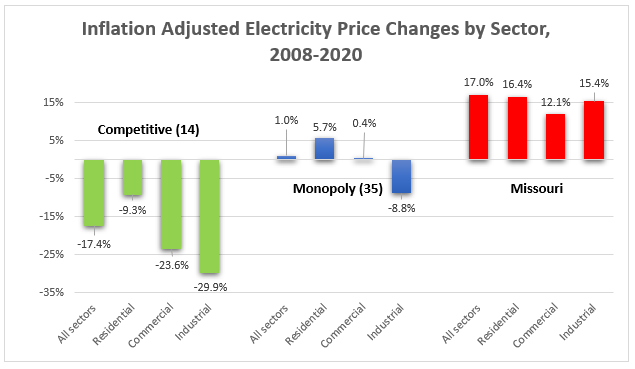
Not having a competitive market comes with its costs, and lately Missourians have been paying the price. For instance, customers of states that allow them to choose from competing retail electric service providers have seen their prices decrease 17 percent since 2008, whereas the average Missourian has seen his prices increase 17 percent during the same time period. Additionally, flexibility in choosing electric service providers appeals to businesses, as they can negotiate their own contracts and pursue their own electric generation goals.

If lawmakers want to reverse rising electricity prices in our state and create a more competitive and business-friendly environment, they don’t have to look far. Illinois received the second-highest grade in this study and has competitively structured electricity markets. As a result, its prices have decreased 13 percent since 2008. Based on these facts, shouldn’t lawmakers consider allowing greater competition in Missouri’s electricity markets?

The House Is on Fire

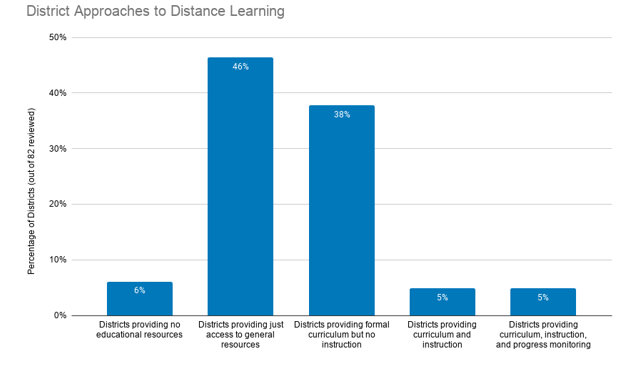
We’re in the midst of an educational crisis. We’re halfway through a third disrupted school year and Missouri students, especially the most vulnerable, have fallen dangerously behind. While the Missouri Department of Elementary and Secondary Education (DESE) has cautioned against drawing conclusions from last year’s test scores, they can’t just be ignored.

It’s troubling enough that only about one third of the Missouri students who took the state assessment last year scored at grade level in math. But for certain categories—Black students and students with disabilities—roughly ninety percent did not hit that benchmark last year. When 75 percent of students in multiple subgroups are below grade level, it’s time for immediate and intensive interventions.

Parents are well aware of what’s going on and many are upset that their children are losing ground. A recent survey found that over half of parents think tutoring would be very helpful for their children this year. Nearly two thirds of parents of students with disabilities would like tutoring for their children. Parents who can afford it are seeking tutors and paying out of pocket for them. But what about the 80 percent of low-income students who are falling behind?

Tennessee just pledged $200 million of its federal stimulus funds to launch a three-year tutoring project called the Tennessee Accelerating Literacy and Learning Corp (TN ALL Corps). High-dosage/low-ratio tutoring has “consistently proven to accelerate achievement as quickly as possible” says Tennessee’s education commissioner. In fact, a study from Brown University found that regular, frequent tutoring sessions can increase learning by up to 10 months.

DESE also has nearly $200 million in funding from the American Rescue Plan, plus millions from earlier rounds of stimulus. So far, Missouri has pledged stimulus funds to teacher recruitment and retention, to the Missouri Leadership Development System for principals, to improving the longitudinal data system, and to teacher professional development. While these may be great ideas in the long run, they don’t address the immediate crisis. Missouri’s needs big, bold ideas from its leaders and it needs them now.

St. Joseph Should Privatize Its Sewer System

A version of this commentary appeared in the St. Joseph News-Press.

The usual problems with water in St. Joseph, Missouri relate to having too much of it all at once. But properly getting rid of the water you have used—through your sewer system—is also a complex issue. More stringent water quality requirements from state and federal regulators have made it more difficult for many municipal utilities to operate. Often, they simply do not have the resources to meet the higher water-quality and sewage-control standards. Even large cities have had trouble dealing with revised Environmental Protection Agency (EPA) sewage guidelines. For instance, Kansas City reached an agreement with the EPA in 2010 to upgrade its sewer system at a cost of $2.5 billion over 25 years, and cities like Kansas City have more resources to deal with sewer infrastructure than communities like St. Joseph.

Sewer rates in St. Joseph are already a matter of complaint. A June 2019 article in the News-Press detailed concerns among the area’s business community that high municipal sewer rates were harming the region’s economic environment. Whatever the price, St. Joseph’s sewer issues aren’t going away anytime soon. The city reached an agreement with the EPA to improve the sewer system years ago. During the Trump administration, the EPA gave St. Joseph additional time and flexibility to complete those required system improvements. Under that revised agreement, the city will be upgrading the system until at least 2036, and during that period will continue to periodically release untreated sewage into the Missouri River during major storm events. While the agreement and time extension with the EPA may be justified, the fact is that St. Joseph has another option to consider: privatization. Water in St. Joseph has long been provided by private utilities, and the city should once again—as it has previously—carefully consider privatizing its sewer system.

Indianapolis outsourced its sewer systems to private operators in 1994, and the cost savings were even greater than had been estimated. The city saved $72 million over the first five years of the contract, and those savings allowed the region to invest in major repairs to its aging sewer system. On a smaller scale, communities across Missouri have realized that the best thing for their residents is to privatize their water and sewer systems. Within just the past two years, voters in Bolivar, Eureka, Taos, Trimble, Purcell, Hallsville, and Garden City have approved privatization of their municipal water and/or sewer systems to either Missouri-American Water or Liberty Utilities. Those communities—mostly small towns spread around the state—realized that maintaining these systems was going to be an enormous burden on city governments not properly equipped to manage them. Privatizing them—for amounts ranging from $200,000 to $28 million—was a way for each city to guarantee proper operation of their water and sewer services by a regulated, privately-operated utility. The cities can use (and have used) the money to pay down debts, invest in other municipal needs, or do whatever the city wants to prioritize.

Arnold, Missouri, is probably the best guide for St. Joseph. Arnold, a suburb of St. Louis with approximately 21,000 residents, was having trouble keeping up its sewer system as it grew in population. In 2015, city voters approved a plan to sell its sewer system to Missouri-American Water for $13.2 million. Since that sale, Missouri-American has completed several promised system upgrades, while Arnold used the money to pay down municipal debt and expand its park system. As a larger city than Arnold, St. Joseph could expect substantially more money in any privatization effort.

Private utilities in Missouri are regulated. Just as Missouri-American Water cannot raise water rates in St. Joseph without approval from the public service commission, no private company could take over the sewers and raise rates further without going through the same approval process. The fact is that running a sewer system under current rules and regulations is expensive and beyond the capacity of many communities. However, it is well within the capacity of larger, private utilities like Missouri-American Water, Veolia, and Liberty Utilities. As the Indianapolis public works director said about the private contractors they hired to operate the sewer system, “It’s just a different league. These guys have resources our guys could only dream of.”

St. Joseph should take advantage of that expertise and seek bids from several private utilities to either outsource the management and operations of their sewer system or—better yet—purchase and operate it. That is the best way that city officials can address the sewer system needs of St. Joseph for the benefit of everyone in the community.


Educational Performance Transparency Is Fundamental

Last month the Show-Me Institute released the Missouri Parents’ Bill of Rights (MPBR), a K-12 transparency and accountability proposal that reaffirms that parents and taxpayers should control the educational system they pay for. Since that time, several additional state-focused “Parents’ Bill of Rights” have been introduced by policymakers, and most of the reform provisions in those proposals hew closely to ours.

But more often than not, one provision that seems to get omitted from these plans is a provision that mandates educational performance transparency. As readers will remember, the MPBR requires not only transparency in curricula and school spending, but it also requires transparency in how well students are being prepared to have a productive life. As my colleague Susan Pendergrass has hammered home with the Missouri School Rankings Project:

Missouri schools are failing to teach the core subjects of reading and math and the most recent test scores show that students are falling further behind. Missouris Department of Secondary and Elementary (MO DESE) has not offered the level of transparency regarding student performance that is necessary to create an education system focused on higher standards, reducing achievement gaps, and results-based accountability. [Emphasis mine]

Susan’s MoSchoolRankings.org project underlines the danger of allowing DESE to obscure the failings of the schools and districts it oversees. DESE should be the partner to the public in demanding transparency and accountability from Missouri K-12 educational institutions. But all too often, it seems instead to be in cahoots with districts, against the interests of parents and taxpayers.

That’s why mandating educational performance transparency as part of the MPBR was important. It’s also why I think it’s important for such transparency to be included in any bill of rights now being proposed by public officials.

Costs of a Cosmetology License

Would you spend over $14,000 on extra schooling to make barely more than minimum wage? It sounds ridiculous, but that’s what the state requires to be a licensed cosmetologist in Missouri. The title of a recent report from the Institute for Justice is true: State cosmetology licensing fails aspiring beauty workers by making it too difficult and expensive to attain a license.

The Institute for Justice’s report examines the debt and dropout rate of cosmetology students across the country, and the numbers are pretty shocking. To receive a cosmetology license in Missouri, one must complete 1,500 educational hours from an accredited cosmetology program. From the 2011–12 school year to the 2016–17 school year, the average cosmetology program cost $14,629 and students took on an average of more than $7,700 in federal student loans.

That’s not pocket change, but it’s even worse when earnings are considered. In Missouri, the median annual wage of a licensed cosmetologist in 2019 was $23,760. That’s slightly lower than the national average of around $26,000 for licensed cosmetologists and slightly higher than yearly earnings from a full-time minimum wage job. (For reference, earning Missouri’s minimum wage of $10.30 for 40 hours per week and 52 weeks per year equates to yearly earnings of $21,424.) And more than two thirds of students do not graduate on time, increasing their debt burden even more.

So much money is spent to fulfill a state educational requirement, but is that requirement even necessary? Occupational licensing is intended to protect the health and safety of consumers, but recent research indicates that only 25 percent of cosmetology training is health and safety training.

Occupational licensing increases costs to consumers, but the other side of that coin is often overlooked. Licensing requirements dramatically increase costs for the workers who must obtain that license to earn a living. This is especially true in cosmetology, where the costs are directly tied to licensing requirements, but this is also true no matter the cost or resulting wages. It’s time for legislators to reconsider these requirements, regulations, and boards that have burdened workers and consumers for too long. A sunset provision for occupational licenses would be a great step toward reducing burdens and costs for consumers and workers.

Springfield Should Reject Subsidies for Sports Town

A version of this commentary appeared in the Springfield News-Leader.

It is important to learn from one’s mistakes, and when it comes to special taxing districts in the Springfield area, there are plenty of mistakes to learn from. Special taxing districts (SDs) are tax districts established to support one specific function or program, such as a school district. In recent years, however, most new SDs have been nothing more than vehicles for corporate welfare, and their use in Springfield has been anything but an example of good government.

Springfield is now considering a gift basket of new tax subsidies for the Sports Town youth sports complex. This included the recent city council approval of a new community improvement district (CID) to use tax dollars to subsidize the private development. First, the city gerrymandered a map to make sure the new CID didn’t include any voters to get around the voting requirements. Next, city leaders decided to give the developers $2 million in upfront subsidies even though the city’s own guidelines recommend against doing exactly that. The upfront subsidy by the city means that all Springfield taxpayers are paying for this project, not just the ones who may use the facility.

Remaining on this expensive list is a request by the developers for $4 million more subsidies from federal stimulus funds. Shockingly, the developers have decided that their project qualifies for federal funding. Maybe it’s for the sewers, or for tourism, or perhaps this project will help fight the COVID pandemic. Youth sports may be infrastructure now. Whatever the feeble excuse is, the lure of “free” federal money is strong. If a private development such as SGF Sports (the company behind Sports Town) cannot succeed without multiple subsidy programs, it’s not the job of taxpayers to ensure it goes forward.

With such a large subsidy upfront, Springfield is basically trying to be a real estate developer. The city should have learned from Greene County that government real estate speculation is a bad idea. That county previously subsidized the private Jamestown development by creating a neighborhood improvement district (NID) to pay off bonds the county issued in support of the proposal. It assumed the future taxes from the NID would suffice to pay off the bonds. It assumed wrong. When the Jamestown project failed, Greene County taxpayers were on the hook for the unpaid debt. Springfield should have learned from this costly mistake.

This SGF Sports CID would be the 17th CID in Greene County, most of them in Springfield, along with at least four more transportation development districts (TDDs). Despite the public-sounding names, many CIDs and TDDs consist of just a few parcels of property with sales taxes imposed on the public for the private benefit of one property owner. These tax dollars are often used for essentially private purposes, such as retail parking lots or landscaping.

How have these other SDs worked out in Springfield? Not very well. Missouri state auditor Nicole Galloway specifically cited Springfield’s HyVee store CID for improperly collecting almost a quarter million dollars of tax money. Galloway also identified Springfield’s College Station TDD downtown for multiple abuses, including failures to notify shoppers of the tax. Based on research on SDs generally in Missouri, the other SDs are likely functioning as corporate welfare schemes here in the Queen City of the Ozarks.

Springfield is a vibrant, growing community that does not need to rely on tax subsidies to boost its economy. If Springfield wants to help all businesses succeed rather than just a select few, it should work with Greene County to lower its commercial property tax surcharge rate, which is high compared to those of other Missouri communities. The CID for Sports Town was not necessary, and $4 million more from federal funds would be an even worse decision. The evidence is clear that these subsidy programs produce more financial mismanagement than economic growth. Springfield should learn from its history and stop repeating the same mistakes.

Brentwood Considering Mandating EV Charging Stations in New Townhomes and Apartments

Brentwood officials are considering a new electric vehicle charging station law that could raise prices for residents either looking to renovate or move into newly built townhomes or apartments.

The rule they’re considering would require electric vehicle charging stations be built with “new and substantial renovations and additions [at least 50 percent of the unit’s final floorspace] on single-family two family and townhomes and new multi-family residential developments.” The Brentwood Planning and Zoning Commission rejected a similar proposed mandate last month, but the Brentwood Board of Aldermen has revived the idea, with the Brentwood mayor indicating they may pass a bill on the matter.

Each EV charger costs an average of $5,000 to install, but it is still unclear who will pay for them. Ameren offers property owners subsidies for EV charging stations up to half the cost, but that still leaves thousands of dollars unaccounted for.

Additionally, their deliberations are vague concerning how many EV charging stations would be required per property. Would it be one per family in the case of townhomes? Would it be a percentage of total parking spaces available, as the new Saint Louis County ordinance requires? Would families that don’t use an EV be paying for their EV-driving neighbor’s charging station?

The board of aldermen’s proposal is not finalized, but the idea should be rejected. Let property owners install EV charging stations at their own pace based on the market demand for them. EV charging stations have grown rapidly across the country for the past several years without mandates like the one Brentwood officials are considering.

In the near future, equipping townhomes and apartments with EV charging stations may indeed make good business sense, either to keep existing tenants or attract new ones. But shouldn’t business and property owners be the ones deciding where to place EV charging stations rather than government officials?

Call for Music Production Tax Credits Sounds Familiar

Gateway Studios is using a hodgepodge of incentives to build a $130 million music production facility in Chesterfield. The company is also lobbying to create a state incentive program specifically for the music production industry. While I’m not opposed to making Chesterfield the new Nashville, it’s a lofty goal that interested parties want to achieve using taxpayer dollars and government handouts. Is anyone else getting déjà vu? This is sounding eerily similar to the colossal failure that was Missouri’s film production tax credit program.

The state’s film tax credit program was intended to stimulate the film industry by reducing a studio’s tax liability. Thankfully,  the film tax credit program sunset in 2013. The program was a failure. The Tax Credit Review Commission recommended that the tax credit be eliminated because it served too narrow of an industry and didn’t provide a positive return on investment. There was very little evidence that the program delivered on any of its promises. Do we really think the music production tax credit will produce a different result under very similar circumstances?

Show-Me Institute writers have been arguing against the film tax credit program for years (this tax credit program continues to haunt the legislature). What was said about that program also rings true for a potential music production tax program: If this industry cannot succeed in Missouri without government assistance, then maybe it shouldn’t be here.

Missouri certainly wasn’t the next Hollywood, but perhaps there’s potential for us to be the country’s next music capital. But that isn’t for the government to decide. If a private company wants to make it happen, great! Lawmakers, on the other hand, should not be giving out incentives (on the backs of other taxpayers) to artificially boost music production companies. It didn’t work with film tax credits—why should we expect a music production tax credit to be any different?

Why Missouri Should Embrace Retail Electric Competition in One Graph

Since 2008, Missourians’ average retail electricity prices have increased the fourth most in the country. The average retail price of electricity jumped 17 percent in our state over this time period after taking inflation into account.

Missourians have little recourse to deal with these rising costs. Missouri’s retail electric markets are monopolized, meaning that each Missourian only has one possible electric service provider.

But it doesn’t have to be this way. As I have written previously, thirteen states and the District of Columbia allow customers to choose between competing electric service providers. Looking at the time since competitive markets matured in 2008, the results have been quite encouraging, as shown in the graph below.

Source: Energy Information Administration

Missourians are losing ground when it comes to overall electric prices, too. In 2008, Missouri’s prices were quite low—43rd-highest overall electricity prices nationwide. Missouri’s prices now sit in the middle of the pack at 29th, due to the rapid price increases shown in the graph above.

Across every sector, competitive states are outperforming monopolized states—and especially Missouri—when it comes to lowering prices. Competition has helped make the electric service industry in those states more efficient and has passed on savings to customers. If lawmakers want to reduce the cost of living for Missourians while enhancing their economic freedom, they ought to consider embracing retail electric competition.

Support Us

The work of the Show-Me Institute would not be possible without the generous support of people who are inspired by the vision of liberty and free enterprise. We hope you will join our efforts and become a Show-Me Institute sponsor.

Donate
Man on Horse Charging