
Susan Pendergrass speaks with Michael Hartney about his new book, How Policies Make Interest Groups.
Produced By Show-Me Opportunity

Susan Pendergrass speaks with Michael Hartney about his new book, How Policies Make Interest Groups.
Produced By Show-Me Opportunity
As someone who disdains unnecessary government regulation and also desperately needs a haircut, I conveniently stumbled upon Daniel Smith’s “The Itch & Razor War”. His working paper recounts the origins of occupational licensing for barbers in the United States. Smith shows that occupational licensing is often promoted as a safety measure but quickly becomes a formidable barrier to entry supported by those already in the profession.
In the Progressive Era of the United States (the late 1890s to the late 1910s), an increasing number of “barber’s itch” (a contagious skin infection spread by using unclean razors) outbreaks led to the creation of barber licensures to ensure the implementation of sanitation efforts to prevent the spread of this ailment. One health column from that time noted that “90 percent of the justification for licensure was Barber’s Itch.”
It didn’t take long for the justification for regulation to evolve as motivations became increasingly self-interested. Unionized barbers began advocating for regulations in order to bar discount barbers from driving down prices. Lobbying included restricting barbers from working on Sunday (which affected discount barbers who worked part-time on the weekends), not allowing some barbers to offer free shoeshines with their haircut, and unique to Missouri, requiring “conversational ability.”
Most of us enjoy a barber who can carry on a conversation, but is this something that needs to be regulated by the state? It seems silly, but we still see the remnants of this type of requirement today where barbers in training have to spend 10 hours on “professional image” and another 10 hours of training on “salesmanship and shop management.”
Though public safety and “barber’s itch” were the impetus for licensing barbers, today only 5.5 percent of the required 2,000 hours for the Missouri barber’s apprenticeship relate to sanitation and sterilization procedures.
The fact is licensing creates an incentive for incumbents in an industry to use these licenses to drive down the number of competitors. This is often known as regulatory capture.
Smith’s analysis found that occupational licensing led to a 45% increase in haircut prices and a 55% increase in shaving prices, but there was no evidence that barber’s itch declined. This aligns with a Florida State meta-analysis, which observes that only 16 percent of occupational licensing studies show a positive relationship between product quality and licensing.
Today we rarely worry about barber’s itch, yet we require even more laborious licensing requirements. Policymakers should review these requirements for all professions to ensure the licensure process is providing a legitimate, beneficial service and not just helping pad the wallets of those already in the profession.
I’ve been giving a lot of thought lately to the findings of Missouri’s blue ribbon commission. In my last post, I lamented the fact that the commission used a very poorly designed survey in an attempt to answer the question, “How do we attract and retain more teachers?”
One glaring problem I see in the report is a complete lack of thought to almost anything besides compensation. Don’t get me wrong, compensation matters, and the commission is absolutely right to consider compensation. But if you are going to examine why there are reported teacher shortages, you ought to do a better job looking for causes or kinks in the teacher pipeline. Simply surveying existing teachers about whether they’d like more money (they would) will not help us answer the most pressing questions.
What are the causes of our current teacher shortage? They are certainly varied. But one thing the commission never seemed to consider was the current hiring practices of school districts.
From 2011 to 2021, enrollment in Missouri public schools dropped by nearly 30,000 students. The largest drop was post-COVID, with the state losing over 20,000 students in that year alone. Nevertheless, the trend is clearly downward.
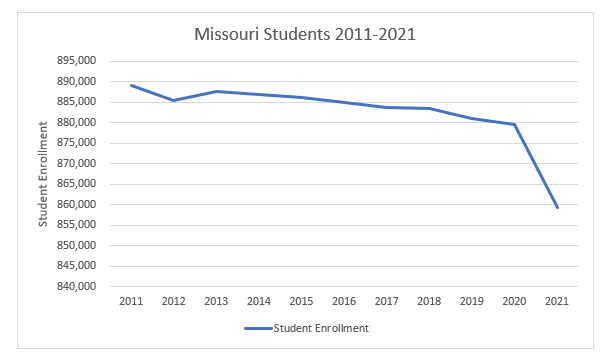
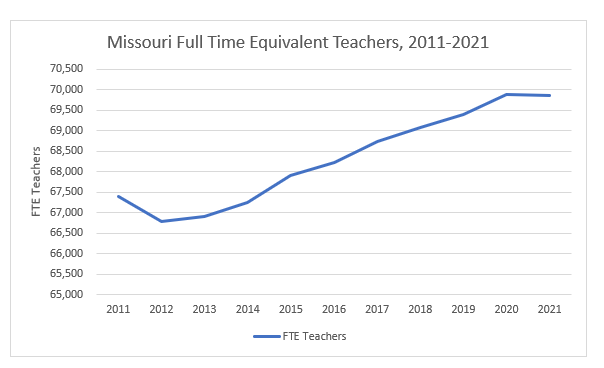
It would make sense, given that total enrollment in the state has been decreasing, to see a similar decline in the number of teachers. Fewer students, fewer teachers needed. But instead, we see the opposite happening. As enrollment drops, the state continues to add to the number of teachers. In the table below, I present the number of full-time equivalent teachers (FTE). From 2011 to 2021—the same period that the state lost 30,000 students—the state added 2,475 FTE teachers. As the state dropped 20,000 students from the rolls, it only lost 10 FTE teachers. This brings the ratio down from 13.2 students per FTE teacher in 2011 to 12.3 in 2021.
If we looked at non-teaching staff and administration, we’d likely see similar trends. Indeed, Economist Ben Scafidi found exactly this when he looked at the data from 1992 to 2015. During that time period, Missouri student enrollment increased 9% while teachers increased 28% and all other staff increased 24%. Hiring seems to be uncorrelated with trends in student enrollment.
Why didn’t the commission consider this? Why wasn’t someone willing to ask the question, “Why are we increasing the number of teachers when the number of students is dropping?”
If you want to understand the teacher shortage, this is pretty important information.
Reviewing the recent release of the National Assessment of Educational Progress (NAEP) is an ideal way to get into the spirit of Halloween. The falloff in student performance is enough to make your skin crawl; to take one example–the NAEP report features a six-point drop in Missouri fourth-grade mathematics and five-point drop in fourth-grade reading.
Show-Me Institute writers have discussed this report in greater detail in previous posts, but here I want to draw attention to comments made by the Commissioner of Education.
In response to the release of these aforementioned test scores, the commissioner released two quotes:
I don’t disagree with the first statement, but what does it say about the quality of Missouri’s teachers? Is the commissioner suggesting that the teachers are to blame for the drop in test scores? And if so, what exactly does the commissioner propose to do about it?
How about this for starters: If high-quality instruction matters so much (and it does), maybe Missouri’s Department of Elementary and Secondary Education (DESE) should reconsider its policy of tying teacher salaries solely to experience and degree acquisition rather than student performance.
As to the second point: yes, the pandemic, or at least the response to the pandemic, did have an impact. Closing schools for months at a time does tend to impair the progress of our students. And yes, there is more work to do . . . but is there nothing more concrete to suggest than “improved systems and processes”? How about turning a critical eye toward DESE’s policy of blanket accreditation and the restrictions on open enrollment and school choice?
The response of our Department of Education to these test results tells us everything we need to know about why Missouri students are lagging behind their peers. Leadership is about a lot more than stating the obvious and then offering anodyne generalities as an excuse for doing nothing. Leadership is about taking real action, even if it means ruffling the feathers of entrenched interests.
What’s really horrifying about the NAEP results is that DESE clearly has no plans to do anything about them.
If Missouri education were a horror movie, we’d say that it’s time for the hero to stop looking outside for monsters to slay.
The calls are coming from inside the house.
This past August, the FDA approved the sale of over-the-counter (OTC) hearing aids. Previously, a prescription for a hearing aid required a visit to a health care professional. Now, anyone with mild to moderate hearing loss can purchase an OTC hearing aid online or at their local pharmacy without needing a medical exam or prescription. Prescribed hearing aids cost the average American between $2,000 to $7,000, whereas OTC hearing aids can now be purchased for as low as $199 at your local CVS or Walgreens.
The FDA decision to loosen regulations has allowed a new market for OTC hearing aids to surface. As tends to happen when the free market is allowed to function, brands now have to compete for the customer if they want to succeed, which leads to much more affordable and better-quality products.
According to the National Institutes of Health (NIH), approximately one in three people between the ages of 65 and 74 and nearly half of adults over 75 suffer from some sort of hearing loss. It’s likely many people don’t want to admit they have trouble hearing and go through the hassle of visiting a specialist, so they don’t take any action to improve their hearing. Hopefully, this increased accessibility of hearing-loss solutions will prompt more Americans to do so. While this is a great step forward in enabling access to hearing aids for the millions of Americans who have mild to moderate hearing loss, those with severe hearing loss still have many barriers, including high costs, to overcome.
To become a hearing-aid specialist in Missouri, a degree in hearing instrument sciences is not enough. A Missouri law requires those who would like to become hearing-aid specialists to obtain and consistently renew a special license that allows them to diagnose, prescribe, and fit people with hearing aids. These sorts of occupational licenses in theory mitigate risks and improve overall quality of services, but they tend to hurt more than they help. A Princeton study demonstrated that even in health-related occupations, “such as dental hygienists, nurse practitioners and opticians . . . licensing restrictions raise the cost of services without improving quality.” The hearing-aid examiner license required by Missouri raises the educational costs and creates barriers for those seeking to become specialists in the field, and in turn likely results in higher healthcare costs for Missourians who need to visit a specialist to obtain their hearing aids.
Kudos to the federal government (something you don’t often hear Show-Me Institute analysts say) for removing an unnecessary healthcare regulation and making hearing aids more affordable and accessible for older Americans. If Missouri wants to help its residents receive more affordable and accessible care, it may want to consider doing the same.
Chesterfield does not have a municipal property tax. There’s nothing wrong with that. It funds its local government primarily with sales taxes. Again, that’s all fine.
But now it wants to both subsidize and fund a major redevelopment of and around the Chesterfield Mall, and it wants to use property taxes to do so. How do you do that when you don’t have a property tax? Solution: you just take the property taxes from other governments. While that type of stealing would be illegal in many other situations, it is, unfortunately, perfectly legal under the tax-increment financing (TIF) laws of Missouri.
How much tax money is Chesterfield planning to take from other taxing districts should the development be approved and built (no guarantees on either of those)? $300 million. That’s right, $300 million.
The development proposal includes over 3,000 new residential units. Those residential units are going to have families with children. That is obviously wonderful, but what is not wonderful is that the school property taxes from those 3,000 units for the life of the TIF (around 30 years due to the phased in nature of it in this instance) will not go to the school districts (mostly Parkway, some in Rockwood). That tax money will go to Chesterfield and to the developer. The plan includes giving millions of dollars voluntarily to Parkway in an effort to buy the school district’s support, but the school districts have added up the money and concluded it will be short. How far short?
$220 million short. That’s right, $220 million. The school districts have calculated the probable number of extra children who will join the district because of the development, the need for an entirely new school building to educate them, the cost to educate those children on top of the new building, the length of the TIF project, and more, and concluded that they are short $220 million tax dollars in this deal. How are Parkway and Rockwood going to make up that estimated $220 million? They have only a few choices: cut school services in various ways or—more likely, in my opinion—request a tax increase on taxpayers outside of the TIF district.
So let’s be clear: in order for taxpayers to fund the demolition of Chesterfield Mall (instead of having the group that actually owns the mall take care of it) and hundreds of millions of dollars’ worth of other amenities—including $23 million to pay the cost of lawyers, planners, and financiers—the residents of Parkway school district can almost certainly look forward to a tax increase on everyone who is not inside the TIF district. (To be clear, residents inside the TIF district will also pay the higher tax, it just won’t go to Parkway schools.)
Something is deeply wrong with how we fund local government in Missouri.
Suppose your boss comes to you one day and asks you to take a survey. He or she asks you, “When considering the components of compensation, please indicate the level of priority you feel that management should give to each. Your choices are more pay (an increase in base salary), performance pay for certain metrics, better health care benefits, or other stipends such as loan forgiveness or housing allowances. What do you choose?”
If you are like most people, you’d choose more pay.
If this survey were conducted with everyone in your company, what would it tell you?
It would tell you compensation preferences among people currently employed by the company.
That’s it.
It would not tell you whether boosting compensation in these ways would increase retention. It wouldn’t tell you whether you’d get more candidates applying for jobs if you did these things.
Of course, you may infer those things . . . but you could be wrong.
If you wanted to know those things, you’d need to design a better survey and you may need to survey different people.
For instance, if you want to know why people are leaving or staying, then you should ask that question. You should ask people who left the job why they left and what would have enticed them to stay. You should ask current employees if they’ve thought about leaving the company and, if so, why? Those questions would help you better understand how to retain people within your company.
Similarly, if you want to know more about recruiting applicants, you’d need to ask different questions and ask questions of different people. You’d ask your employees, “What attracted you to this job?” You’d ask people not employed at your company if they ever thought about applying for a job at your company and what would entice them to work for your company.
The questions you ask matter, and poorly designed surveys do little to help us answer the questions we really want answered.
Now imagine you were going to base a $29.5 million decision on the results of this survey. You’d think you’d want to get the questions right.
Well, you would unless you were the state’s Blue Ribbon Commission looking at the state’s teacher shortage.
The figure below shows the question the commission asked teachers. As Gomer Pyle might say, “Surprise, surprise, surprise.” Teachers want what anyone asked this question might want—more money!
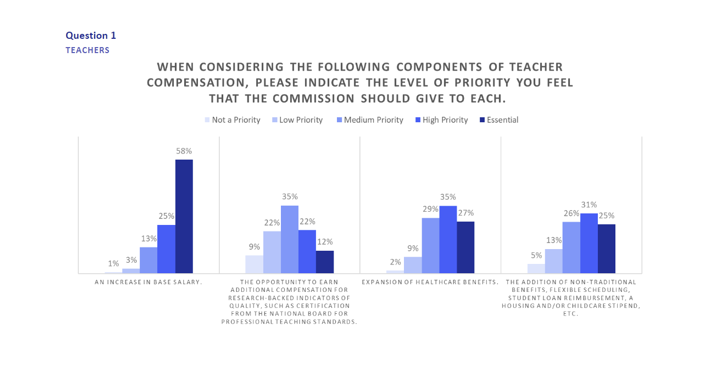
I’m not saying we shouldn’t pay teachers more money. Maybe we should. What I’m saying is that that the state should not base important and complex decisions on poorly constructed surveys that tell us what we should already know—people like being paid more.
My dad used to ask me: If everyone else jumped off a cliff, would you do it too? The 2022 scores on the Nation’s Report Card were just released and the results in both reading and math were dreadful. And yet, I know that when Missourians read that 7 in 10 of our 8th graders are below grade level, they’ll ask, “But what about every other state?” Sure, we’ve gone off a cliff and are about to hit the rocky shore below, but presumably others are freefalling as well.
For the record, here is how Missouri’s scale score (a 0–500 scale for reading and a 0–300 scale for math) on each of the four assessments compares to the U.S. average. Missouri’s 4th-grade reading score dropped by 5 points between 2019 and 2022. The national 4th-grade reading score dropped by 3 points. Missouri’s 4th-grade math scores dropped by 6 points (nationally—5 point drop). Missouri’s 8th-grade reading scores dropped by 6 points (nationally—3 point drop). Finally, Missouri’s 8th-grade math scores dropped by a whopping 9 points, compared to a national drop of 8 points. In summary, Missouri’s decline was worse on all accounts.
Twenty five states had smaller declines in 4th-grade reading, and 28 did in math. The 8th-grade results are worse; 39 states had smaller declines in reading, and 30 did in math. A handful of states had score gains here or there or declines of just a point or two in their scale scores.
So, if it really matters whether Missouri did badly on its own or worse than other states—the answer is both.
The 2022 scores on the Nation’s Report Card (or NAEP), a test administered every other year by the U.S. Department of Education, are in—and the results are disastrous. Reading and math scores for 4th and 8th graders plummeted nationally and in every state.
Let’s be perfectly clear: Missouri has been heading toward a test score cliff for some time. The pandemic just punched the gas pedal like Thelma and Louise. In fact, Missouri’s NAEP scores peaked in about 2009, around the same time that enrollment in our public schools peaked. In 2009, nearly one third (36 percent) of Missouri 4th graders scored at the Proficient level or higher in reading and 41 percent did in math. Last year, just 30 percent hit the mark in reading and 34 percent did in math. The 8th-grade numbers are similar. Reading scores topped out in 2015 at 36 percent Proficient or higher and have been slowly declining ever since, reaching 28 percent last year. 8th-grade math scores, which reached a high of 35.5 percent in 2009, dropped like a rock in one year to 24 percent of students scoring Proficient or higher.
But here are the numbers that should really scare us. In 2022, a shocking 40 percent of 4th graders scored Below Basic in reading. On this test, “Basic” means a “partial mastery of the knowledge and skills that are fundamental for proficient work at a given grade.” Four in ten Missouri 4th graders do not even have a partial mastery of 4th-grade reading. How can these students be expected to read and understand a math or science book? A disturbing 39 percent of 8th graders scored Below Basic in math. How will these students navigate high school and become anything close to college or career ready?
Brace yourself for the excuses—much of the blame will be placed on the pandemic—and pleas for more money. The painful truth is that on somebody’s watch, Missouri went from having about 40 percent of their students on grade level to an equal percentage not having even a basic grasp of the material. Is a blue ribbon commission really going to get to the bottom of the problem? Should we expect a reversal of fortune without changing how we do business? I’m not holding my breath.