Aldermanic Discourtesy

“Aldermanic courtesy” is a practice adopted by some local government boards or councils that gives wide latitude to local officials for what is allowed or approved within their ward or district. There are many “quality-of-life” issues where preferences vary within a larger city, so some level of deference to local preferences is inevitable and fine. Issues such as liquor licenses, bar operating hours, minor traffic rules (e.g., stop signs or one-way streets), minor zoning choices, and much more are often left to the discretion of the local elected member of whatever board or council applies. In the City of St. Louis, tax subsidies for local developments often fall under this umbrella of aldermanic courtesy.

While I recognize the appropriate use of aldermanic courtesy in some instances, I am the last person to defend its widespread practice. Laws should be applied evenly to the greatest extent possible, and too often aldermanic courtesy just enhances the whims and personal power of the practitioners. Whether your new restaurant is allowed to serve liquor should not depend on whether the alderman likes you or not.

Recent unfortunate events in the City of St. Louis have brought the practice justifiably into question, but like a desperate gambler whose every bet is wrong, the board of alderman can’t even get ethical reform right. The board just decided to bypass the usual practice of aldermanic courtesy in the 17th Ward FOR ALL THE WRONG REASONS. The local alderwoman had been more hesitant to support tax subsidies in her ward, and she deserves praise for that (and some related criticism). So the developers who want their giveaways just found another member of the board to introduce their subsidy bill, and it is expected to pass.

The most absurd statement in the story is this one:

In any case, [Alderman Marlene] Davis said aldermen should be willing to listen to the “experts at SLDC,” who professionally vet development projects.

The idea that “experts” at the St. Louis Development Corporation actually “vet” these development subsidy requests is beyond absurd. The ease and frequency in which developers receive these subsidies, combined with the continued decline of much of the City of St. Louis, are Exhibits A through Z for why all these types of subsidies don’t work.

These tax subsidies are there for the taking. A few aldermen, such as Ms. Pihl, occasionally try to push back somewhat. So what happens then? You just find another member of the board to go around the member who won’t rubber stamp your handout. If this is how we are going to reform aldermanic courtesy in the City of St. Louis, then bring back the crooked assessor.


Ladue Food Trucks Have Started Rolling—Now We Need to Step on the Gas

I hoped that Show-Me Institute videos, testimonies, and articles would bring needed reform to food truck policy in Ladue, and it seems like these efforts have at least gotten the ball rolling. I mean, how could anyone oppose the undeniable truth of a street interview? While there are still far too many restrictions on food truck operation, I commend Ladue officials for removing the blanket ban on food trucks and taking a first step in allowing this lucrative, fun, and growing industry to establish a foothold (or parking space) in their city.

Although the ban was removed, strict regulations still exist, as food trucks must be part of a special event, which is a serious obstacle. Special events require a thirty-day notice prior to the date, and if a special event uses more than eight vendors (among other stipulations), then 120 days of notice are required. These rules constrain opportunities for food trucks in Ladue, making the city an occasional stop rather than a hub.

The scale of the food truck industry has skyrocketed in recent years, as the number of businesses has increased from 9,705 in 2012, to 22,474 in 2018, to 35,512 in 2022. Ladue regulations prevent the city from effectively capturing sizeable sales tax revenue, increased options for consumers, and job opportunities for aspiring entrepreneurs.

For consumers, food trucks provide on-the-go food options to those on lunch break, on a walk with their children, or hanging out with friends. The increased competition drives down prices and provides increased choices (including niche ones) to consumers.

Permission to more easily operate in Ladue could lead to more permanent businesses in the city. If a food truck found success in Ladue, food truck operators may decide to establish traditional brick-and-mortar locations in the city. This isn’t just hypothetical—food trucks have turned into traditional restaurants elsewhere in St. Louis.

Most anxieties about food trucks are unfounded. If concerns exist regarding restaurant surplus, increased competition helps create a more efficient economy. If policymakers fear exacerbating the labor shortage in restaurants, the average food truck business has 1.2 employees. Whatever the worry may be, food trucks should not be strictly limited to special events, and Ladue would benefit from food trucks being able to fully and freely operate within its borders.

Laclede County Proposes Its Own Tax Cut

Patrick Ishmael and I have been writing and talking a lot about the proposal on the ballot in Clay County to reduce its very high commercial property surtax. Voters in Clay County will decide whether to reduce the surtax rate slightly to equal Jackson County’s tax rate. We think that even though the change is modest, it would be a beneficial move for economic growth in Clay County.

Not to be outdone, Laclede County officials have also decided to put a surtax reduction before voters. While the Laclede County rate is not as high as the Clay County rate, it is nonetheless very high and by far the highest among neighboring counties. Laclede County’s rate cut is also larger than Clay County’s. Laclede County officials are proposing to reduce the surtax from $1.03 per $100 of assessed valuation to $0.51. The key thing to remember is that the surtax does not roll back as assessed valuations increase, so over time as the local economy grows—and this tax cut should help it grow more—the rate remains the same and the tax revenue generated by it will increase. For the record, the $0.51 rate is right on average for Missouri counties. (Some are saying that the average rate is $1.02, but whoever calculated that clearly used a weighted average. The largest counties of St. Louis, Jackson, and Clay with their very high rates significantly alter the calculation. I think the unweighted average (mean: $0.53; median: $0.41) is preferable for comparing individual counties to each other, especially counties such as Laclede, which is economically competing more with Camden and Dallas counties than with St. Louis and Kansas City.)

The Lebanon R-3 school district is crying some wolf about the size of this rate cut. School officials claim the district will lose $275,000 per year from this; however, Lebanon R-3 is a large school district, and that figure is less than one percent of its total revenues. This is a district that received $4 million in federal stimulus funds alone last year and which is poised, like every Missouri taxing district, to soon see a significant increase in personal property tax revenues this year from the dramatic increase in used car values. The personal property tax windfall alone should make up for the potential loss of revenue from the surtax reduction, should the voters pass it.

This commercial property surtax cut should be a real benefit to economic growth and job growth in Laclede County, and it will be interesting to see what the voters decide.


Robertson Fire District Changes Move Forward

A judge has thrown out a lawsuit that sought to block a recall vote for Robertson Fire District in northwest St. Louis County. So the recall vote of the full board will move forward, although the politics of that recall are not what this post is about. As I have written about before, this dispute is a complicated but ultimately vital issue that perfectly encapsulates what is wrong with so many of our very small tax entities in Missouri that get little attention from the public or media.

To summarize, about 20 years ago Hazelwood annexed a part of unincorporated St. Louis County that had been served by Robertson Fire District. Because of an obscure and misguided law (RSMO 72.418), Hazelwood was not allowed to use its own fire department provide fire protection services to the newly annexed area. Instead, Hazelwood was required to keep paying Robertson Fire District the amount it was due from property taxes within the part of its district now within Hazelwood. (It’s more complicated than that, but those are the basics of the arrangement.)

That part is troubling enough, but what happened over the ensuing years is that the fire district was able to convince voters in that area to increase their property taxes dramatically, because the residents did not owe the increased taxes like they normally would. In this case, the entire city of Hazelwood had to pay the higher taxes that benefitted (perhaps) a small number of residents. These elections were likely held on little-attended election dates where small groups of residents were able to wield outsized influence. The fire department union probably comes into play here, as a very politically active union can more easily dominate a fire district than a city fire department, although it can certainly do so with the latter, too.

Over the years, it has gotten to the point where Hazelwood is considering bankruptcy to pay the insane taxes it owes a fire district for services Hazelwood could and should be providing itself to these residents. This situation reflects everything that can go wrong with local government in Missouri—high taxes, inefficient government, and the imposition of taxes on taxpayers who have no say in the matter to benefit special interests. I wrote about this issue in my paper on Special Laws in Missouri. RSMO 72.418 needs to be changed so that cities that annex or incorporate have the option of providing fire services to the new parts of a city if that is what the new residents want. It is reasonable to require some type of payment to the fire district in these instances, but the current law allows the rampant abuse we are seeing in St. Louis County by the Robertson Fire District and needs to be substantially changed.

WATCH: Taxes Have Consequences with Arthur B. Laffer, Jeanne Sinquefield and Brian Domitrovic

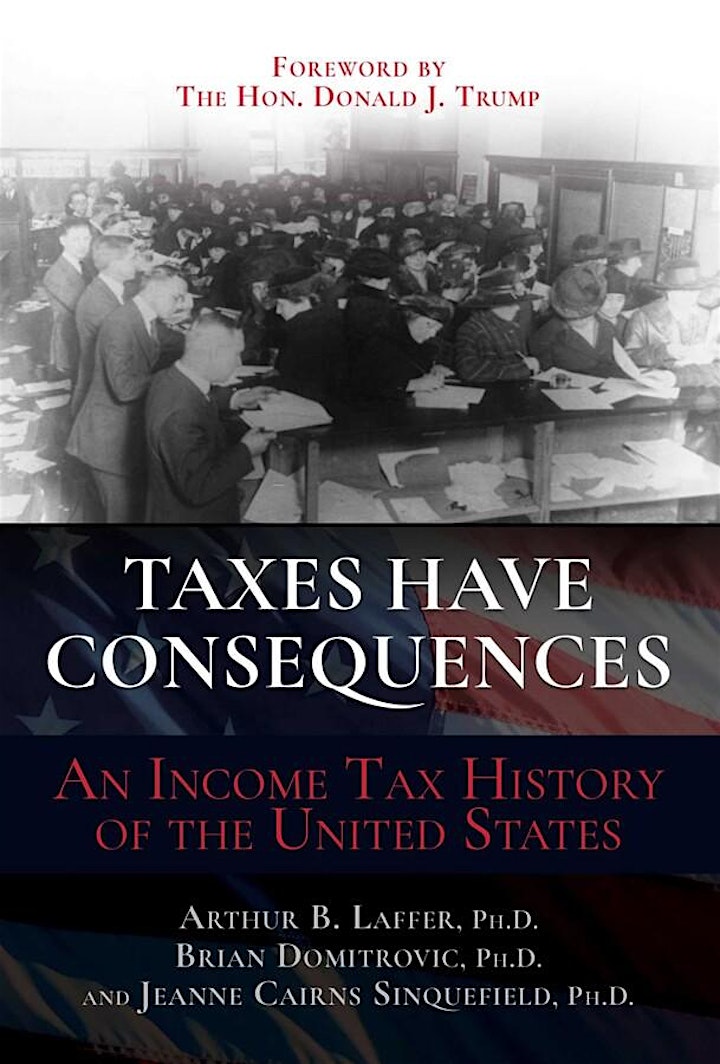
On September 20, 2022, Show-Me Institute and Show-Me Opportunity hosted a discussion with Arthur B. Laffer, Jeanne Sinquefield and Brian Domitrovic about their upcoming book Taxes Have Consequences: An Income Tax History of the United States.


About The Book

Taxes Have Consequences: Dr. Arthur B. Laffer and Dr. Jeanne Sinquefield imageAuthors: Arthur B. Laffer, Brian Domitrovic and Jeanne Cairns Sinquefield


The definitive history of the effect of the income tax on the economy.

Ever since 1913, when the United States first imposed the income tax via constitutional amendment, the top rate of that tax has determined the fate of the American economy. When the top rate has been high, as in the late 1910s, the 1930s, 1940s, 1950s, and 1970s, the response of those with money and capital has been to curtail real economic activity in favor of protecting assets and income streams. Huge declines have come to the economy in these circumstances.

The most brutal example was the Great Depression itself. When the top tax rate has been cut and held at reduced levels—as in the 1920s, the 1960s, in the long boom of the 1980s and 1990s, and briefly in the late 2010s—astonishing reversals have occurred. The rich have brought their money out of hiding and put it to work in the economy. The huge swings in the American economy since 1913 have had an inverse relationship to income tax rates.

About the Speakers

Arthur B. Laffer is the legendary founder of supply-side economics and economic advisor to President Ronald Reagan and Prime Minister Margaret Thatcher. He was awarded the Presidential Medal of Freedom by President Donald Trump in 2019.

Jeanne Cairns Sinquefield helped pioneer index-fund investing as executive vice president and head of trading at Dimensional Fund Advisors.

Brian Domitrovic is the author of five books, including the landmark history of supply-side economics Econoclasts.

Pay Differentiation Can Heal Missouri’s “Teaching Shortage”

Amidst a “teaching shortage” that is driving almost 25% of Missouri school districts into four-day school weeks, Missouri schools and officials are searching for relief and solutions.

The Missouri Blue Ribbon Commission has been tasked with finding solutions for this “crisis.” The commission proposed additional funding for the Career Ladder Program (opportunities for professional development and extra pay), Grow Your Own Program (local teacher recruitment), and raising the base salary for teachers to $38,000.

Two key questions arise from this proposal:

  1. What is the nature of this teacher shortage? Is it truly a crisis?
  2. How will handing out more money solve the issue?

To answer the first question, it is important to note that the total number of public school teachers in Missouri (71,055) in 2020–2021 is the highest it has been in the past five years. One might think this is a normal occurrence because the population of the United States is increasing.

However, public school enrollment in Missouri has been steadily decreasing, from over 915,000 students in 2016 to under 860,000 in 2021. Additionally, enrollment is projected to dip below 800,000 by 2030—a 10 percent drop in less than fifteen years.

So, what gives? Why are schools feeling the burdens of shortages and claiming that there is a crisis if they have an increasing number of teachers for a decreasing number of students?

It is not because of a shortage of total teachers, but a deficiency of specific teachers. Teachers for special education, mathematics, physics, and biology are in low supply.

One of the reasons for these specific vacancies is the lack of pay differentiation for teachers. In Missouri, public school teachers are expected to be paid equally across the board, whether they are special educators, calculus teachers, or elementary music teachers. This isn’t to say that any of these jobs are easy—there are difficulties in each of these different sectors—but objectively, a special educator and calculus teacher require higher credentials than an elementary music teacher.

Lack of additional pay likely means many future teachers are not pursuing credentials that cost additional time and additional money because it doesn’t pay off. This contributes to a lower proportion of teachers entering these fields.

This brings us to my second question: How will raising pay across the board solve this issue? It won’t. If the ratio of special educators to elementary music teachers is 1:1, an additional uniform $6,000 raise likely won’t change the ratio. The problem of specific teacher vacancies would remain. While the commission’s idea of increasing salary and recruitment is the right one, the funding needs to be allocated more carefully.

If the commission wants to solve this “teacher crisis,” pay differentiation, or at least extra compensation in these low-supply fields, needs to be implemented. The extra time and money required to become proficient in high-demand fields should be balanced with a pay increase, and teaching roles could then be more evenly filled in Missouri.

The Legendary Loop Trolley Saga Continues

A familiar sentence for St. Louis residents: The Loop Trolley is back in the news! Show-Me Institute analysts have been covering this issue for a long time, and lucky for you all, a new chapter is now unfolding.

In addition to the $51 million that has already been spent on the Loop Trolley project, the East-West Gateway Council of Governments has recently decided to approve an additional $1.2 million of spending from federal grant funds and an additional $540,000 local match.

While St. Louis residents may want government officials to abandon this project that has been characterized by incompetence and countless setbacks, the cheapest solution for taxpayers is actually for the trolley to run. The federal government has threatened to demand repayment of $37 million in grants given to St. Louis if the trolley stops running. Abandoning this project does not mean that taxpayers would abandon paying for it. Because of this potential clawback, city officials argue this additional funding is necessary for sustaining the trolley and avoiding a bigger financial blow.

Despite concerns about self-sustainability, trolley tickets have been free to riders since its re-opening on August 4th. Although I understand that making tickets free could boost popularity by attracting people to try the trolley, there needs to be a long-term economic plan if it will truly be self-sustaining.

Trolley officials should seek to maximize profit with methods such as ticket prices, advertisements, renting to private parties (Nashville does this often), and possibly even filming for commercials and movies/TV shows. The goal should be to reduce the burden on taxpayers—who have already paid entirely too much for this project—as much as possible.

Like it or not, the Loop Trolley is most likely a long-term part of St. Louis’s future. However, it does not need to be a long-term drain on taxpayer funds. A plan for self-sustainability through trolley revenue is a necessary next step.

This Is What Number Four Looks Like?

By now, we have all seen that wonderful photo of the young child sitting in the backseat of her parents’ car. You know, the one where the adorable blonde with buck teeth gives her mother the side eye. The meme has been shared countless times via social media. It also happens to exemplify the exact feeling I had upon reviewing the Heritage Foundation’s recently released Education Freedom Report Card.

The report ranked Missouri 17th overall in terms of education freedom. This ranking includes measures on “transparency,” “regulatory freedom,” and “spending.” But it was the ranking on “school choice” that stood out the most. The Heritage Foundation ranked Missouri 4th in the country in terms of having the best school choice environment. This ranking included considerations for private school choice, private school choice program design, charter schools, homeschooling, and public school choice.

The reason I was so shocked by this ranking should be obvious to anyone living in the Show-Me State—school choice options are almost nonexistent for anyone living outside of St. Louis or Kansas City.

This is what school choice looks like in Missouri.

Charter Schools

The National Center for Education Statistics (NCES) reported that in Missouri there were 71 total charter schools in 2019—20 (Missouri ranks 27th in the number of charter schools). This accounts for 2.9 percent of total public schools (34th overall). In total, these charter schools served fewer than 25,000 students (28th overall), or 2.7% of all public school students (34th overall).

What the NCES rankings don’t reveal is that all these schools and all these students are in either St. Louis City or Kansas City. Missouri has had charter schools for more than 20 years. The first one ever to open outside of the major cities just opened this year; the Leadership School opened with 94 students in the Normandy School District, and it faced considerable opposition. As the St. Louis Post-Dispatch reports:

Normandy schools have not been fully accredited for the last decade and are under the control of the Missouri Board of Elementary and Secondary Education. In 2021, Normandy students scored lower than any district in the state in English with 14% proficiency and second lowest in math with 5% proficiency.

This is what number four looks like?

Private School Choice

The Missouri Legislature created the Missouri Empowerment Scholarship Accounts Program in 2021. Students are using the program for the first time this year. EdChoice reports that 51% of families in “applicable Missouri cities and counties” are eligible for the program. While that sounds impressive, it is not. The program is limited to counties eligible for charter schools or cities with more than 30,000 residents. Just as charter schools are out of reach for many in our state, these program restrictions put school choice out of reach for many Missourians. Furthermore, that 51% number includes everyone eligible based on income restrictions without taking into account other factors (200% of the federal free-and-reduced price lunch income level).

Even if you do live in Clay, Jackson, Jefferson, St. Charles, or St. Louis County (the eligible counties), or Columbia, St. Joseph, Joplin, Jefferson City, Cape Girardeau, and the City of St. Louis (the eligible cities) and you meet the income requirements, you still have other hurdles. Your child must meet one of the following criteria to be eligible: have an Individualized Education Program, be entering kindergarten or first grade, or have attended public school the previous year.

At most, based on the number of tax credits available for the program, the scholarship program could serve 3,900 Missouri students.

This is what number four looks like?

We are certainly glad to see the small gains Missouri has made toward greater educational freedom, but the work is not done despite this curious number four ranking.

Support Us

The work of the Show-Me Institute would not be possible without the generous support of people who are inspired by the vision of liberty and free enterprise. We hope you will join our efforts and become a Show-Me Institute sponsor.

Donate
Man on Horse Charging