Inflation and the Dangers of False Narratives

With the release of inflation data over the past two weeks—consumer inflation (CPI) late last week and producer inflation (PPI) this week—glimmering signs of hope are emerging that 1970s and ’80s-era inflation may finally be in the rearview mirror. Predictably, this has led to crowing by the Biden administration that its policies deserve the credit, but the reality is quite the opposite. The administration’s glut of spending helped fuel the inflation to begin with, and the Federal Reserve has been cleaning up the mess over the past year after finally abandoning its use of the word “transitory” to refer to what clearly has been a persistent bout of inflation.

Beginning in early 2022, the Fed initiated a rate hike campaign that, to date, has taken the federal funds rate (which influences other interest rates in the economy) from 0% to over 4%. We now have evidence that the Fed’s rate hikes are beginning to bite. Consumer price inflation peaked in the summer of 2022 at over 9% and has been on the decline ever since, most recently hitting 6.5%. This lag between rate hikes and inflation dropping is common. Moreover, because the monthly inflation increases were so high in the first half of 2022 and have been considerably lower over the past few months, the topline year-over-year inflation readings are set to fall rapidly over the next several months—possibly even falling below 4% by early summer. The figure below visualizes a plausible path of inflation over the next few months.
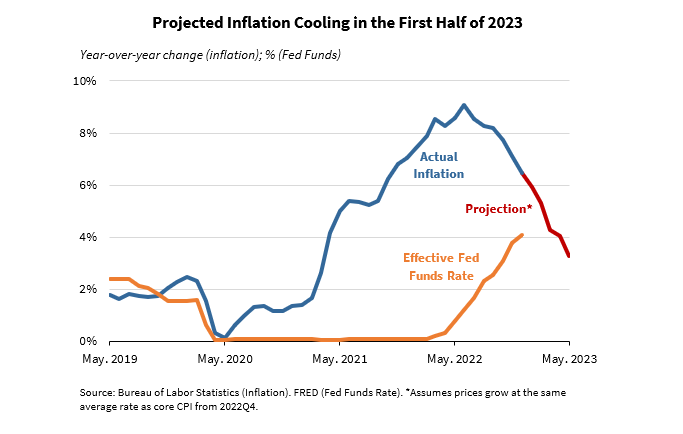
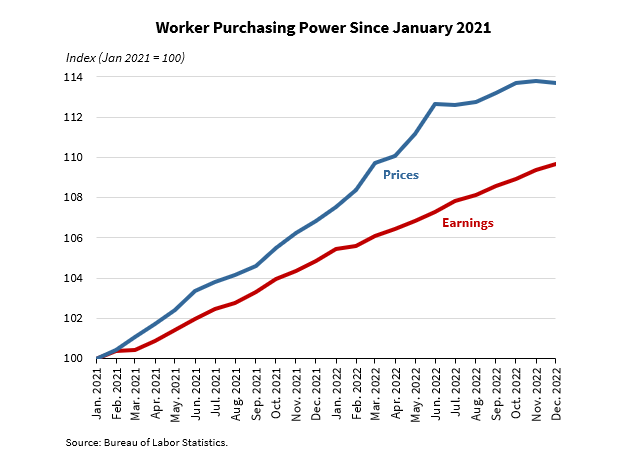
If this projection comes to pass, it would of course be very good news for families’ pocketbooks. Keep in mind, however, that inflation is declining despite the federal government continuing to spend too much money, and not because of any of the recently passed legislation. Absent the spending binge of 2021 and 2022, the United States would almost surely not have seen the decades-high inflation that has robbed families of precious purchasing power—an erosion shown in the figure below. Since the passage of the American Rescue Plan Act in early 2021, consumer prices have risen cumulatively by nearly 14%. During that same period, worker earnings have increased by less than 10%. This four-point gap marks a significant decline in purchasing power that is showing no immediate signs of reversing.
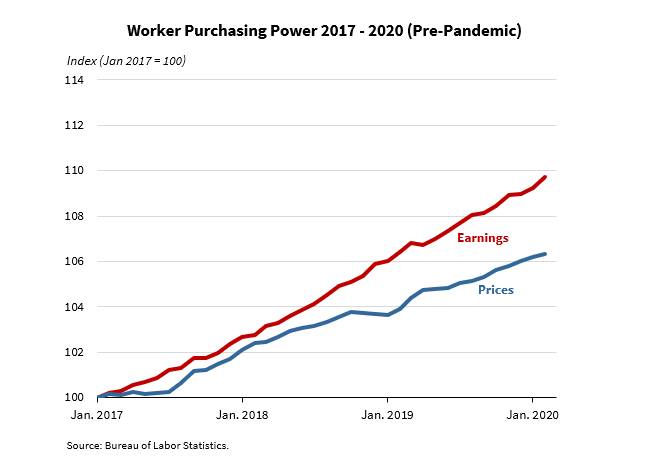
By contrast, if one looks at recent history—namely, the period between early 2017 and the beginning of the COVID-19 pandemic—earnings noticeably outpaced inflation, as shown in the figure below. In fact, inflation-adjusted median household income jumped by the most on record during that period, just as poverty rates hit historic lows. It is worth pointing out that economic gains of that size were not expected. Instead, the economy outperformed earlier projections from the Congressional Budget Office made prior to the pro-growth tax reforms passed in 2017 and the concerted effort across federal agencies to streamline and reduce the burden of regulations.
Looking forward, the good news is that inflation is likely to continue falling, and possibly at a faster pace over the next few months. Producer price inflation is also moderating, with the most recent core reading (which strips out volatile components related to food, energy, and trade services) coming in at “just” 4.6% year-over-year. However, it is important that we do not move the goalposts and lower the bar for victory. The objective clearly stated by the Federal Reserve—and to which Americans have become accustomed over the past few decades—is inflation that is 2% or less. For this reason, nobody should expect the Federal Reserve to immediately stop hiking rates—let alone begin to cut them—until inflation falls below the 2% threshold and stays there for a while. The Federal Reserve has signaled this much in its recent communications.

Of course, the timeline for finally taming high inflation could be significantly accelerated with a pro-growth, supply-side agenda that unleashed the productive capacity of the U.S. economy whereby businesses could meet demand without raising prices. If we conceptualize inflation as too much money chasing too few goods, one approach to reducing inflation is to take money out of the economy—exactly what the Fed is doing right now—while the other approach is to ramp up the amount of goods and services the economy produces. In light of divided government, substantial tax and regulatory reform is unlikely, but on the positive side, massive partisan tax hikes and spending bills are unlikely too. Inflation relief is (likely) on the way, but it is important to understand how we got here so we don’t end up making the same mistakes again.
State of the State, School Spending and the STL Earnings Tax

Susan Pendergrass, David Stokes and Elias Tsapelas join Zach Lawhorn to discuss the newly added spending data at MoSchoolRankings.org, takeaways from the State of the State Address and a new court decision on applying the City of St. Louis earnings tax to remote work.

Listen on Apple Podcasts 

Listen on Stitcher 

Listen on SoundCloud

Produced by Show-Me Opportunity

Now What? The Debt Ceiling Crisis with Brian Riedl

Susan Pendergrass speaks with Brian Riedl about the U.S. hitting the debt ceiling and what happens next.

Brian Riedl is a senior fellow at the Manhattan Institute, focusing on budget, tax, and economic policy. Previously, he worked for six years as chief economist to Senator Rob Portman (R-OH) and as staff director of the Senate Finance Subcommittee on Fiscal Responsibility and Economic Growth. He also served as a director of budget and spending policy for Marco Rubio’s presidential campaign and was the lead architect of the ten-year deficit-reduction plan for Mitt Romney’s presidential campaign.

Listen on Apple Podcasts 

Listen on Stitcher 

Listen on SoundCloud

Produced by Show-Me Opportunity

Missouri’s State of the Bloating State

Earlier this month, I expressed my general optimism that Missouri’s 2023 legislative session would be a good one, focused on transparency and reform. Now after the governor’s State of the State address yesterday, I’m not so sure. The word “transparency” showed up zero times in the governor’s prepared remarks, and the word “reform” showed up twice—once in a heading that had seemingly nothing to do with the section’s content, and once referring to a past jobs program. Such thin gruel is especially shocking, given the governor’s own regrets about the transparency and reform initiatives that didn’t pass last year.

But boy, is there a lot of spending—some of which might be justified, such as expanding Interstate 70—but the emphasis on expanding government made the speech basically indistinguishable from a speech by a tax-and-spend liberal. The governor didn’t propose a single meaningful change to the state’s failing education system or suggest a single reduction in government. Nothing about further tax cuts. Nothing about anything truly aspirational, reform minded, or geared toward good governance at all.

It’s understandable that the governor would want to pursue some form of legacy initiative or project near the end of his final term. Frankly, redoing I-70 should be plenty. But programs that permanently expand the reach of Missouri’s welfare state—like a universal pre-K program that the Heritage Foundation has eviscerated time and again—run completely against the small government view that many politicians in Missouri had historically given lip service to.

Perhaps in future speeches and press availabilities, the governor will expand upon his State of the State remarks, adding back in some of the reform-minded small government conservatism.  The legislature has been advocating for a variety of these small government reforms, and I thought the governor’s office was in agreement. The governor can, and should, do better.

The High-quality Interdistrict Choice Act

On December 1st, Representative Brad Pollitt pre-filed a bill that would expand educational opportunities in the state of Missouri. This bill includes the “Public School Open Enrollment Act,” and would be an important step forward in enabling Missouri parents to choose where they send their children to school.

Under this new open enrollment program, Missouri school districts that choose to participate could receive transfer students from any public school in the state. While this bill would put Missouri on the path to education choice, policymakers could do a lot more to provide students with greater interdistrict choice by making district participation in the program mandatory. Not only would a mandatory program give parents and students a much greater number of educational opportunities, but it would also increase competition among schools and districts, which would lead to higher-quality schools that better serve the needs of students.

Director of Education Policy Susan Pendergrass created model legislation for what we are calling the High-quality Interdistrict Choice Act to demonstrate what a mandatory open enrollment program would look like. If implemented, such legislation could make Missouri a national leader in school choice rankings.

Follow the Money

Believe it or not, the average amount spent per student in Missouri last year was over $13,000. Do you ever wonder where more than $250,000 spent on a classroom of 20 students goes? So did we—so we built a website to help answer this question. The average teacher salary is just over $52,000. Even with benefits, that leaves a lot of money. Maybe it goes to books, computers, administration, utility bills, buses, and gasoline. Maybe it goes to legal fees and advertising, professional development for teachers, travel to conferences and membership fees.

Of course, public education has a lot of moving parts and they all cost money. But it’s public money—our money. That’s why the Show-Me Institute decided to build a website that would allow anyone to see how every dollar was spent in 2021 in each of the 551 public school districts and charter school local education agencies in the state. MOSchoolRankings.org, which already has two years of school and district report cards with letter grades, now also shows where every dollar came from and how it was spent. These data were already available on the Missouri Department of Elementary and Secondary Education (DESE) website as Annual Secretary to the Board (ASBR) reports. We simply put them into a single data file and built a portal to make it easy for users to dig into the numbers.

Did we include spending on land, buildings, or other capital? Those are in the ASBR, so, yes. Did we include principal and interest payments on debt? Yes, we did. Did we include district revenue from athletic event admissions and bookstore sales? We did. Did we include revenue that one school district pays to another school district? We did. Did we include revenue that parents pay as tuition to send their children to a school outside their district? We did. Did we include revenue from bond sales that are issued to build things? We did. If the district reported it to the state as a source of revenue or as an expense, we included it.

I believe that the public sector should make it easy for citizens to see how their money is being spent. I don’t believe that the powers that be should tailor spending numbers to include some things and exclude others. So we’re providing everything, and users can decide what they consider to be relevant. Heck, we even made the entire data set of nearly 500 variables for each district available for download. And the DESE accounting manual can be accessed on the site.

Of course, when you look at the numbers for a district, you may have some questions. Those are questions that ought to be answered by superintendents, school boards and DESE.

Falling Behind on Telemedicine

Not long ago, Missouri was a national leader in telemedicine. Governor Parson was among the first to waive unnecessary restrictions on telemedicine as part of the state’s response to COVID-19, and those waivers played a key role in allowing the service to flourish. But the waivers have since expired, and our elected officials have yet to take the action necessary to ensure continued easy access to telemedicine. Missouri is falling behind, as numerous states and even the federal government are recognizing the important role telemedicine should play in health care going forward.

As I’ve written repeatedly, the growth in telemedicine services was one of the few silver linings of the pandemic, and all it took was the government getting out of the way. Prior to 2020, most forms of health coverage, including Medicare and Medicaid, covered telemedicine services only in some circumstances. Various laws and regulations restricted where telemedicine services could be accessed and who could provide them, which drastically limited their benefits. But once the COVID-19 public health emergencies were declared, many of these restrictions were waived, and millions of people nationally tried remote health care for the very first time.

At the end of 2022, as Missouri turned the corner on the pandemic, Governor Parson allowed the telemedicine waivers to expire. Though telemedicine usage was lower at that time than it was during its 2020 peak, it was still far more popular than it was before the pandemic. There is no doubt that some medical services could be better in person, and there are some potential risks for fraud and abuse with remotely offered services. But after multiple years of telemedicine proving its place as a reliable health care option, bringing back old barriers that were shown to drastically limit health care access should have been out of the question.

All things considered, I was optimistic last year that Missouri’s legislature would at least make the waivers permanent, if only because that would maintain a level of access to health care that Missourians had grown accustomed to. But, as with many other priorities this past legislative session, telemedicine reform failed to make it across the finish line.

As this year’s legislative session gets underway, our elected officials have a fresh opportunity to make things right on telemedicine. Giving Missourians the increased options and access they had in the very recent past seems like a perfect place to start.

What Does Missouri’s Teacher Shortage Really Look Like

A version of this commentary was published in the Columbia Daily Tribune.

Over the past few years, Missourians have gotten a better understanding of the term “shortage.” Whether it was soup or toilet paper, we can all remember those empty shelves at the grocery store at the beginning of the COVID-19 pandemic. Maybe that’s why the term “teacher shortage” has many policymakers on edge these days. There’s just one problem: in education, the term “shortage” doesn’t mean what you think it means.

Take the “shortage” of elementary school teachers in Missouri for example. In 2021, the Springfield School District wanted to hire 55 elementary school teachers. They received 2,155 applications from individuals with the appropriate certification. Yet, for one reason or another, they left six positions vacant. This is a teacher shortage.

The problem is the misleading way in which the Missouri Department of Elementary and Secondary Education presents the data. In the “Teacher Shortage Report for Missouri,” released in December 2022, DESE defines shortage areas as “those content areas within the state for which positions were filled with inappropriately certified teachers(s) or left vacant due to the absence of certified candidates.”

This is possibly the broadest definition of what it means to have a shortage. If a school district hires a private school teacher with 10 years of experience and a bachelor’s degree in elementary education? Shortage. They hire an individual with an MBA to teach high school business, but he does not have certification? Shortage. Let’s say they hire someone with a high school mathematics certification to teach elementary or middle school mathematics. Shortage. Keep in mind, the state has dozens of teacher certification areas, and being certified in one does not qualify you to teach another. With this broad definition, DESE suggests Missouri was short 532 elementary school teachers (Grades 1–6) in 2022, making this the highest shortage area.

Let’s put that into perspective using raw, unweighted data provided by request from DESE. In 2022, there were 2,015 job openings for elementary school teaching positions. Districts received over 21,000 applications, more than 18,000 of which had the appropriate certification. Of course, teachers may apply for more than one job.  In all, 32 elementary positions were left vacant. Thirteen of those vacancies were in the Riverview Gardens School District alone.

There is a teacher shortage—it’s just not as widespread as most believe. In total, across all certification areas, Missouri had 258 positions left vacant in 2022. These vacancies were spread across 74 of the state’s 550+ school districts, but nearly half of all vacancies were in just five school districts: Hickman Mills (17), Kansas City (17), St. Louis Special School District (19), Hazelwood (27), and Riverview Gardens (47).

Aside from the Special School District, which is a unique district that serves special-needs students in St. Louis County, the other four districts have a lot in common. They tend to serve students who come from low-income families who are black. For example, more than 97 percent of Riverview Gardens students are black.

The shortage narrative has been used to push for an increase to the starting teacher salary in Missouri. According to data obtained from the Missouri State Teachers Association, the average starting salary in these four districts is $40,075. That is well above the current state minimum of $25,000 and even above the proposed minimum of $38,000 that is currently before the Missouri legislature. Estimates suggest this increase would cost the state $21 million.

Such an increase could actually exacerbate the problems facing high-poverty, majority-minority school districts. If all the districts that currently pay less are forced to offer higher wages, Riverview Gardens, Hickman Mills, and other districts that struggle with teacher recruitment will lose the competitive advantage of higher salaries. Imagine: the state could spend $21 million and fail to even address the real shortage problem in Missouri’s most disadvantaged school districts.

Missouri’s teacher shortage is not equally felt throughout the state; it is most pronounced in high-poverty, majority-minority school districts. Accordingly, strategies to address the shortage should provide targeted support for the affected districts. This could include salary supplements for teachers in hard-to-staff schools, or it could mean intense marketing, recruitment, and human-resource support for these schools. An across-the-board increase in minimum teacher salary is not what Missouri needs, and it could very well do more harm than good.

Support Us

The work of the Show-Me Institute would not be possible without the generous support of people who are inspired by the vision of liberty and free enterprise. We hope you will join our efforts and become a Show-Me Institute sponsor.

Donate
Man on Horse Charging