The Latest GDP Report: What Does It Mean for 2023?

While Washington, D.C., is seized by speculation surrounding debt ceiling showdowns and the specter of government default, other recent news—namely, the latest report from the Bureau of Economic Analysis on the nation’s gross domestic product (GDP)—provided some welcome but qualified good news on the economy. According to the report, inflation-adjusted (real) GDP grew by 2.9% on an annualized basis in the fourth quarter of 2022, which modestly exceeded consensus expectations. Moreover, unlike the third quarter data—which showed growth despite a large decline in private domestic investment—each of the topline spending categories showed growth in the fourth quarter, albeit meager growth in some cases.

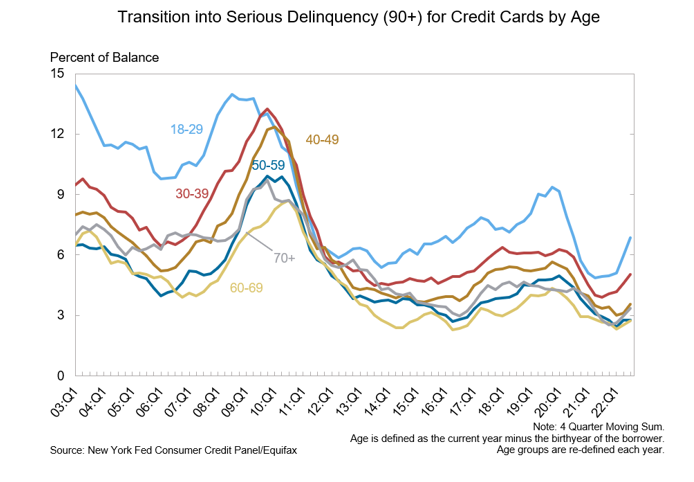
First of all, consumer spending is holding up. After only growing by 1.3% in the first quarter of 2022, it ended the year growing at a 2.1% clip—hardly robust, but clearly in positive territory. Consumers have been slammed by high inflation and eroding purchasing power for the better part of two years, but the steady job market and still-elevated checking account balances of households have managed to keep them afloat. Unfortunately, so too has rapid growth in credit card utilization, which may act as a source of financial vulnerability for consumers going forward as they grapple with continued interest rate hikes. Transitions into credit card delinquency are already on the rise, driven especially by households in the 18–29 and 30–39 year age ranges.
Switching gears, gross private domestic investment declined notably in the third quarter of 2022 (9.6% on an annualized basis) but increased by 1.4% in the fourth quarter. On the surface, this turnaround is good news. However, peeking beneath the hood reveals some reasons to be cautious. Most strikingly, residential investment fell by 26.7% as the housing market gets pummeled by the rapid rise of mortgage rates over 2022. In the first week of January 2022, the average rate for 30-year fixed-rate mortgages sat at 3.2%. In the last week of December, it was at 6.4%. Such a huge increase in rates translates to a jump in monthly payments of over $800 for someone buying a $400,000 house with a 20% down payment—making it more difficult to qualify for a loan.
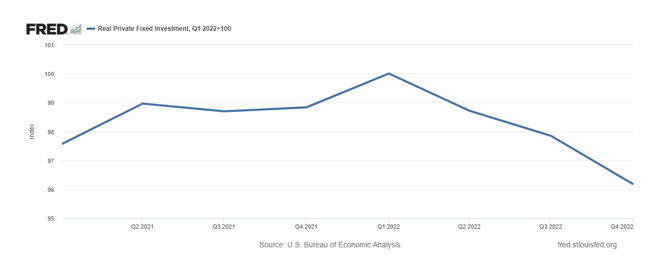
Looking beyond the housing market, nonresidential fixed investment increased by an anemic 0.7% on an annualized basis in the fourth quarter after growing by 6.2% in the third quarter, a sizable deterioration. As a result, fixed investment overall fell by 6.7% on an annualized basis in the fourth quarter, which is even worse than the 3.5% decline in the third quarter. So how is it, exactly, that private investment still increased by 1.4% overall? The answer: inventories increased, which is far less important for economic growth in 2023 and beyond than businesses confidently investing in new factories and capital.

So what does all this mean for 2023? Unfortunately, not much. The good news is that the economy is not crumbling—at least not yet. And there are also reasons to be hopeful that the Federal Reserve’s interest rate hikes are finally breaking the back of inflation despite the federal government’s fiscal profligacy since the beginning of 2021. However, interest rates are still on their way up, consumers are borrowing more, gas prices are on the rise again, and the housing market is stalling out, with very real prospects of modest to moderate house price declines in at least certain pockets of the country. None of these trends bode well for consumer sentiment or small business optimism. But there’s still a chance that the Federal Reserve can manage to thread the needle, and divided government in Washington, D.C., means that more blowout inflationary spending packages are less likely. It’s certainly something worth crossing our fingers about.

Federal Lawmakers to Consider (Longshot) Income Tax Repeal Bill

It’s tax season—that magical time of the year when we revisit our past year of income and find out whether we owe the government more money, or whether we overpaid and are owed a refund. Fun times. But if some members of the U.S. House of Representatives have their way, your income tax calculations will get way easier—because the income tax wouldn’t exist:

Republicans in the House of Representatives will vote on a bill that would abolish the Internal Revenue Service (IRS), eliminate the national income tax and replace it with a national consumption tax.

Fox News Digital has learned that the House will be voting on Georgia Republican Rep. Buddy Carter’s reintroduced Fair Tax Act that aims to reel in the IRS and remove the national income tax, as well as other taxes, and replace them with a single consumption tax.

The vote on the bill was made as part of the deal between House Speaker Kevin McCarthy, R-Calif., and members of the House Freedom Caucus and was pushed forward in his quest for the gavel last week.

Am I saying there’s a chance?! No, not really. The Senate and the president will almost certainly reject abolishing the income tax, and it’s not entirely clear that even the House has the votes to pass it through the chamber. Then there’s the sticky issue of repealing the 16th Amendment, which enabled the national income tax; if this law were to pass, you’d need to repeal the amendment so that we won’t someday end up with both a sales tax and a renewed income tax! Details, details.

But is a national move away from the income tax the right idea? Undoubtedly. Income taxes are destructive to growth at all levels of government, and as Institute analysts press for the elimination of Missouri’s income taxes, our federal counterparts should consider similar tax reductions and reform. Whether this latest effort is the best approach or even has a snowball’s chance of success remains to be seen, but I’m glad the conversation is at least being had. It’s overdue.

Education, Health Care, and $1,000 in Bitcoin

David Stokes, Elias Tsapelas, and Patrick Ishmael join Zach Lawhorn to discuss which bills are moving in Jefferson City, a recent court decision on the City of St. Louis’ earnings tax, and the impeachment of the mayor of Cool Valley, Missouri.

Listen on Apple Podcasts 

Listen on Stitcher 

Listen on SoundCloud

Produced by Show-Me Opportunity

The Right Way to Expand Broadband

In his state of the state address, Governor Parson touted broadband expansion in Missouri and proposed spending significantly more money to go further. From the speech:

Last year, we made one of the largest investments in broadband expansion across our state. Thanks to our efforts, nearly 70,000 under-served homes and businesses across our state Now have broadband. But we know we can’t stop now. That is why we are investing an additional $250 million dollars to do even more. If we can put electricity in every home, we can do the same with broadband today. We are not done until every home, every school, every business, and every farm has access to quality internet.

Most Missourians have access to high-speed internet. For those who don’t—who are primarily in very rural areas—the lack of internet can indeed be an issue. Using federal stimulus funds intended for broadband expansion in Missouri to address that problem is fine with me, but it needs to be done the right way.

What is the right way? It’s to focus on the small number of Missourians who truly have little to no internet access. What is the wrong way to address it? The wrong way is to allow the money to be used by cities and towns to create their own municipal internet companies that will compete with the private sector in communities that the private sector is already serving, like in Marshall, Missouri.

Government-owned networks are subsidized by taxpayers by definition and they have often been a failure when tried around the country. Kentucky is the poster child for this at the state level. Local government in Missouri should not be in the broadband business except as a provider of last resort. Local government is poorly suited to providing services in a rapidly changing, highly technical field like broadband and internet services. For most of Missouri, the private sector has been providing perfectly fine internet services for years. Having cities or counties create their own, taxpayer-subsidized, tax-exempt internet companies will easily be a net negative throughout Missouri.

Get it, “net negative?”

The Results Are in—We Got a C-

The Center for Education Reform’s (CER) Parent Power! Index was just released and Missouri actually improved from a D on the last index to a solid C-. CER created the index in 1999 to measure whether a state has “policies in place that put students ahead of systems,” “values the diversity of need and condition of every family,” “provides accessible information,” and “puts families in charge.” Despite having several school choice programs, Missouri, it seems, falls short on delivery.

In fact, the researchers at CER determined that our governor has “been quiet on the subject of parent power and educational choice.” They also noted that, while school report cards can be found on DESE’s website, they are “not very user-friendly or easy to navigate.” (So apparently, Institute analysts  are not the only ones making that claim.) We got a C on our charter school law because it’s only limited to students in a couple of communities. We got D’s on digital and personalized learning, choice programs, and teacher quality.

The Parent Power! Index doesn’t seem to mesh well with the Heritage Foundation’s Education Freedom Index, where we did great on everything but Transparency. The key difference between these two measures is that the CER index examines how Missouri families are actually faring in the education landscape. Do policies as implemented empower parents? What are the governor and state legislature actually doing to put students first and give families the information they need? Meanwhile, the Heritage index is grading how we appear on paper. We’ve got charter schools and a private school choice program. Kudos to us. The fact that 95 percent of Missouri families can’t access this school choice program is just an inconvenient truth.

If Missouri were on a dating app for school choice, our profile would look great. But the first date is going to reveal the truth. There’s very little “there” there.

On Lying, Kansas City Says the Quiet Part Out Loud

When I was at Saint Louis University’s School of Law back in 2006, I vividly remember finding out that SLU (a Jesuit school) had been arguing to Missouri courts that it was not, in fact, an institution “controlled by a religious creed” so that it could qualify for tax incentives for a new arena in midtown. The university got its tax incentives, but for many practicing Catholics who had attended SLU, the school’s court argument was both illuminating and disturbing. To the public, SLU portrayed itself as Catholic, period, and I think still does. But to the government, SLU portrayed itself as only in that “tradition”—and thus eligible for Caesar’s coin.

Court filings tend to draw the truth out of circumstances that marketing materials can often conceal and gloss over, and I was reminded of my alma mater’s proof of this years ago when I saw a story today about litigation involving the City of Kansas City, flagged to me by my colleague David Stokes. And boy, is the lesson a doozy:

The city filed a motion in Jackson County Circuit Court last week seeking the dismissal of a lawsuit filed by Chris Hernandez, the city’s former communications director. In his suit, Hernandez alleged that he was demoted for refusing to lie to the Star and other local news organizations about city projects and services at the behest of City Manager Brian Platt.

In its motion, the city argues that lying to the press is not a violation of any law, rule or regulation.

“Despite the respected place that the press has as the fourth estate of American politics, there is no law concerning false disclosures to the press,” the city’s motion reads. “Nor is there a rule or regulation set forth by any governmental entity, including the city, that governs false disclosures to the press.”

The specific issue is what Kansas City officials were saying to the press and the public about the extent of road resurfacing being done by the city in 2022. Being more generous, the city’s intended “media strategy” was to knowingly overstate the truth of the work by about one third; being less generous, the city’s plan was to lie to make itself look good.

Whatever the characterization you prefer, the city’s filing should be illuminating for big- and small-government types alike. Whatever your preferred size of government, truth and transparency in government operation is fundamental to justify taking money from the public through force of taxation and allowing elected officials and bureaucrats to spend it on the public’s behalf. Without it, government is just a self-serving cabal stealing money from you under color of law.

Kansas City’s “trust us, you can’t trust us” court filing reaffirms the importance of robust transparency and consequences for misbehavior for state and local governments. Without transparency and accountability, government will run roughshod over you and your rights. But you already knew that.


How to Start a Microschool with Don Soifer

Susan Pendergrass speaks with Don Soifer.

Don Soifer is Chief Executive Officer of the National Microschooling Center, America’s comprehensive resource center, movement-builder and authority for the most exciting new education movement in a generation. He co-created and co-directed the Southern Nevada Urban Micro Academy, the nation’s first public–private partnership microschool with the City of North Las Vegas, delivering unprecedented academic growth with a previously underserved population of families under pandemic operating conditions.

Listen on Apple Podcasts 

Listen on Stitcher 

Listen on SoundCloud

Produced by Show-Me Opportunity

Empowering Parents of Every Background with Krissia Campos Spivey

Susan Pendergrass speaks with Krissia Campos Spivey.

Krissia Campos Spivey is a rising national leader in ensuring equality of educational opportunity for Hispanic families. After raising the bar for parent-facing school choice resources in Spanish as a part of National School Choice Week, she’s expanding on that work as director of the newly launched Conoce tus Opciones Escolares (CTOE). In tandem with National School Choice Week, CTOE helps parents explore all of their K-12 education options, in Spanish, year-round.

Listen on Apple Podcasts 

Listen on Stitcher 

Listen on SoundCloud

Produced by Show-Me Opportunity

National School Choice Week with Shelby Doyle

Susan Pendergrass speaks with Shelby Doyle about National School Choice Week 2023.

As vice president of public awareness at National School Choice Week, Shelby serves as the lead strategist for media outreach, digital communications, and as a national spokesperson. In addition, she works with schools, organizations, and individuals across the country to help raise awareness about the tens of thousands of independently-planned events that make up the Week.

Listen on Apple Podcasts 

Listen on Stitcher 

Listen on SoundCloud

Produced by Show-Me Opportunity

Support Us

The work of the Show-Me Institute would not be possible without the generous support of people who are inspired by the vision of liberty and free enterprise. We hope you will join our efforts and become a Show-Me Institute sponsor.

Donate
Man on Horse Charging