Funding Open Enrollment in Missouri with Aaron Smith

Susan Pendergrass speaks with Aaron Smith about how other states fund open enrollment programs in their public school systems and what Missouri can learn from those models.

Aaron Smith is the director of education reform at Reason Foundation.

Smith works extensively on education finance policy and his writing has appeared in dozens of outlets including National Review, The Hill, and Education Week.

Listen on Apple Podcasts 

Listen on Stitcher 

Listen on SoundCloud

Produced by Show-Me Opportunity

Parents’ Bill of Rights Legislation Clears Senate

In a significant first step to becoming law, the Missouri Senate passed Senate Bill (SB) 4 on Tuesday. The bill creates a Parents’ Bill of Rights, a transparency website, establishes accountability report cards, and advances a number of related accountability and transparency items. Among them:

[T]he new legislation, for example, would bar teaching “that individuals, by virtue of their race, ethnicity, color, or national origin, bear collective guilt and are inherently responsible for actions committed in the past by others. . . .”

The legislation also includes a number of parental rights, including being able to access curricula, the names of guest speakers at the school, and information about collection and transmission of student data.

It sets up the “Missouri Education Transparency and Accountability Portal” allowing the public to access “every school district’s curriculum, textbooks, source materials, and syllabi.”

The package also requires the Missouri Department of Elementary and Secondary Education to create a class for schools to teach about patriotism.

The vote wasn’t close at 21 in favor and 12 against, with two self-described conservatives strangely voting against the bill. Both explained the basis for their votes during the floor debate for SB 4, and to put it lightly, neither senator made a compelling case for opposition.

I’ll explore the bill more in-depth later, but I’ll say here that gripes about statutory language intended to ensure districts don’t get sued for publishing copyrighted material and penalize schools for noncompliance are unfounded and ill-considered. The senators should get better outside counsel than what they received here.

Chances are good that SB 4 will be tweaked and possibly improved by the House, which will take the bill up in the weeks ahead. Chances are also good that some schools and school districts will try to work around or undermine the intent of the law after it’s been implemented, necessitating follow-up legislation to close any loopholes that emerge. But even if SB 4 were passed as is, it’d still be one of the strongest parents’ rights bills in the country. Whenever it does pass this session, it will be a good day for taxpayers and parents.

St. Louis: Come for the Tax Subsidies, Depart When You Can

In 2010, the very large Polsinelli Law Firm received millions in tax incentives to help it “decide” to keep its office in downtown St. Louis. The exact amount of the subsidy is unknown, but as of 2016 its total value was reported as being around $3 million. So, in other words, lots of money.

Clearly, since government economic development officials are so good at picking winners and losers, this subsidy has accomplished its goals and now the firm is operating without any tax subsidy and thriving in downtown St. Louis, right?

Not quite. Polsinelli announced two months ago that it is moving its local office to Clayton. No subsidy is required for this move (to the best of my knowledge). Polsinelli will be moving to the Centene Building, which is itself an argument for the uselessness of tax incentives.

Polsinelli has every right to move wherever it wants and I wish the firm the best. But as the City of St. Louis, Chesterfield, Crestwood, and more continue to dive headfirst into the tax subsidy well, the Polsinelli example is a perfect illustration that economic development based on tax incentives does not work. It just doesn’t. Politicians and economic development officials cannot predict the future. Their decisions are biased by political interests, or worse. The incentives for politicians and economic development officials bias them toward ribbon cuttings and campaign boasts at the expense of long-term thinking.

Yet we continue to prime this empty pump with new plans and programs every year, despite the repeated failure of the process. Economic development officials boast loudly of their few successes (which really just means the subsidies weren’t needed in the first place) while ignoring their many, many failures. It’s almost as if actual economic development isn’t their main goal in the first place.

Statewide Trends and the “Teacher Shortage”

The Department of Elementary and Secondary Education (DESE) recently released demographic and faculty data for 2022. Given the current headlines about alleged teacher shortages and teacher salary issues, understanding the current education demographic trends is essential.

Stories about the teacher shortage conjure images of overwhelmed teachers across Missouri struggling to manage overflowing classrooms and a growing student population. If you never looked at the statewide numbers and only at media headlines, you might think the sky was falling. A few examples: “The Profession that Prepares People for all Other Professions is Diminishing (in Missouri),” “Teachers in Missouri are Not Returning to the Classroom,” and “A Look at the Local Impact of the Teacher Shortage Crisis (in Missouri).”

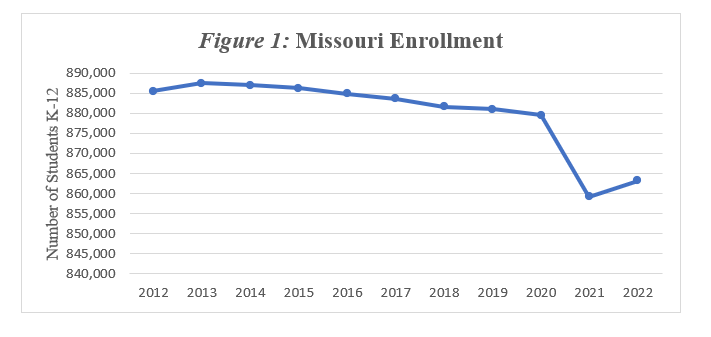
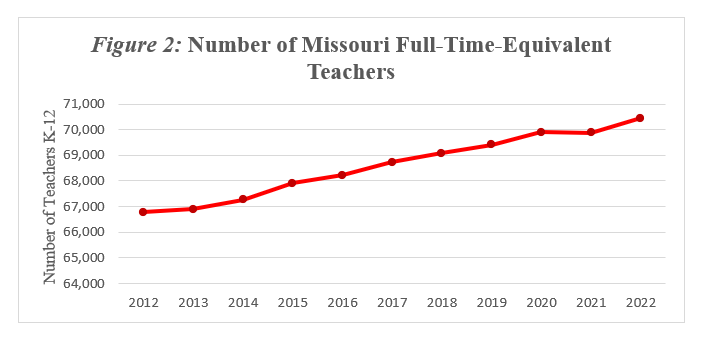
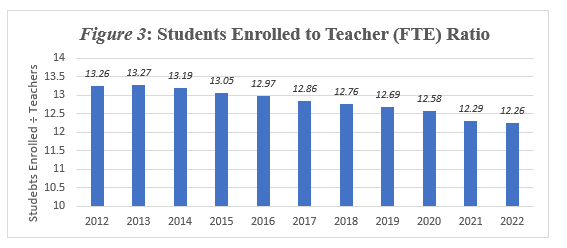
While the statewide trends are relatively minor, they still directly contradict the idea that teachers across the state are in short supply. The figures below depict statewide trends.

Student enrollment numbers have bounced back a bit from the COVID-19 dip and currently sit at 863,000. Nevertheless, prior to the pandemic, enrollment had been falling every year since 2013, and the 2022 number is still not close to the 2020 enrollment figure of 879,000. Conversely, teacher FTE (full-time equivalent) rose during the pandemic, and actually increased by a greater percentage (0.78%) than enrollment (0.41%) in 2022.

Even with the first positive enrollment growth since 2013, the student enrolled to teacher ratio still decreased from 12.29 to 12.26. The national student enrolled to teacher ratio has been decreasing for a long time, from 27 in 1951, to 20 in 1976, and to 16 in 2000. In 2020, the national ratio was 15.2, almost 3 whole students higher than Missouri’s total.

If the student-to-teacher ratio is so low, why are schools feeling the heat? The answer: there is a shortage of teachers to fill specific positions, not a shortage of teachers in general.

Five districts account for 50 percent of teacher vacancies in Missouri, and many of these vacancies are in a few subject areas—including special education, English-language learning (ELL), and mathematics. Allowing school districts to pay teachers more to fill these high-need vacancies—pay differentiation—is something I have discussed before, and could help solve this problem. Luckily, House Bill (HB) 190 is currently progressing through the Missouri Legislature, and it would allow for pay differentiation in our state.

There are districts in Missouri with needs for specific teachers. But that does not mean the whole state has a teacher crisis, and the data make it clear that Missouri is not facing any systemic teacher crisis. It is unfortunate that some Missourians may be getting the wrong impression from some inaccurate headlines, and one would hope that going forward we can have a debate that takes the actual facts into consideration.

St. Louis Should Eliminate Its Economic Development Agencies

A version of this commentary appeared in the St. Louis Business Journal.

In July 2010, Missouri politicians joined the state’s economic development agency to announce the awarding of $17 million in state tax incentives, along with $39 million in local tax subsidies, to the Mamtek project in Moberly. The project called for making artificial sweetener using a process that would start in China and finish at a new plant in Moberly, creating 600 local jobs here. There was just one problem—it was all a scam.

It may seem unfair of me to criticize a government agency for falling victim to a criminal conspiracy, albeit one that really wasn’t that sophisticated, but government economic development agencies are a catch-22 for taxpayers. When they do a bad job—as they did in Mamtek—they waste our tax money. As with the St. Louis Marketplace or the Olde Towne Plaza in Ballwin, we can list plenty of private business projects government had no reason to get involved in but did, to the detriment of taxpayers. But we can only wish they always did a bad job. It’s when they do their jobs right that taxpayers and average citizens really get burned.

When economic development officials do their jobs right, all they are really doing is subsidizing economic activity that likely would have happened anyway for the benefit of politically connected companies. As the old joke goes, economic development officials are great at creating jobs for other economic development officials. For everyone else, not so much. For all their skillful use of political buzzwords and claiming credit when none is deserved, it remains true that “government is a bad venture capitalist,” to quote President Obama’s economic advisor, Larry Summers. Summers was being polite. Government, in the form of local, state, and federal economic development agencies, is a terrible venture capitalist. It’s not that government officials don’t get their bets right often enough; it’s that they actively get them wrong because economic development officials are heavily influenced by the political incentives to reward supporters of the politicians who employ them. A short-term political payoff is more important than long-term success.

St. Louis Mayor Tishaura Jones came into office two years ago pledging to make changes to the city’s economic development process. To a small degree, her administration has reduced the subsidies it is giving out to companies, and for that she deserves credit. But they also figured out a way to somehow make a bad process even worse by imposing an “economic justice” imperative on it. So now, instead of listening to development officials fabricate how their corporate welfare led to jobs, growth, and so on, we get the additional pleasure of hearing how tax subsidies lead to more “equity.” Death can’t come fast enough.

Economist Dick Netzer mocked the exaggerated claims of success made by economic development officials when he wrote, “Who needs oil wells, when a state can be another Kuwait just by increasing the budget of a tiny agency?” Claims of subsidy successes often border on the absurd. The author once heard a Clay County economic development official claim that “All of the growth” in the town of Liberty—a fast growing, suburban community north of Kansas City, the likes of which have been growing across the nation for decades—was due to a tax-increment financing (TIF) package they passed. Chesterfield officials talk about the Valley TIF there in much the same way, as if suburbanization hadn’t existed until Missouri’s TIF law was passed in the late 1980s.

The self-aggrandizement of the economic development industry would be understandable if the system worked, but it doesn’t. The East-West Gateway Council of Governments (EWG) did a major study of TIF and other subsidies a decade ago and concluded that they created one job for every $370,000 in tax subsidies. That is a terrible return on the subsidy, as EWG stated. Economists Alan Peters and Peter Fisher studied tax incentives closely and concluded that they work about 10 percent of the time and are simply a waste of money the other 90 percent. They added that, like the Clay County officials mentioned above, economic development officials often credit all new employment and growth to tax subsidies. Yet our region continues to pass out tax subsidies like other people’s candy, evidenced by the atrocious decision of the St. Louis County TIF commission to approve $300 million in subsidies for the “blighted” part of Chesterfield just last month.

If we really wanted to help our community grow, residents of the St. Louis-area could get no better gift than the elimination of state and local economic development agencies. They are a blight on capitalism and an actively harmful influence on the civic and economic life of our state.

ROFR Makes Me ROFL

To paraphrase General Douglas MacArthur, bad public policy ideas never die, they just get reintroduced in the next legislative session.

One such very bad policy idea is right of first refusal, which grants major Missouri utilities the automatic right to win all bids on new electric construction lines if they so choose. You may want to read that again. It doesn’t just give major utilities the right to bid on all projects—that goes without saying. It gives them the right to win any project they want, no matter what any other utility or construction company may bid. The idea here is to funnel projects to Missouri companies and “protect” Missouri jobs at the expense of out-of-state competitors. If you think this raises prices on consumers, as any grade school economics textbook would predict, it does. Significantly.

My former Show-Me Institute colleague Jakob Puckett wrote about this issue last year.  The same bills have been introduced again this session, so we shall return to Jakob’s arguments from last year:

Wouldn’t it be better for the legislature to propose subjecting transmission lines to competitive bidding, rather than shielding them from it? Since transmission costs are ultimately passed on to customers, it’s customers who bear the brunt, or receive the benefit, of cost-inflating or cost-saving policies.

Missouri will need more electric transmission lines built in the coming years. To build those lines at the lowest possible cost, Missouri needs more free-market activity in transmission projects, not less.

The state-based protectionism here is really something. While you frequently see such types of anti-market, anti-consumer protectionism at the national level (such as the administration’s ill-conceived plan to require only American-made products in our infrastructure efforts), you rarely see it at the state level. But here we have it. It is bad at the national level (with some exceptions, of course), but at least one can understand where it is coming from. As for this one, I’m at a complete loss. Are we really willing to cast everything aside because a company based in Arkansas that hires workers from Oklahoma might offer the best bid (and thereby save Missourians’ money) for a project near Joplin? (That’s a hypothetical project, for the record.)

As Jakob said, we need more markets in electricity, not less, and these bills power us in completely the wrong direction.

How We Fund Schools with Chad Aldeman

Susan Pendergrass speaks with Chad Aldeman about school funding, teacher pay, pension systems and more.

Chad Aldeman is the Policy Director of the Edunomics Lab at Georgetown University. Prior to joining the Edunomics Lab, Chad worked at Bellwether Education Partners and the U.S. Department of Education. He has published reports on K-12 and higher education accountability systems; school choice; and teacher preparation, teacher evaluations, and teacher compensation. He also served as the founding editor for TeacherPensions.org. His work has been featured in the Washington Post, New York Times, and Wall Street Journal. Chad holds a bachelor’s degree from the University of Iowa and a master’s of public policy degree from the College of William and Mary.

Listen on Apple Podcasts 

Listen on Stitcher 

Listen on SoundCloud

Produced by Show-Me Opportunity

House Bill 190 and the Teacher Shortage

House Bill (HB) 190 is on the move in the Missouri House of Representatives, as it is now being debated in committee. What is HB 190? It’s a bill that would allow Missouri school districts to pay teachers different amounts if they teach in a “high-need subject area or school.”

If a school has more than a 5% teacher vacancy or is filled with non-fully certified teachers, then it qualifies as a “high-need school.” “High-need subject areas” are defined as subjects in which a district had to leave a position vacant or filled the position with non-fully certified teachers in the previous year. Missouri uses a “single salary schedule,” which sets a salary floor for teachers with a bonus for master’s degree holders. Currently, a district cannot pay a science teacher more than an English teacher with similar experience and degree level—a master’s degree in physics is equivalent to a master’s degree in English.

As an example: under HB 190, a district could offer a new special education teacher (a high-need position in many districts) a salary above the current salary floor to recruit the teacher. Districts are also allowed to raise the salaries of current teachers in high-need subject areas in order to retain them. There are some limitations—HB 190 does not allow a district to demote a different teacher in order to use this enhanced flexibility to recruit or retain a teacher. Districts are limited by their own budgets, they can choose to offer these high salaries, but they must make space to do so without lowering other teachers’ salaries.

The broader debate on this topic is about an alleged teacher shortage in Missouri. But the problem is not quite that simple, or quite that broad. Missouri is having trouble recruiting teachers in specific subject areas, such as special education and mathematics. The problem is also highly concentrated; 5 school districts accounted for almost 50 percent of school vacancies in 2022. Given that Missouri is having trouble attracting teachers for certain high-need areas and schools, it makes sense to allow districts to pay certain teachers more in order to persuade candidates to fill those jobs.

Despite the logic of HB 190, several lawmakers voiced their opposition in a recent committee hearing, claiming it would “pit teacher against teacher” and that the bill would end up “doing a lot more harm to the culture of the district and the staff and schools than good.” These complaints don’t add up. There’s already significant pay differentiation in schools among teachers—veteran teachers make more money, and so do teachers with advanced degrees. Paying teachers in certain subject areas more money is just one additional variable.

This policy might also encourage Missouri teachers to gain additional skills and certifications in order to qualify for higher-paying positions. An English teacher might spend time learning about special education reading to become a teacher in a high-need subject area and receive the corresponding pay increase. This could potentially help schools fill vacancies faster, as it may be easier to promote from within instead of embarking on an external search.

We have a narrow problem in Missouri with hiring specific teachers, and that means we need a targeted solution. Pay differentiation is an idea worth strongly considering, and the objections from critics, at least so far, don’t have much merit. I’m glad to see that the legislature appears to be taking this idea seriously.

Support Us

The work of the Show-Me Institute would not be possible without the generous support of people who are inspired by the vision of liberty and free enterprise. We hope you will join our efforts and become a Show-Me Institute sponsor.

Donate
Man on Horse Charging