A Bad Day to Be an Ameren Customer

Well, it’s been coming for months, but KWMU reports that Ameren has officially begun hearings in front of the Public Service Commission to raise rates by 12 percent. Ameren probably won’t hear a decision about this until sometime early next year. Hopefully, by then this whole economic catastrophe will blow over and a utility price hike won’t feel as bad.

Ameren claims the increased funds will go toward employee wages, construction materials, power plant fuels, and capital expenditures. Many people are raising an eyebrow or two because of this proposal’s timing. I’m sure it’s just a coincidence that Ameren wants to raise rates at the same time it wants to build a new nuclear plant. But, of course, raising customers’ rates in order to fund plant construction is illegal, but I’m sure that Ameren officials know that. Also, it has that new renewable energy mandate to manufacture and pay for. But, hey, that’s supposed to save us all money in the long run. … I just wish those savings would get here sooner.

A Great Day to Be an Intern

My fellow intern, Calvin Harris, has just received word that his mother is officially a breast cancer survivor. Since receiving word, he has bolted out of the office to go celebrate with his mom. We wish Calvin and his mom the best of luck and couldn’t be happier about her clean bill of health. This is even better than the day when we got free BBQ at lunch.

The Gun Buyback May Not Come Back

An article from the Post-Dispatch tells us that, despite a request from the police chief to repeat last year’s gun buyback, the Board of Police Commissioners failed to approve funding for the program. The matter failed on a 2-2 tie vote, with the mayor — who would’ve voted for it — absent, because of a prior engagement.

Free-market advocates want to reduce violent crime as much as any other group, perhaps more so. If gun buybacks* reduce crime, I’m officially gung-ho: Let’s do it.

Unfortunately, there appears to be no evidence that gun buybacks actually reduce crime in the slightest measurable way. Here are some links. From the first link:

[A]cademic researchers – often divided by passionate differences over gun control – are in rare agreement in their conclusions.

[…] University of Pennsylvania professor Lawrence Sherman, who headed a wide-ranging assessment of crime prevention programs, called gun buy-backs “the program that is best known to be ineffective” in reducing firearms violence.

From the fourth link:

“The typical person who hands in a gun is not a criminal,” [research director at the Independent Institute, Alex] Tabarrok says. “If they want to reduce crime, they ought to put more police on the streets, something we know works.”

Show-Me Daily has covered this before — mostly last year, when this unfortunate idea took hold of our police. I don’t particularly blame them; if it were my job to deal face-to-face with criminals every day, I’d want to do whatever I could to reduce the chance that they’d wave a gun my way. Unfortunately, gun buybacks simply are not a useful way to accomplish this, and they may have the opposite of their intended result.

For a tangentially related post to which the Peltzman Effect also applies, read this (if you haven’t already).

*The word “buyback” in this case is a particularly euphemistic misnomer, in my opinion. It subtly reinforces the idea that the police are the source of all guns/protection, thus undermining the notion that individuals have the right/responsibility to defend themselves. This is in no way aimed at the StL PD, who I’m sure did not invent or popularize this term, I mean only to call attention to the subtle psychological damage this term may be inflicting.

Liberty, Curfews, and My Dart Nights

The Post-Dispatch has a story today about the proposal for University City to enforce a stricter curfew in the Loop district. Now, this is something I am qualified to write about, because I know the Loop pretty damned well. I have played darts at Blueberry Hill almost every Wednesday night since 1996, and that is where I first met my wife. But, despite my love of the Loop, and my full recognition of its importance to University City (where we live), I don’t know whether I support an enhanced curfew.

A curfew will only move a problem, not solve it. The Galleria moved its problem (with loitering young people, some committing crimes) to the Loop by instituting a curfew. Now the Loop wants to move the problem somewhere else. If you are a Loop business owner, solving the problem might be ideal — but moving it is fine, too. In the bigger picture, though, simply moving it is not fine.

I am not going to go on about violating anyone’s rights, because I agree with the laws that basically don’t allow a lot of rights until you turn 18. I think people tend to turn to curfews as a solution because there is not much else that can be done about large groups of young people hanging out in places they shouldn’t be. From the article:

The business leaders would like University City to provide more recreation programs for young people and encourage them to be with their families.

Neither of these things is really the responsibility of government — especially the latter. As for providing more recreation opportunities, I guess they could keep the rec center open later, but do we really think most of these kids live in University City, and hence come from families that pay taxes that support the rec center? The kids in question come from all over, and keeping the rec center open quite late — not to mention staffing it with security — would cost U. City taxpayers a lot of money. Perhaps it would be money well spent if it keeps people coming into the Loop and paying sales taxes. Perhaps not. But let’s be honest — hanging out in a hip place like the Loop is part of the fun for the kids, and some rec league isn’t going to replace that.

There is a thin line between kids harmlessly hanging out and aggressive youths making people feel uncomfortable — via panhandling, catcalls, or whatever. But making people feel uncomfortable is not necessarily a crime. It may, however, keep people away, which is what the Loop business owners fear. I can’t fathom having been allowed to hang out in the Loop late at night with my friends when I was 15. I can’t fathom allowing my son to do it when he is 15. But I am not stupid enough to think that all of these kids have Norman Rockwell homes and schools awaiting them when they do finally go home. I don’t know what the answer is. For the Loop, it may be a curfew. For our entire area, it is much more difficult.

I will, however, enthusiastically support a curfew if the police could arrest my friend Jimmy for violating it just once, even though he is now 37.

Economics 101

After attending an Institute for Humane Studies workshop this past summer, I established a firm economic foundation. My professor reduced the whole field into one single sentence: The art of economics consists in looking not merely at the immediate but at the longer effects of any act or policy; it consists in tracing the consequences of that policy not merely for one group but for all groups.

This lesson is further validated by economist Henry Hazlitt, who believed that many of the economic fallacies in the world today stem from one or two issues: Looking only at the immediate consequences of an act or proposal, or looking at the consequences only for a particular group — to the neglect of others.

Today’s economic lesson is about the St. Louis Board of Aldermen and its proposal to limit payday loan stores in the area, as reported by the Post-Dispatch. Payday loans are short-term loans that are intended to cover borrowers’ expenses until their next pay period. According to many consumer advocate groups, payday loan stores are predatory — they prey on uninformed consumers and dish out loans with a vague screening process, making it easy for any Joe Six Pack to take out a loan.

Personally, I can’t stand them. Payday loan stores can take people who are already in an economic hole and turn their situations into economic craters. In spite of this, the stores represent a last resort for people who operate with little or no economic safety net. Let’s not forget, there is a market out there that really can take advantage of payday loans. Eliminating stores removes market competition, so that stores still operating end up offering even less favorable terms, or more restrictive screening. This would put those consumers in an even bigger bind. In the Post-Dispatch article, Tom Linafelt, a spokesman for Quik Cash, even stated, “Laws to restrict the opening of new stores actually help companies like his because they lessen competition.” Unfortunately, this guy is right.

Justin Hauke, a former Show-Me Institute policy analyst, wrote a piece on this topic back in 2007. Rather than pass new regulation, legislatures should get to the root of the financial problems surrounding payday loans, by encouraging programs that increase financial literacy (preferably in high school) or that seek alternative sources of short-term financing — such as lines of credit, or credit unions. No matter what, Economics 101 teaches us that we should look past the immediate consequences of an act, or the consequences for a particular group, so that we don’t neglect others.

Way to go, class. You earned your sticker for today.

Accountability

The state is putting pressure on Riverview Gardens to do something about its abysmal performance, or else. If the district doesn’t shape up, it faces a state takeover — the fate that met the St. Louis Public Schools.

The threat embodies everything you could ask for in state accountability: The district has specific benchmarks that it must meet. It has to meet them in a specific amount of time, and soon. The state isn’t holding the district to some dream promise that every child will know calculus in 10 years. Riverview Gardens isn’t being asked to achieve the impossible, just to earn a few more points on its evaluation, which many other districts accomplish without trouble. The consequences of failure are substantive, and no one doubts that the state can follow through.

Despite all this, the incentive probably won’t spur much improvement in Riverview Gardens. After all, none of those factors were able to save SLPS from a takeover.

Now imagine if parents in Riverview Gardens could send their children to another school — a charter school, a private school, or a better district. Riverview Gardens would have to win people back. They would have to make changes. They would have to become more like a charter school, a private school, or a better district. They would learn from the competition, just like students learn from playing chess against a better chess player or from competing with a better basketball team.

Benchmarks are well and good. But asking a district to improve without facing competition is like asking a kid to become a better athlete by playing basketball alone.

Hadley Township Redevelopment Has Been a Disaster

If you want an example of the terrible effects of eminent domain, you don’t need to look any further than Hadley Township in Richmond Heights. It was covered as part of Tim Lee’s study of eminent domain abuse for the Show-Me Institute. It is even more than just a horrible example of eminent domain abuse, though — it is the ultimate example of why local government should not get into the redevelopment business in the first place. While nobody has yet been put out of their homes, an entire neighborhood is suffering greatly from the combination of a city wanting to redevelop its community, the threat of eminent domain hanging over the heads of residents (some of whom have, admittedly, always wanted to sell), and the recent failures of the development proposal stemming from the credit crisis.

None of this had to happen. If the city has stayed out, involving itself only in the potential rezoning, the developer would have made offers to the residents. If he had made a good enough offer, likely all would have sold. And if someone decided not to sell their property and the development died as a result, then so be it. As for the business knowledge of local officials, how about this quote from one of the councilmembers in the Post-Dispatch article:

But Councilwoman Gina Mitten was disappointed.

“A $200 million project — and the developer can’t come up with another $72,000?” said an exasperated Mitten.

Yes, that is exactly how business is done. You come up with a business plan and then you just have as much money waiting on the side as the government wants you to hand over. (This post should not be taken, in any way, as defending the developer. …)

Cost-Benefit Analysis of Seat Belts, or: The Day I Couldn’t Think of a Seat Belt Pun

St. Louis County has recently begun tightly enforcing a county ordinance allowing police to fine motorists in unincorporated areas for not wearing seat belts. So far, over 100 tickets have been given out for failing to wear a seat belt.

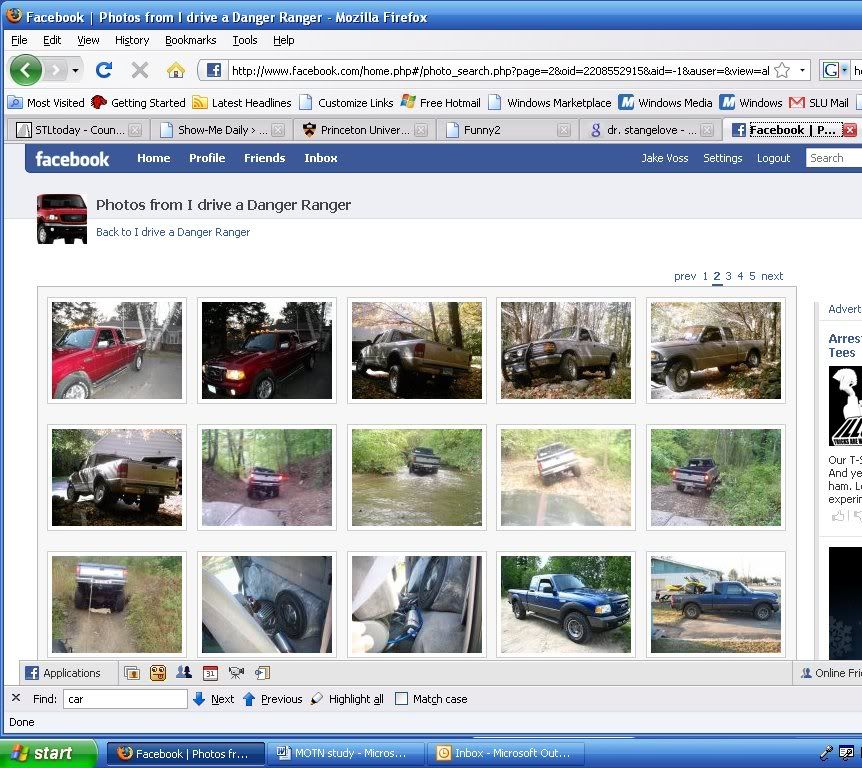
Once again, I think this is one of those feel-good laws that, when a layer or two is pulled back, does not make a ton of sense. Let’s take a look at this law for a moment. It penalizes any motorist who is not wearing a seat belt. Now, a seat belt is a device that protects you, and you alone, lowering the chance of injury or death in the instance of a collision. If I were driving my Danger Ranger down the road, it would make no difference to me whether every other motorist was wearing his or her seat belt. (Let’s ignore any association between not wearing a seat belt, risk-taking, and driving safely.)

Now, as with any decision, I have to consider the costs and benefits of wearing a seat belt. Some costs could be discomfort when wearing it, or the fact that my seat belt often gets caught in my car door. But these costs are offset by the benefits the seat belt offers, mainly the lower chance of injury or death that I mentioned earlier.

When talking about this law with fellow staff members here at the Show-Me Institute, a few more possible motivations for this law arose. For one, it may lead to a lower mortality rate for St. Louis County as a whole. This could be achieved in other ways, of course, such as drastically lowering speed limits, or through much stricter enforcement (as Josh Smith pointed out to me), but that would be detrimental to St. Louis County’s economy.

Here’s a fun way to look at it: The statistical value of a human life has been estimated to be $1.76 million. This figure comes from a 2002 estimate of $1.54 million, which I’ve adjusted for inflation. Now, while it can be seen as immoral to put a monetary value on human life, this number is thought to be what each person adds to society around them over the span of their life, sans all the mushy stuff like love and affection. Now, by drastically lowering the speed limit, millions of dollars would be saved in terms of human life. But the detrimental effects to our economy in terms of lost mobility and productivity would easily offset those millions. Rather, the government is able to set an equilibrium point for speed limits that is beneficial both to the economy and to human life — although the speed limit on Shrewsbury Avenue is ridiculous.

But what about seat belts? Well, it seems to me that if a person already considers the costs of wearing a seat belt to be too high, $10 will not change their mind at all. Statisitcally, it is said that you are 50 percent less likely to be hurt in an accident when wearing a seat belt. Now, the accuracy of this statistic is, of course, questionable, but shouldn’t the amount of the fine reflect it somehow? By not wearing your seat belt, you have decided that discomfort, or other costs, are a more important factor in determining your behavior than the $1.7 million you are adding to society throughout your life. But in St. Louis County, the cost for getting caught not wearing a seat belt is $10. I just wish there were more logic to this number. Sure, it’s round and ends in zero, but shouldn’t the fine at least reflect the increased risk? Why should a speeding ticket cost hundreds of dollars, and yet not wearing a seat belt only cost you 10? If you are going to make laws telling me how to drive, at least make them consistent.

Here’s a thought: How about establishing incentives to wear a seat belt (if the lower mortality or injury rates weren’t enough). Every time I drive a mile while wearing my seat belt, my insurance should drop by a penny. Sound ridiculous? It was kind of supposed to.


Support Us

The work of the Show-Me Institute would not be possible without the generous support of people who are inspired by the vision of liberty and free enterprise. We hope you will join our efforts and become a Show-Me Institute sponsor.

Donate
Man on Horse Charging