Royals Put Off Stadium Decision Another Month

Now that it’s almost Christmas, I can’t help but compare the latest news about the Kansas City Royals to a holiday classic, White Christmas. For younger readers, White Christmas is about two entertainers (Wallace and Davis) who try to help an old friend’s ski lodge. As the movie pivots toward its conclusion, Wallace abruptly leaves dinner, inspired by something Davis has just told him. Davis, flummoxed, turns to another friend:

Phil Davis: [sighs] I don’t know what he’s up to, but he’s got that Rodgers and Hammerstein look again.

Betty Haynes: Is that bad?

Phil Davis: Not bad, but always expensive.

I’m afraid things are about to get more expensive with the Royals:

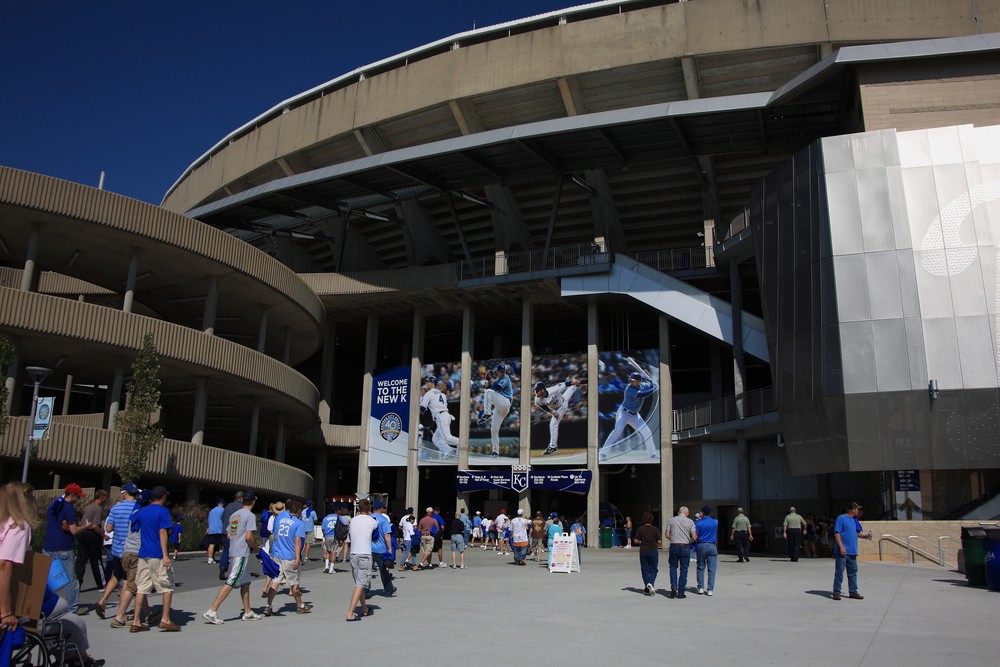
The Royals had previously announced a decision on a new Kansas City ballpark by the end of September. Now, as of Sept. 21, the team is looking to push off a decision as negotiations continue with both Jackson County and Clay County officials over the cost and funding of the projects. If the team goes downtown, the new ballpark would be located in the East Village near the downtown loop, on a 27-acre site bounded by 8th Street to the north, 12th Street to the south (where the main entrance would be located), Charlotte Street to the east to Cherry Street to the west; if the team does go with North Kansas City, an 18th Avenue and Fayette Street ballpark location would be part of the 90-acre site. The target date for both locations: 2028.

The fact that negotiations are continuing with both counties is concerning, precisely for the reason Quentin Lucas mentioned at the outset when Clay County’s bid was announced: the longer this bidding war goes on, the worse served local taxpayers are going to be. It’s hard to envision a circumstance where longer negotiations would decrease the amount of money shoveled over to the Kansas City Royals at the end of this process, so moving the decision date from late September to late October is a very unwelcome development.

Again, no public money should be going to a project like this, but if it is, it would be far better for that decision to be made sooner and not later. The decision coming later than was promised should concern all taxpayers.

Welcome to “Kensas City”: Barbie-Themed Streetcar Wrap Costs Taxpayers $25,000

Are the Underpants Gnomes running the Kansas City Streetcar Authority (KCSA)? Hot on the wheels—pardon, hot on the heels—of the news that Kansas City’s riverfront streetcar extension will be going way, way over budget, we now find out that the KCSA has a very nuanced approach to making the streetcar make anything resembling sense. My best guess at the latest gnomish rationale is as follows:

Phase 1: Build the Kansas City Streetcar and make it free to ride.

Phase 2: Spend $25,000 to wrap a streetcar in a Barbie theme:

Kansas City, Missouri, unveiled a Barbie-themed streetcar, dubbed the “Dream Streetcar” earlier this month. The streetcar is decked out in familiar bubblegum-pink wrapping and even rewrites the city’s name as “Kensas City.” A lucky passenger can even choose a seat decked out to resemble characters from the recent Barbie film, like “Stereotypical Barbie, President Barbie, Cowboy Ken, and even Allan.”

Oh, and the whole thing cost taxpayers $25,000.

According to records obtained by KCUR, Kansas City’s NPR affiliate, the hefty public spending is due to the fact that the Dream Streetcar is not actually a sponsored ad for the blockbuster Barbie movie that premiered in July. Instead, it’s a project by the Kansas City Streetcar Authority (KCSA) to increase ridership, even though the streetcar is free to ride.

Phase 3: . . . Profit?

I’m of course kidding about “profit” even being a consideration here—this is government after all—but it is off-putting to see precious taxpayer resources being spent so frivolously. Ridership numbers on the streetcar have no bearing on anything except maybe the egos of city officials. Hit the link, too, for quotes from yours truly and Show-Me Institute alumnus Patrick Tuohey, now at the Better Cities Project.

How We’re Writing Off an Entire Generation with Michael Petrilli

Susan Pendergrass speaks with Michael J. Petrilli about his recent op-ed featured in The New York Times, titled ‘We Can Fight Learning Loss Only With Accountability and Action’.

Listen on Apple Podcasts 

Listen on SoundCloud

Michael J. Petrilli is president of the Thomas B. Fordham Institute, research fellow at Stanford University’s Hoover Institution, executive editor of Education Next, editor in chief of the Education Gadfly Weekly, and host of the Education Gadfly Show podcast. An award-winning writer, he is the author of The Diverse Schools Dilemma, editor of Education for Upward Mobility, and co-editor of How to Educate an American and Follow the Science to School. An expert on charter schools, school accountability, evidence-based practices, and trends in test scores and other student outcomes, Petrilli has published opinion pieces in the New York Times, Washington Post, Wall Street Journal, Bloomberg, and Slate, and appears frequently on television and radio. Petrilli helped to create the U.S. Department of Education’s Office of Innovation and Improvement and the Policy Innovators in Education Network. He lives with his family in Bethesda, Maryland.

Produced By Show- Me Opportunity

To Nobody’s Surprise, Riverfront Extension of Kansas City Streetcar Going over Budget

It’s the viral crossover no one asked for and no one needs—high inflation and government waste. But here in Kansas City, it’s a mashup we’re getting anyway with the extension of the streetcar to the riverfront.

The question: how much over the $34.9 million budgeted for the project could 0.7 miles of rail cost taxpayers? The answer: another $10 million, and possibly more:

“We determined that both of the (contractors) were qualified, the technical proposals were sound, but their costs were above the estimate, and both of their costs were above the budget, significantly so,” KCATA Deputy CEO Dick Jarrold said during a Tuesday presentation to the agency’s Finance Committee. The KCATA is one of four groups heading the riverfront streetcar project, alongside Kansas City, the Kansas City Streetcar Authority and Port Authority of Kansas City. . . .

The Mid-America Regional Council (MARC) has authorized about $9.6 million in additional federal dollars for the riverfront streetcar through the Surface Transportation Block Grant program, and a MARC committee has recommended an additional $1 million in federal Carbon Reduction program grant funds. The programs require local matching funds, which Jarrold said are anticipated from Port KC and the Streetcar Authority in an as-yet undetermined amount. [emphasis mine]

Keep in mind that the estimate for the original plan to extend the streetcar to the riverfront was $22.2 million, meaning the apparent final (?) cost of the line is on course to double that estimate, with or without the local match considered.

Yet, that’s been the track record for this toy train for over a decade now. I wrote here in 2011, 2012 and 2013 and for Forbes in 2014 that the Kansas City streetcar was a profligate and bad idea. And yet, despite the many opportunities to prove naysayers wrong, the streetcar remains a remarkably poor fiscal and policy decision to this day.

An Airing of Grievances about Sewer Sales in Festus

I have a lot of problems with how the sewer system sale is being handled in Festus, and you people are going to read about it. (Crystal City is involved here, too, but that doesn’t flow with my reference.)

For some background, Festus and Crystal City—two adjoining cities in Jefferson County—are planning to sell their shared municipal sewer system. That, by itself, is a good thing they deserve credit for. However, the cities never went out for open bids on the project. They negotiated behind the scenes with only one other entity, the Jefferson County Public Sewer District (JCPSD), on the sale. They went public in June with the proposal and have entered into a formal arrangement to continue negotiations with the JCPSD. (Nobody has finalized anything yet, to be clear.)

JCPSD is offering $5 million for the system. While that may be a fair price and while JCPSD seems fully capable of running the sewer system for the community, how do the cities know if it is the best deal if they don’t accept other bids?

I filed a sunshine request with Festus last month for public records regarding the potential sale. I asked for the available records. I received the response last week. The city’s response is utterly worthless. There is nothing in it beyond copies of prior ordinances authorizing the sewer system, recent bills authorizing the city to negotiate with JCPSD, and copies of public notices. There is not one e-mail in the response, which means either no city officials or employees ever sent an e-mail on this topic over the past year—or they are claiming every e-mail is privileged. When we asked why there were no e-mails in the response, this is what they wrote me:

The City has reviewed the records within its custody which would be responsive to the requests. In response to those requests, we have provided those records which are responsive and which are open under the Missouri Sunshine Law. As noted in the City’s letter responding to the requests, certain records of the City were withheld as closed records, pursuant to Section 610.021, RSMo (1), (2), (12), and (17).

In fact, total secrecy was demanded by JCPSD and the two cities right from the beginning, despite the fact that openness, not secrecy, would have likely led to more bids and a better deal for the cities and taxpayers. Here is section eleven from the initial letter from the JCPSD to the cities dated November 17, 2022, but not made public until much later:

Without the prior written approval of the other parties, unless otherwise required by law, neither the JMUC, District, nor Cities will disclose the existence of this letter or any information concerning the transactions contemplated in this letter, to any third party, other than such party’s attorney, accountant, or professional advisor who needs to know such information to perform his or her duties in connection with this letter or intend or the transactions contemplated by this letter and who shall first agree to the confidentiality of this letter.

This has been anything but an open and transparent process. The public hearings on this matter were held shortly after the proposal was first announced, and the two city councils voted to approve the memorandum of understanding with JCPSD the exact same night as the public hearings. (Officials voting the same night is always a red flag that a public hearing is a dog-and-pony show.) The cities took no other bids or proposals, despite being well aware other entities would like to bid on the sewer systems. Now they are hiding behind legal exemptions to not share any records on the deliberations and discussions of the sale.

Festus and Crystal City selling their sewer system to a larger organization, public or private, with more resources is a great idea. Going about it all in this manner, however, is terrible government. It may be legal, but it is wrong.

Veto Session, Tax Freeze, and Holding Students Back

David Stokes, Elias Tsapelas, and Avery Frank join Zach Lawhorn to discuss the veto session, freezing property taxes for seniors in St. Charles County, the formation of a committee on the St. Louis earnings tax, and more.

Listen on Apple Podcasts 

Listen on SoundCloud

Produced by Show-Me Opportunity

Stop Blaming Homeschoolers

In an incredibly shameless move, the Missouri Department of Elementary and Secondary Education (DESE) has submitted a budget request for 2025 that raises the dollar amount per student in the foundation formula because the number of public school students is declining. Apparently, the most important thing is to make sure districts don’t get less money when their enrollment is declining.

DESE and the state board of education would have you believe that the pandemic has led Missouri families to simply keep their kids at home—just like the parents who are working remotely. That, they say, is the culprit. Incorrect. I have been making this point routinely over the past year. Missouri, as a state, has declining enrollment. Actually, K-12 enrollment is declining at the national level as well.

If you look at the following graph of the number of Missouri public school kindergartners each year, you can see that, after growing for a decade or so, enrollment peaked in 2013. Since then, pandemics notwithstanding, cohorts have been getting smaller and smaller. That peak is now in high school. Within a few years, the number of our high school graduates will begin a steady decline.

Missouri kindergarten enrollment: 2002–2022

If we take the position that this is a temporary problem and we manipulate the formula to make sure that overall funding stays the same (DESE actually asked for a $100M increase), we will be misappropriating taxpayer dollars. We need to fund the schools and students we have, not the schools and students we used to have.

Highlighting Creativity in Education with Dalena Wallace

Susan Pendergrass speaks with Dalena Wallace about how to incentivize, and support outside-of-the-box approaches to education.

Listen on Apple Podcasts 

Listen on SoundCloud

Dalena Wallace is a busy homeschool mom of six. She manages a co-op serving 35 local homeschoolers and operates a hybrid microschool called AIM High. She is the founder of AIM Educational Collaborative LLC which helps provide assistance and coaching for others who would like to build Autonomous, Innovative, and Missional educational models.

To learn more about her work visit: www.aimeducationks.com/

Learn more about KPI’s September 23 event here: kansaspolicy.org/events/

Produced by Show-Me Opportunity


Support Us

The work of the Show-Me Institute would not be possible without the generous support of people who are inspired by the vision of liberty and free enterprise. We hope you will join our efforts and become a Show-Me Institute sponsor.

Donate
Man on Horse Charging