Most schools embraced digital learning during and after the COVID pandemic, dramatically increasing students’ screen time during the school day. Combined with the long hours many children already spend on screens outside of school, the result has been an unprecedented amount of daily screen exposure.
But people are starting to push back. More than half of states have policies that limit or fully ban cell phones in schools. And many states and school districts have also enacted, or are considering, policies that limit screen use for instruction. Patrick Johann recently reviewed an instructional-use screen time policy adopted by the Los Angeles Unified School District, which is scheduled to take effect this upcoming school year.
Missouri is part of this broader trend. Last year the state banned cell phone use during the school day, and lawmakers debated the Student Screen-Time Standards Act during the 2026 legislative session, which would have curbed screen use for instruction. The Student Screen-Time Standards Act didn’t pass into law, but similar legislation will almost surely be introduced in 2027.
The rationale for cell-phone bans is that cell phones are a distraction. For laws that limit screens for instructional use, the idea is that screen-based instruction simply does not produce as much learning as face-to-face teaching. Technology offers many benefits, but it has been unable to replace the human interaction that many students—especially those from disadvantaged backgrounds—need to thrive in school.
If we had a robust market for school choice, I would welcome schools that make technology central to their instructional model. Some students will undoubtedly flourish in those environments, and technology can support a level of personalized instruction that is difficult to achieve in a traditional classroom. Alpha School is an interesting model with promising early results.
But in states like Missouri, where most students are still required to attend their residentially zoned public school, school districts should not use learning models that don’t benefit most students.
A recent article at The74 discusses an unlikely ally in all of this: students themselves. The article explains how many students describe their relationship with technology in terms that resemble addiction. The author writes:
They don’t want to be on their phones eight or nine hours a day. They don’t want to use AI to complete their assignments and short-circuit their ability to learn and grow. They know their attention span is stunted. But in so many circumstances, they simply can’t resist.
When the pandemic hit, schools shifted quickly toward technology-based instruction. It all happened very fast. However, as is often the case in such circumstances, the pendulum may have swung too far. Perhaps the clearest sign is the growing consensus for a course correction—from parents to teachers to policymakers and, increasingly, to students themselves.
The federal government will roll out a new tax-credit program in 2027 to expand school choice. Taxpayers will be able to receive a dollar-for-dollar federal tax credit for donations of up to $1,700 annually to a scholarship-granting organization (SGO) in Missouri—or any other participating state. The SGO then distributes scholarships to families seeking alternatives to their residentially assigned public schools.
In a previous post I wrote about the new program, focusing on the challenge of deciding which educational expenses should qualify for scholarship funding.
Over at Education Next, Rick Hess has a thoughtful piece on other aspects of the program. As both a school choice advocate and an advocate of fiscal responsibility, he opens with a concession, acknowledging the potential loss of tax revenue the program could create at a time when the federal debt is growing rapidly.
He then makes what I think is the right point: While it is unfortunate that the federal budget is off the rails, it is hard to get too worked up about this program when (a) it is a drop in the bucket compared to our broader fiscal problems, and (b) so much of our debt-financed spending benefits older Americans. If we’re going to keep borrowing, why not direct at least a small share toward expanding opportunities for children?
I share Hess’s bottom-line sentiment. I wish the federal government managed its finances more responsibly. But since that does not appear likely anytime soon, investing a bit more in the children who will ultimately inherit—and help repay—that debt seems sensible to me.
Turning to the program itself, Hess raises an important practical concern. Even though this is a dollar-for-dollar tax credit, which means it is effectively costless for taxpayers to participate, we should not assume it will be widely used. Many taxpayers may be unaware the credit exists. Others may doubt they’ll actually receive it or may not know how to make a qualifying donation to an SGO. Even modest uncertainty or inconvenience can discourage participation.
These are legitimate concerns. The new scholarship tax credit has the potential to generate substantial resources to expand school choice, but realizing that potential is not automatic. As Hess puts it, “I don’t put a lot of stock in the casual assurance that taxpayers will jump through hoops to give money away simply because, as one very prominent champion explained to me, ‘It’s a good thing to do.’”
Hess’s piece points to one of the program’s biggest implementation challenges. Helping taxpayers understand the credit—and making participation as simple as possible—could make an enormous difference. Show-Me Institute analysts will certainly be doing our part, and I hope many others will as well.
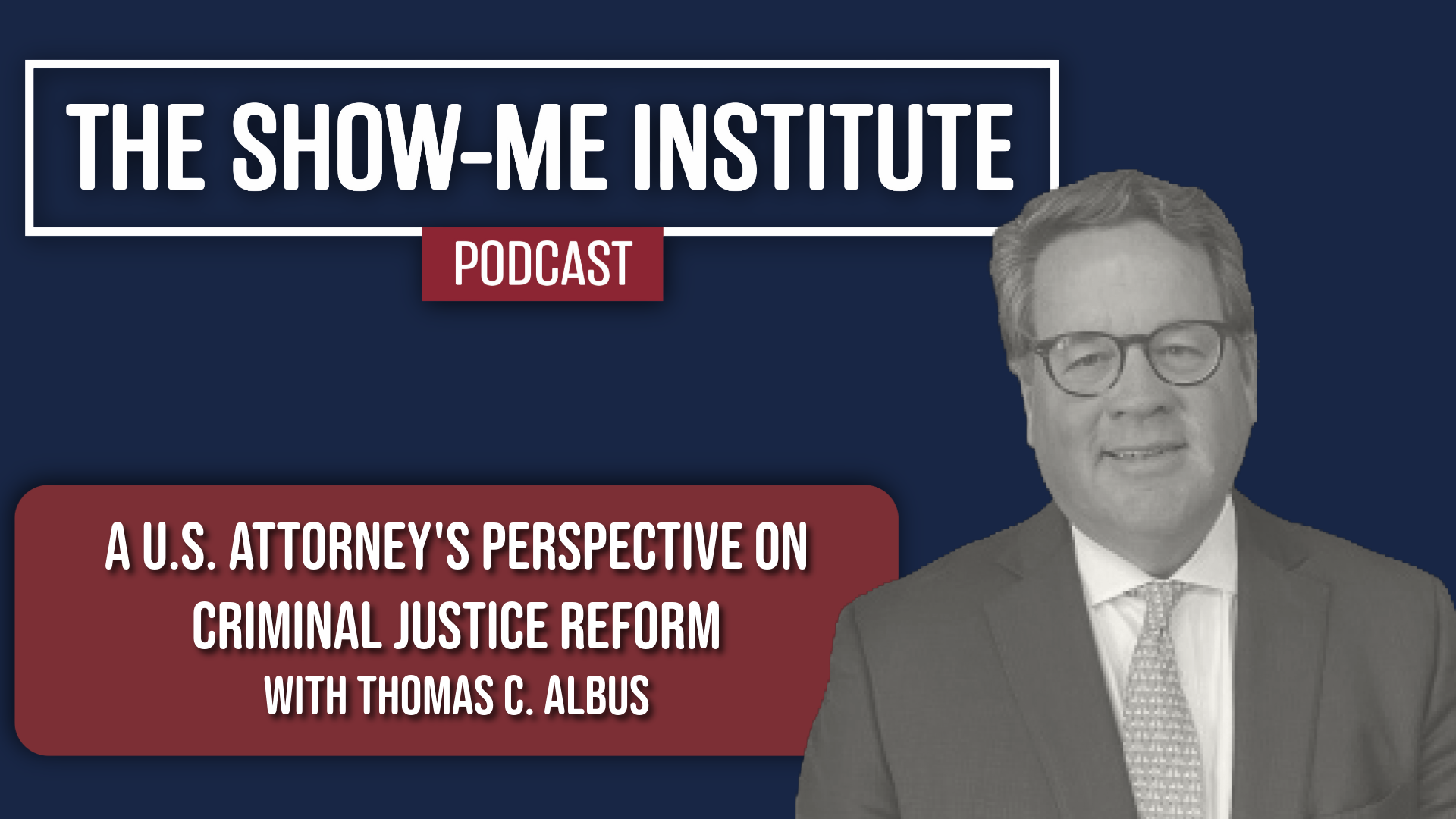
Susan Pendergrass speaks with Thomas C. Albus, United States Attorney for the Eastern District of Missouri, about public safety and criminal justice reform in the St. Louis region. They discuss the limits of risk assessment tools in bail decisions, why the city of St. Louis and St. Louis County have such different homicide rates, the case for judicial discretion over algorithmic recommendations, the connection between education, social capital, and crime, and more.
Susan Pendergrass (00:02):
Thank you so much for joining us, Tom Albus, the U.S. Attorney for the Eastern District of Missouri. The Show-Me Institute, in the last year or so, we’ve been digging into the issues of public safety and criminal justice reform, because one of our goals is to make Missouri a growth state where people want to raise their families and businesses want to come and open. Clearly, if our cities are perceived as being a place where you can’t walk to your car at night and put your groceries away, then people won’t want to do that. We’ve been trying to understand what’s going on mostly in the St. Louis metropolitan area and have realized that a lot of the issue is a disconnect between what’s actually happening and people’s perceptions. People just perceive St. Louis as a dangerous city. I did a podcast recently with Doug Burris, and he had some encouraging things to say about our prison system. I appreciate you coming on and giving us another perspective, because the most important thing for me is to try to understand this.
Tom Albus (01:20):
Thank you very much for having me. Just so everyone understands, I know Doug Burris very well and think very highly of him. He ran the probation office here in federal court for many years. When I was an assistant US attorney, I was a line prosecutor for many years before I got this job, and immediately before that, I was a circuit judge in St. Louis County, so I was a judge in the state system compared to the federal system. Doug came and helped run the county justice center, and he’s a very innovative, thoughtful person. So I don’t mean to argue with him, but I listened to your podcast with Doug, and one of the things he was talking about was getting people off probation faster, which is fine. You might remember the example he used, the first-degree robber versus the grandmother who cashed her deceased husband’s Social Security check. Those shouldn’t be treated the same, and of course they’re not treated the same now. Alternative probation is a great option for somebody like that grandmother rather than sending her to prison. But bear in mind, if you explain to Mr. and Mrs. John Q. Public that this lady cashed $75,000 worth of Social Security checks, do you want to do anything to her? We probably don’t want to incarcerate that person, but the alternative would be probation with a requirement to pay the money back to the extent she can. So no one’s suggesting treating that person the same as a violent criminal, but people do need to have accountability.
Susan Pendergrass (03:13):
About this idea of applying a risk assessment when somebody’s arrested or convicted, so that we’re sure to lock up dangerous criminals and aren’t simply using building more prisons as our policy solution, what do you think is the more efficient use of government resources when it comes to making people feel safer?
Tom Albus (03:42):
You’re absolutely right. We use this risk assessment in St. Louis County. I didn’t learn any of this in law school, but I did feel like it was common sense: does this person have a prior conviction, that person is riskier to let out on bond before trial; is this person under a certain age, that person is riskier. Social scientists create these risk factors, and frankly, I think intuitively anybody, whether they have legal training or not, would apply something similar. They’re fine as far as they go, but when we were in St. Louis County, no matter how many priors the offender had, no matter how young they were, no matter how frequently they had priors, the recommendation was always, well, you’re going to let this person out on bond, and it was just a matter of how many accoutrements to the bond, how frequently they had to check in, and so on. There was no part of the risk assessment where it said this person should be detained before trial, which to me didn’t seem sensible. Some people need to be detained before trial. Another thing these risk assessments didn’t take into account was the strength of the evidence against the person. What if the person was found by police with the smoking gun over the body of the victim? Shouldn’t you take that into account? These risk factors don’t. A lot of times the risk assessment tools are being pushed by NGOs and foundations that, if you look at their website, say their goal is to get everybody out of prison. Again, this is social science, not chemistry. Everybody has a point of view that should be considered, but we have to consider the point of view of the groups pushing to reform how probation credit is counted or to add these risk assessments, because everybody in the criminal justice system has their own point of view.
Susan Pendergrass (05:58):
So what is the reality with the prison population in Missouri? Is it growing or declining?
Tom Albus (06:04):
I believe, and I’ll have to check these numbers, that the Missouri Department of Corrections population is roughly one-third less than it was ten years ago. I believe the United States Bureau of Prisons, the people in prison for federal crimes, is one-quarter less than it was ten years ago, between COVID, a different approach, and the First Step Act. Now, I know you’re very interested in educational policy. What if we had a one-third increase in fourth-grade reading scores in Missouri? Everybody would be pretty happy with that. So here we have these great statistics, but to the extent everything else is equal, if crime is the same and the prison population is down, everybody wants that. But is crime down, and is it down to a level we’re satisfied with?
Susan Pendergrass (07:04):
And is it? People are talking all over the place, including leadership in St. Louis, about how much crime is down. But when we’ve talked to people on the street or had public events, people don’t feel like crime is down. People still see panhandling and graffiti and public disorder. People still don’t want to park their car and walk to a baseball game downtown. Everyone knows you leave your car unlocked because you’re going to get smashed and grabbed anyway. There isn’t a perception that St. Louis feels safer.
Tom Albus (07:38):
Right, and it’s a complex situation regionally. The city of St. Louis, to its credit, has reduced homicides from the mid-200s in 2020 to about 140 in 2025. That’s 50 homicides per 100,000 people. The national average is in the high single digits, so it’s still very elevated in the city of St. Louis. Now you go across Skinker to St. Louis County, where I was a judge, and we’re sitting at roughly the national average in the high single digits. A trend you don’t hear much about is that’s a much elevated rate over the last 10 to 15 years in St. Louis County, maybe 2x or 3x higher than it was 10 to 15 years ago. Then you go across the Missouri River to St. Charles County, and they’re looking at about one murder per 100,000 people. So it’s a big difference as you proceed west on Highway 70, and one size doesn’t necessarily fit all.
Susan Pendergrass (08:50):
What’s been going on in St. Louis County that it’s gone up?
Tom Albus (08:56):
I don’t really know the source of it, but we are dealing with a lot more violent crime in St. Louis County than we did, say, twenty years ago. For example, even though we’ve got approximately four times more people living in St. Louis County than in St. Louis City, we only have about one-third as many homicides every year as the city. Yet we’ve got 200-plus people awaiting trial for homicide in St. Louis County. That’s really the focus of the prosecutor’s office, and rightly so, but they didn’t have the capacity twenty years ago to handle the rate of homicides they’re seeing now, and this backlog is a consequence of that, in my view.
Susan Pendergrass (09:48):
Plus clearance rates haven’t really improved. A lot of the crimes identified as murders aren’t getting solved.
Tom Albus (09:56):
If you look at it, the City of St. Louis Police Department would say their clearance rate has gone up quite a bit, and those are statistics the city updates every day on the police department’s website. At some points they’ve recorded a clearance rate of over 100 percent in the last year because they’re solving historical cases in addition to new cases as they come in. So they’ve gotten their clearance rate very high, and that’s important too, not only for how long you’re going to sentence someone, but because people need to understand that if you commit an offense you’re going to be called to account. Chief Tracy in the city is proud of his clearance rate going up, and he’s right to be.
Susan Pendergrass (10:39):
What are your thoughts on mandatory minimums when judges have discretion?
Tom Albus (10:46):
Mandatory minimums exist in state and federal crime. You could say someone is in prison for second-degree murder and subject to a mandatory minimum of ten years, that’s true, but I don’t think that’s what people are really thinking about when they raise this issue. There are very few people incarcerated in the Missouri Department of Corrections who are there only because of a mandatory minimum that the judge would have preferred to sentence below but wasn’t able to. There was a lot of that when I first became an assistant US attorney 25 years ago with the crack cases, where you could get a five-year mandatory minimum for a very small amount of crack. That was passed by Congress in the Crime Act of 1994, and those ratios have since been changed by Congress. People will talk about nonviolent offenders, but a drug dealer, to me, is not a nonviolent offender. We’re not talking about crack as much anymore. We’re talking about fentanyl, and everybody knows what happens when you come into contact with fentanyl, roughly two hundred Americans a day die from fentanyl overdoses. I would consider that a violent crime, not to mention that firearms and violence often go along with drug dealing. The whole point of my visit with you is just to say these are not easy questions to answer. But if somebody came into your neighborhood and was dealing fentanyl to anybody who wanted it and had money to pay, I would be concerned. Maybe strictly speaking that’s not a violent crime, but it’s a very dangerous, antisocial crime.
Susan Pendergrass (12:42):
So you see these nonprofits and NGOs saying, let’s clear the prisons, let’s put more people on ankle monitors, let’s stop building these massive prisons, Arkansas is building a billion-dollar prison, and there are a lot of foundations saying we could be smarter about this. It sounds like you don’t completely align with that thinking.
Tom Albus (13:13):
Everybody should know where everyone is coming from. You probably recall about ten years ago, when Governor Parson first became governor, Missouri was in the same boat. They said they didn’t have a lot of money, certainly not enough to build new prisons, and Governor Parson said we’re just not going to go down that road. As I said, we were able to reduce our DOC population in Missouri substantially, by a third, and the need for those new prisons went away. Statistically speaking, we’re doing better in 2026 than we did in 2020, notwithstanding the fact that we have a third fewer people in prison. That’s a good thing. But if a foundation comes in and says, well, we have this risk assessment tool, and it’s just science, nothing to it other than science, I’d suggest everyone go to that foundation’s website and see what their mission statement says. This is social science, not physics or chemistry or biology. Everybody has their political point of view, and there’s nothing wrong with that, but we need to disabuse ourselves of the idea that it’s a no-brainer, that you just use this risk assessment, let everybody off probation, and everything gets better and cheaper, a win-win-win. I just don’t subscribe to that.
Susan Pendergrass (14:45):
I saw a case, not in Missouri, of a guy accused in a terrible case involving a child, whose risk assessment was very low, but the nature of the crime was terrible. He was let out and reoffended. I remember thinking the risk assessment didn’t do its job because it didn’t pick up on this particular person’s potential for criminality. In a world with finite resources, what do we do to make St. Louisans feel safer?
Tom Albus (15:31):
That’s what’s so thorny about it. When I was sitting as a judge, sometimes I’d think, what would my wife think, or my mother, or a friend, about this particular person, risk assessment tool aside. For example, if someone’s on bond for a felony and then arrested for a new felony, that gets them a point on their risk assessment. But I think a lot of Missourians would say, I don’t care if you get one point or ten points or thirty points, if we’ve already let you out on bond and you committed a new offense, that’s it, you’re not getting another chance. And then we get into, well, was it a violent crime? If he stole a car on Monday and then steals another car the following Monday, some people would say we just can’t accept that, it’s absurd. I think people are at least entitled to that opinion, even though it’s contrary to what is supposedly following the science.
Susan Pendergrass (16:32):
So do we put more discretion in the hands of judges?
Tom Albus (16:35):
Again, I don’t think anyone’s suggesting the judge can’t override the assessment. I overrode it all the time, and my colleagues did too, because that’s the role of the judge. One thing that came up, you may have followed, there was a juvenile assessment tool that was frequently followed, and the juvenile officer or judge was very reluctant to go against the risk assessment for the juvenile. That got the police up in arms, and there may have been some legislation around it. But the judge should always be able to go against the risk assessment. And as I mentioned earlier, what about a written confession? There’s no question the person did it. You’re presumed innocent at trial, but we can weigh the facts against the person in terms of setting the bond.
Susan Pendergrass (17:34):
Yeah, I think my biggest issue with the perception of public safety in St. Louis, when I lived right between Skinker and DeBaliviere, near Delmar, was just a lack of the rule of law around me. People ran stop signs and stoplights, and there were smash-and-grabs, and someone could commit a crime and get on the MetroLink and get away. We all kind of agree that the MetroLink stations feel really dangerous. We’ve all just accepted that we have to keep floodlights on the outside of our house. Living in the city of St. Louis, which I love, you just develop this tolerance for the fact that crime is going to happen around you and there’s nothing you can do about it. I didn’t feel like the police were really enforcing the small things, and people were getting away with big things too. I wonder what the fix is for that.
Tom Albus (18:40):
Right, and another thing being debated is that you need police officers, and we have perhaps fifty percent fewer police officers policing the city of St. Louis than we did ten years ago. That’s not a good thing. I am in favor of having police officers in the neighborhood. When I was an AUSA, I would go to neighborhood meetings and try to understand what was going on. I never heard anybody say we want fewer police in our neighborhood. I always heard people in every neighborhood saying we want more police, this corner’s a problem, please take care of it. It’s a challenge for the city of St. Louis, and I wish them nothing but the best in getting as many more police officers as they can.
Susan Pendergrass (19:28):
Yeah, and 911 is a bit of a problem too. People complain about not being able to get through. We have 28 different systems, and the city-county line makes it all very confusing. Talks of merging the two always seem to result in nothing, but as you just mentioned, the difference in the murder rate between one side of the line and the other, something needs to be done to fix that.
Tom Albus (20:01):
I always go by the murder rate, because those all get called in. There’s also a difference in how frequently a car break-in might get called in across different areas of our region, so you can’t necessarily rely on all statistics. But homicides get called in, and homicides are a good indicator of the overall safety of a community.
Susan Pendergrass (20:24):
So generally, if you could wave a magic wand, what would you do? Is there anything you would change within the probation, pretrial, and prison system?
Tom Albus (20:38):
No one likes to think about building more prisons because it’s very expensive and it’s kind of the last tool in the toolbox. But in the city of St. Louis, they took out of service and knocked down the medium-security institution known as the Workhouse. That’s not available anymore. So the only place state court judges in the city have to put offenders being detained pretrial is the Justice Center downtown, and that’s at capacity. I would want a lot more police officers, and I probably would want some more places to put the real repeat offenders, the antisocial people, certainly the violent people, so they are incapacitated and out of our community. People who commit Class A or Class B felonies, or new felonies while on probation, parole, or pretrial detention, they still get bond because we’re out of places to put these people. And as we all know, we’re talking about a very small percentage of our community committing these serious crimes. Then we could go back to people having more social capital in the community, people looking out for them, and not letting teenagers or young people be directionless. I see a lot of that when I sit in a courtroom in the city or county, people who just don’t have a plan for their lives and don’t have people in the courtroom supporting them. That’s what I would really change.
Susan Pendergrass (22:17):
Yeah. I mostly study education policy, and St. Louis Public Schools has a chronic absenteeism rate of about 55 percent. I don’t think they even know where those kids are. Until we fix some of those things and somebody’s keeping track of these teenagers, I don’t see their propensity for committing crime going down. I believe first you fix the education system, before they get to the criminal justice system, but unfortunately we don’t have that right now in St. Louis. Well, I appreciate you coming on and giving a different perspective. I’ve heard more than one person, not just Doug Burris, say that risk assessment is going to be the way to fix the problem, and it’s good to hear a different perspective that it comes with a lot of caveats, at minimum.
Tom Albus (23:09):
Right. There are a lot of good people working on this problem, but it’s just not a problem that has a silver bullet, that I’ve seen in 25 years.
Susan Pendergrass (23:18):
Good to know. Well, thank you so much, Tom. I really appreciate it.
Tom Albus (23:21):
Thank you very much, Susan. Thanks for having me.
Many Missouri counties have a property tax that funds senior services. However, almost all of them passed it before the senior service property tax freezes were put into place, so at least senior citizens paid the taxes that funded the services. That is not how it works in Jackson County, which adopted the tax freeze and then passed the senior service tax in 2024, and is not how it would work in St. Louis County if voters approved this tax. Senior citizens who get the services would be exempt from paying the new tax if they own their home. Yes, seniors who rent would possibly pay the new tax through their rent payments, but keep in mind that many seniors who don’t live on their own live in senior communities, which are sometimes non-profits (entirely, or in part) that also won’t pay the new tax.
It is bad enough that seniors now vote, thanks to the freeze, on tax increases that they don’t have to pay. But to create a new fund specifically to fund senior services from a new tax they (mostly) won’t pay is truly entering the tax policy Twilight Zone. (Note that seniors who own their homes will be exempt from this tax if it passes. People saying it won’t apply in this instance, such as in this story, are wrong.)
Susan Pendergrass speaks with Chad Aldeman, education policy researcher and founder of Read Not Guess, about Missouri’s early literacy crisis and why the legislature has struggled to address it. They discuss what it means for a fourth grader to be below basic in reading, why three-cueing may be harmful to early readers, the science of reading and what it actually prescribes, the case for third-grade retention policies, and more.
Susan Pendergrass (00:00):
Looking forward to this conversation with you, Chad Aldeman. I just want to give you a little background on why I want to talk to you today. Missouri just wrapped up its legislative session in late May. This is the second year in a row that we have tried to make some inroads into what I consider to be a crisis, which is that 42 percent of our fourth graders are below basic in reading. We have tried to force the state education agency, the Department of Elementary and Secondary Education, to improve how reading is taught and to create a system of guardrails around kids being promoted without knowing how to read, all of which have failed. What does it mean for a fourth grader to be below basic in reading? Given that more than four in ten Missouri fourth graders scored below basic, what does that mean?
Chad Aldeman (00:59):
Below basic is a very low level. It means that kids cannot read an unfamiliar passage and understand what it means. In fourth grade, maybe you’re not super worried about those kids, but you probably should be, because that is a key milestone. If you’re not reading in fourth grade, you’re really going to struggle with everything that comes next. You’re not going to be able to understand social studies and science. You may not be able to read owners’ manuals or instruction manuals when you’re trying to build things at your house. You’re really going to be dependent on other people interpreting words and language for you. YouTube is helpful, lots of things are helpful, but we’re still in a written culture, and there’s lots of information that’s written that if you can’t pass even the basic level you’re going to struggle with in life going forward.
Susan Pendergrass (02:02):
Yeah, so this is kind of the problem, which I consider to be basically a crisis. Forty-two percent of our kids are below basic. What we call it when we’re trying to fix it goes by a bunch of different names: early reading, early literacy, read to learn. But when my kids were little, about thirty years ago, I think it was called whole language, this language-rich environment where kids would just learn to read. But now there’s a thing called three-cueing. What is three-cueing? I assume it means that kids are supposed to look three different places for cues, but what specifically is it?
Chad Aldeman (02:37):
Three-cueing and whole language have a lot of similarities. They’re basically trying to get people to memorize words. Rather than sounding out, like my name is Chad, which is pretty phonetic, rather than understanding that the CH combination makes the ch sound, they want you to just memorize the picture in your head of what the word looks like. Really good readers do have a lot of memorized words. I don’t have to sound out my name. There are lots of words that my brain just goes to instantly because I’m so familiar with them. But taking what expert readers can do and using that as a method to teach kids is actually really harmful. Kids develop those skills by learning the core elements. The CH combination makes the ch sound, and they need to practice that when they’re learning to read. Over time they’ll just see it and recognize it quickly. English is quirky. English is not entirely phonetic, but it’s still quite phonetic, and phonics is still the building block of reading. There are cases when CH doesn’t make the ch sound, when it makes the hard C sound. Kids need to understand and recognize those as well. They need repetitions, and they need to understand what the normal rule is and what some of the exceptions are.
Susan Pendergrass (04:04):
So would three-cueing be considered part of the science of reading or not?
Chad Aldeman (04:08):
Three-cueing is not part of the science of reading. Three-cueing is saying, rather than teaching kids the building blocks of the language, have them guess at the words based on a picture they see. So there’s a picture of a horse, and they see a word, and they just guess horse. The text may actually say pony, and sometimes those differences really do matter.
Susan Pendergrass (04:29):
Ha.
Chad Aldeman (04:38):
The second cue is the first letter of the word, and the third is other context clues. So if it’s a story about horses, you might guess horse. And those cues are actually detrimental to learning how to read, to knowing what the words and letters actually translate into.
Susan Pendergrass (05:02):
Why? Why is it detrimental?
Chad Aldeman (05:04):
Because it leads to guessing. It might be harmless for a four-year-old to say pony when the word actually says horse. But as kids get older and start reading more complex texts, those types of mistakes really do matter. And if you haven’t learned the phonetic skills, you’re not going to be able to read a word like ribonucleic acid or something like that. When you start reading more complex words, all of a sudden you can’t break them down. Your mind doesn’t have the ability to understand how to break down a word that you’re not familiar with.
Susan Pendergrass (05:33):
Mm-hmm. So two years in a row at least, the legislature has tried to ban three-cueing so that teachers would not be allowed to use it. They punted a little bit and said it can’t be the first thing they use, but could still be a tool in their toolbox. They’ve gotten a lot of pushback. In Missouri, legislators are sometimes former teachers, sometimes married to a teacher, sometimes their best friend is a teacher. And they’ll just say, you know what, we’re a local control state, so we can’t tell these teachers what to do. When they’re in the moment in the classroom, they know best, and that’s how we roll in Missouri. But what I hear you saying is it can actually be harmful.
Chad Aldeman (06:39):
Yeah, and there actually is a science about how kids learn to read. It’s been well documented for a long time through empirical researchers looking at whether kids do better under method A or method B. What they found is that teaching kids the building blocks of reading, the phonetics, is more helpful, particularly for students who might struggle, or who are dyslexic, or have other language issues. If you teach the three-cueing strategies, you’re teaching them the wrong thing and leading them down a side road. It can lead to bad habit formation, which is then really hard to kick later on. The other thing that’s relevant here is that reading is somewhat sequential, and kids need a lot of practice in the early grades in order to be proficient readers. If you use the three-cueing tactics, you will not be giving them the building blocks they need to develop. And it’s a challenge to get kids back on track if they’re off. There’s all kinds of data about delays in reading, and kids who aren’t proficient by third grade will struggle in the short and long term. So it’s really important to catch those issues as early as possible in K through two.
Susan Pendergrass (08:14):
Well, on that note, another component to the legislation that’s been considered and that we have been supportive of is that if a child at third or fourth grade has demonstrated that they are substantially behind in learning to read, they should not be promoted to the next grade. What do you think about that policy?
Chad Aldeman (08:34):
Some people may hear that policy and think it’s punitive and it’s going to be bad for kids, but it’s not really about what happens at the end of third grade. I see that policy as more of a threat to the adults in that student’s life about making sure that doesn’t happen. In K through two, those students are being flagged and identified as being at risk of potentially being held back.
Susan Pendergrass (08:39):
Mean.
Chad Aldeman (09:04):
And they’re given interventions and supports so that they’re ready to take and pass the assessment in third grade. That’s really my read of the evidence. In the states that have these types of policies, kids who are flagged as needing more help get the help. That is the key: this sort of threat of being held back, and then the interventions and all the adult behaviors it changes. Teachers then know which kids need extra help. They then communicate to parents, hey, your child is behind and they need to catch up, and here’s what we’re going to do to help them. I wrote about this in Mississippi. They have learning plans, specific, tailored, individualized instructional plans for children who are at risk of being held back. And parents are brought into the conversation. It’s pretty scary that your child may be at risk of being held back, and here’s what we’re going to do in the interim to get them ready. That is the key for me. It’s not what happens in third grade. It’s all the stuff that happens before and what the adults can do to make sure kids are ready.
Susan Pendergrass (10:19):
Yeah, because if I understand it correctly, Mississippi has that policy, but they don’t actually retain that many kids.
Chad Aldeman (10:26):
Yeah, that’s right. In state after state, the states that have these types of policies, the number of kids who are ultimately retained is not that high. There are screens that are identified earlier in K through two, and then interventions are put in place. There are oftentimes some exceptions for students with severe disabilities or English learners who are newly arrived, and chances for retakes if there’s something about stress on the day or they go through a summer program. There are other ways to get students ready. It’s not just the third-grade cut point.
Susan Pendergrass (11:07):
Yeah, it seems like one of those situations, and I doubt it’s unique to Missouri, where people in charge of teaching young children to read feel threatened or feel like they’re being criticized, because we have a real problem with 42 percent of our kids being almost illiterate. And the adults are taking it personally, and therefore they’re resistant to any policy that would force the hand of these districts or teachers. And to me that’s just a shame.
Chad Aldeman (11:47):
Yes, I agree. I think part of it goes to the culture in education where every teacher is supposed to create their own idea and method for how to teach. We don’t really give teachers the building blocks of here’s a well-scripted curriculum, and if you follow this your kids are likely to be successful. Some of the highest-performing schools, school districts, and countries do a much better job of being clear that here’s a well-defined, articulated curriculum, and we’re going to support teachers to do it. There’s still the question of how it gets implemented, but the what is pretty well articulated. And this goes back to the science of reading idea: there is a science. It is evolving in the sense that there’s still more research being conducted and we’re still learning new things, but we know a fair amount about how kids learn to read. So teachers, schools, and teacher preparation programs should be equipping their teachers to use those things.
Susan Pendergrass (12:58):
So you have spent a lot of time studying and writing about this, and you decided to take a leap and start your own company?
Chad Aldeman (13:06):
Yes. I got interested in this because my own child was taught to read using three-cueing. He came home during the pandemic and I was oblivious. I kind of thought my son could read. We had been to school and celebrated his reading superpowers that the teachers had taught, and they were things like guessing at pictures, picture power.
Susan Pendergrass (13:26):
Yeah.
Chad Aldeman (13:33):
During the pandemic, he was a kindergartner and he came home, and we sent him up to his room to do silent independent reading. It turns out he was just guessing. He hadn’t been taught how to sound out words. After working with him, I came up with a program called Read Not Guess. It’s designed for parents to work with their kids, both to build early literacy building blocks like phonetic skills, and also as a way that they can spot early reading issues with their own children. It gives parents the tools to work with their kids, support them from home, and be an advocate by their side.
Susan Pendergrass (14:12):
And your son was in what’s considered to be one of the top school districts in the country, Fairfax County, Virginia.
Chad Aldeman (14:17):
Yeah, Fairfax County Public Schools. People move here for the schools, and yet we were using a balanced literacy three-cueing approach to teaching reading. To the district’s credit, partly because the state forced them to change, they have now moved to a more phonics-based approach and are using something called content knowledge building. So they’ve adopted a curriculum that’s also trying to build
Susan Pendergrass (14:22):
Yeah. Sure.
Chad Aldeman (14:47):
content knowledge along the way, which I’m supportive of. I’m sure there are people within the district who are upset, but the state said this is what we’re going to do, and so they’ve moved in that direction.
Susan Pendergrass (15:01):
You’re certainly not anti-teacher. You’ve been working on teacher issues for as long as I can remember, right?
Chad Aldeman (15:06):
No, I’m very pro-teacher. I’m pro-good policy. I’m pro-helping kids learn to read, and I think that’s one of the basic things that schools can do and that they should be doing.
Susan Pendergrass (15:08):
Yeah. Yeah. It really is frustrating to me that when something’s not going well in our state, we have 520 school districts, not county-based like Virginia’s, and it just feels like a throwaway line to say, well, we’re a local control state. As a matter of fact, somebody in our state education agency said out loud in a recorded meeting, it’s not our fault the kids can’t read, we’re local control. Everyone passes the buck and no one takes any responsibility. Some of them actively work against retaining third graders who can’t read or banning three-cueing. The last thing we were looking for was just that every student in the state would take essentially the same test with the same cutoff score so we could know consistently across districts which students are in that at-risk group so that we could identify them early. We got pushback on all of it. It’s baffling to me. We’re not trying to be mean to teachers. We’re trying to help little kids, because I see it ultimately impacting the Missouri workforce and everything else. We are graduating kids from high school who cannot really read.
Chad Aldeman (16:30):
Yeah, there’s a reason that the state created an education system in the first place, and the districts are entities of the state. They’re state standards, and so they should be teaching kids to those standards, and reading is a big essential building block of that. How far they get down into curricular choices is something that people can still debate, but the ultimate goal of teaching kids to read, and the argument that here are some methods that have been fundamentally disproven that we should as a state abandon, I think is a good and valid argument.
Susan Pendergrass (17:09):
Mississippi seemed to lead the way with this with the Mississippi Miracle, and then we have Louisiana and some other states. Do you see this spreading nationwide, this idea of forcing schools to use the science of reading?
Chad Aldeman (17:25):
Yeah. More states have science of reading laws, and they vary in their components. Last I saw it was 42 states. So Missouri is one of the last stragglers to not have one of these laws. The laws vary across the country in terms of how strict they are, what the state does versus what they put on districts, in terms of the third-grade retention policy versus state mandates on curriculum, whether they’re giving districts a menu of
Susan Pendergrass (17:37):
Right.
Chad Aldeman (17:56):
options or just saying they can’t use three-cueing. There are also other things around screening what happens for students in K through two, how much parents are notified, and what they’re given to help their children. All those things vary, but I think the most interesting point for Missouri is that most states have now adopted one of these laws and are pushing in this direction because they see the crisis as you’ve articulated it and the urgency for it. There’s still some important implementation work to get right if Missouri wants to see strong outcomes. Being focused on third-grade reading is very important, building it into accountability systems, building it into everything the state does, trying to simplify that and keeping it a priority. If the state is saying we don’t really care if it happens, then you’re not going to get outcomes. But if you focus on it and think about ways to drive it, there are levers that can be used.
Susan Pendergrass (19:03):
Yeah. Well, I hope we do it. Read Not Guess, where do folks find out more about that?
Chad Aldeman (19:10):
Read Not Guess is a website. It’s an email-based program. Parents can sign up for free at any time. There are three levels, starting with a beginner level, level one, then level two and level three. They’re all 30-day sequences. When parents sign up they receive
Susan Pendergrass (19:17):
Free, right?
Chad Aldeman (19:32):
a sequence of 30 emails for each of the levels. I also have one for slightly older kids who just need more practice, called a daily decodable program. There’s an app version of that program as well, or a workbook if parents want it in print form.
Susan Pendergrass (19:43):
Well, that’s great. Way to jump in and try to solve the problem yourself. I appreciate that. Thanks so much, Chad. Always great to talk to you. This was fairly narrow. We might need to have you come back and talk about school finance and teacher pipelines, but I’m going to reserve you for early literacy today. Thank you so much.
Economic development incentives are usually sold as investments. The state offers tax credits, cash grants, or other subsidies to persuade a company to expand or relocate. If the deal works, supporters claim, taxpayers get jobs and the state or local economy is strengthened.
What’s more, studies in Missouri and across the country have noted that these programs do not help create jobs or spur neighborhood investment in the aggregate. Often they simply enrich political cronies.
A new study concludes that some other beneficiaries of large incentive programs are lobbyists.
Instead of asking whether subsidies create jobs, the authors ask what happens to businesses’ behavior after states begin offering exceptionally large incentive packages. Their answer is striking, if not surprising: Businesses appear to devote more resources to lobbying government.
The study, recently published in Small Business Economics, examines more than 40,000 state economic development awards made between 1997 and 2019. The researchers identified the point at which a state first awarded what they call an “extraordinarily large” incentive—defined as more than 3,500 times larger than that state’s historical median award—and then compared those states with similar states that had not yet crossed that threshold.
Rather than counting announced jobs or measuring state economic output, they looked at employment in the lobbying industry.
The reasoning comes from economist William Baumol’s distinction between productive and unproductive entrepreneurship. Entrepreneurs are talented at recognizing opportunities. Sometimes those opportunities involve creating new products or better ways of serving customers. Sometimes they involve obtaining advantages through government. Public policy can influence which of those activities becomes more profitable.
The authors found that after states began offering these unusually large subsidies, employment at lobbying firms increased by roughly 3.6%. Those gains were concentrated in state capital counties, where lobbying activity is naturally centered. They also found lobbying employment became more geographically concentrated around state capitals after these awards.
The study is not claiming that lobbying is improper. Businesses have every right to petition government. Instead, the paper documents something more modest—and perhaps more important. When governments begin offering extraordinarily valuable subsidies, businesses respond by investing more heavily in political activity.
If winning a government incentive can be worth hundreds of millions of dollars, devoting additional resources to influencing government becomes a rational business decision.
That makes perfect sense if you’re running a business. But is it where we want to invest our resources as a state or community? Shouldn’t that entrepreneurial energy be going toward making our lives better rather than thinking up new ways to squeeze tax dollars out of government?
In politics, we often argue about how best to solve problems. That is good. It is when we ask how government can best solve problems that we invite all sorts of additional problems. This study tells us what we likely already know: When you start handing out lots of money, you encourage more people to ask for it. We may be creating jobs—but it’s likely not the jobs you were hoping for.
Susan Pendergrass (00:00):
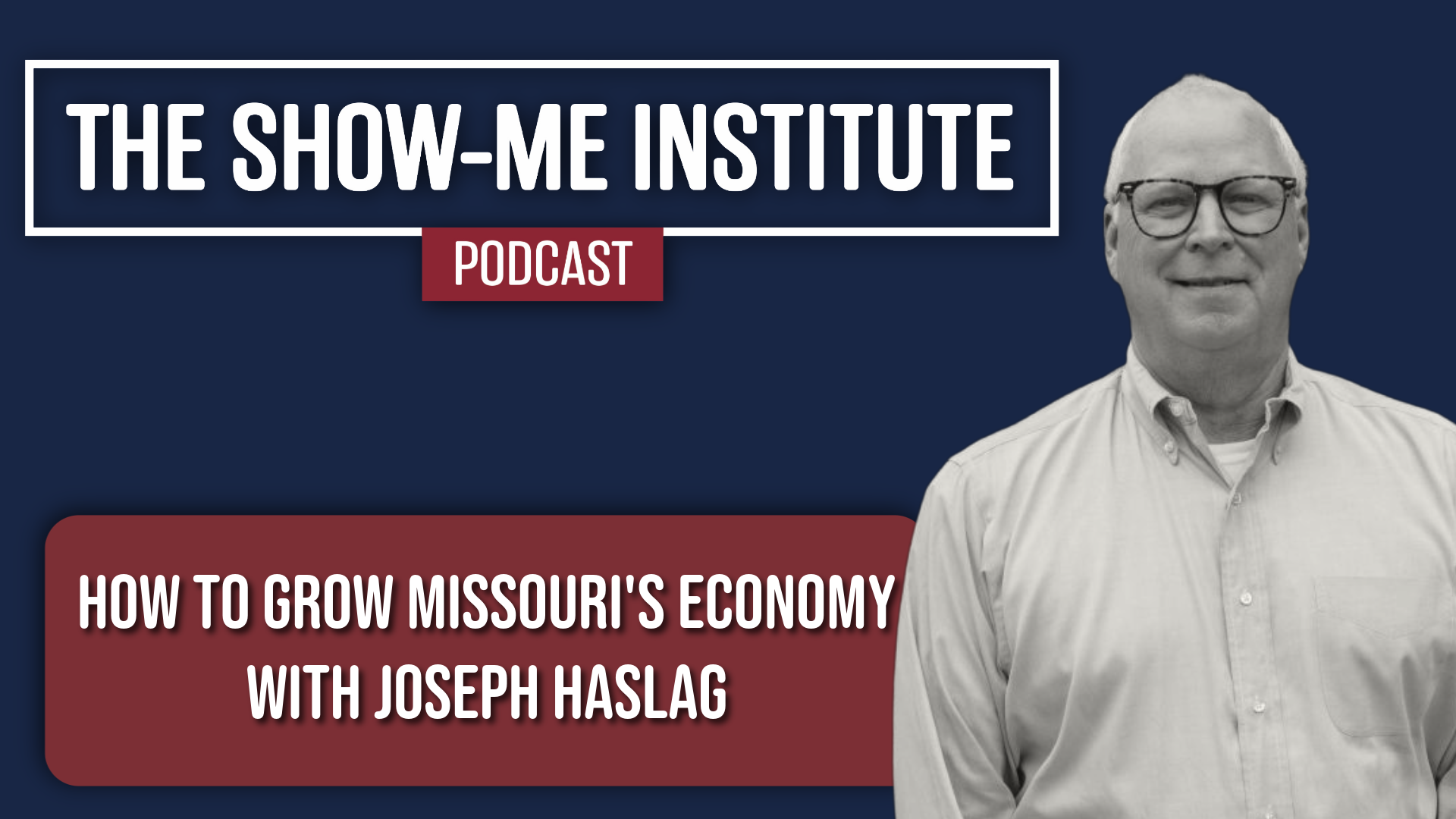
So great to be joined today by Professor Joe Haslag of Auburn University, formerly of the University of Missouri. You’re an expert on all things economic in Missouri, and you have a new paper for the Show-Me Institute about the Missouri economy. A lot of people when they think of the economy only think of the national economy and not the fact that states have economies too, with GDPs and all kinds of things that influence them, and not all state economies are the same. One of the things I was struck by initially in the paper is that Missouri is ranked 44th for GDP growth. What do you think is going on with that? Why has Missouri fallen so far?
Joe Haslag (00:52):
We couldn’t answer that question in half an hour, Susan. That’s a big one.
Susan Pendergrass (00:55):
Yeah, well let’s just give it a shot. Why have other states’ economies grown faster than ours?
Joe Haslag (01:03):
Well, Missouri has not been a center of innovation, and those things are hard to pin down. There are states that have grown really fast. Since air conditioning has become more accommodating and cheaper, we’ve seen some growth in the South, and there are states like Florida and Texas that have opted for faster growth and attracted a lot of people. So there’s always this question of are you talking about just the total economy and how it grows, or are you talking about the economy per person? Both matter and both are relevant measures depending on the story you’re trying to tell. At the heart of it, though, where growth comes from is not just from adding a bunch of people. If that were the case, we would have grown during the Middle Ages just from population growth. It’s not just about adding people and workers, it’s about the productivity of those workers, how much each one can produce. We’ve seen innovations: the tractor was an innovation compared to the horse and plow, and computers were an innovation compared to adding machines. And when you say 44th, that’s one of the critical things. Missouri is also 44th in the average rate of productivity growth per worker. We just haven’t been a source of super
Susan Pendergrass (02:26):
Sure.
Joe Haslag (02:54):
strength in that area. And I still say “we” because I was born in Missouri and spent a major chunk of my professional career at the university there. Until we change, and it’s hard, what you’d like to say is is there an easy path? Can we just do X, Y, and Z and guarantee it? No. There is no one thing that fits all. But what we do see is that people respond to incentives. What you’d like to set up is a business environment, a tax environment, and other kinds of settings that just make people take some chances. Some are going to pay off and some are going to fail, and you recognize that, but over time you see faster growth in those places.
Susan Pendergrass (03:41):
Yeah. You talk specifically about states in terms of labor productivity. States that invest in certain sectors of the economy, particularly construction, where productivity may be growing faster than other sectors. Is that something Missouri should do? Should we be placing bets on labor sectors?
Joe Haslag (03:57):
That’s a great question. The evidence in this paper is that industrial policy is not something that works very well. Trying to pick winners and losers is exactly the kind of thing we saw in the failed experiments of the USSR and some other places. We all talk about China’s explosive growth for a couple of decades. That wasn’t part of the planned economy. That was coming from the part where they just let loose their entrepreneurs and gave them the right environment, that word again, where they could take chances and succeed. So yeah, picking an industrial policy, there’s just no evidence that growth in one sector’s labor is going to give rise to faster productivity growth.
Susan Pendergrass (05:10):
Okay, so let’s look at a different lever that we’re talking about a lot in Missouri right now, which is reducing or getting rid of the income tax. It feels like a lot of states are trying to do it. And what if all the states around Missouri did the same thing? Would that have an impact on how much our GDP benefits from it?
Joe Haslag (05:29):
Sure. I mean, if we, first of all you said something interesting at the beginning. We think about the national economy, but you can draw borders around any area you want, a state, a city, a metropolitan area like St. Louis, and ask how they’re doing. One of the things that is remarkable is the biggest metropolitan area in Missouri has been stagnant for four or five decades. The population in the St. Louis MSA has been about two and a half million people for at least thirty or forty years. Where they live on the Missouri side or the Illinois side may fluctuate, but the total hasn’t changed. And the city of St. Louis proper has this weird status. Missouri has a unique thing where the city of St. Louis is its own county entity. And the city of St. Louis is
Susan Pendergrass (06:05):
Yeah. Right.
Joe Haslag (06:25):
almost becoming a ghost town. It went from a million people in 1900 to somewhere around 300,000 right now.
Susan Pendergrass (06:32):
Yeah. And they of course have the earnings tax. I can definitely see the counterfactual to this argument. I know people who live in states where they keep raising the income tax and piling on other taxes, Oregon comes to mind, and people are leaving. And we know that Texas and Florida, like you said, people are moving there and they don’t have income tax.
Joe Haslag (06:50):
I think it’s more to it than just the income tax rate, but the income tax rate is part of this package of incentives. Alone, the income tax is a pretty powerful thing, because it changes the returns to every kind of business activity, every kind of trade where we’re exchanging work or productivity or investment for something. Getting rid of the income tax, and there’s a piece in the paper where there’s actually an estimate, a projection of how much, based on the evidence across the country, getting rid of Missouri’s income tax would add to the growth rate.
Susan Pendergrass (07:32):
And how much would it add to people’s pockets?
Joe Haslag (07:33):
Well, the growth rate is about between a
Susan Pendergrass (07:35):
I mean, this is a number that people have been talking about in Missouri the last year. We get rid of the income tax, everyone will have $2,800 or $2,900 more. And your estimate is $2,900?
Joe Haslag (07:39):
Right around $2,900. And it takes a few years to get there, but the point is you get an immediate pop and then faster growth for the rest of the time.
Susan Pendergrass (07:57):
And you have a similar estimate if we improve our labor productivity. How do we go about doing that?
Joe Haslag (08:02):
You create incentives. Productivity still comes from what human beings do, what men and women in the labor force do. My incentive to innovate in a state where the income tax rate is eight or nine percent is a lot lower than it is in a state where it’s one or two percent,
Susan Pendergrass (08:06):
Yeah. Right. Yeah.
Joe Haslag (08:29):
simply because I get to keep more of what the risk produces. We often talk about business as us versus them. But at the heart of the matter, there are people out there saying, I want a better standard of living for myself and my family, and I’m willing to take some risk. I may start in my basement, or in an office with just two or three people. But if my idea is a winning idea, those people who started with me, the people I employ as I expand my business, sure, do I benefit? Yeah, I do. But I also took a lot of risk to do that. I could have fallen flat on my face and come away with nothing.
Susan Pendergrass (09:05):
Yeah. I think you make that point quite well where you talk about dividing up the pie versus growing the pie. You could grow the size of the pie and everyone could theoretically get a bigger slice of it. And I think that’s where people assume everything is fixed. In fact, in the data you were analyzing, we have both the Great Recession and COVID bookending it, and that has to have some impact on Missouri’s long-term growth trajectory, right?
Joe Haslag (09:26):
Yeah, it’s harder to discern. The financial crisis cleared out a bunch of stuff where people had taken risk, some of those were financial risks, and it spread to a bigger group of people. The Great Recession
Susan Pendergrass (09:48):
Did it muddy things up at all?
Joe Haslag (10:09):
It goes back to the idea of creative destruction. Sometimes you have a big destruction and it creates an opportunity for lots of creation. Did the financial crisis of 2008 give rise to the AI expansion? It might have sped it up.
Susan Pendergrass (10:12):
Yeah. Yeah.
Joe Haslag (10:26):
I don’t know for sure, but I think COVID probably had some impacts on that as well. Since we couldn’t be with one another and couldn’t get those spillovers from working together, we relied on computer hardware and software to do those things for us.
Susan Pendergrass (10:36):
Yeah. It was an engine of change in education because people started tutoring and teaching online, realizing you could get a tutor from across the country. It really opened up a lot of interesting new things that I’m not sure have completely sifted out, and I assume that’s true throughout the economy. In a lot of ways, necessity being the mother of invention, it increased productivity.
Joe Haslag (11:16):
No doubt. But I also think that what we’re seeing is the call by so many corporations across the country that, sure, you’ve worked five days a week remote for a couple of years, but we really want you to come back. We think it’s in our best interest as a corporation, for our shareholders, for those folks to be back in the office. Maybe four days a week instead of five, but there’s something about being together that creates possibilities for innovations as well. I’ll tell you a quick story. The semester after the University of Missouri got off of any sort of
Susan Pendergrass (11:38):
Mm-hmm. Yeah. Yeah.
Joe Haslag (11:55):
remote or semi-remote teaching, I was teaching an undergraduate class. That class is typically between 60 and 80 kids, an advanced course, mostly juniors and seniors. You can tell with senioritis, somewhere about 12 weeks into a 16-week semester, you’re down to somewhere between 60 and 70 percent attendance.
Susan Pendergrass (12:11):
Yeah. Yeah.
Joe Haslag (12:19):
That first semester back, it stayed close to 90 percent the entire semester, simply because they were dying to just be in the same room with each other. They recognized that there were spillovers from being in the classroom.
Susan Pendergrass (12:27):
Right. That’s interesting. So if you were given a magic wand and you wanted Missouri’s GDP growth to not be 44th, to be maybe top 25, what would you do with the Missouri economy to really kick-start it?
Joe Haslag (12:52):
I think two things. The easiest one is on the policy front: we just let the returns go back to the people. The tax rate in Missouri, I wouldn’t say it’s an abomination, but I just don’t think it’s been very helpful. But on top of that, our K-12 education, and this is going to appeal to you, has been an issue. We don’t have much competition. But I’m also going to put in a plug: I think Missouri has almost turned its back on higher ed.
Susan Pendergrass (13:20):
Yeah. You say this in the paper. Our educational attainment is tanking, right?
Joe Haslag (13:36):
Yeah. We just don’t have a commitment to it. The question I think would be most interesting is what would the St. Louis economy look like if Wash U wasn’t there? Wash U is an engine of innovation. There’s a lot of great things going on at the med school and the engineering school, and I think it’s just teaching people to learn how to think. Now those people end up going all over the world, but if there was a commitment to, I mean, the University of Missouri has lagged behind some of our Midwestern counterparts. Illinois, Michigan, Wisconsin are all suffering from the same straitjacket, which is that the amount of state funding they receive is down. But I’d also say Missouri is sort of doubly hurt because the state gives the university system whatever money they’re going to give, but then the university system is also controlled by the state in terms of how much they can raise tuition. So there’s no freedom to test what the market forces would look like. And at higher ed, maybe more so than K-12, spending per student at K-12 is not always the recipe for predicting success. However, at higher ed, because there are market forces that tend to work at a different level,
Susan Pendergrass (15:08):
It is not. Yeah.
Joe Haslag (15:19):
money and innovation tend to go hand in hand. Higher ed seems to be going through some sort of shift right now, and I’m not sure I understand exactly what’s going on with it. But if you were to tell me what the two big policies would be, I’m not saying the state of Missouri should spend more on higher ed, but they should loosen the purse strings and let those institutions compete with the market and see what they could do.
Susan Pendergrass (15:31):
Yeah. I think it’s one of the easier parts of the budget to cut. And as our revenue is going down, there seems to be a larger group of stakeholders in K-12: there are 520 superintendents and school boards. That’s a tougher one to cut than higher ed, and I feel like they’ve taken budget cuts.
Joe Haslag (15:55):
And maybe it’s not that the state should be paying the university systems more, but they should let them go. Let them set tuition rates at whatever they think is right. And if it doesn’t work and they fail, then you end up looking more like the University of Idaho than the University of Michigan in terms of how you’re contributing to the state economy. But
Susan Pendergrass (16:22):
Yeah.
Joe Haslag (16:37):
I think there are opportunities to exploit there and we just can’t seem to. There also seems to be this weird critical mass that’s important in higher ed. You have to have a bunch of people together who are all pulling the wagon in the same direction.
Susan Pendergrass (16:42):
Yeah. Well, we also have declining enrollment. Fewer kids coming up. I think we had our largest graduating high school class last year or the year before, so that’s going to make it tough. So just to clarify,
Joe Haslag (16:59):
Yeah.
Susan Pendergrass (17:03):
if Missouri were able to move its income tax rate down close to zero, you, based on your research, feel confident that Missourians would have more money in their pocket?
Joe Haslag (17:12):
More than confident. I think it’s unambiguous. The math is pretty straightforward. If you have a hundred-dollar paycheck and your taxes go from five percent to two percent,
Susan Pendergrass (17:15):
Okay. You heard it here.
Joe Haslag (17:35):
it was my pleasure. Susan, it’s always good to see you and cross paths. I wish I could be there on the ground and have all those conversations I had fifteen years ago when we were talking about this. Thanks for your service.
Susan Pendergrass (17:44):
We’ll welcome you back. Thank you so much. Appreciate it.
Amendment 5 would require the legislature to phase out the state income tax over time, with the pace of reductions tied to revenue-growth triggers. Amendment 5 would also allow lawmakers to reform Missouri’s sales tax system, require that any sales tax changes that increase state revenues be used to reduce the state income tax on at least a dollar-for-dollar basis, require local governments to reduce other local taxes if changes to the sales tax increase local revenues, and prevent the income tax from being reinstated once eliminated.
2. What decisions would Amendment 5 leave for future lawmakers?
The amendment itself does not change the sales tax, make any goods or services taxable, or determine how quickly the income tax must be eliminated. The details of the revenue-growth triggers and any possible changes to the sales tax base would need to be established in statute through the normal legislative process.
3. Why is Missouri considering this proposal?
Missouri has experienced slower population and economic growth than much of the country in recent decades. IRS migration data show that Missouri loses hundreds of millions of dollars in income to other states each year through domestic migration. Amendment 5 reflects an effort to reverse those trends by reforming the policies that affect where families and businesses choose to locate.
4. Why does state tax policy matter?
States are in a national competition for families, workers, businesses, and investment. States with no income tax, like Tennessee, have seen stronger population and economic growth than Missouri in recent decades. If Missouri hopes to improve its economic trajectory, examining what high-growth states are doing differently is a logical place to start.
5. Why eliminate the income tax?
Decades of academic research conclude that taxes on income are more harmful to economic growth than taxes on consumption because they reduce the rewards for work, entrepreneurship, saving, and investment.
6. Why does Amendment 5 authorize changes to Missouri’s sales tax system?
Missouri’s primary sources of tax revenue are income and sales taxes. If income tax rates are reduced over time, the structure of Missouri’s sales tax system becomes increasingly important. Missouri’s sales tax system was designed for an economy centered on the sale of physical goods, but consumers now spend a larger share of their earnings on services and digital purchases, leaving a system full of exemptions and carveouts that no longer reflect the modern economy. Amendment 5 would allow lawmakers to modernize that system while phasing out the income tax.
7. Why does the amendment change constitutional limits on taxation?
Missouri’s Constitution currently prohibits lawmakers from expanding the sales tax to goods and services that were not taxable in 2015. Amendment 5 would remove that restriction, allowing lawmakers to modernize the sales tax system. Separately, the 1996 update to the Hancock Amendment requires voter approval when lawmakers increase net state tax and fee collections beyond a certain threshold in a single year. Amendment 5 would also exempt new sales tax revenues from that threshold for five years, but only if any additional state revenue generated is paired with corresponding income tax reductions.
8. Would eliminating the income tax require much higher sales tax rates?
Amendment 5 does not mandate any future sales tax rates or require lawmakers to broaden Missouri’s sales tax base. Broadening the sales tax base by taxing additional goods and services or by reducing exemptions and carveouts would affect the sales tax rates needed to raise a given amount of revenue. Any additional state revenue generated by those changes would be used to reduce income taxes, as required by the text of the amendment. Estimates projecting very high sales tax rates typically assume Missouri’s current sales tax base remains unchanged and that the income tax must be replaced all at once. Amendment 5 makes neither of these assumptions.
9. How could local governments and taxation be affected?
Missouri’s local governments are among the most reliant on sales taxes in the country. If state lawmakers broaden Missouri’s sales tax base, local sales taxes would apply to those newly taxable items as well. If those changes increase local revenue, Amendment 5 requires local governments to reduce other local taxes by an equivalent amount. Local officials and statutory enactments would determine whether those reductions come from property taxes, sales taxes, earnings taxes, or other local taxes.
10. Could Amendment 5 create a hole in Missouri’s budget?
Amendment 5 is designed to prevent such a scenario. It requires income tax reductions to be tied to growth in state revenues, requires any sales tax changes that increase state revenue to be paired with offsetting income tax reductions, and, importantly, does not establish a fixed timeline for income tax elimination.
11. How is Amendment 5 different from the Kansas tax cuts?
Kansas reduced income tax rates immediately, created new tax preferences, and did not pair those changes with spending reductions or other offsetting measures. Amendment 5 takes a different approach on all three fronts. It phases out the income tax gradually, does not create new tax preferences, and requires any sales tax changes that increase revenue to be accompanied by corresponding income tax reductions.
Have a safe and happy Fourth of July from all of us at the Show-Me Institute.
Support Us
The work of the Show-Me Institute would not be possible without the generous support of people who are inspired by the vision of liberty and free enterprise. We hope you will join our efforts and become a Show-Me Institute sponsor.