New Show-Me Institute Video About Olivette TIF

In 2000, Olivette officials debated a major tax subsidy for a new retail center. The subsidy was in the form of Tax Increment Financing (TIF) and the proposal was put before the voters. It was defeated in a referendum, and today, it remains one of the only examples of a defeated TIF in Missouri. Back in the late 1990s, the TIF supporters made all the same arguments we hear with every TIF: “This is the only way to revitalize our community” and other such falsehoods. Recently, the Show-Me Institute decided to investigate what happened in one of the few places where an enormous TIF was rejected.

The area that was supposed to be razed, with “help” from eminent domain, using TIF in 2000 is doing just fine in 2013. There are new homes and new businesses, all without subsidies. Most importantly, the residents and the neighborhood are still in good shape. That situation was not made any easier 15 years ago, when the entire community was in fear of being bought out (or taken) and torn down for a Walmart.

Check out our newest video about the Olivette TIF proposal here. Communities are strongest when individuals are empowered, not government planners and subsidized developers.

The Tax Subsidy That Wasn’t

In the 1990s, private developers partnered with members of the Olivette City Council to endorse the implementation of a $38 million in the area just west of the intersection of I-170 and Olive Blvd. Due to the threat of eminent domain and several years of unresolved negotiations, local homeowners were left in the lurch about the status of their property. Finally, in 2000, Olivette residents voted in a referendum against the project with a margin of 53.5 to 46.5 percent (absolute numbers are 1,656-1,435) to defeat the TIF proposal.

Supporters of the TIF proposal argued that it was the only way for Olivette to compete and generate new tax revenues. At the time, the
Riverfront Times reported on the debate about this tax subsidy
. After the TIF was defeated, what happened? Were the TIF supporters correct? Was a taxpayer-subsidized mega-project the only way to save the area?

Not surprisingly, the TIF supporters were completely wrong. By letting the free market have control over real estate development, the area has experienced a period of sustainable economic progress and revitalization. A bustling Chevys Fresh Mex restaurant continues to thrive. A CVS Pharmacy that opened in 2009 was built without public subsidies. Most notably, the area’s previously existing homes are well maintained, and a new, post-TIF, housing development?— The Villas at Hilltop?— offers upscale townhome-style living. 

Rather than enduring the forfeiture of tax revenues, as would have occurred under the TIF proposal, these properties naturally generate income for local government services instead. The Chevys, CVS, and Villas together are appraised for a noteworthy $11,329,300 and paid $212,355.48 in property taxes in 2012. Additionally, between the years of 1993-1995 and 2005-2007, Olivette’s average sales tax receipts increased more than 143 percent ($1,022,382 to $2,487,038) and its total share of the state’s tax receipts largely stayed the same as well, at about 0.5 percent. The private land developers and their allies on the Olivette City Council warned that TIF funding was absolutely necessary in order to stimulate economic growth. But does this area look blighted to you?

More from the Show-Me Institute on Tax Increment Financing:

Save Gordon Parks Elementary School

Gordon Parks Elementary School, a charter school in Kansas City, has abysmally low achievement scores. In 2012, just 13 percent of students scored proficient or advanced on the state’s communication arts exam and 17 percent in math. For this reason, among others, the State Board of Education, at the behest of the Missouri Department of Elementary and Secondary Education (DESE), voted to not renew the school’s charter. The decision of DESE and the State Board to close Gordon Parks may sound reasonable, there is just one problem — it may not be their decision to make.

That is the argument of the Gordon Parks School Board and Doug Thaman, executive director of the Missouri Charter Public School Association. In a recent Missouri Times article Thaman said:

Our concern is that this action overstepped authority. It’s the responsibility of the sponsor of the school to make a decision whether it’s renewed or closed. There was no indication to University of Central Missouri about the closing or information that they weren’t conducting evaluations correctly.

You see, in Missouri, colleges and universities sponsor charter schools. It is up to these institutions to evaluate their charter schools and to revoke their sponsorship if they are not performing or improving.

I certainly don’t believe low-performing schools should remain open. (For the record, there are five traditional public schools in the Kansas City District that performed lower than Gordon Parks in communication arts and nine that performed lower in math.) However, that decision is best decided by the school’s sponsor and by the individual choices of parents and students, not bureaucrats in Jefferson City. After all, it is the parents, students, and the school sponsor who benefit or are hurt due to the school’s performance. Therefore, it is the parents and the sponsor who should have the final say in closing the school.

The courts likely will settle this case; still, the damage to Gordon Parks is most likely done. Many of the students and staff have already left. The court decision, however, could set an important precedent for charter schools in Missouri. It would either give greater authority to the state to close charter schools or reserve that right for the charter school’s sponsor. I hope it’s the latter.

In Case There Were Any Doubts About The ‘Growth Corridor’ We’re In, Here’s Another Data Point

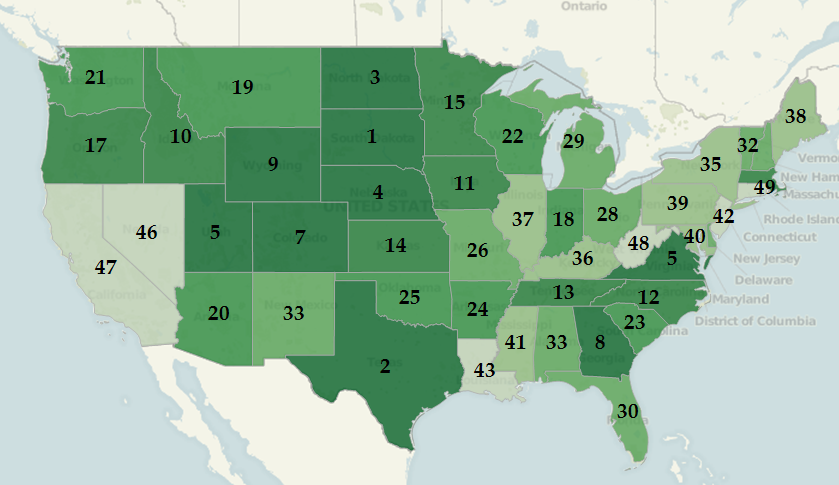
Today, Show-Me Institute Research Fellow Rik Hafer wrote in the St. Louis Beacon about a recent CNBC business survey and how Missouri did. The result: Missouri ranked just on the bottom half of the list in 26th place. Now, “about average” wouldn’t be so bad normally, but as we’ve noted before, Missouri finds itself near the epicenter of the Midwestern growth corridor — where “average” simply isn’t good enough. CNBC’s survey demonstrates the existence of the corridor yet again.

The top four states in CNBC’s survey are right in the middle of the growth corridor: 1. South Dakota, 2. Texas, 3. North Dakota, and 4. Nebraska. And make no mistake, not all of these states were always ranked so high. As far back as 2008, Nebraska’s CNBC ranking was tracking closely with Missouri’s. But then . . . it wasn’t. Nebraska moved into the top five nationwide; meanwhile, Missouri fell further behind. Kansas is always cited as a reason Missouri should be working hard to make itself more attractive to business, and that remains an obvious argument. But Missouri’s economic problems do not begin and end with Kansas, as the Nebraska example bears out. A broader picture of the region that includes only our immediate neighbors should also concern Missourians: Of the eight states that border Missouri, only two are ranked worse — Illinois and Kentucky, both on Missouri’s eastern border.

Now as we always note, your mileage will vary with these surveys, but as Hafer notes, when just about all of them are showing basically the same thing, it makes Missouri’s economic problems all the more clear.

Should we care about such surveys[?] When they converge, yes. CNBC’s ranking corroborates Forbes magazine’s 2013 ranking analysis that placed Missouri at 29. And a report from CNBC earlier this year showed that using data from the National Association of Manufacturers, Missouri did not even make the list of 20 states with the highest manufacturing job creation since the end of 2009. Notably, Illinois, Iowa, Kansas, Kentucky and Tennessee all made the list.

Will Missouri continue down a path of mediocrity? It will unless its leaders — both political and business — grapple with those issues over which they have some control to change in a manner that enticed businesses to start or relocate to our state. Education and tax policies seem like a good place to start the discussion.

Missouri has been headed in the wrong direction for far too long. It’s time to change course.

False Pride: Missouri’s Governor Shouldn’t Be Boasting About “Low” Unemployment

As first appearing in the Weekly Standard on July 7th, 2013 (a slightly different version ran in the July 14th Columbia Tribune):

It is perhaps the best known of all of Mark Twain’s quotes – “There are lies, damned lies, and statistics.” It would be hard to find a better illustration of that line than the misuse of unemployment statistics in Twain’s home state of Missouri.

After peaking at 9.6 percent in July of 2009, Missouri’s unemployment rate fell three full percentage points—to 6.6 percent—at the end of 2012. That compares to a 1.7 percentage point decrease in the national unemployment rate.

To hear Missouri Gov. Jay Nixon talk, you might think that Missouri’s economy is booming. “Missouri families and businesses are reaping the benefits as our economy continues to grow,” Nixon said in early June, citing 44 consecutive months in which the state’s unemployment rate has been at or below the national average. “In every corner of our state, businesses large and small are deciding to invest and expand.” Though Missouri’s unemployment has ticked back to 6.8 percent, it remains below the national average of 7.6 percent.

But Missouri is not blazing a path for other states to follow. To the contrary, it ranks near the bottom of all states in job creation. In this regard, the Show-Me State serves as a textbook example of the fallacy of thinking that a large drop in the unemployment rate must be synonymous with a corresponding increase in business activity and employment.

From 2010 through 2012, total employment in Missouri grew a trifling 1.8 percent, compared to 4.1 percent for the nation as a whole. Thus, Missouri considerably underperformed the rest of the nation in job growth—even as it seemingly excelled in dealing with the scourge of high unemployment.

You will not find any stories in Missouri newspapers trumpeting the state’s economic performance. Whatever the governor might say, most Missourians are well aware of the state’s inability to keep pace with its neighbors in business and job creation. In the past three calendar years, Missouri ranked dead last among Midwestern states (counting Missouri and the neighboring states of Kansas, Nebraska, Iowa, Illinois, Tennessee, Kentucky, Arkansas, and Oklahoma) in growth of both employment and GDP.

So why the disconnect between the good numbers on unemployment and the bad numbers on GDP growth and employment? The answer lies in a far-from-vibrant workforce. This goes beyond the fact (and it is a fact) that job growth in Missouri has failed to keep pace with population growth. Over the past three years, tens of thousands of Missourians have quietly exited the labor market. And that has had the effect of lowering the state’s unemployment rate.

In the Bureau of Labor Statistics way of calculating unemployment, able-bodied people without jobs are not counted as unemployed if they have stopped looking for work. What the BLS calls the “labor force” is the sum of total employment and total unemployment, and people who are eligible for employment but do not seek it are neither fish nor fowl—neither employed, nor unemployed.

From July 2009 to April 2013, the number of unemployed people in Missouri fell by 96,000. But the number of employed people rose by only 26,000—which means that some 70,000 people (the difference between the two numbers) dropped off the grid—in neither working nor actively seeking work.

Who are these dropouts? I can easily think of a dozen of them in my own circle of friends and family members. They include non-working sons and daughters of affluent parents who have discovered they, too, qualify for food stamps and other forms of welfare, extended by the government or their own parents. They include doctors, lawyers, and other business or professional people who have retired or quit working earlier than they might otherwise have done—as a result of the combination of unhappiness at their former jobs and seeing no possibility of finding other, better employment.

In the previously mentioned time period, the labor force participation rate in Missouri (the labor force divided by the labor-eligible population) fell from 66.6 percent to 64.0 percent—a drop of 2.6 percentage points. That compares with a 2.2 percentage point drop in the participation rate nationally over the same time.

The disappearance of 2.6 percent of the workforce is no small thing. Without it, Missouri’s unemployment rate, instead of falling three points, would have increased 0.7 points to 10.3 percent.

The Show-Me State did not, in any real sense, add jobs to bring down what counts officially as the unemployment rate. Rather, it shed workers. And that is nothing to cheer about. It is a sorry reflection on the large number of people who have given up hope of finding a job.


Andrew Wilson is the resident fellow and senior writer at the Show-Me Institute, which promotes market solutions for Missouri public policy.


No Soup For You: Nixon Wants ‘Project-by-Project’ Tax Cuts, Not Tax Cuts For All

It’s always remarkable to see politicians who are against general tax relief exalt the arrival of businesses attracted . . . by tax incentives. After all, a tax break is just a tax cut, albeit for some extra-special, often politically connected individual or industry.

And that’s precisely what happened yesterday in Kansas City, when Missouri Gov. Jay Nixon — who recently vetoed the Broad-Based Tax Relief Act — was on hand to celebrate the opening of Freightquote’s new office in south Kansas City. Freightquote, as you may remember, was attracted from Kansas to Missouri with more than $60 million in state and local tax incentives, which begs the question: If Freightquote can get crazy tax breaks like that to move from Lenexa, Kan., a short, leisurely drive down I-435, why can’t we all get a little tax relief?

The short answer: we’re not special enough.

Tax cuts should be pursued on a “specific project-by-project basis,” [Nixon] said. “We need to come at this in an overall thoughtful way, not just throw darts.”

Giving tax cuts to everyone is “throwing darts,” but picking a few projects for special tax breaks is . . . “thoughtful”? What is this, newspeak? How is giving special, targeted tax breaks not “throwing darts”? And what makes the governor think the government’s more thoughtful and better at throwing darts than the marketplace, where poor decisions are rewarded with foreclosures and bankruptcies, not press conferences and ribbon cuttings?

He then rejected tax cuts for all Missouri residents, or what he called an “across the board tax experiment.”

Catch that? Tax breaks are OK, but they have to be government-approved tax breaks for special tax-break recipients. Tax breaks for the rest of us, the hoi polloi in the market, are an “experiment.” We apparently throw darts; the government is “thoughtful.”

Amazing to hear this sort of stuff in, of all places, the Show-Me State. You deserve better than this.

School Transfers, Follow The Money (Part 2)

Right now, there are so many unknowns when it comes to the issue of student transfers from unaccredited school districts. How many students will leave Riverview Gardens and Normandy? What schools will they attend? How much tuition will the districts pay? Etc., etc., etc. The one thing we know for sure is that the two districts the unaccredited districts will be providing transportation to — Francis Howell and Mehlville — do not seem excited to have been selected.

Many are still asking why these two unlikely districts were chosen. In my last post, I pointed to the most obvious reason — money. The unaccredited districts have to pay tuition to the accredited districts that accept their students. Therefore, they have every incentive to persuade their transferring students to attend a district that spends less than they spend in their own district.

Some question whether money could really explain the unaccredited district’s rationale and encouraged me to look at academics. For that reason, I present the table below. In this table, I present the percentage of students who scored proficient or advanced on state exams in English language arts and mathematics. Once again, I provide the current expenditure per pupil.

STL area schools panda2012

As you can see, the Mehlville and Francis Howell school districts clearly perform better than the two unaccredited districts. However, they are far from standouts in this regard. In fact, eight school districts outperform Francis Howell and 11 (including Francis Howell) outperform Mehlville. Of those higher performing districts, none spends less than Mehlville and only two spend less than Francis Howell.

I certainly cannot rule out academics as one of the deciding factors in determining where to provide transportation, but it seems clear that it was not the deciding factor.

Budget Action In Search Of A Crisis

Three weeks ago, Missouri Gov. Jay Nixon announced that he would withhold slightly more than $400 million from the state’s 2014 budget. His action was supposedly due to the “significant costs” of the Broad-Based Tax Relief Act (BBTRA), which he recently vetoed and the legislature may try to override this fall. The governor’s full restriction list is here. It includes more than $66 million carved from the Department of Elementary and Secondary Education, more than $43 million from the Department of Higher Education, and more than $17 million from the state park system. The governor has also sought out a road map to eliminate 1,000 state positions if the tax cut is resurrected.

It seems the governor wants as many people to know about, and feel, these cutbacks as possible. However, the budget facts paint a far less dire picture than the one the governor has sketched out, and to which he is presumably reacting. As the Associated Press‘s David Lieb noted:

. . . Nixon announced more than $400 million of spending restrictions for education, building projects and other government services, even though Missouri began its fiscal year July 1 with a cash balance of around $450 million.

The state apparently has more money in the bank than Nixon has set aside from the budget to supposedly avert a budget deficit. And that’s before we even start talking about the BBTRA, which the governor claims is the driving factor behind his cutbacks. Indeed, with all impacts on the budget included, the fiscal note on the cost of the BBTRA suggests the tax cut would decrease state revenue by about $200 million in 2014 — which is far short of the $400 million the governor withheld.

The state’s education system and other programs are the ones that get hit hard because of the withholding, for seemingly no good reason. The money in the bank doesn’t justify it, and the price tag of the tax cut doesn’t justify it. I’m not so sure Missouri’s schools appreciate their funding being held hostage in the governor’s fight with the legislature, especially when the facts don’t justify the cutbacks.

‘This Is What Airports Do,’ Part 2

The chart below documents the estimated amount of tax dollars lost because of Kansas City International Airport (MCI) acting like a private property developer.

We know that government departments such as the airport do not pay taxes. This is also true for tenants on airport land. According to Karbank Real Estate Co.,  which competes against the taxpayer-subsidized airport, the assessed value of the Blount International facility on airport land is slightly more than $7 million, or one-third the appraised value. As a result, the affected tax districts have lost almost $650,000 in annual tax revenue. The Park Hill School District alone is denied $380,000; Kansas City proper loses slightly more than $107,000; Mid-Continent library loses $22,000.

Of course reading this, you might think that officials in Platte County — the county in which the airport is located — are up in arms about this deal because they are losing thousands of tax dollars to an airport that undercuts private taxpaying developers. But you’d be wrong. The Platte County Economic Development Council not only supports the airport in the past deal, but also in the current plan for a new terminal. Heck, Alicia Stephens, executive director of the Platte County EDC, supports the new terminal project and the mayor appointed her to the Airport Task Force!

But don’t worry about Stephens losing her job for supporting deals that cost Platte County dearly. Her boss, the chairman of the Platte County EDC, is none other than Mark Van Loh — the head of the Kansas City Aviation Department, whose developments are robbing Platte County of tax dollars.

Reasonable people are left with two compelling questions: How can Stephens credibly serve on a task force in which she will be asked to pass judgment on a proposal by her boss? And why does Platte County tolerate its EDC chairman having such a clear and significant conflict of interest?

Here is a table Karbank compiled that provides a breakdown of tax revenue NOT being paid on property that the airport developed:

TAX DISTRICT LEVY PER $100 TOTAL
State Blind Pension Fund 0.0300 $2,105
County 0.0200 $1,403
Health 0.0800 $5,613
Board of Services for Handicapped 0.1299 $9,114
Mental Health 0.1000 $7,016
Mid-Continent Library 0.3200 $22,451
Senior Citizen Levy 0.0500 $3,508
Park Hill School District 5.4133 $379,797
Platte City Special Road District 0.2150 $15,084
Kansas City 1.5294 $107,303
Kansas City Community College 0.2329 $16,340
M&M Replacement Tax 0.3600 $25,258
Kansas City Traffic Way 0.2500 $17,540
Kansas City Parkway 0.5000 $35,080
TOTAL $647,612

Not satisfied with giving away the house on rent and taxes, the Aviation Department signed a lease agreement that stipulated, (emphasis added):

In the event that ad valorem real property taxes are assessed against the Premises, the bonus value of this Lease, the Infrastructure Improvements or any component of the Premises or the leasehold estate created by this Lease (“Taxes”) and paid by Lessee, City shall either pay Lessee an amount equal to such Taxes or credit such amount against Rent owed to City by Lessee.

In other words, Kansas City is on the hook for any taxes owed on the property should the abatement end. And it might. Karbank is suing the airport over the matter, alleging that the agreement, which they claim is effectively 100 percent abatement  in perpetuity, is unconstitutional. Whatever the results of the lawsuit, MCI needs to act like an airport, not Donald Trump.

Support Us

The work of the Show-Me Institute would not be possible without the generous support of people who are inspired by the vision of liberty and free enterprise. We hope you will join our efforts and become a Show-Me Institute sponsor.

Donate
Man on Horse Charging