Lindbergh Crowd Halts Scripted Common Core Meeting

Common_Core_Meeting_May2_Lindbergh

Officials from the Missouri Department of Elementary and Secondary Education (DESE) are finding out that it might not be easier to ask for forgiveness than for permission, at least not when it comes to the Common Core State Standards. DESE adopted the standards without public knowledge and last night, officials from DESE attempted to justify their decision with a one-sided presentation. Many concerned citizens and parents, however, were not interested in listening to DESE’s Common Core gospel.

At the meeting I attended at the Lindbergh School District, citizens showed up with questions; DESE officials showed up with scripts and videos. The plan was to divide the crowd into small groups so we could discuss the standards. They even provided a form for us to write down what we like about the standards and what we dislike. That plan may have worked at other meetings, but the folks at Lindbergh demanded to be heard.

The DESE officials seemed shocked when patrons who wanted to be heard continually interrupted the presentation.

One lady sitting near me said, “Can’t you deviate from your script?”

Another shouted, “This goes against teaching.” She was implying that the officials should have been willing to take questions, like a good teacher would during a lesson.

After the crowd’s continual pestering, and the crowd’s refusal to separate into small groups, the DESE officials began fielding questions. Of course, they were not answering the questions, just listening to them.

The concerns were myriad, ranging from questions about data collection to issues of local control.

I asked two questions:

  1. How is this not an unfunded mandate? It will cost districts money to implement the new standards and to purchase all of the technology needed for the tests. If the legislature did this without providing additional funds, it might be a violation of the Hancock Amendment. What is the difference if DESE requires additional spending, but does not provide additional resources for school districts?
  2. There is so much double-speak. On one hand, you say these are just standards, they do not tell teachers how to teach. Then in the next sentence, you say that this is changing what teachers are doing in the classroom. How can it be both?

Though I liked my questions, I think the best came from a gentleman in the back of the room. He asked, “Why are you surprised by this response?” He was asking what many were thinking. As a school board member from a district in Franklin County shouted, “We’ve seen these videos.” In fact, many of the people at the meeting had read the information on the script and they had watched the videos on the website.

What the parents wanted was to be heard, not to have the Common Core force-fed to them.

Missourians deserve a fair discussion; they deserve a true debate of the issues. Instead, DESE officials have made up their mind. That is apparent in the statement that Missouri State Board of Education member Mike Ponder made: “I know that people can have a difference of opinion on the matter, but the idea behind the Common Core is here to stay.” In other words, we are doing this whether you like it or not.

If Missourians want a true dialogue on this issue, it will have to come from the people.

To learn more about the Common Core, I encourage you to visit:

Why we need school choice (An essay detailing my personal story. It links math instruction, Common Core, and school choice).

What is so common about the Common Core (Blog)

DESE should consider district level waivers (Blog)

Missouri should avoid implementation of the Common Core (Testimony)

Constructive Criticism for Common Core Constructivism Deniers (on Jay P. Greene’s Blog)

Gunning For Tax Breaks

It appears the Missouri House is set to approve a bill that would grant a tax break to gun manufacturers (hat tip: John Combest). My first reaction was that this is a stunt. Yet, worse ideas have come out of the Missouri Legislature so maybe the House is for real.

Stunt or not, this is a bad idea. According to the bill’s own sponsor, gun companies are moving because of strict gun regulations. There is no mention of the tax environment. No matter one’s opinion regarding gun control, giving tax dollars to companies that do not need them does not make sense. It is not like other tax credit programs have covered themselves in glory.

If the state really wants to make Missouri more appealing to all businesses, including gun manufacturers, it should eliminate business income taxes. That would be too simple, though, wouldn’t it?

The first step in overcoming a problem is admitting it exists. The state seems to give at least lip service to that via the Tax Credit Review Commission. But just when you think there might be hope to get our tax credit problem under control, you see stuff like this. Hopefully, this will not actually become law, but who knows at this point?

Missouri Assessments Need Greater Consistency

As Missouri enters its bi-annual reassessment process, I think people would be surprised to know just how substantial the difference in taxation is between different types of land. In Chesterfield (a wealthy suburb of Saint Louis where they still have some farms) there is a 56-acre agricultural parcel along the Missouri River that paid only $87 in taxes in 2012. A neighboring 59-acre parcel assessed as commercial land paid 42 times more than that in taxes: $3,651. Even more dramatically, a friend of mine paid more than $7,400 in taxes for 4 acres of residential property nearby. How did this difference become so dramatic? How does 56 acres pay $87 while 4 acres plus a home pays 85 times more than that?

Our state needs to confront the issue of underassessment in rural Missouri. Throughout Missouri, some of America’s best farmland is assessed and taxed at an incredibly low rate. The United States Department of Agriculture calculates all the agricultural property in Missouri at a market value of $74 billion. According to the Missouri State Tax Commission (STC), however, that same land has a taxable value of just $1.7 billion. That means we are setting taxes based on 2 percent of market value. The STC has attempted to partly address this by increasing set assessments for farmland, but the legislature has prevented such action.

Unlike residential, commercial, or even unused agricultural property, Missouri law does not base farm appraisals on market prices. Actively farmed land is appraised and taxed based on a state grading system, not assessment practices. Not surprisingly, that grading system sets assessments that are extremely low. For example, Missouri’s farmland has an average market value of $3,340 an acre. But the best farmland in the state can be valued — at most — at $985 an acre for purposes of taxation. For pastureland, the average value in Missouri is $1,820, but the most it can be valued for taxes is just $195. If your home or business is worth $100,000, it is supposed to be appraised at $100,000. Only farmland gets automatically set at a discount.

Then it gets even more extreme. An assessment ratio is then applied to the value of all property. That ratio is 32 percent for commercial property, 19 percent for residential property, and 12 percent for agricultural property. Your $100,000 home appraisal pays taxes based on an assessment of $19,000. But your $5,000 acre of prime farmland is valued at only $985, and then pays taxes on 12 percent of that, a value of just $118. That is how you get 56 acres of land paying only $87 in taxes.

Why does this matter to the average taxpayer? My purpose here is not to complain about low taxes. In fact, I like low taxes and I do not think farmers should pay high taxes. But if local government in Missouri is going to be primarily based on property taxation, then the system needs to be consistent and fair to all.

Low farmland assessments lead to low property tax bases for rural school districts. That would be fine if it simply meant that rural schools received less and spent less, and it only affected rural residents and children, in accordance with their wishes as voters and taxpayers. However, our statewide school funding formula attempts to equalize school funding. Low rural tax bases mean that income and sales taxes that people pay elsewhere in Missouri, and especially in the heavily populated, high-income portions of Saint Louis and Jackson counties, have more of their taxes transferred to rural schools. What we essentially have is an established system where rural areas pay low taxes yet the suburban taxpayers of Saint Louis and Kansas City subsidize their schools. Ensuring that rural schools have access to adequate education funding is necessary, but the people with high assessments and high taxes should not be subsidizing a system designed around low assessments in the first place.

Missouri needs greater consistency in appraisals and assessments. Market prices should be given a greater role in farm appraisals and assessments, like other types of real property. At a minimum, the new grading system with higher assessment amounts that the STC set should be adopted. If we are going to rely on a system of property taxes, we need to make it a more accurate system.

David Stokes is a policy analyst at the Show-Me Institute, which promotes market solutions for Missouri public policy.

Remember That Residents Are Customers

One of the reasons I shop on Amazon almost weekly is because of the company’s impeccable customer service. (I also like that I can read reviews from strangers on everything before I buy, allowing them to justify my purchases when they say, “This is the best EVER, you need this!”)

Successful business owners will tell you that paying attention to their customers’ needs is ultimately what drives the business. Yet, sometimes customer desires can be pushed aside, even when they are observable and understandable.

There is strong opposition to the proposed new Kansas City Airport terminal, from both Kansas City residents and politicians. A recent poll showed that two-thirds of respondents were opposed to a single terminal, and groups such as Save KCI are getting involved in the discussion. Despite the vocal opposition, however, the city supports moving forward with a study to lay out plans for the new terminal.

If the study were coming from a completely unbiased source, I would say, study away. But many times these studies report what the strong political interests want, instead of truly depicting the best options for a project.

This case is different from some other public projects because ultimately, the success of the airport depends on how many people use it. If the new terminal is not user-friendly and travelers do not like it — they are less likely to fly as often. Right now, people love the convenience of the airport. If it becomes a hassle to fly, the city must remember that people do have other options. It is counteractive to waste billions, as we did in Saint Louis, on a new terminal that attracts less business than the supposedly outdated one.

Better Bottom-Line Fuels Budget Battle

Because of increased revenue, the state of Missouri looks like it is on track for a surplus by the end of the current fiscal year. Great! Now the question is, what to do with it? The House and Senate are going back and forth on what to do with any projected surplus. Hopefully it is not plugged into the operating budget, but anything is possible. Of course, I have a modest suggestion.

How about using some of that surplus to pay off the state’s pension liabilities? The Missouri State Employees Retirement System (MOSERS), for example, has an unfunded liability of more than $3 billion (it is really much larger than that, but for the sake of argument, let’s go with the official numbers). Even if the state moved to a defined contribution (DC) plan immediately, the current liabilities in the pension remain.

Unless there is some kind of economic miracle between now and June 30, the surplus will not be $3 billion. However, a little money invested now can yield large savings in the future. Even using a 4 percent discount rate, a $100 million investment today will be worth more than three times as much in 30 years. It is the same principle as putting a larger down payment on a house. The larger up-front payment will mean lower total spending on the mortgage as a whole. That is a savings for future taxpayers.

A state surplus would be a good thing, but the state has an obligation to use any surplus responsibly. Helping to make sure our pensions are funded is a worthy goal and one worth pursuing.

Kansas City Thinkin’ About A Charter Change

Tony’s Kansas City has had the story about some in Kansas City who are considering changes to the city charter in order to strengthen the role of the mayor. This is as good an opportunity as any to remind people of all the work we have released on the issue of local government in Kansas City.

My main charter recommendation for Kansas City government is to remove the peculiar designation that makes each at-large councilmember also represent one of the council districts. There are benefits to at-large elections (lower overall spending), but they are reduced if you make at-large officials also represent a district. Just let the at-large reps serve at-large and the district reps serve the districts.

It will be interesting to see what concrete proposals come out of this. Will the role of the mayor be increased at the expense of the council or the city manager? It is basically impossible to implement a true “strong mayor” system like Chicago (or, for a Missouri example, like Florissant — neither is really a good comparison) and maintain an influential city manager. But there certainly can be smaller steps taken to strike more of a balance. I cannot wait to hear what those steps may be.

Ethanol Subsidies Should Be Eliminated

Give Ryland Utlaut points for audacity in his commentary in favor of the Renewable Fuel Standard (RFS). Seeing an ethanol producer rail against “special interests” is like watching members of the Kardashian clan object to reality television. The ethanol industry is the ultimate “special interest.” The industry exists only because of government mandates and subsidies; there is no real market demand for its product.

Unfortunately for the ethanol industry, everything it claims it can do is already being accomplished by improved natural gas production, commonly called “shale gas,” in the United States. Increasing American energy output? Check. Reducing dependence on foreign oil? Check. Lowering energy costs for consumers? Check. Reducing CO2 emissions to improve our environment? Check. American energy output currently is the highest it has been for decades and our dependence on foreign oil is the lowest it has been for decades. We have shale gas extraction to thank for this, not biofuels such as ethanol that have long had political muscle but no market appeal.

Fortunately for consumers and taxpayers, these amazing changes to our energy industry are being accomplished with limited government involvement. The federal government is not even the primary regulator of natural gas, states are. Natural gas is subsidized to a lesser degree than many other types of energy, especially ethanol. According to the U.S. Energy Information Agency (EIA), in 2010, natural gas produced 80 percent of the non-electricity energy in the country, and received 21 percent of the subsidies. Biofuels, including ethanol, produced just 11 percent of the non-electricity energy in the country, but received a whopping 73 percent of the subsidies.

How has America benefitted from those huge subsidies ($6.64 billion in fiscal year 2010, the most of any type of energy)? Our largest “benefit” has been a major diversion of corn from food — where it was useful — to gas — where it is not. This has helped lead to increased food prices. Nice benefit – higher prices across the entire food chain, from eggs and bread to chicken and steak, and almost all dairy products, costing American consumers billions of dollars.

Most ethanol consumed in Missouri is a result of our state’s deplorable E10 mandate that all gasoline sold includes 10 percent ethanol. However, in some places, E85 gasoline is sold at gas stations as a consumer option. In those places, E85 competes with traditional gasoline on price and quality, like any product in a market economy should. E85 competition should be the model for the industry, not continued reliance upon federal and state mandates and subsidies. Regrettably, organizations such as the Coalition for E85 remain committed to government involvement as a staple of the industry.

Utlaut quotes a number of impressive-sounding totals for ethanol investment in Missouri. Whatever the totals are, they do not hide the fact that without government support, the industry would shrink dramatically – and almost certainly collapse. That may sound unfortunate, but is it really preferable to continue taking tax dollars from everyone else to prop it up? The simple fact is there is no sizable market demand for ethanol.

The growth of the ethanol industry in Missouri and the entire country is tied to government. We have a state mandate that ethanol be in our gasoline. We use state tax dollars to support its production. We have federal mandates that a certain amount of ethanol and other renewable fuels be sold (the RFS), whether people want it or not. We have all of these subsidies despite the fact that shale gas is already moving our energy industry forward and succeeding in ways ethanol can only dream (or lobby) about.

The Renewable Fuel Standard was unnecessary even before shale gas and other improvements rendered it meaningless. Once again, the free market is solving problems on its own. The ethanol industry is like your least favorite uncle at Christmas who borrows money from your parents to buy you a crummy gift you do not want or need and then expects you to fawn all over him. No thanks, we would just like our money back. The RFS needs to go.

David Stokes is a policy analyst at the Show-Me Institute, which promotes market solutions for Missouri public policy.

Part Five: The Smallness Of The Potentially ‘Hip’ Core

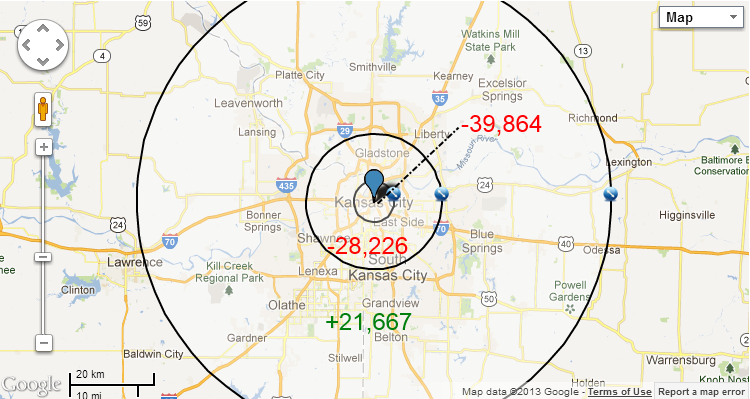
In Part Four, I wrote about how the number of jobs in Saint Louis’ “central core” fell dramatically in the last decade. The Brookings Institution found that in the 3 miles surrounding Saint Louis’ business district, the city had lost almost 28,000 jobs from 2000 to 2010. Of the job growth the region did experience, those jobs predominantly materialized far outside the city center.

Kansas City feels Saint Louis’ pain. Like Saint Louis, Kansas City has undertaken a series of urban redevelopment plans of its own that, again, have focused on attracting the “hip” class to the city center, oftentimes with significant tax incentives. And as has become commonplace, the hip have come, but the jobs have not.

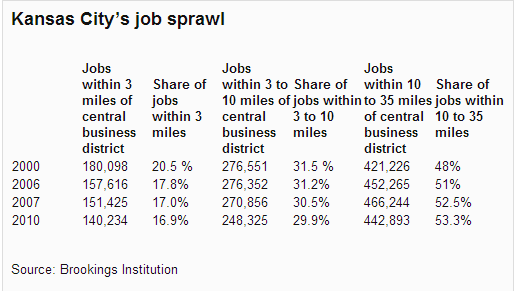
A report released […] by the Brookings Institution said that in 2010 just 16.9 percent of the area’s jobs were in the core, defined as within three miles of Kansas City’s downtown. That’s down from 20.5 percent in 2000.

Dragged down by the Great Recession, the raw number of jobs in the central core also shrank from 180,000 in 2000 to 140,000 in 2010, according to the study.

For areas between 3 and 10 miles from the city center, the number of jobs also dropped. But between 10 and 35 miles from the central business district? As in Saint Louis, the total number of jobs rose — and in Kansas City’s case, they rose significantly.

The chart below, created by the Kansas City Star, tells the decade-long tale.

Indeed, all of the regions in Kansas City were buffeted by the Great Recession. Notably, the 10- to 35-mile band was still shy of its intra-decade high as of 2010. But the downtown Kansas City job figures tell a pretty unambiguous tale: jobs have been falling in Kansas City’s central core. Like Saint Louis, population in downtown Kansas City rose over the decade, but . . . (emphasis mine)

. . . new residents hadn’t translated directly to job creation in the core by the time the Brookings information was compiled.

Since then, “we’re seeing some small businesses locate in the Crossroads and the like, but they don’t employ that many,” said Jeff Pinkerton, economist at the Mid-America Regional Council. “And we haven’t had any major employer move downtown recently.

“The fact is that jobs follow rooftops, and housing is growing in the suburbs.”

As has been explained before, “the hip crowd” does not typically have much in the way of jobs coattails. Unfortunately, it seems, Saint Louis and Kansas City know this all too well.

Support Us

The work of the Show-Me Institute would not be possible without the generous support of people who are inspired by the vision of liberty and free enterprise. We hope you will join our efforts and become a Show-Me Institute sponsor.

Donate
Man on Horse Charging