The Kansas/Missouri Economic Border War, In A Graph

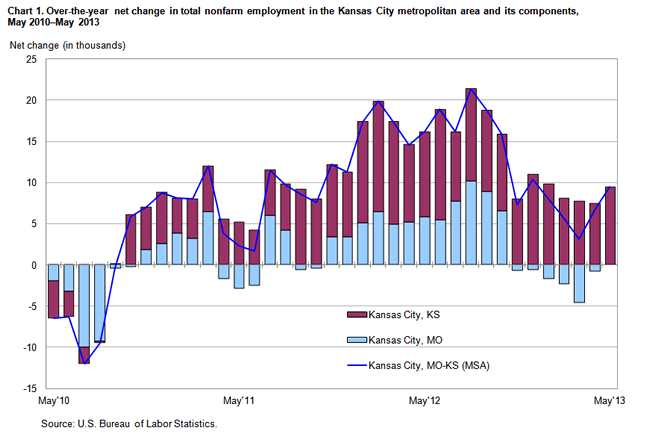
Via the U.S. Bureau of Labor Statistics, who does it look like has been winning the battle lately?

Stay above the line and you gained jobs; drop below the line and you’ve lost them. And to be clear, the Kansas City, Kan./Kansas City, Mo., designations here are references to the Metropolitan Statistical Areas that compose the Kansas City metropolitan area; indeed, the data used here is appropriately broad and provides a fuller picture of Kansas City’s regional economic picture by including other large Kansas and Missouri cities along and around the border — from Overland Park to Platte City and beyond.

In the past, we’ve talked about how jobs have moved, or simply disappeared, from Kansas City’s city center in the past decade. These BLS figures provide further meat to those bones, showing that when it comes to job creation and growth, the advantage right now appears to be very much in Kansas’ favor. The question is, how long will Missouri let that undesirable status quo remain?

MCI’s New Terminal Won’t Be A Money Maker (Terminal Financing – Part 1)

An optimistic projection of future income still shows that Kansas City International Airport (MCI) will lose tens of millions of dollars a year trying to pay down the debt for a proposed new $1.2 billion terminal. The Kansas City Aviation Department may believe that a billion dollar project will satisfy the pride of the city government, but it cannot expect that any potential increased income will match the investment costs.

The yearly debt service required to pay off the $1.5 billion in bonds requested for the new terminal is more than twice MCI’s current net income, which was $30 million from operations in 2012. In order to pay off $1.5 billion in new bonds, MCI would have to pay an additional $68 million per year in interest and amortization. To support their plan, officials with the Aviation Department claim that the project will increase concession revenue and decrease security and maintenance costs.

According to the Aviation Department’s plan, the new terminal will increase revenue with more space for restaurants and services. However, in 2012, MCI only made $14 million from rentals and concessions. Comparing MCI with peer airports (pages 73-75) it could, at best, double concessions and rental fees. That would generate an additional $14 million in revenue.

The current cost of law enforcement and terminal maintenance is about $14.5 million. Reducing security lines and using a new, centralized facility is projected to decrease costs, but there is a limit to efficiency savings. In addition, MCI receives sizable federal grants for security and maintenance, so the federal government will share any savings. So, as a best-case-scenario, let’s be generous and assume that the annual cost savings is $7 million.

The figures suggest that Kansas City will not recoup its new investment costs even in the best conditions. Even if MCI doubled its concession/rental income and slashed its security and maintenance by 50 percent, the airport could cover less than a third ($21 million) of the project’s $68 million yearly financing costs.

Ultimately, the airport will have to bridge that $47 million gap with higher landing fees, federal grants, Kansas City taxes, or an unappealing combination of the three.


An optimistic projection of future income still shows that Kansas City International Airport (MCI) will lose tens of millions of dollars a year trying to pay down the debt for a proposed new $1.2 billion terminal. The Kansas City Aviation Department may believe that a billion dollar project will satisfy the pride of the city government, but it cannot expect that any potential increased income will match the investment costs.

The yearly debt service required to pay off the $1.5 billion in bonds requested for the new terminal is more than twice MCI’s current net income, which was $30 million from operations in 2012. In order to pay off $1.5 billion in new bonds, MCI would have to pay an additional $68 million per year in interest and amortization. To support their plan, officials with the Aviation Department claim that the project will increase concession revenue and decrease security and maintenance costs.

According to the Aviation Department’s plan, the new terminal will increase revenue with more space for restaurants and services. However, in 2012, MCI only made $14 million from rentals and concessions. Comparing MCI with peer airports (pages 73-75) it could, at best, double concessions and rental fees. That would generate an additional $14 million in revenue.

The current cost of law enforcement and terminal maintenance is about $14.5 million. Reducing security lines and using a new, centralized facility is projected to decrease costs, but there is a limit to efficiency savings. In addition, MCI receives sizable federal grants for security and maintenance, so the federal government will share any savings. So, as a best-case-scenario, let’s be generous and assume that the annual cost savings is $7 million.

The figures suggest that Kansas City will not recoup its new investment costs even in the best conditions. Even if MCI doubled its concession/rental income and slashed its security and maintenance by 50 percent, the airport could cover less than a third ($21 million) of the project’s $68 million yearly financing costs.

Ultimately, the airport will have to bridge that $47 million gap with higher landing fees, federal grants, Kansas City taxes, or an unappealing combination of the three.
Show-Me Minute: Tax Credits

The Show-Me Minute is a short radio advertisement to inform listeners about the work of the Show-Me Institute in a particular policy area. In this Show-Me Minute which first aired on KWTO 560AM in Springfield, MO, we discuss tax credits.

Transcript:

Know any big time gamblers?

Sure you do. They’re your elected
officials. They gamble all the time with tax credits. Tax credits sound like
a great idea–a way to attract business without spending any money. It’s
like using your credit card to buy that expensive watch or HD TV you’ve
always wanted. You don’t have to pay any money up front and you figure
you’ll somehow have the money when you need it. So Governments hand
out tax credits like candy, rolling the dice with your dollars and betting that
they can pick winning businesses.

But tax credits aren’t free money. Often the gamble doesn’t pay
off and then the bill comes to you in the form of reduced services or
higher taxes. Why should lawmakers gamble with your money? They
shouldn’t. Let the free market work. If a business idea is such a good one,
let private entrepreneurs develop it and assume the risk.

This has been the Show-Me Minute.~ learn more about the Show-Me
Institute, where liberty comes first, click on our website at ShowMeInstitute.org

Kansas City School’s Untested Tech Program

The Kansas City School Board recently unveiled a new program in which they’ll give each student a tablet computer.

Andrea Flinders, president of the local teachers’ union, was critical of the plan, saying:

If you think throwing a computer at [students] in August and letting them take it home is going to automatically cure all the evils of this district, then you are clueless.

Flinders is correct; there is no compelling research indicating that such an approach is worthwhile. And if the school district wants to test such a program, this is not how they should go about it.

An article in Salon Magazine sheds some light on the practice, which is not limited to Kansas City:

[F]or all the anecdotal evidence supporting iPads, there’s other anecdotal evidence from schools that suggests iPads actually harm education.

What do school board members make of the controversy? Board Member Kyleen Carroll told teachers that if they are not on board with the plan to “go somewhere else.” This is similar to a reaction from Missouri Department of Elementary and Secondary Education (DESE) officials when parents objected to scripted answers to their questions about the Common Core State Standards. Officials said, “If you are unable to follow the way we are going to hold this meeting, you’re welcome to go ahead and leave.”

Of course, some families will do exactly that. In some ways, that is normal and fine. That is how cities and schools are forced to compete. However, for poor families, that is not exactly a realistic option. And it is never the proper reaction from a public official such as a school board member.

Parents and teachers are frustrated with the education bureaucracy’s inability to efficiently and effectively educate our children. If anyone needs to leave or go somewhere else, it is the bureaucrats, not the parents.

Saint Louis Public School District Adds Blue Chip To Portfolio

Often, the best way to solve a problem is to try a new strategy. In 2011, Saint Louis Public Schools (SLPS) Superintendent Kelvin Adams announced that the district would offer a “portfolio of schools” to improve its system. Last week, the district announced that Adams and SLPS are making good on that promise. SLPS has formed a unique partnership with KIPP (Knowledge is Power Program) St. Louis, a high-performing, established charter school. With KIPP, SLPS will be adding a blue chip to the district’s portfolio of schools.

Previously, KIPP and SLPS operated as separate districts, or Local Education Agencies (LEA), with separate funding, buildings, and evaluations. Under the new partnership, KIPP will get access to vacant SLPS buildings; in exchange, KIPP’s student achievement results will be counted as part of SLPS’s as if they are one district. Unfortunately, Missouri does not evaluate public schools individually; evaluations are conducted by district. Therefore, KIPP’s high achievement scores will likely inflate SLPS’s evaluation and buoy underperforming public schools. Nevertheless, the new partnership between SLPS and KIPP should be applauded because it marks a step forward in how Saint Louis operates its school system.

In the book The Urban School System of the Future: Applying the Principles and Lessons of Chartering, Andy Smarick writes:

The world increasingly, and accurately, thinks of a city’s K-12 education system as a collection of diverse schools, not a single, dominant administrative unit. This is the reason why the term “portfolio of schools” has become a staple of the education lexicon. It is also the reason why more and more leaders are drawing a distinction between a “school system” and a “system of schools.”

The portfolio model acknowledges that there is no one-best way to educate kids. The new partnership between KIPP and SLPS recognizes that charter schools and traditional public schools can cooperatively co-exist. When they do, everyone wins. I hope this new relationship between the district and charter schools will be the first of many. By adding quality charter operators to its portfolio of schools, Saint Louis can redesign its educational landscape and continue to improve the “system of schools.”

New Show-Me Institute Video About Olivette TIF

In 2000, Olivette officials debated a major tax subsidy for a new retail center. The subsidy was in the form of Tax Increment Financing (TIF) and the proposal was put before the voters. It was defeated in a referendum, and today, it remains one of the only examples of a defeated TIF in Missouri. Back in the late 1990s, the TIF supporters made all the same arguments we hear with every TIF: “This is the only way to revitalize our community” and other such falsehoods. Recently, the Show-Me Institute decided to investigate what happened in one of the few places where an enormous TIF was rejected.

The area that was supposed to be razed, with “help” from eminent domain, using TIF in 2000 is doing just fine in 2013. There are new homes and new businesses, all without subsidies. Most importantly, the residents and the neighborhood are still in good shape. That situation was not made any easier 15 years ago, when the entire community was in fear of being bought out (or taken) and torn down for a Walmart.

Check out our newest video about the Olivette TIF proposal here. Communities are strongest when individuals are empowered, not government planners and subsidized developers.

The Tax Subsidy That Wasn’t

In the 1990s, private developers partnered with members of the Olivette City Council to endorse the implementation of a $38 million in the area just west of the intersection of I-170 and Olive Blvd. Due to the threat of eminent domain and several years of unresolved negotiations, local homeowners were left in the lurch about the status of their property. Finally, in 2000, Olivette residents voted in a referendum against the project with a margin of 53.5 to 46.5 percent (absolute numbers are 1,656-1,435) to defeat the TIF proposal.

Supporters of the TIF proposal argued that it was the only way for Olivette to compete and generate new tax revenues. At the time, the
Riverfront Times reported on the debate about this tax subsidy
. After the TIF was defeated, what happened? Were the TIF supporters correct? Was a taxpayer-subsidized mega-project the only way to save the area?

Not surprisingly, the TIF supporters were completely wrong. By letting the free market have control over real estate development, the area has experienced a period of sustainable economic progress and revitalization. A bustling Chevys Fresh Mex restaurant continues to thrive. A CVS Pharmacy that opened in 2009 was built without public subsidies. Most notably, the area’s previously existing homes are well maintained, and a new, post-TIF, housing development?— The Villas at Hilltop?— offers upscale townhome-style living. 

Rather than enduring the forfeiture of tax revenues, as would have occurred under the TIF proposal, these properties naturally generate income for local government services instead. The Chevys, CVS, and Villas together are appraised for a noteworthy $11,329,300 and paid $212,355.48 in property taxes in 2012. Additionally, between the years of 1993-1995 and 2005-2007, Olivette’s average sales tax receipts increased more than 143 percent ($1,022,382 to $2,487,038) and its total share of the state’s tax receipts largely stayed the same as well, at about 0.5 percent. The private land developers and their allies on the Olivette City Council warned that TIF funding was absolutely necessary in order to stimulate economic growth. But does this area look blighted to you?

More from the Show-Me Institute on Tax Increment Financing:

Save Gordon Parks Elementary School

Gordon Parks Elementary School, a charter school in Kansas City, has abysmally low achievement scores. In 2012, just 13 percent of students scored proficient or advanced on the state’s communication arts exam and 17 percent in math. For this reason, among others, the State Board of Education, at the behest of the Missouri Department of Elementary and Secondary Education (DESE), voted to not renew the school’s charter. The decision of DESE and the State Board to close Gordon Parks may sound reasonable, there is just one problem — it may not be their decision to make.

That is the argument of the Gordon Parks School Board and Doug Thaman, executive director of the Missouri Charter Public School Association. In a recent Missouri Times article Thaman said:

Our concern is that this action overstepped authority. It’s the responsibility of the sponsor of the school to make a decision whether it’s renewed or closed. There was no indication to University of Central Missouri about the closing or information that they weren’t conducting evaluations correctly.

You see, in Missouri, colleges and universities sponsor charter schools. It is up to these institutions to evaluate their charter schools and to revoke their sponsorship if they are not performing or improving.

I certainly don’t believe low-performing schools should remain open. (For the record, there are five traditional public schools in the Kansas City District that performed lower than Gordon Parks in communication arts and nine that performed lower in math.) However, that decision is best decided by the school’s sponsor and by the individual choices of parents and students, not bureaucrats in Jefferson City. After all, it is the parents, students, and the school sponsor who benefit or are hurt due to the school’s performance. Therefore, it is the parents and the sponsor who should have the final say in closing the school.

The courts likely will settle this case; still, the damage to Gordon Parks is most likely done. Many of the students and staff have already left. The court decision, however, could set an important precedent for charter schools in Missouri. It would either give greater authority to the state to close charter schools or reserve that right for the charter school’s sponsor. I hope it’s the latter.

In Case There Were Any Doubts About The ‘Growth Corridor’ We’re In, Here’s Another Data Point

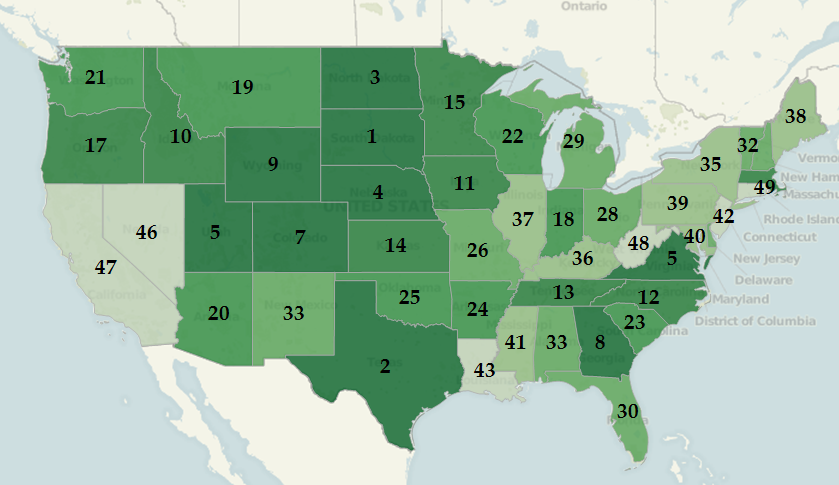
Today, Show-Me Institute Research Fellow Rik Hafer wrote in the St. Louis Beacon about a recent CNBC business survey and how Missouri did. The result: Missouri ranked just on the bottom half of the list in 26th place. Now, “about average” wouldn’t be so bad normally, but as we’ve noted before, Missouri finds itself near the epicenter of the Midwestern growth corridor — where “average” simply isn’t good enough. CNBC’s survey demonstrates the existence of the corridor yet again.

The top four states in CNBC’s survey are right in the middle of the growth corridor: 1. South Dakota, 2. Texas, 3. North Dakota, and 4. Nebraska. And make no mistake, not all of these states were always ranked so high. As far back as 2008, Nebraska’s CNBC ranking was tracking closely with Missouri’s. But then . . . it wasn’t. Nebraska moved into the top five nationwide; meanwhile, Missouri fell further behind. Kansas is always cited as a reason Missouri should be working hard to make itself more attractive to business, and that remains an obvious argument. But Missouri’s economic problems do not begin and end with Kansas, as the Nebraska example bears out. A broader picture of the region that includes only our immediate neighbors should also concern Missourians: Of the eight states that border Missouri, only two are ranked worse — Illinois and Kentucky, both on Missouri’s eastern border.

Now as we always note, your mileage will vary with these surveys, but as Hafer notes, when just about all of them are showing basically the same thing, it makes Missouri’s economic problems all the more clear.

Should we care about such surveys[?] When they converge, yes. CNBC’s ranking corroborates Forbes magazine’s 2013 ranking analysis that placed Missouri at 29. And a report from CNBC earlier this year showed that using data from the National Association of Manufacturers, Missouri did not even make the list of 20 states with the highest manufacturing job creation since the end of 2009. Notably, Illinois, Iowa, Kansas, Kentucky and Tennessee all made the list.

Will Missouri continue down a path of mediocrity? It will unless its leaders — both political and business — grapple with those issues over which they have some control to change in a manner that enticed businesses to start or relocate to our state. Education and tax policies seem like a good place to start the discussion.

Missouri has been headed in the wrong direction for far too long. It’s time to change course.

Support Us

The work of the Show-Me Institute would not be possible without the generous support of people who are inspired by the vision of liberty and free enterprise. We hope you will join our efforts and become a Show-Me Institute sponsor.

Donate
Man on Horse Charging