Don’t Feed The Blob: An Open Letter To The Editor About Government’s Spooky Growth

To the Editor:

For those of us who like a good old-fashioned scare, this time of year is a real (trick or) treat. Halloween stories of ghouls, goblins, and ghosts make for a fun annual tradition, safely delivering in fiction what would be truly frightening in fact.

Yet while it does not wear a hockey mask or carry a cleaver, Missouri state government is a scary story in its own right. Today, the state spends taxpayer money at a rate of almost $800 a second, and if the fate of last year’s tax cut is any indication, it’s more likely that this spending will rise than fall. In fact, if some legislators have their way, next year, the state will throw billions more into an already broken Medicaid program. The state seems to be just like the creature from the 1950s horror film “The Blob” — growing and covering Missourians in regulations and burdens as it goes along.

Instead of feeding The Blob, the legislature should take a different approach and return power to the People — through tax cuts and other free-market, people-powered reforms. The Blob was defeated when people united to turn back its growth; defeating big government will require a similar commitment from Missourians.

Patrick Ishmael
Policy Analyst
Show-Me Institute

Portland’s (And Kansas City’s) Streetcar Collapse

A television station in Portland, Ore., reported that the city’s ever-expanding streetcar system is losing money.

Streetcar service and routes are expanding, and this week Portland Mayor Charlie Hales floated the idea of expanding streetcar lines east of Martin Luther King Boulevard. But last year the Portland Streetcar collected less than half the fare revenue they expected. That meant the Portland Bureau of Transportation ended up helping finance streetcar operations to the tune of $200,000. In fact, over the last five years, PBOT has increased its yearly streetcar spending by more than $2 million.

“The city of Portland has kicked in sufficient money to maintain our operating level,” said Portland Streetcar Executive Director Rick Gustafson.

You read that right, city officials want to expand streetcar service despite the fact that fare revenue is less than half of what they budgeted. As a result, the city has to fund the effort out of its general revenue.

But Eric Fruits, an urban economics professor at Portland State University, calls the streetcar “a money pit.”

“I think what we need to do now is figure out a way to reduce that deficit as much as possible so that we’re not taking money out of the general fund,” Fruits told KOIN 6 News.

The board is considering raising the streetcar fare from $1 to $2.50, but others fear that such an increase will further dampen revenue. Incredibly, the story goes on to say that streetcar proponents are  “convinced the changes, while expensive, are worth it no matter who pays for it in the long run.”

Does anyone doubt that this will be the case in Kansas City? The Kansas City streetcar is currently slated to be free to ride, just as Portland’s was. But when the bill gets too large, Kansas City will start charging a fee, just like Portland did in 2011. The result in Kansas City, as it was in Portland, will be fewer riders, even though in Portland the routes were expanded. The city will be on the hook for the cost and — as has been the case all over the country — the transit authorities will start taking money from successful and cheap bus transportation.

Just as in Portland, count on Kansas City’s streetcar supporters to remain steadfast, no matter who pays for it in the long run. Talk about being taken for a ride.

Governor Nixon And Higher Education

Missouri Gov. Jay Nixon recently stated that “education is the best economic development tool available.” He is correct: an educated work force is an important ingredient to economic growth. Sadly, it also helps explain why Missouri’s record of economic growth gets a failing grade.

In a recent Saint Louis Beacon editorial, I noted that budget decisions have reduced funding for higher education. Spending on higher education has declined in real terms since 1990. This has had several effects, including forcing Missouri universities and colleges to raise tuition. It also has affected the educational accomplishment of the average Missourian.

How does Missouri stack up when compared to other states in educational achievement by its citizens? In 2008, Missouri ranked 33rd out of the 50 states using the statistic “percent of adults having a bachelor’s degree or more.” Don’t like “number of degrees” as a measure of what you have learned? Using standardized test scores (the National Assessment of Educational Progress, or NAEP) as a measure of educational attainment, Stanford University professor Eric Hanushek recently reported that since 1992, the gain in NAEP test scores for Missouri relative to other states is unimpressive.  On this score, Missouri ranks 27th out of 41 states for which data are available.

Missouri’s lackluster educational record is one of several factors that has negatively affected our economic standard of living. In a 2012 Show-Me Institute study, SMI economists Joseph Haslag and Michael Podgursky reported that Missouri’s economy expanded at a slower pace than any of its neighbors since 1997. Compared to all 50 states, Missouri ranked 48th in terms of economic growth. Even in a world of social promotion, this is not a passing record of achievement.

Nixon has called for additional funds for higher education in the fiscal year 2015 budget. Whether these funds survive the political battlefield and find their way to colleges and universities is a dubious proposition. Nor do I mean to suggest that simply throwing more dollars at education is the answer to improving the situation. One thing is certain, however: Unless Missouri’s educational report card improves in the coming years, do not expect to experience an economic boom any time soon.

It Begins: Missouri Officials Already Planning To Spend More Of Your Money In 2014

Late last week, Missouri Gov. Jay Nixon backed off a plan that would have returned some food stamp work requirements to their pre-recession levels. “With greater certainty about what the federal funding level for the food stamp program will be after last week’s budget agreement,” he wrote, “we have made a determination that the appropriate course of action is to maintain the policy that is currently in place.”

In other words: we could have spent less on the program, but … we won’t.

That episode should have been the first clue of what the Missouri Legislature and the governor have in store for their constituents in 2014: big-time government spending. We are two months away from the next legislative session, but right on schedule, we are already seeing news percolate that Jefferson City bureaucrats are expecting even more money to be dumped into the fiscal sinkhole that is Missouri government. [Emphasis mine.]

In a subtle shift from years past, some Missouri budget officials now are openly talking about the potential to spend more – as opposed to emphasizing the need to pare back.

“Revenue is certainly looking better,” said Linda Luebbering, the budget director for Democratic Gov. Jay Nixon. “We don’t have as much of that hole to fill up as we have other years. Hopefully there will be some room to do a few more things” in the next budget.

Sad and predictable. For once, it would be nice to see state officials in Jefferson City plan to spend less of your money, not more.

Teacher Tenure Reform: Not Just About Bad Teachers

Stack Of Cash

The discussion about teacher tenure reform often focuses on the negative aspects, such as getting rid of bad teachers. What most Missourians don’t realize is that our current tenure law also has important implications for rewarding exceptional teachers.

In 2001, the Sherwood-Cass R-VIII School District attempted to give small bonuses to seven teachers. The district wanted to entice these good teachers to sign two-year contracts instead of typical one-year contracts. The Sherwood National Education Association (NEA) challenged the district’s actions.

The courts ruled in favor of the Sherwood NEA, determining that the state’s Teacher Tenure Act does not allow this “commitment pay.” The Missouri Court of Appeals in Sherwood National Education Association v. Sherwood-Cass R-VIII School District said:

The principle[] … is that teachers cannot be compensated for their teaching duties in an amount other than what is set forth in the salary schedule without running afoul of the Teacher Tenure Act. Sherwood, 168 S.W.3d 456, 460 (Mo. Ct. App. W.D. 2005) [emphasis added].

The law has been interpreted to say teachers in Missouri cannot receive performance or merit pay of any sort. The decision in Sherwood establishes precedent for other courts and is a strong deterrent to other school districts considering forms of merit pay.

Teacher tenure laws may make it harder to fire teachers, but in Missouri, they have been interpreted to also prevent districts from incentivizing the good ones to stay. As it stands, school districts are discouraged from using basic forms of merit pay to try to prevent attrition of good teachers. Nor can they use merit pay to reward exceptional teachers for a job well done.

All the more reason to say “it is time for teacher tenure reform.”

Surprise! Rural America Not Seeing Lower Insurance Prices, Either

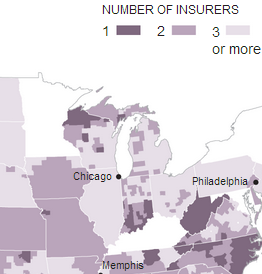
This is arguably old news for Show-Me Daily readers, but lest there be any doubt, the New York Times helpfully confirms the point: the Affordable Care Act (ACA) has failed to lower the cost of health insurance for rural Americans.

While competition is intense in many populous regions, rural areas and small towns have far fewer carriers offering plans in the law’s online exchanges. Those places, many of them poor, are being asked to choose from some of the highest-priced plans in the 34 states where the federal government is running the health insurance marketplaces, a review by The New York Times has found.

So, what’s going on? [Emphasis mine.]

The analysis suggests that the ambitions of the Affordable Care Act to increase competition have unfolded unevenly, at least in the early going, and have not addressed many of the factors that contribute to high prices. Insurance companies are reluctant to enter challenging new markets, experts say, because medical costs are high, dominant insurers are difficult to unseat, and powerful hospital systems resist efforts to lower rates.

“There’s nothing in the structure of the Affordable Care Act which really deals with that problem,” said John Holahan, a fellow at the Urban Institute, who noted that many factors determine costs in a given market. “I think that all else being equal, premiums will clearly be higher when there’s not that competition.”

Bingo.

I’ve said it before and it needs to be said again: The Affordable Care Act doubled down on a broken status quo, neglecting the importance of genuine competition in getting the cost of health insurance down. Taxpayers buying insurance through an ACA marketplace are seeing this failure firsthand, not only with fewer health insurance choices, but also narrower hospital networks within those choices. And as we know, those price and competition problems aren’t reserved to rural Missourians alone in the Show-Me State, as this New York Times graphic reaffirms.

Having, at most, two insurers in each county statewide — and in some cases, only one “option” in a county — is simply not enough to rein in the cost of insurance. If we really want to bend the cost curve of health care down, we need genuine, robust competition in health insurance. The ACA clearly isn’t getting that job done.

The Difference Between A Low Tax And A Harmful Tax

In September, the Missouri General Assembly attempted to override Missouri Gov. Jay Nixon’s veto of House Bill 253. Discussion was robust as sides were formed. On one side, groups argued that Missouri is not a high-tax state; indeed, quite the opposite is true. The other side argued that Missouri’s 6 percent maximum individual income tax rate (7 percent if you include the earnings taxes that apply in Saint Louis and Kansas City) is at least partly responsible for slow growth in the state’s economy. Winston Churchill famously wrote, “Statistics are like a drunk with a lamppost: used more for support than illumination.” So, let us plow through the results. Ultimately, my goal is to turn to economics as the way to illuminate all the facts.

First, what is the case for Missouri being a low-tax state? Most often, people cite the Tax Foundation’s calculations based on Census Bureau data. For example, in 2011, Missouri ranked 46th lowest in terms of per capita state tax collections. No one would disagree with that stat, per capita state tax collections is measuring the amount of taxes paid to state government divided by the population of the state. In other words, it is a measure of the average state tax burden for people living in Missouri. It follows that Missouri government does not collect much from its citizens compared to other states.

Most often, economists focus on the marginal income tax rate. The marginal rate is the policy variable while the actual payment is the product of the income tax rate, which is the state government controls, and the base, which reflects the decisions people make. In terms of 2011 corporate income tax rates, Missouri had the 33rd-highest tax rate of the 50 states. Missouri’s individual income tax rate of 6 percent is the 21st-highest rate among the 50 states. Some would argue that we want to include Saint Louis and Kansas City earnings taxes. It is true that both rates apply, but only to those living or working in the two cities (probably about a million people). If we include the earnings tax rate, then the marginal rate for people living or working in those two cities is 7 percent. Accordingly, people living or working in those two cities face the 14th-highest individual income tax rate. (Similarly, the corporate tax rate would rank higher if you included earnings taxes.) These are the facts.

Do the facts imply that Missouri is a low-tax state? To help illuminate how people change their behavior and how these responses affect some of the alleged “low-tax” measures, consider, for illustrative purposes, that there is a state consisting of two houses, labeled House A and House B. Suppose that House A and House B each produce goods and services that are sold to the rest of the world. The value of each house’s production is $100,000 so that total production is equal to $200,000. Now consider that the state government implements a tax rate of 2 percent on House A’s production. For simplicity, assume that the people in House A can walk to House B and produce there, thus avoiding the new state tax. Because there is no production in House A, 0.02 times zero equals zero. By the state tax burden measure, the state would not impose any burden on its citizens. The marginal income tax rate is 2 percent.

Now, suppose every other state consists of two houses just like our home state. Total production is $200,000 in every other state. We consider a case in which every other state imposes a 1 percent income tax rate on all houses. In addition, it is costly to move from state to state so everyone stays in his or her own state. The total tax revenues in every other state would be $2,000, or the per capita state revenue burden would be $1,000.

Based on this hypothetical snapshot world, if we call the first illustrative state “Missouri,” then it would be the 50th-lowest tax state because its per capita state tax burden is zero while all other states’ per capita state tax burden is $1,000. In contrast, Missouri would have the highest marginal income tax rate because 2 percent is greater than 1 percent. Missouri would simultaneously be ranked the lowest- and highest-taxed state.

There is one last fact that needs to be raised. What is the state economy’s performance? Between 1997 and 2012, Missouri’s economy increased at a 0.9 percent annual rate. This is the 47th-slowest growth rate among the 50 states. And the corporate and individual income tax rates are the two rates that are most associated with economic growth; in other words, these are the tax rates that are most harmful to economic growth.

Missouri’s slow economic growth is not solely the result of its tax structure. The tax structure, however, does not help. The key facts are that Missouri is growing slowly and there are tax reform measures that can improve economic growth without shrinking state government. Let’s talk about those.


How Many Missourians Have Gotten Coverage Through The Exchange? Insurers Keep Mum

As the problems mount at HealthCare.Gov, the question of how many people have been able to actually enroll is becoming a larger and larger issue. Apparently in North Dakota — which has a federally run exchange like Missouri — you can count the number of successful applications on your hands and toes. [Emphasis mine.]

Twenty North Dakotans have enrolled for health insurance through the new federal health exchange, according to figures from the three North Dakota companies offering coverage on the marketplace.

The online marketplace at healthcare.gov, where health insurance is sold, is a key aspect of the health insurance law signed by President Barack Obama commonly known as Obamacare. It has been plagued by traffic issues and widespread glitches since it went live about three weeks ago.

So far, there have been no reports of the enrollment numbers in Missouri, at least to my knowledge. I have reached out to the insurers who are in the Missouri exchange and hit a brick wall when it comes to actual numbers. HHS records suggest there are technically four insurance providers in the Missouri exchange: two affiliated with Blue Cross Blue Shield, and two affiliated with Coventry. (Because affiliates don’t really compete with one another, consumers are effectively left with only two insurer options in each county, in general.) Both Blue Cross affiliates — Anthem Blue Cross and Blue Shield, and Blue Cross and Blue Shield of Kansas City — said that they will not be releasing their numbers. I have yet to receive a return call from either Coventry affiliate.

While we wait, the email I received from Anthem is below. It pretty well summarizes the position of Blue Cross.

Anthem Blue Cross and Blue Shield in Missouri’s parent company has just begun to receive confirmation of enrollment in the federal exchanges from CMS. Although it is too soon to provide Missouri enrollment details at this time, we have seen unprecedented call volumes and heavy web traffic for our exchange plans which is consistent with the experience reported by some state exchanges. We believe consumers will continue to be attracted to our trusted brand name and quality product offerings on the exchanges.

Deb Wiethop
Communications Director
Anthem Blue Cross and Blue Shield in Missouri

Naturally, “volume” and “web traffic” aren’t “enrollment,” so it looks like the actual enrollment figures will remain unknown. Why insurers are so unwilling to release the numbers is a subject of considerable speculation, but if Thursday’s movement toward a delay of the individual mandate is any indication, North Dakota’s enrollment experience may not be unique.

The EPA And Kansas City

Most people know that as a result of foot dragging from Kansas City politicians, the Environmental Protection Agency (EPA) sued the city over our antebellum sewer system. As a result, our already inefficient and Byzantine water department will be increasing our rates in order to pay for the overhaul — whenever that happens.

If you like paying more for your water, wait until you learn about what the EPA wants to do to energy costs. According to the Associated Industries of Missouri, the impact of new regulations on coal “will require the reduction of emissions of toxic air pollutants from power plants in the U.S. The cost, estimated by the EPA, is expected to be $9.6 billion in 2015, and nearly that amount in 2016 and beyond.” For those of us in Kansas City, the news is especially bad [emphasis added]:

The EPA estimates rates will rise by an average of 3.1% nationally as a result of this rule alone.  Because Missouri generates a major portion of its electricity from plants that will be affected by the rule, the impact to your rates are estimated to rise by 6.3% in the far western part of Missouri, 2.8% in Eastern and Central Missouri, and 3.1% in Southeast Missouri.

The city is already struggling to pay the hundreds of millions of dollars  for the construction of a streetcar system that was adopted with a vote of about 300 people.  Now we learn that once built, thanks to the EPA, the costs of operating it are apparently going to be about 6 percent higher.

The EPA is conducting “Clean Air Act listening sessions” across the country, and one of them is scheduled for Nov. 4 just across the border in Lenexa, Kan. In order to attend and tell them what you think, you have to register in advance (no surprise there). Proponents of the streetcar are already wringing their hands about a proposed Jackson County tax — they may want to take a good look at an EPA rule that effectively taxes their pet project and would make non-electric transit even more attractive.

Support Us

The work of the Show-Me Institute would not be possible without the generous support of people who are inspired by the vision of liberty and free enterprise. We hope you will join our efforts and become a Show-Me Institute sponsor.

Donate
Man on Horse Charging