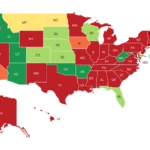
Under Governor Kehoe’s January 2026 executive order, the Missouri Department of Elementary and Secondary Education (DESE) will soon release letter grades for schools and districts based on student achievement. This is an exciting policy development. Missouri families and taxpayers will finally have clear and transparent information about school performance.
Several states where students perform substantially better on national assessments than students in Missouri already use similar letter-grade systems. One early adopter is Florida, which introduced school letter grades in 1999 under the leadership of Governor Jeb Bush.
Bush recently penned an op-ed on the website The 74 reflecting on Florida’s experience. He describes the rationale for school letter grades as follows:
Parents should not have to become data analysts to know whether their children are on track. They should be able to compare classroom grades with objective assessments given by the state, district or school and get a clear answer.
[The transparency of letter grades] can be uncomfortable, but honest information is the first step toward timely help.
The problem Bush describes is that schools often give students grades that are much more favorable than their performance on objective assessments would suggest. This masks academic problems and leaves parents with a misleading picture of how their children are doing. The phenomenon is so common in education that it has a name: the honesty gap.
A letter-grade system for schools, based on objective test data, can help close this gap. But only if the school grades themselves are honest. And this is where Florida’s experience offers a cautionary tale.
The thrust of Bush’s op-ed is that although Florida’s letter-grade system was initially well designed, its value has eroded over time as grading standards have weakened. The same grade inflation that plagues student report cards has spilled over to schools. Today, more than 75 percent of Florida schools receive an A or B, even though only about 40 percent of students meet grade-level academic standards.
It is easy to understand how this can happen. Adults within the education system have strong incentives to push for higher grades. Higher grades make everyone’s lives easier. This is precisely the discomfort that Bush references in his piece. Honest grades sometimes require telling schools, educators, and parents things that they don’t want to hear.
But if we give in to the pressure and award high grades to schools that don’t merit them, the system ceases to serve its purpose. As Bush explains, inflated school grades mean, among other things, that “schools that have real concerns about their student outcomes aren’t being adequately identified for additional supports that could ultimately improve their overall performance.”
Missouri is at the beginning of its letter-grade journey, and Governor Kehoe’s executive order anticipates this problem. It calls for automatically raising grading standards whenever 65 percent of schools earn an A or B. This is a sensible safeguard, but without legislation to codify it, future policymakers could weaken or abandon it.
We would do well to pay attention to states like Florida that have more established school grading systems. We can either learn from their experiences, or we can make the same mistakes ourselves.