Paying Excellent Teachers to Serve High-Need Schools

Missouri has a teacher shortage. Just ask anyone.

Except the actual teacher shortage problem is different from what many people assume.

In our new paper on Missouri’s teacher pipeline, James Shuls and I show that the state’s teacher labor market does not indicate a broad shortage of teachers. Since 2013, Missouri has hired 4,000 teachers while public school enrollment has fallen by almost 30,000 students. The shortage pressure appears to be coming from specific high-need subject areas and schools.

Broad policy solutions like raising the statewide minimum teacher salary will not effectively address the problems in Missouri’s teacher labor market. Targeted policy solutions are needed. One such solution is paying excellent teachers to work in high-need schools.

Before making the case for this policy, it’s worth acknowledging how narrow the shortage really is. The St. Louis region is a clear example. Most of the region appeared to face very low shortage pressure. But the Riverview Gardens, Normandy, and Jennings school districts faced strong shortage pressure. These three districts are also among the lowest performing in the state, and as of 2022, these schools ranked 549th, 544th, and 502nd out of 552 school districts in academic performance, respectively.

These districts are struggling disproportionately to attract and retain teachers, and their students are struggling to learn.

A form of “crisis pay” for excellent teachers willing to work in these districts could help attract and retain teachers and improve academic outcomes. It would function much like differential pay, which is already used in healthcare to draw providers to higher-need hospitals.

Paying excellent teachers, of course, requires an evaluation system that meaningfully and fairly differentiates teacher performance. A notable example is right next door in Tennessee: the Tennessee Educator Accelerator Model (TEAM).

This idea is not unprecedented.

When the Dallas Independent School District offered sizable financial incentives to reassign top-rated teachers to high-need elementary schools through its ACE program, there was immediate improvement in student achievement that had “dramatic, lasting, positive effects on student learning through middle school.”

For districts like Riverview Gardens, which had just 5.1% of its almost 5,000 students score proficient in mathematics, this type of policy could help many children get help from excellent teachers.

There is a growing desire to put market forces to work in Missouri’s long-monopolized public education system. Paying excellent teachers to work in high-need schools would be a meaningful step toward that goal.

Are Schools Built for Girls?

It’s a fair question. District administrators, school leaders, and especially teachers are disproportionately women, and it is not hard to imagine that schools could develop blind spots about what boys need to succeed.

The data certainly point toward something going awry. Boys graduate from high school at lower rates, earn lower grades, and are much less likely to attend college than girls. The gender gap in bachelor’s degree attainment is wider today—15 percentage points in favor of women—than it was in the opposite direction when Title IX was passed in 1972, when the gap was 13 percentage points in favor of men.

To put it lightly, boys are not thriving in school.

It is easy to imagine how boys might get inadvertently left behind. Take reading as an example. Boys are interested in boy-oriented topics—competition, fighting, adventure, even violence. These topics may be less appealing to the overwhelmingly female elementary teaching workforce, which could subtly steer students toward different kinds of books. Some boys might learn the wrong lesson: reading is boring.

But maybe they would like reading if they were reading the right things.

I’ll be the first to admit I’m speculating. But it does not take much imagination to see how a school environment poorly matched to boys’ interests and dispositions could cause them to check out. Whatever the explanation, the larger pattern in the data is clear: boys are falling behind.

What can be done?

I would welcome education technocrats taking a more thoughtful approach to designing schools, including greater recognition of how boys’ needs are overlooked. But I am more optimistic about addressing this problem through school choice. If parents have options, the fact that some schools are a poor fit for boys would be less of a concern. But most parents in Missouri have just one option: their residentially zoned public school.

With a more robust school-choice system, parents could choose schools that better serve their sons. More recess. Comic books. More opportunities to build things and work with their hands. Not every boy would want these things, of course, but that’s precisely the point of choice.

This was the first thought that came to mind when I read a recent uplifting story about The Foundry. From the Foundry’s website:

The first and most tangible prong of The Foundry’s mission is to teach practical skills to boys. Boys 9-17 are divided into groups according to age or skill level and taught basics like the names of tools, how to safely use them, how to fix faucets, how to jump start a car and how to grill burgers.

I am not aware of any hard evidence on The Foundry’s effectiveness. But the anecdotes are compelling, and I can see how it could be a great fit for some boys. More broadly, we should push for policies that give families access to a richer array of educational options built around different ideas about what children need.

Instead, for most Missouri families, it is still the local public school or bust. And the data are telling us that, for too many boys, the current system is a bust.

What Parents Think About Public Education with Colyn Ritter

Susan Pendergrass speaks with Colyn Ritter, research analyst at EdChoice, about the annual Schooling in America survey. They discuss why public confidence in K-12 education has been declining, the real reasons parents switch their kids’ schools, why open enrollment polls at 80 percent support among parents, and what parents think about AI and cell phones in the classroom.

Listen on Spotify

Listen on Apple Podcasts 

Listen on SoundCloud

Episode Transcript

Susan Pendergrass (00:00): Thanks so much for joining us this morning, Colyn Ritter from EdChoice. You guys once a year put out your Schooling in America survey, is that right?

Colyn Ritter (00:08): That’s right, and thank you so much for having me, Susan. So we do an annual survey with Braun Research, who is our partner on this project, and it is called Schooling in America. We’ve been doing it since 2013. And I’d say about 75% of the survey is dedicated to questions that we ask each year so that we’re able to trend them and see how things change over time. And then I’d say about a quarter of the survey is dedicated to newer, more timely questions, depending on what’s happening. I know a few years ago we were asking about school safety. In 2020 we asked about COVID-related things. We dedicated some questions in the last few years to AI and technology. This year we spent some time looking at the federal tax credit program.

Susan Pendergrass (00:49): Yeah, I definitely want to dig in on some of those. But the big thing that I think, I don’t know, it seems to be an emerging issue, and there’s a Gallup poll that you and I were just chatting about offline a little bit, is that the general feeling of positivity toward public education in the United States seems to be suffering. And in fact, in your poll you show that when you look at, not necessarily just parents, but the general population, about sixty percent of folks say that public education is on the wrong track and forty percent say it’s on the right track. What do you think’s going on there?

Colyn Ritter (01:23): So yeah, we did talk a little bit about it offline. The public is more pessimistic than parents. Like you said, sixty-two percent of the public say it’s on the wrong track compared to fifty-six percent of parents. We did see that peak for both groups in twenty twenty-four, and it has come down slightly since that point. My personal belief is that K-12 education news is not widely covered in mainstream media, especially with other things going on, when there’s a war going on and an election year and things like that.

Susan Pendergrass (01:57): We are hearing a lot, I think it’s hitting mainstream media, that young kids can’t read. And there was a little stuff in the media, or maybe just in my corner of the media, and some podcasts and whatnot about the University of California San Diego kids who can’t do math. They showed up

Colyn Ritter (02:12): That’s right. Yeah.

Susan Pendergrass (02:13): and they needed to take elementary-level remedial math. And then a

Colyn Ritter (02:17): Yeah.

Susan Pendergrass (02:17): few days ago some new international test scores were released, PISA, and they showed

Colyn Ritter (02:21): Yeah.

Susan Pendergrass (02:22): that our fifteen-year-olds’ reading skills are at the lowest level since the turn of the century, I think. I mean, tanking, and not COVID-related, just tanking on reading. So I think it’s possible that people are blaming the public school system for some of that.

Colyn Ritter (02:37): Yeah, and to round out my thought, when K-12 education news does hit mainstream media, it’s almost always going to be negative, at least in my experience following it. And rightfully so in some cases, like you said, with the test scores and things. So I think that contributes a lot to why the public feels that K-12 education is on the wrong track, and parents as well. But it is something to monitor when it comes to the new developments in K-12 ed, what does kind of break through. Some part of what we’ve thought about asking is following up with a why. Why do they feel K-12 education is headed on the wrong track, especially from the parents’ perspective, because we kind of want to dive into what’s different about their own kids’ education that they do feel satisfied with, which we see constantly in Schooling in America and in our other polling. Nearly, over two-thirds, nearly three-fourths of parents are at least somewhat satisfied with their kids’ education, public,

Susan Pendergrass (03:33): Yeah.

Colyn Ritter (03:34): private, across sector. But why that is compared to their feelings about the overall landscape of K-12 ed. And I think, the stories about test scores, the NAEP scores over the past few years, those

Susan Pendergrass (03:44): Yeah.

Colyn Ritter (03:45): definitely hit, hearing that an entire grade level across the country is struggling to read or do basic math is going to stick with you, and that will kind of contrast with what you’re seeing with your own kid. Parents aren’t going to be happy if their kid can’t read or do math.

Susan Pendergrass (04:02): Right. And also the public school system seemed to have, well, it has in fact entered into the culture wars in some ways.

Colyn Ritter (04:09): No doubt.

Susan Pendergrass (04:09): We got into the 1619 Project and CRT and all of that, and I think that even people without kids in school were being very concerned about what was happening in the schools, in general. But what I

Colyn Ritter (04:23): I also think there’s a lack of engagement from the public school system. I

Susan Pendergrass (04:26): Yeah.

Colyn Ritter (04:27): was listening to a story about the Texas ESA program and how a lot of kids with special needs are moving. There were, they highlighted a specific school district in Texas, and in part they asked, they reached out to that school district for comment as to why these families are leaving, and there was just no reaction, no response. And I think, if you’re a public school system that is saying we need more money, school choice is sucking funds from the public school, I would expect to at least hear how much money, or for what, or maybe answering the question why they’re leaving, which we look at a little bit in the survey with school switchers, but I don’t want to derail the conversation completely.

Susan Pendergrass (05:11): No, I want to get to switchers, ’cause that’s really kind of why I wanted to talk to you. But, you know, I was gonna say, certainly you guys at EdChoice, you work in this policy area similar to us at the Show-Me Institute, where we want to get parents, every parent, at least a handful of high-quality options for their child. And I’m also agnostic about what they pick, but I don’t want any one child to be forced into a school that is either a failing school or failing for that kid for whatever reason. And as long as people have options, I feel like when parents choose they get a little bit more invested and they are more likely to be a little bit more satisfied, right? But in a lot of places, Missouri is one of them, ninety-five percent of our parents have no choice. They only have their one assigned public school and that’s it, unless they want to do virtual. But

Colyn Ritter (05:58): Right.

Susan Pendergrass (05:59): that’s got to be, to me that would reduce the overall satisfaction rate with the system, because everyone whose kid doesn’t want to get on the bus in the morning, or thinks the teachers don’t

Colyn Ritter (06:09): Yeah.

Susan Pendergrass (06:10): like them, whatever their reason is, they have to go anyway. They don’t have any choices. So that’s not going to lead to a very positive outcome. So let’s talk about the questions that you asked about switchers, ’cause I think this is very interesting. Do you think people are surprised at the percentage of parents who do switch their kid’s school at least once?

Colyn Ritter (06:31): Yeah, I do think it’s more than what most people would expect. We’ve asked this question in our other polls through the Morning Consult public opinion tracker, which is more monthly, and that’s a whole other operation that we have that I’m happy to touch on.

Susan Pendergrass (06:45): You guys are a great source for polling data, for sure.

Colyn Ritter (06:48): That’s very kind. Sometimes it feels like we’re throwing too much out there. We might be overloading people. But I agree that it’s very fun to look through all the different types of questions and the different subgroups and crosstabs. But with school switchers, we’ve seen roughly a quarter, it usually hovers between twenty to twenty-five percent, but twenty-eight percent in Schooling in America said that they’ve switched their child’s school types. And we were keen in the wording of the question to say besides switching from elementary to middle or middle to high school, some more traditional types of switching that you’d expect to see. And it was 28% who say that yes, their child has changed school types. And then we asked, not so much directly why they switched, but what issues the child was struggling with at their previous schooling environment. And the reasons were similar to what we’ve seen in the past. The top reasons were excessive stress or anxiety at thirty percent, academic needs not being met at thirty percent, and then bullying at twenty-eight percent. And those are typically the three that we see. So, from what I’ve heard and listened to and learned from talking to people about this data is that most people think when parents switch schools it’s because their kid’s not learning. Which, we see here certainly with the academic needs not being met, but it can be happening for other reasons like stress or anxiety, mental health, or a safety thing like bullying. And I think that’s kind of where my issue with the overall discussion around choice, it falls flat in the sense that people might think it’s very transactional, my kid’s not learning best here, so I want to move. But it’s more than just that. It always has been. It’s about safety, it’s about mental health, it’s about special needs not being met, issues with teachers, too-big class sizes, lack of personalized or individualized learning. And so I think that’s sort of where this conversation around choice needs to start, and it has started in a lot of states. Parents are diverse, students’ learning is quite diverse and it’s changing rapidly, especially with the introduction of technology and all these new ways to learn. And we should take it seriously that not all kids are alike, and the reason they’re leaving is similarly diverse.

Susan Pendergrass (09:05): Yeah, we have discussed the idea of open enrollment, public school open enrollment, in Missouri now for I don’t know, five, six, seven years, and it’s never gotten anywhere.

Colyn Ritter (09:13): Yeah.

Susan Pendergrass (09:14): And even when we do talk about it, it’s generally a system where districts would get to opt in, they wouldn’t have to participate, they wouldn’t have to take kids. And the conversation around it is always so disheartening to me, because I think people are like, well the only reason kids will switch is X, like they want to go from poor schools to rich schools. I’m like, that does not play out in the data. That’s not what we know about parents. And if you just think about it, I have three kids who went through the public school system. One kid, one year, just not getting along with whatever’s happening there, or the youngest kid having to put up with whatever the older kid did with the teachers. There’s so many reasons, and it’s not anyone’s job to try to figure out what those are. You don’t need to justify that. You just need to have a place that your child wants to go to in the morning and wants to learn when they get there. And that’s what we’re trying to guard for. But it’s always like, well they’ll just all want to go to the rich districts. That’s nowhere on your list.

Colyn Ritter (10:08): Yeah. It’s more than just that. And I think parents are looking at their other options. It might be the fact that they do want to go to rich schools, but it might be the fact that they’re far away, or that their kid has some need that that school can’t offer. And I think, like you said, if we give parents more options, they’ll be more engaged in their child’s learning, and I think that is an overall win-win for everyone. We talk about student engagement a lot, but I think parent engagement with their kids’ learning is a very underappreciated, underrated aspect of this whole thing. EdChoice has looked at studies around parent engagement for parents that participate in a school choice program versus parents that aren’t, and it’s higher, and that might seem practical and make sense, but that’s what we’re really trying to do here, is just get parents more engaged, and hopefully their students will be more engaged as well. And to do that we need to deliver high-quality options and have a marketplace that’s reflective and can help provide the types of options that parents say their child needs. And that is changing all the time.

Susan Pendergrass (11:19): That’s right.

Colyn Ritter (11:20): We’re not looking at schools the way we should, in the sense of what is changing in the future that schools need to be preparing students for. We’re still looking at things like, can your child read and can they do math. Absolutely, those are

Susan Pendergrass (11:39): Yes.

Colyn Ritter (11:40): paramount. Those are the bottom of the pyramid in terms of hierarchy of needs. But now we’re kind of looking toward the top and saying, all right, well, what if my kid wants to learn a trade? What if my kid wants to be an engineer, what if they want to be a welder? Is this something that the school can offer? Are these skills that this school can offer my child if they’re pursuing something like this? And we’ve seen this in data, not so much in Schooling in America, but what are parents looking for for their child after high school. And the traditional graduate high school, go to a four-year college, get a scholarship, it’s still the most prominent option chosen by parents, but it is decreasing year over year. And I think that’s reflective of the cost of higher ed, what’s

Susan Pendergrass (12:22): Yeah.

Colyn Ritter (12:23): required, the skills required. And it starts from K-12. And so we need to have a robust marketplace with a good supply side of education that parents know how to navigate. And so that’s sort of what we’re trying to embark on, and you know that well, obviously.

Susan Pendergrass (12:38): Yeah, I think the model of the last century was, well, we’ll just make every school fit every kid, basically. So we’ll just put it

Colyn Ritter (12:45): Yeah, yeah, exactly.

Susan Pendergrass (12:46): all under one roof, and we’ll try to get every school, we’ll have every vo-tech program, every college prep program. And sometimes people who are against school choice will say, we have to take every kid that shows up. And I’m like, that’s the whole point. It

Colyn Ritter (12:56): Mm-hmm.

Susan Pendergrass (12:58): that is an ineffective and inefficient way to go about this. You shouldn’t have to take every kid that shows up when they state what their needs are. We could have a robust marketplace, a pluralist system of schools, and they can gravitate to the one that’s the best fit for them, rather than trying to make every school fit every kid.

Colyn Ritter (13:16): No doubt. And that impacts teachers, it impacts administrators, it impacts parents. I mean, no wonder we’re looking at a reading, a literacy crisis and a math crisis, because we’ve flown too close to the sun in that regard, in my mind. We’ve asked schools, teachers, administrators to do way too much with too many kids, because we’re stuck in the zip-code-assigned schooling model that has been around forever. And school choice has existed forever, for those who can afford to pick up and move their house to a different school district. But we have to adapt. How many signs do we need staring us right in the face before we say, hey, we need to kind of rethink this thing? And credit to a bunch of states across the country, and not just any, it’s a very diverse list of states with very robust school choice programs. I’m talking about a Florida, an Arizona, Iowa, New Hampshire, West Virginia, Arkansas as well.

Susan Pendergrass (14:14): Arkansas. Alabama, right? Yeah.

Colyn Ritter (14:17): Indiana, Ohio. You cannot just group these states in one bucket, red, blue, South, north type of thing. It’s happening because they’re listening to parents, and parents are very clear in what they’re saying. And that’s kind of what we’ve seen constantly in Schooling in America, is that parents have very diverse schooling preferences. And the reasons this year we’ve seen why their kid left or they switched their kid’s school are also diverse, and it’s

Susan Pendergrass (14:43): Yeah.

Colyn Ritter (14:43): staring us in the face again.

Susan Pendergrass (14:45): Well when we look at open enrollment in particular, ’cause this is an issue that’s near and dear to us Missourians, that

Colyn Ritter (14:52): Of course.

Susan Pendergrass (14:52): has always had extremely high favorability, both among parents and among the general population. When you put this idea, when Minnesota started it thirty-five years ago, I think nineteen-ninety-ish, some states have just been doing this for decades basically, people are like, yeah, absolutely. What’s the seventy-some percent support of the general population for open enrollment? And is it eighty for parents in your data?

Colyn Ritter (15:15): Eighty-three percent for parents, which we don’t see eighty percent support for much today,

Susan Pendergrass (15:20): Yeah.

Colyn Ritter (15:21): but especially in these surveys it’s ESAs and open enrollment that see eighty-ish percent support. And one thing I’d add on open enrollment, Susan, is that we ask parents if they’re aware of the policy in their state. We ask about ESAs, vouchers, charter schools, open enrollment. Charter schools, now granted, they’ve been around for longer, but over half of parents are able to say whether their state has open enrollment. Another eleven percent say no. But the fact that the unsure percentage is lower than the others is interesting and worth harping on, the fact that people are more aware of open enrollment than other types of choice policies. Now whether or not they’re accurate or not, that’s still something I’m working on, and the sample sizes from all states aren’t the best. But

Susan Pendergrass (16:07): Mm-hmm.

Colyn Ritter (16:08): it’s a fun little exercise with this data to see, all right, they’re aware of these policies, now how accurate are they based on where they responded from. I believe last year we were at, like sixty percent accuracy with open enrollment overall,

Susan Pendergrass (16:22): Like.

Colyn Ritter (16:22): which I think is pretty great.

Susan Pendergrass (16:24): Yeah, I’ll usually have, in late summer, a handful of parents reach out to say, hey, can I, I’m just checking, can I switch my kid to a different public school? And I

Colyn Ritter (16:33): Yeah.

Susan Pendergrass (16:33): always have to say, I’m sorry, you cannot, take it up with your legislator, but not yet.

Colyn Ritter (16:35): Yeah. Yeah, yeah.

Susan Pendergrass (16:38): We’d love to see it happen, but we’re one of the last holdouts, certainly in our region. Iowa,

Colyn Ritter (16:43): Mm-hmm.

Susan Pendergrass (16:43): you can pick public or private. Arkansas, public or private. Oklahoma, public or private. We’re just surrounded by school choice, and we are somehow keeping a stake in the ground that we’re going to be the last bastion of zip-code assignment.

Colyn Ritter (16:56): Yeah, it’s kind of, Kansas and Missouri are constantly trying to be the last one. I live in Kansas. I went to school in Missouri.

Susan Pendergrass (17:02): Yeah, I don’t know. Well, Kansas, you live in Kansas now?

Colyn Ritter (17:06): I do. I went to school at Saint Louis University and now I live in Kansas City, Kansas, which, the border is two minutes from us.

Susan Pendergrass (17:14): But I mean Kansas has a robust public open enrollment policy.

Colyn Ritter (17:19): They do have good open enrollment. I’m more so thinking about private school choice. They have a very limited tax credit scholarship program, but you’re

Susan Pendergrass (17:26): Yeah, yeah, yeah, yeah.

Colyn Ritter (17:28): right that there is a distinction between Kansas and Missouri with open enrollment.

Susan Pendergrass (17:32): So real quick, what are you finding? You said you did last year some questions around technology and AI.

Colyn Ritter (17:39): Mm-hmm. That’s right.

Susan Pendergrass (17:40): What are you finding with parents there?

Colyn Ritter (17:43): It’s interesting, so, and this is last year’s data, I’m happy to share it with anyone that’s interested.

Susan Pendergrass (17:49): Yeah, yeah, yeah.

Colyn Ritter (17:51): We kind of break it into two molds, there’s AI and then there’s cell phones. Cell phone bans are a very prominent topic in K-12 education discourse now, with more states looking to experiment with cell phone bans, whether it’s bell-to-bell or just during instructional time. We ask parents whether or not they support the use of such technology in their child’s classes. They’re very okay with laptops and online learning platforms like Canvas, things like that. They’re about 50-50 with AI, which is decreasing actually, which is interesting. And then cell phones, it’s about, only the support for AI is decreasing in classrooms,

Susan Pendergrass (18:27): Which is decreasing, people who want it? Yeah. Sure it is.

Colyn Ritter (18:33): which is worth monitoring, obviously. So we asked, do you support the teaching of responsible use of AI in schools? And parents are very supportive of that. So while they’re skeptical of AI being used, they do still want schools to teach how to use AI responsibly. So it’s a little bit of a contradiction there, but I think we’re all trying to

Susan Pendergrass (18:52): We’re all trying to figure it out.

Colyn Ritter (18:54): figure it out. Schools certainly are, but I do think that second bullet point is more important, that parents are keen to have their kids learn how to use it responsibly, and they feel that schools can help in that. It’s tough, because that’s adding another thing that schools need to sort of, we’re trying to figure out, schools are trying to figure out their AI policy. But tech and AI, the questions around that are only going to expand. So we’re going to keep asking those as well, just to keep a finger on the pulse.

Susan Pendergrass (19:23): Well, I do want to make a plug for this, because this is, number one, a very great survey, and you’ve been doing it for over a decade now. But also you’ve got a great website that’s very interactive. Folks can look at all of these full questions by category, you’ve got cool charts that move around. Where can anyone find this information?

Colyn Ritter (19:41): That’s very kind. We have an absolutely amazing communications and graphic design team who do it all. If

Susan Pendergrass (19:46): Yeah, it’s really great.

Colyn Ritter (19:47): I was in charge of it, it would look way, way less nice. So

Susan Pendergrass (19:50): No.

Colyn Ritter (19:52): edchoice.org is where you should go. Then the research library, where you’ll see on our banner tab, you’ll see the research library where you can find all the reports by my great colleagues and our fellows, like Susan.

Susan Pendergrass (20:07): Uh-huh.

Colyn Ritter (20:07): And then we also have a Schooling in America tab where we have an online dashboard, so if you just want a quick set, you can find that very

Susan Pendergrass (20:12): Really cool. And what’s your monthly survey, or your other survey?

Colyn Ritter (20:18): Yes, so right under the Schooling in America tab, you’ll see the Public Opinion Tracker, which is in partnership with Morning Consult. That is our monthly polling that we use for more state-specific topics. We still ask questions like right direction, wrong track for education, support for school choice policies, things like that. We do it more monthly because we want to be more reflexive to what’s going on in K-12 education, because a once-a-year survey only gives you one shot at that. And we survey teachers there as well, so it’s not just parents in the gen pop. But we’re always looking for questions, for ideas to poll to include in our polls, so feel free to reach out. My email is [email protected], or just

Susan Pendergrass (21:00): Great.

Colyn Ritter (21:01): type it into the contact us at edchoice.org, and one of us will reach out. But yeah, we’re always trying to

Susan Pendergrass (21:07): Yeah, it’s really great.

Colyn Ritter (21:08): better understand what parents and the gen pop are saying about K-12 ed.

Susan Pendergrass (21:12): Well, thanks for coming on and explaining it to us. I really appreciate it.

Colyn Ritter (21:15): Thank you so much, Susan.

Produced by Show-Me opportunity

Hillsboro School District Seeking Enormous Tax Increase

There are several school districts in the St. Louis region seeking property tax increases on the November ballot. Parkway ($0.46) and Webster Groves ($0.65) both have substantial tax increases before voters, but the Hillsboro school district tax proposal takes the cake. The Hillsboro R-3 School District is asking for an increase of $1.39 per $100 of assessed value, or a 37 percent increase. I have honestly not seen a tax increase proposal this large in my time following local government.

(An AI-assisted review of tax increases in Missouri tells me there have been a few larger ones over the past 20 years, but they were in much smaller districts with much lower total assessed valuations. The Blackwater school district, for example, passed a $1.50 increase in 2021, but the increase was split over two years to offset the impact slightly.)

The average home value in Hillsboro is $324,000. This means an average tax increase of $855 if the measure passes. However you want to put it, that is a lot of money to most people.

The district is telling people it is controlling costs and it needs the tax increase for a variety of reasons. Here is the part that interested me the most:

He [the superintendent] also pointed to lower administrative spending as proof that Hillsboro has worked to control costs.

According to the figures presented, the district spent about $1.5 million on executive administrative salaries in 2018. That amount fell to about $739,000 in 2025. Benefit costs in that category fell from about $426,000 to $194,000 during the same period.

Hillsboro also reported having one administrator for every 186 students. The statewide average is one administrator for every 156 students.

The Show-Me Institute just released a report on the public school personnel boom in Missouri. What did our research find about Hillsboro school district? From 2000 to 2025, student enrollment declined 13 percent. The total number of teachers increased only slightly, three percent, but average teacher salary went down 18 percent. How about the administration? From 2000 to 2025, the total number of administrators increased by 42 percent. The average administrator salary has declined by 11 percent, but with so many more administrators the total spending on administrators has increased by 25 percent. (All numbers are adjusted for inflation.)

The fact is that Hillsboro schools are like most other school districts in Missouri. Student enrollment is declining. Teacher salaries are holding flat or declining. But spending on administrators? That has increased significantly.

Of course, Hillsboro may have legitimate cause to increase administrator spending and staffing at this level. After all, its staffing-to-student ratios were relatively high before. But when a tax increase of this size is on the ballot, it is imperative to have transparency and accountability on spending.

More to the Fiscal Note

It’s easy to argue that a program’s benefits outweigh its costs. But if you never measure the benefits, how can you know that’s true?

As Missouri lawmakers prepare for upcoming years of tighter budgets, this is one question that needs to be asked. Earlier this year, one lawmaker looking for places to cut in the budget asked the Department of Social Services (DSS) to identify potential savings in Medicaid, the state’s most expensive program. The department pointed to chiropractic care, an optional benefit, because it had not found evidence of the supposed savings that were used to justify adding it nearly a decade ago. The funding was removed from the budget, and Missouri stopped covering the benefit on July 1.

On its face, this looks like a story of good governance. A program was adopted at least partly based on expected savings elsewhere in the budget, but once the state couldn’t show those savings occurred, lawmakers reconsidered it. But the chiropractic story raises a bigger question about what happens to fiscal estimates after a bill becomes law.

Back in 2018, when Missouri approved Medicaid coverage for chiropractic care, I was working on the state’s Medicaid budget, attending hearings and reviewing fiscal notes. Lawmakers had proposed covering chiropractic care for several years, but the fiscal notes showed it would cost the state millions of dollars. Supporters argued the benefit could save money elsewhere in Medicaid by reducing opioid prescriptions, back surgeries, and other treatments. After some pushback, DSS incorporated those assumptions into its fiscal note, estimating nearly $12 million in state general revenue savings during the first two full years.

Eight years later, the department could not point to hard evidence that those savings occurred. Unfortunately, determining whether the savings actually materialized isn’t as simple as comparing the estimate with what the state ultimately spent.

Missouri’s DSS knows exactly how much Medicaid paid for chiropractic care. What it can’t directly observe is what Medicaid would have spent on those same patients without the benefit. The department noted that 97 percent of recipients who received chiropractic care did not have back surgery. But that doesn’t tell us how many would have needed surgery otherwise, or how much the state actually saved.

Projected savings like these can make a program appear much less expensive when lawmakers are deciding whether to adopt it. Every bill that receives a hearing in Jefferson City gets a fiscal note estimating what it could cost or save the state. Once the bill becomes law, however, the budget process does not routinely require anyone to go back and see how those estimates held up.

This issue is not unique to Medicaid. Tax incentives, for example, are often justified by projections of jobs, investment, or economic activity that would not otherwise occur. Simply counting what happened afterward tells us no more about an incentive’s effect than the absence of back surgeries tells us how much chiropractic care saved Medicaid.

In this case, it took lawmakers eight years to revisit the assumptions behind chiropractic care’s fiscal estimates. As our elected officials look for ways to rein in state spending, going back through other fiscal notes and comparing what programs were expected to cost or save with what actually happened would be an obvious place to start.

City Admits Zoning Is a Barrier

A recent story in The Kansas City Star on an effort at housing reform in Lee’s Summit makes an important and necessary admission: the problem is government regulation.

The city is growing in population. That is good. But the supply of housing is not keeping up with that growth. That is bad. As a result, housing prices are rising and pricing out long-time residents. That is also bad.

The good news is that city staff issued a report with some recommendations, including relaxing the city’s restrictive zoning codes. Tracy Albers, the city’s development services director, offers a remarkably free-market reform proposal. According to the Star:

[Albers] said that the city’s influence on which new housing types are built in Lee’s Summit is “limited”. City staff can’t control interest rates or construction costs, she said, but they can woo developers, invest in other projects that make people want to live in Lee’s Summit, create more permissive zoning policies and “make the development process as predictable as possible.”

Unfortunately, despite the proposal having many free-market ideas, there are some red flags. Wooing developers and investing in projects feel like euphemisms for taxpayer subsidies. But those don’t appear to address the problem Lee’s Summit is having. They have plenty of people, and the city is growing. The problem is that the city’s rules and regulations are getting in the way of the market’s ability to accommodate that growth. Remove those barriers, and let’s see what happens.

A Better Way to Teach History with Jon Bassett and Gary Shiffman


Susan Pendergrass speaks with Jon Bassett and Gary Shiffman, founding partners of 4QM Teaching, about their Four Question Method for teaching history and social studies. They discuss why so much history instruction fails to build lasting knowledge, the four questions that structure a well-taught history lesson (what happened, what were they thinking, why then and there, and what do we think about that), why “knowledge first” matters for both literacy and civic discourse, and how their approach could help address declining civics and history knowledge among young people.

Listen on Spotify

Listen on Apple Podcasts 

Listen on SoundCloud

Episode Transcript

Susan Pendergrass (00:00): Thank you so much for joining us on the Show-Me Institute podcast. We’ve got John Bassett and Gary Shiffman. You guys are the founding partners of 4QM Teaching, which we’ll talk about later. But you guys were both, both of you have been classroom teachers, is that right?

Gary Shiffman (00:16): Yeah.

Jon Bassett (00:16): Yeah. So I was a classroom teacher for thirty-four years. I taught at a Catholic school in the South Bronx. I taught at sort of a medium-sized suburban school in Boston and then a large comprehensive high school outside of Boston, in Newton, Massachusetts. And that’s where I met Gary. And the story goes that I ended up hiring him in two thousand and one to teach in the department that I was chair of, and that kicked off a long and productive argument. Gary, you want to tell her about the argument?

Gary Shiffman (00:55): I guess, yeah. So I was a career changer. It was two thousand two, by the way. Historians, get that right.

Susan Pendergrass (01:02): And the argument continues.

Gary Shiffman (01:04): The argument continues. This is how we are. This is just it. So in 2002, I was an ex-political science professor. I didn’t get tenure at the University of California, San Diego, where I was teaching. I was a classroom teacher too, just had no idea what I was doing. Anyway, I decided I wanted to be a high school teacher, so I applied to lots of jobs, many, many jobs. I had a wife and two kids. My wife was employed, but we needed me to have a job, so I applied to a lot of jobs and I got exactly one job interview. And that was with John at Newton North High School. So I went in and did a demo lesson to show that I was qualified to take this job. And he asked me after the demo, he says, so tell me about the lesson you just taught. Reasonable question. And I said, can I tell you what I would do next time? And that got me the job. Because I had the inkling by the end of the demo, I didn’t really know what I was doing and I needed to learn. And he knew that going in, because I was a university professor without any real training in teaching, so obviously I didn’t know anything. And so he hired me. Well, John can tell you the story about why he hired me, but anyway, he hired me and I was there at Newton North for four years, and then I got the job of department chair, the same job he had, but I had it in a neighboring town, Brookline, where John happened to have gone to school and where my wife went to school, which is why we were living there. And so I got to be back in my hometown, Brookline, Massachusetts, chair of the department there, and I’d had that job for seventeen years. Well, I quit in twenty twenty-three to work on this.

Susan Pendergrass (02:41): Yeah, so here you guys are. And I think that you’ve started a nonprofit that we’re here to talk about today, but I think that a lot of our best ideas in education come out of the classroom, obviously. Teachers have a very entrepreneurial spirit oftentimes, if we can find ways to harness it, and I think it’s so great that you have. But at the Show-Me Institute, we have been talking in recent weeks about these polls that have been coming out that show that people are feeling more positively about socialism and less positively about capitalism. And some folks are very upset about it. We’ve had one of the pollsters on, Emily Ekins from the Cato Institute, to talk about their findings. And part of their poll found this growing interest in socialism, but also found that, I think, 40% of respondents didn’t know how many branches the federal government has. And a very high percentage didn’t know what we had just celebrated the two hundred and fiftieth birthday of, or which country we went to war with in the Revolutionary War. I mean, it’s just a really troubling lack of historical content knowledge. And then you ask this question, how do you feel about socialism and capitalism? And so people have been saying, do you think people even know what socialism and capitalism are? I don’t know, but I would guess probably not if they don’t know how many branches we have. And so, you know, then it’s like, what do you do? I’ve looked at the Missouri social studies standards. They’re pretty thin, and we don’t really report test scores, and there’s no real accountability. It’s not part of our accountability system. So I suspect kids are learning less and less about history, civics, government. And now you have stepped in to sort of address this problem. Is that right?

Jon Bassett (04:29): Yeah, I mean, I would say this is not a new problem, and we certainly would not guarantee that if history were taught well, everyone would reject socialism. I don’t know about that. But your anecdote about people not knowing who we fought against in the Revolution, we actually have an anecdote about that in our book. When I was teaching the American Revolution, and I was doing a bang-up job because I was teaching this great story, and I’m teaching the story of Lexington and Concord, and halfway through, these two girls in the back raise their hand and they say, wait a minute, Mr. Bassett, we’re fighting against the British? And I was like, my god. And so I think a lot of history, our big insight, we think, is that a lot of history is badly taught, because history teachers aren’t really exactly clear on what they’re doing when they’re teaching history well. And we argued for over a decade about what good history teaching looks like. And to make it both memorable and engaging, you have to be clear about what question is on the table in any given lesson or any given part of a lesson. And so that was our insight, that we’ve broken down into four questions that x-ray the discipline of social studies, and we think that it can both engage kids and make it memorable, but also provide insight into the structures of the disciplines themselves.

Susan Pendergrass (06:00): Okay, so let’s go through the four questions. How do you take these in order to teach a lesson about the American Revolution?

Gary Shiffman (06:07): Question one. What happened? It turns out that you cannot think about things you don’t know about. You could make stuff up, I guess, but you can’t think about it. And so if you take that question seriously, what happened? You think, all right, my kids need to know what happened. American Revolution. What happened? They need to know who was involved and what they did, right? They need to get that story in some way. And then to avoid the calamity in John’s classroom where the girls don’t know what’s going on, right? These are good kids. They want to know. They asked, right?

Susan Pendergrass (06:39): They needed that.

Gary Shiffman (06:41): They need to know, and they need to not just get the story, they need to tell the story back. So when we ask question one, we’re not just saying what happened, and we’re not just framing lessons around that. We actually have a methodology for doing that, for asking and answering that question. We call that skill narration. It’s a thinking skill. It’s hard. If you don’t think it’s hard, try it yourself. You’ll see there’s plenty to criticize about any first performance, right? So by focusing our method on question one, what happened, you’ve got to learn a story, you’ve got to tell it back, and there’s a rubric, there’s criteria for telling it back well. Now what we’re doing is not only getting kids up the chain toward real knowledge, but we’re actually working memory. I would say in answer to your last question, part of the problem is, we just wrote a blog post for the American Enterprise Institute. We were invited to submit a chapter on social studies. And our argument is we need a barn clearing in social studies the way they did it in early literacy, which was that scientists, cognitive scientists, psychologists who study learning know a lot about how human memory works. Unfortunately, many educational theories have no idea. So we’re trying to align our method with what we know about how human memory works. If you say nobody remembers anything from school, well, that was bad teaching. The problem is that the overall infrastructure for our field has not incorporated that science yet. We’re trying to incorporate the science. We want to incorporate the science, just like literacy. We need to clean house a little bit and focus on the activities that will actually create enduring knowledge, long-term memory, for kids.

Jon Bassett (08:19): Right. And so one of those is learning a story and telling it back. And so that’s question one. Everything starts from that. That story has some interesting people in it who made some interesting decisions that might seem strange or odd or consequential. Question two, we pause the narration and we try to dive into the heads of people who drove that story forward, and we ask, what were they thinking? So the guys who signed the Declaration of Independence, they took an enormous risk. You know, Ben Franklin, we must hang together or we will surely hang separately, right? And they pledged their lives, their treasure, and their sacred honor on a war against the world’s most powerful country. What were they thinking? This is question two, and this is the thinking skill of interpretation. So we read primary sources, we would read the declaration, and try to figure out, okay, what’s in the heads of the guys who wrote that and signed that? And then Gary was the guy who convinced me that question three exists. Gary, talk about question three.

Gary Shiffman (09:18): Sure. I just want to point out, question two deepens the story, because you’ve learned the story, you’ve learned what happened. Now we’re really going to know those characters well and know their thinking. It’s a post hole. It helps us remember the story, because now we’ve really spent time with Franklin or Jefferson or whoever, right? So question three is a stepping-back kind of question. And the question is, why then and there? So there have been anti-colonial rebellions for a long time. There have been wars of independence for a long time. There have been wars in general for a long time. But they don’t happen all the time, they happen sometimes, under some conditions. So I came from a political science department. I was a political scientist before I became a history teacher, and political scientists are weird. They’re a weird bunch, kind of like economists this way. They actually don’t care about the American Revolution. They care about revolutions in general. Under what conditions do revolutions occur? So you can marry that study, the study of the conditions under which stuff happens, to our study of narrative history. And you can do it very nicely, because once you know about a case pretty well and you know the people, the revolutionaries involved in that case, you’re only a stone’s throw away from, huh, does stuff like that happen all the time? So it turns out that Nova Scotia, a British colony, now part of Canada, was a fourteenth colony. Thirteen colonies rebelled. Nova Scotia was invited to join, and they said, thanks, but no, we’ll sit this one out. Jamaica was a British colony in the New World, and it turns out they also decided, nah, we’ll sit that out. How come? Why there, in the 13 colonies, but not in these other British colonies? And it turns out the pattern’s not that complicated. They needed British security, or the colonials were going to be killed because they were minorities, or vulnerable to whatever. There are lots of plausible answers to why Nova Scotia and Jamaica went one way and the 13 colonies went the other way. The point is to put on the table for kids questions like this, so they learn the thinking skill of what we call explanation. How do you consider changes or differences that might explain a different outcome in time? Like, once you know the British colonists in the 13 colonies were pretty happy being British until they weren’t, what changed? Or they were different from Nova Scotia, Virginia and Massachusetts were different from Nova Scotia. In what ways? And what you’re learning to do is what political scientists and economists do all the time. We should try to identify the factors that may make a difference in outcomes in the world. Turns out to be super fun with kids if you set the puzzle up right and you’ve got the question really clear.

Jon Bassett (11:48): And it’s also one of the things where, you know, we say all the time, you need to study history so you can understand the way the world works today. But we often don’t really cash that out. And question three cashes that out, because you can say, okay, why then and there for the American Revolution? Under what conditions do we get revolutions? Let’s look at some contemporary cases. And so we do that a lot in our curriculum. Question four is, what do we think about that? And this is where we get to exercise judgment. And we’ll focus in on a particular person or a particular policy, a particular decision, and we’ll say, well, was this the right thing or the wrong thing? Under what conditions is it right to do this thing? And we phrase the question with a “we,” not because we expect everyone to agree, we absolutely do not, but we are going to discuss this question in community, in a classroom community, and we’re modeling civic discourse here. So, you know, was the American Revolution justified? Some people think yes, some people think no, right? Why would you think that? What are your principles for justifying revolution? And then, under what conditions is it right to take up arms against your long-standing government? And so that’s sort of the payoff question.

Susan Pendergrass (13:04): And I saw that you’ve written about the same concept with Truman dropping the bombs on Hiroshima and Nagasaki, which I can imagine would be a much more enriched conversation about judgment, right? Like, was it right?

Jon Bassett (13:17): Well, the reason it’s question four for a reason, which is that if you just go, well, Truman and the bomb, well, if we haven’t studied that very much, I’ll just give you an answer: well, you should never bomb civilians. Never? Yeah. But if you’ve done the whole story of World War II and you’ve done question two on Truman, and you know something about the underlying context and conditions, then usually you get, one of my favorite moments teaching question four was with this kid who was kind of struggling and asking it, and he’s like, that’s a hard question. There you go.

Susan Pendergrass (13:54): Yeah. Well, would you have said then, before, when what we need barn clearing about is that kids were given an original source document like the Declaration of Independence and told, what do you think? Like, were they going from here to here? Or what was the problem, that we were skipping some of these steps?

Gary Shiffman (14:17): Well, yes, we’re absolutely thinking about those steps. And teachers, so the dominant view of pedagogy was students need to talk as much as possible. Student discourse. And students need to talk, don’t get me wrong. We absolutely need to get kids to think out loud, to write their thoughts, to revise a lot. They need to be involved in their learning. Of course, that’s obvious. But if you give a kid a document that they find virtually impenetrable, because it was written hundreds of years ago by people with very different norms about English prose, among other things, who don’t know anything about the context, and you say, read this and now tell me what you think, think about how many of the four questions you just skipped. They don’t know what happened. You have to do what happened first. Second, it’s a very difficult document. When we do documents, when we ask kids to interpret a meaningful artifact from the past, we go very slowly. We’re going to take a piece of the document they can read in one sitting. Really read. We’re going to contextualize it, which means we’re going to remind them of the story they know that puts it in context. We’re going to have them establish the plain meaning. Takes a lot of time. It’s work. They have to know what those words mean. They have to really look at those sentences and understand the syntax. Does it sound like work? Yeah, it is work. Next, they’re going to interpret, and this is, we’re going to teach them, we’re going to give them guidelines for doing that. What is the purpose the authors were attempting to achieve when they wrote this document in this way? They could have written it a different way. They could have written nothing at all. What do we know, based on the context and the words they wrote? What plausible claims can we make, based on textual evidence, about what their goal was? Furthermore, what were their assumptions? Things they thought were true about the world that you see they must have thought was true, even though they didn’t actually say it. They assumed things about how the British would react. They assumed things about how their American audience would react. They didn’t say, I think the audience is going to react this way. This is inference. But you can teach kids to do that if you go slow and you’re methodical and you practice it over and over again, which is exactly how we design our curriculum. So now we’ve done the story first. We’ve really taken that document apart and gone slowly. And we haven’t even gotten to the “what do you think” part yet. That’s question four. That’s a different lesson. I don’t care what you think yet. I care what you think about what they thought. That’s question two. But when we get to planning our own little insurrections, or deciding they’re always a bad idea, whatever we decide, that’s a separate lesson, which has its own protocols for thinking and for doing it right.

Jon Bassett (16:50): Yeah, I would say, Susan, when you said, are we skipping steps? Yeah, absolutely. I mean, a couple of the big ones, one of the big ones is knowledge first. And we have a slogan, we have laptop stickers that say “story first.” And a lot of teachers believe that. Or we sometimes work with teachers and we say, listen, kids have to get the story before they can think about it. And so we have question one lessons where kids get the story and they practice telling it back. And sometimes teachers tell us, well, if my administrator comes in and sees that my kids are just reading and taking notes on this story, or they see me lecturing and kids taking notes on the story, they’re going to tell me that’s low level and it’s not good pedagogy. And the problem is that it’s story first, not story only. And so knowledge first is just, we know this from cognitive science, but like Gary said earlier, that often doesn’t filter into the classroom. Another problem we see is document overload. And in history classes, people are told the kids have to do documents. So, we’ve seen lesson plans that call for middle school students to read four or five primary source documents from the 19th century in a single class period. And you can’t take it seriously if that’s what you’re doing. And so by having four questions and by having four lesson types, every lesson is just one thing. We’re going to learn the story today, kids. Today we’re going to dive into the heads of the signers of the Declaration. So we’re going to read a piece of that document slowly and carefully, the way Gary described. Today we’re going to look at underlying context and conditions. We’re going to work on a question three puzzle. That’s going to take the whole class period. We’re going to talk about what we think about that. Again, whole class period. Just the clarity of the questions and giving it the time it needs and respecting knowledge first. Those, I think, are the

Susan Pendergrass (18:57): Yeah, and I don’t want to belabor this point, but this is kind of why your stuff was appealing to us. But if you ask somebody what they think about socialism, and they say, is socialism free health care and free child care and rent controls, then yes, I like it. Because if you don’t know, if you don’t have any context for what it is, and I’ve had people say, well, are they learning about Stalin? And I’m like, probably not. I guess probably not, right? Because if you just associate it with what you’re hearing today, and the same thing with capitalism, well, I associate it with whoever, some of these very wealthy people who are around these days, maybe I don’t like that. And if you don’t have an underlying base of knowledge, then your opinion is just based on sort of what you see right in front of you right now. And that is skipping all of those steps. And I’m not saying anybody can’t have that opinion, that’s fine. It’s just that it’s coming from a place of not much underlying content knowledge. And I think that’s problematic. And I mean, we’ve seen similar things in reading, and I just wonder, what kind of happened? You know, we had A Nation at Risk in the eighties where they were like, we need to get back on track. And then we got kind of into whole language, and then we got into this interactive math, and then we got into like, history and how you feel about it. And now, is a pendulum swinging back where we’re like, science of reading and phonics? And we know, with all due respect to UCSD, Gary, like those kids don’t do math, can’t do math. And now we have a real problem with kids being able to do well on civics, like NAEP civics and history tests. So what happened? Did we just lower the bar too much? Or what happened, do you think?

Jon Bassett (20:36): Well, we squeezed history out, is one thing that happened. And the emphasis, you know, you mentioned in your intro that history’s not tested in Missouri. Okay, not tested. Then, if I’m a principal and my school is going to get a state rating based on test scores, it’s going to be math and literacy. And so we’re going to focus on those things and we’re going to squeeze out the other things. But

Gary Shiffman (21:01): And one of the reasons, by the way, we love Natalie Wexler, who is our patron saint. She wrote a book saying, look, people are in their classroom spending two hours a day teaching comprehension skills, which don’t really exist. How about teach some history? How about some knowledge? Teach kids stuff. Kids are sponges. Kids want to learn stuff. First of all, they want stories, right? Ever, I had two kids. I have vivid, wonderful memories of sitting them on my lap, reading them stories. When you finish a story, the first thing they say is, again. They want it again. They love dinosaurs and trucks and stars and Pokemon and whatever it is. They just want to know stuff. And if you go into school and you practice skills, my god, how stultifying, right? But it was driven by the misguided belief that if we can’t nail that literacy exam, we’re doing a bad job. But Natalie raises the question, what if the exam isn’t very good? You have flushed all the learning out of your system in pursuit of an exam that doesn’t actually tell you what you want to know.

Jon Bassett (22:05): Well, and the reason, that exam, it’s not that you can’t test, it’s not, we’re not against testing. The problem is that people lost sight of the fact that literacy is, at least in large part, it’s just knowing stuff. And so if you actually taught history and science well, that would improve literacy. Because literacy has two components. Can I sound out the word? And do I know what the word means? And it turns out that learning a lot of history is really good for that second part, because there’s just a lot of general knowledge that comes from history, and it literally builds vocabulary. But rather than saying, what are we doing today, we are vocabulary-building children? No, we’re going to learn some history. And then, as an ancillary benefit, that’s going to build some vocabulary.

Susan Pendergrass (22:55): So now you have this, 4QM, what are you hoping to do with it? Are you going to spread the word?

Gary Shiffman (23:01): We are hoping. We are hoping, Susan, thank you for helping us.

Susan Pendergrass (23:04): So how do you get this into classrooms? Honestly, we’ve talked about this a lot at the Show-Me Institute. Like, okay, we know we have a problem with content knowledge in these areas. We know the standards are not great. And they take the test, but that doesn’t count toward accountability. What do we do? Do we want better standards? Do we want better teaching? We kind of, to your point, we kind of know where to go with this science of reading thing, but we don’t really know where to go with this teaching history and social studies thing. So are you guys providing a pathway?

Jon Bassett (23:32): So I think what we’re trying to do is sort of do an end run around the institutions that currently dominate our field and are making what we think are pretty significant and long-standing errors. And so we’ve built a curriculum and we’re building more. We have a middle school U.S. history one curriculum fully built out, and then we’re selling subscriptions to that. We’re building a world cultures and geography curriculum, also for middle school, that’ll be completed within the next few months. And our idea, I think, is we’ve had success in schools and districts where there’s a mid-level administrator who’s like, things aren’t really great here, but I think they could be better. And they bring us in and we train teachers and we give them curriculum. And I think that’s sort of the current state of affairs, but Gary, you know, we have big visions. Gary wants to take on the College Board, and I think that would be great.

Susan Pendergrass (24:34): Yeah, yeah.

Gary Shiffman (24:35): Yeah. Well, so John’s exactly right. I mean, it’s interesting, I want to write a blog post in praise of middle managers. The unsung heroes are the people, they’re not the big bosses who have to deal with the public all the time. And then teachers are crucial, but individual teachers can’t change a system. But sometimes the middle managers can say, exactly as John said, I’ve got people who can teach, and I’ve got kids willing to learn, and I don’t have the right tools for them. If I got them the right tools and we all pulled in the same direction, things would get a lot better. And when those people step out and say, let’s try this, and they support it, and they don’t just throw… I mean, some administrators, of course, are going to say, I got your curriculum, what do you want, I got your textbooks, what do you want. That’s not what I’m talking about. I’m talking about people saying, no, we have to see this through. It’s a project. I have to make people see that it’s valuable. And sometimes it comes from teachers who convince administrators. Those are the best cases, actually. Some teacher says, my god, this is great, we’ve got to do this. But in any case, when they all push in the same direction… So that’s one level. But the capstones of the system, if we could get training programs, if teacher education involved training in good curriculum, the logic of it, how to deliver it, if you really went to grad school and learned the four-question method and then became a history teacher, yay. And then at the other end, the College Board writes these exams, and they’re fine, everybody takes, all the high flyers take AP, some schools make all the kids take AP. AP has a thinking skills list that’ll make your eyes cross. And the reality is, mostly it’s telling stories. Tell this story. Every once in a while they throw in and mention this document when you do it. But what if the College Board actually took thinking skills seriously and aligned their content, as we have, integrated the content and the skills, you’d give harder tests, they’d actually be more meaningful.

Susan Pendergrass (26:30): And do you have results in test scores? I hate to always just go there, but do you have results that are concrete?

Gary Shiffman (26:37): We have no science to support our intervention. No, neither does anybody else, by the way. Let’s be, all the science that drives the science of learning was done in labs on college sophomores. It’s all memory, it’s all cog-sci and all,

Jon Bassett (26:51): I mean, there’s the Fordham study that found additional time on social studies improved literacy scores in elementary and middle school. But that doesn’t say anything about the four question method. No, I think, so no, we don’t have a nice randomized, you know, half the kids took the four question method, half the kids did it regularly. We have a lot of anecdotes. Our most gratifying response from teachers is a combination of, often we hear teachers say, that’s what I’m doing. And it’s like, we like to say we didn’t really invent the four question method so much as we observed it. And so it’s clarifying for teachers. Then the second thing that’s really gratifying is we have a video up on our website of a Texas teacher who’s like, yep, I started doing 4QM, it was really hard, it was hard for me, it was hard for my students, they were complaining. So I stopped. I went back to what I was doing before, and I did that for a few weeks, and I was like, this is terrible. And I’m going back to the four question method, and I stuck with it. And by the time my kids took the mid-year test in January, I had the highest scores on that test that I’d ever had, because the kids are getting primary source documents like, yeah, no problem, I know what to do with that. I identify it, I contextualize it, I understand the plain meaning, then I do my inference, because they’ve practiced the skill and gotten better at it.

Gary Shiffman (28:11): So

Jon Bassett (28:12): We think the fact that it’s hard at first is actually evidence that it’s a real thing, that it’s worth doing.

Susan Pendergrass (28:22): Yeah, and one thing that I saw in something you guys, somebody, one of you wrote was that ironically, as kids are doing more of, like, read a primary document, tell me what you think, and tell me what you think, tell me what you think, the willingness to engage in conversation around controversial issues has gone down, right? Because everyone’s got a strong opinion, and people don’t want to jump in and talk about, like, the dropping of the bombs on Hiroshima and Nagasaki, maybe, or they don’t want to talk about, I think you mentioned race reparations. Why? What is the connection? They’ve been talking so much about how they feel about stuff, and then they don’t want to engage in conversations. Or do they not have facts? What do you think?

Gary Shiffman (29:01): I think it’s all of it. I think it’s knowledge and skills, both. But yeah, so your comment reminds me that there’s some obscure research on this. Read about people who read novels, and it’s impossible to disentangle all the factors, why do some people read a lot of novels. But apparently fiction can build empathy. And the idea is you’re just taking the perspective of lots of characters. In a well-written novel, when you get fully engaged, you have to think through the situation from a variety of points of view. And I do think that our question two lessons, they’re built around that model. You don’t have to like Jefferson or Franklin or King George or any of these people, but you need to try to understand what they were thinking. It’s called historical empathy. And I do think, one of the many pieces, lack of knowledge, social inhibition, the fear of being humiliated online, all of that stuff is real. But part of it is, if you don’t practice trying to understand what other people think, even if you don’t like them, how are you going to engage in civic dialogue? You’re just going to cartoon your enemies, right? You’re just going to stay in your silo. But if you have to… And by the way, so John hires me in two thousand two, I’m Jewish, I’m teaching in a school with a lot of Jewish kids, I’m teaching modern world history. And you know what we’re going to do? We’re going to try to understand what Hitler was thinking.

Susan Pendergrass (30:24): Yeah.

Gary Shiffman (30:25): And I go back to that because we’ve had pushback from people, like, that person’s kind of edgy. I’m like, excuse me, some of the most important teaching I ever did was telling my room full of students of all religions and ethnicities, including Jewish kids, we need to understand this because this is real. This actually happened. This is a real person. And none of us want this to happen again. But that’s a slogan. We need to understand how it happens and what the thinking looks like.

Jon Bassett (30:58): And one of the big insights of the method is, by separating question two and question four,

Susan Pendergrass (31:03): Right, that’s what I’m thinking.

Jon Bassett (31:05): it makes the whole conversation easier, right? Like, I’m going to ask, so in our, we have a document, from South Carolina in the Civil War, we have a document from a pro-slavery senator. We’re not going to read that because we think slavery is great. We don’t, we think it’s terrible. But we’ve got to understand what they were thinking. Right.

Gary Shiffman (31:28): That’s

Jon Bassett (31:28): Different question from, what do we think about that? So let’s practice on that. And then when we do get to a real question four, well, under what conditions is revolution justified? Or, one of my favorites, who gets a statue, right? I had a

Susan Pendergrass (31:44): I was just thinking.

Jon Bassett (31:45): four, Boston took down its Columbus statue. Was that the right decision or the wrong decision, right? And when you have practice understanding, working with empathy, and then we also frame our question four lessons really carefully and step by step. So, it’s not just throwing everybody in the mix. It’s so gratifying when you see kids who are able to disagree deeply and sincerely. And we always say the goal of a question four lesson is not to convince other people, it’s to understand each other. And so you want to build a border wall, I think that’s a bad idea, what are your reasons, what are my reasons, how do we talk about that? That’s, and the method helps to make those lessons much better and easier and safer for teachers, for students, for everybody.

Susan Pendergrass (32:43): And I think the key is putting that at the end, making that question four, not question one. Because I think a lot of times it is, “what do you think” becomes question one. And they can’t disentangle what they think with how other people thought. And I think that we really need to get away from that type of discourse. And no matter what, your timing is great, because I think you’re at a time when we are beginning to see that we need some new direction in this field. And I think your method looks great. So I appreciate you coming and telling us about it. Where can people find out more?

Jon Bassett (33:20): 4qmteaching.net.

Susan Pendergrass (33:23): You’ve been writing about it here and there. So I hope that people pursue looking into this, because I think it just makes so much more sense to me. And maybe we get some of the heat off the discourse.

Jon Bassett (33:36): More light, less heat.

Susan Pendergrass (33:38): More light, less heat. That’d be great. Thank you so much, Jon Bassett and Gary Shiffman. I appreciate it.

Jon Bassett (33:44): Thank you.

Produced by Show-Me Opportunity

What Does a Streetcar System Cost?

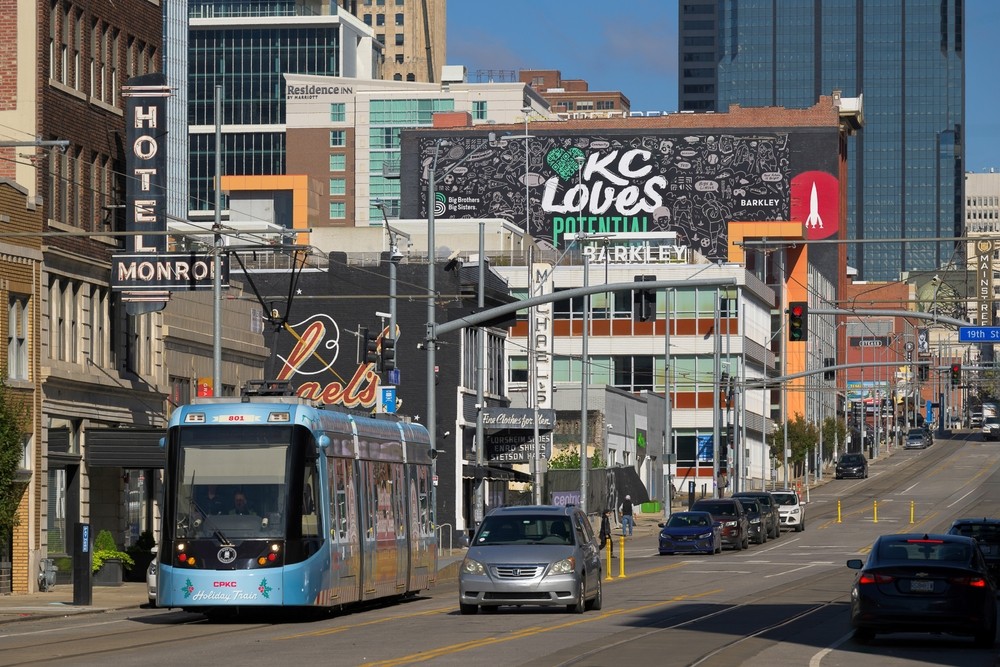
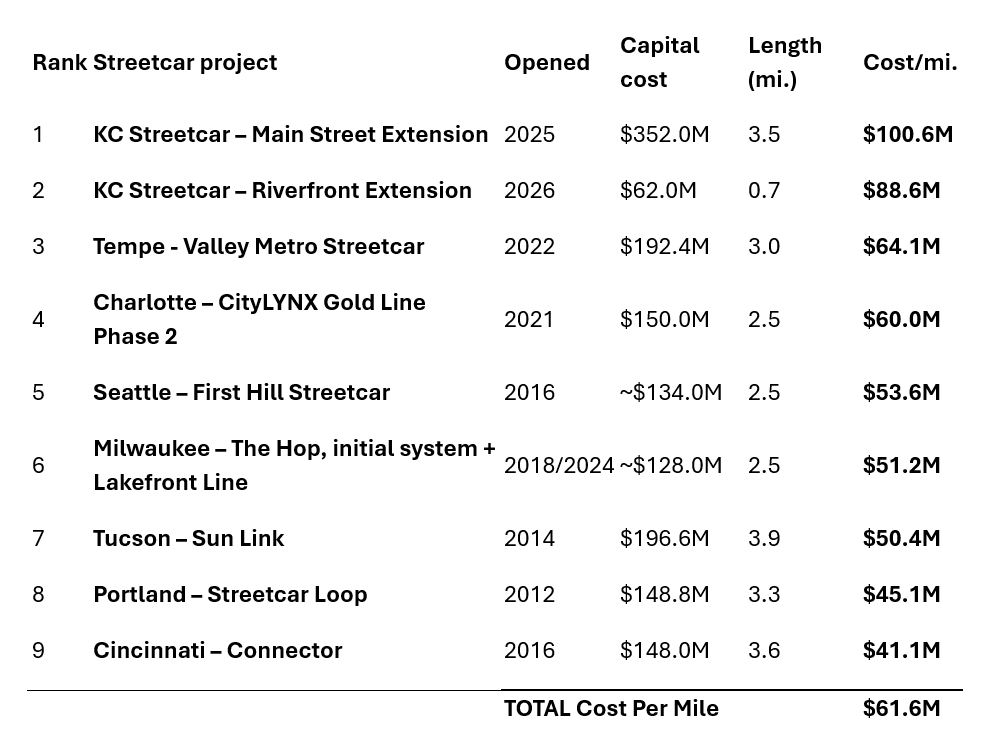
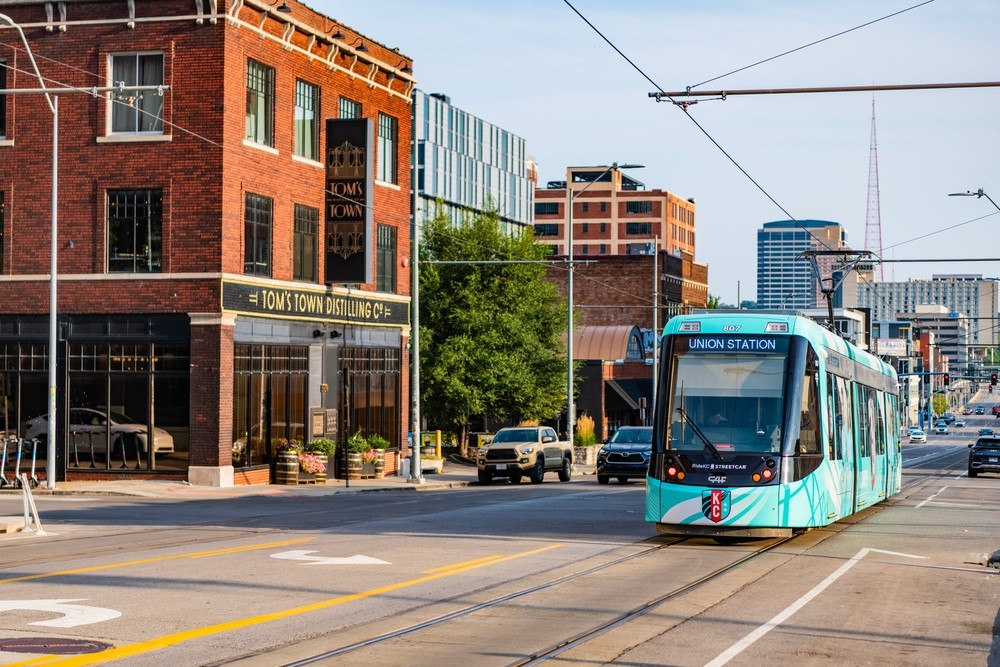
Kansas City just spent over $100 million per mile for its Main Street streetcar extension, making it the most expensive system per mile in the United States. Last year, Randall O’Toole estimated that the average streetcar cost per mile is around $91 million. It’s worth looking at some recent examples to see if that number is accurate.

Looking at recently opened systems (see table below), the cost per mile seems to be lower, at about $61.6 million. Note that I am excluding the yet-to-be opened Orange County line, which may run as much as $156 million per mile, and the Sacramento line (~$47.7 million per mile), which had been paused because of construction costs.

Former Kansas City City Manager Brian Platt told KCUR radio in 2024: “These things cost $150 million per mile.” That’s way off the mark, but important because Kansas City is considering a few other extensions to the streetcar line. If $150 million per mile is the baseline cost, streetcar passengers won’t be the only ones taken for a ride.

The KC Streetcar’s Sales Tax Claim

In a recent essay for the Missouri Independent, I responded to an op-ed in The Kansas City Star by former Kansas City Mayor Sly James. In the piece, he extolled the streetcar for helping the city grow, and claimed the streetcar is an opportunity to bring the city together.

The mayor’s piece was mostly fluff—and several assertions he made were flatly wrong. One of them involved the success of the streetcar to drive the city’s economic growth, using sales tax receipts as evidence.

I first learned of this claim after I authored a piece in the Star in July 2024. In that column—and here on the Show-Me Institute website—I used property tax assessment data provided by Jackson County. From 2014 through 2023, the total value of the streetcar transportation development district (TDD), which runs along the entire route of the streetcar, grew at the same rate as the county as a whole. If the streetcar were truly a driver of economic development, one would expect to see the values in the TDD rise faster.

The streetcar authority, in a May 6, 2019, press release, does provide evidence of increases in total market value within the TDD, but it doesn’t go the extra—and necessary—step of comparing it to the county. Such growth may seem impressive, until you realize it was happening in places nowhere near the streetcar.

Even if the streetcar TDD property values had risen faster than property values elsewhere, it’s possible that the cause was something other than the streetcar. It could have been due to the number of other development subsidies handed out along the route. But the data show us that there is no growth, regardless of the reason.

After the piece was published, streetcar supporters alluded to the growth in sales tax receipts within the TDD, but did not share any information to back up this claim. James refers to this too in his recent piece, writing: “Sales tax receipts generated within the Transportation Development District surged by more than 65% following the line’s opening — far outpacing citywide growth.”

It appears that the source of these data is a 2019 article in Metro magazine in which the head of the KC Streetcar Authority, Tom Gerend, writes:

Sales taxes within the streetcar’s downtown Transportation Development District, a revenue-generation mechanism, have increased by 65% compared with approximately 16% growth citywide over the same period. Downtown is growing at a faster rate than the city as a whole and proving to be a strong economic engine.

That claim is from a press release dated September 14, 2016, on the streetcar authority’s own website. It reports that sales tax receipts grew by 58% from 2014 through 2016, versus 16% citywide. That May 6, 2019, press release repeats the sales tax increase claim, except at 60%.

Let us assume some version of these numbers is true. The TDD is a small district, and it is entirely plausible that even two or three downtown venues saw a big growth in their sales tax receipts. That may account for such impressive growth in a small district that wouldn’t cause much of a ripple citywide. What it doesn’t tell us is whether that sales tax growth was throughout the TDD, or whether it was due to the streetcar. That’s clearly what streetcar supporters want readers to believe. They may believe it themselves.

It reminds me of what former Show-Me Institute researcher Joe Miller uncovered in June 2016: even the Federal Transit Administration pointed out that “Almost all [civic] representatives interviewed believed that streetcars positively affected the built environment, particularly in attracting new development. . . .  Few, if any, streetcar system operators seek information on their impact on economic activity, although most interviewed consider economic-related questions to be vital and desire further research on this topic.”

That’s damning.

Streetcar operators believe it; they just can’t prove it. Apparently they don’t even try.

Kansas City is considering expanding the streetcar system. We will likely hear all these economic benefit claims again. But until we see meaningful data, the claims can’t be taken seriously.

Support Us

The work of the Show-Me Institute would not be possible without the generous support of people who are inspired by the vision of liberty and free enterprise. We hope you will join our efforts and become a Show-Me Institute sponsor.

Donate
Man on Horse Charging