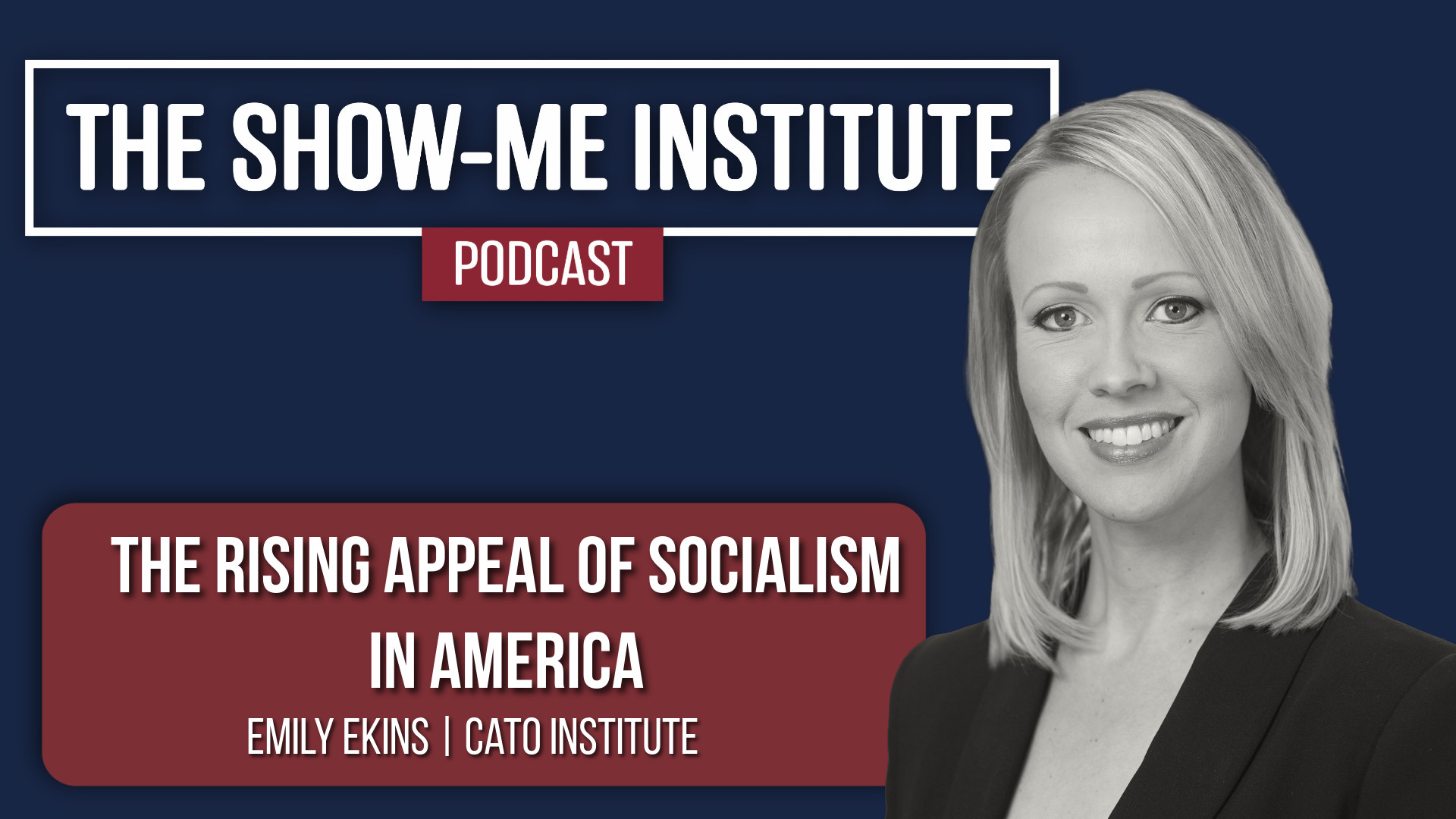
Susan Pendergrass speaks with Emily Ekins, vice president for policy and society and director of polling at the Cato Institute, about new survey data on Americans’ declining civic knowledge and growing openness to socialism. They discuss why younger Americans are less averse to socialism and communism than older generations, what Cato’s polling reveals about basic civic knowledge gaps, why the founders prioritized protecting rights and freedoms above solving economic problems, the psychological concept of locus of control and its link to support for socialism, and more.
Episode Transcript
Susan Pendergrass (00:00):
Thanks so much for joining us on the podcast. Emily Ekins, you are at the Cato Institute, vice president of politics and society and also director of polling, right, Cato? Thanks for
Emily Ekins (00:10):
That’s correct, yes.
Susan Pendergrass (00:11):
joining us. You guys do lots of great polling and survey that you did recently this summer that kind of coincided with the two hundred and fiftieth birthday of the United States particularly caught our eye, and I appreciate you coming on to talk about it.
Emily Ekins (00:25):
Thank you for having me. Glad to talk about it.
Susan Pendergrass (00:28):
Yeah, I mean, honestly, there’s a lot in the news these days, multiple surveys coming up with results that I guess some people are shocked by, but clearly within this week we’ve had new election results, and something about the idea of socialism is really resonating with folks in the United States right now. Why do you suppose that is?
Emily Ekins (00:52):
Well, that’s a really tough question. I think
Susan Pendergrass (00:53):
That’s a big question. But first of all, you could tell us what your poll found on it, but your poll supports what many of them support, which is that views on socialism are more positive than they’ve been in the past, and views on capitalism are more negative. And I just wonder, since you’re out talking to people, why do you suppose?
Emily Ekins (01:12):
Yeah, so first let’s separate out young people from older people.
Susan Pendergrass (01:17):
Okay.
Emily Ekins (01:17):
especially Americans who grew up and came of political age during the Cold War, they know what socialism is and they know how many tens of millions of people it murdered over the past hundred years or so. And so there’s really a strong aversion to the word socialism, to the word communism, among people of that older generation. But there really is a drop-off. And it’s hard not to think that the Cold War ending had something to do with it, where these younger generations had less reason, perhaps, or teachers didn’t talk about why not socialism, why not communism, it just doesn’t work. And so right now, a lot of young people are worried about affordability, and particularly housing. I have to say, looking through the data, it seems like housing may be kind of a linchpin here, that people who are really struggling to afford their rent or their mortgage, or paying a large percentage of their income on housing, they’re very susceptible to these arguments, because people come around and say, well, we’re going to lower your price, the cost of living. The problem is that these policies, centralized economic planning, just does not work. It has the same set of consequences. But I think economic anxiety is part of it. But there’s actually more to it, and I’d love to talk to you about that, because our survey was connected to America’s 250th and the Fourth of July. We launched it right before the Fourth of July, but we had a lot of questions on our nation’s founding. What led to the founding and the creation of our country? And I think what we found is that young people know next to nothing about things that matter. We asked, we had a series of civic questions, seven questions. They only answered one of seven correctly. The one they answered correctly was, who was the first president? And 70% knew it was George Washington. And I thought, well, good, at least they know that. But the problem is they don’t know the more important questions. Why did we declare independence from Great Britain? Why did we adopt the Constitution of the United States? What is the purpose of the Constitution of the United States? And without knowing the why, it’s really easy for other people, trying to curry favor and win votes, to come in, rewrite history, and basically tell young people that they offer an alternative program that will solve their problems. And without knowing the history of why we set up a system of limited government, when they hear these alternative proposals, they don’t understand where it could go wrong.
Susan Pendergrass (04:10):
Yeah, and just to clarify, some of the questions you asked were like, how many branches of the federal government are there? And half, almost half, of the respondents got it wrong, right? They did not know it was three. What country we fought in the Revolutionary War, a lot of folks didn’t get that right. I mean, some of these very basic questions, and that jumped out at me immediately, like when you ask somebody their opinion on socialism and they don’t know how many branches we have of our federal government, how could they possibly answer that question in an informed way? Right.
Emily Ekins (04:40):
Yes, no, I’d love to share something with you. We kind of got into the weeds on this one question. We asked a question where we said, what is the purpose of government? Is the purpose of government primarily, not to say there’s no other purpose, but what’s the primary purpose of government, is it to protect rights and freedoms, or is it to solve economic and social problems, or both equally? And about a third of all Americans, so this isn’t just looking at young people, this is all Americans, only a third of Americans said to protect rights and freedoms. Most everyone else said it was either both equally or to solve economic and social problems. And so here’s the fun part. We took this question and we loaded it into four of the leading AI models, so Grok, ChatGPT, Claude, Google Gemini. We said, feed in all of the writings, speeches, drafts, letters, published and unpublished works of the American founders. How would they have answered this question? And all four models came back with the same answer. They said, this isn’t even contestable, this isn’t even hard, it was very clearly number one, which was to protect rights and freedoms. So why? Well, so that’s why I’m saying the why really matters. Teaching young people, teaching Americans the why. Why did the founders think it was protecting rights and freedoms? Aren’t there complex economic and social problems we want to tackle? Well, here’s why. The argument they made was, they weren’t anarchists, they wanted the government to do some things, but they recognized that when government was not constrained in its power, and was not governed by consent of the governed, right, that problems happened, that government exploited people, government oppressed people. And so there was a hierarchy of goals here, and the main goal was government needs to protect rights and freedoms first. And then everything else has to be subordinate to that. And as long as your program or your idea does not require the government to fail in its duty to that first goal, which is to protect rights and freedoms, then you can have a discussion. And apparently, this was just the thing the founders agreed on. Now, you had Alexander Hamilton and Thomas Jefferson, different sides, different opinions about the role of government, but I thought that is the argument, that’s the discussion I think is missing from our current framework, which is why. Why is unlimited government dangerous? Why do we want to limit it? Isn’t it obstructive? Isn’t it preventing us from solving problems that we need to solve? Well, here’s why. And then if you want to have government do X, Y, or Z, make sure we don’t undermine liberty in the process of doing it.
Susan Pendergrass (07:41):
Yeah, I think that’s right, but then you also see, okay, so absolutely, when you talk to folks who are gravitating towards this new idea of socialism and democratic socialism, it’s like, well, I think
healthcare should be free for everybody, I think housing needs to be affordable, I think childcare needs to be affordable, without kind of taking that next step, which is to say the government’s going to pay for everything. And then the government’s going to decide. I’ve talked to people who like this idea, and they’re like, I’m
Emily Ekins (08:07):
Mm-hmm.
Susan Pendergrass (08:08):
willing to give some of my paycheck to help do this. And I’m like, but there’s central planning involved. They will decide how much of your paycheck and they will decide where it goes to. And that is, they, whoever’s in office. Like if you don’t like the people in office today, they, we are the central planners. That’s how it works, and generally they haven’t done a good job at it. But on the other hand, they’re like, I just want people to have healthcare and I just want people to have housing, what’s wrong with that? Without realizing, I think, to your point, this idea of the social contract, where the government only governs by the consent of the people, I just think that violates that in a way that says, we’ll give all the power to the government and we’ll let them decide how that gets redistributed. Not to mention the fact it’s never worked. It’s been tried multiple times and has never worked, but it sounds so attractive right now. And
Emily Ekins (08:57):
Right.
Susan Pendergrass (08:58):
I also think part of that attractiveness that comes out in your survey is people recognize that currently there is a feeling that capitalism is turning into crony capitalism, and there’s a lot of fears around fraud and things at the federal level, that I think is not only making socialism more attractive but is kind of giving capitalism a bad name. What do you think?
Emily Ekins (09:28):
Yes. Okay, there’s so much I agree with what you were saying there, and there’s a lot to unpack. I think that there’s two things going on when we’re talking about, like you said, people just want affordable healthcare, they want people to be able to afford their housing, childcare if they need that, and so forth. So there’s two issues. One is abuse of power, and then what actually works. So one is, make sure that you don’t give government too much power, because it always leads in the same direction. Can someone show me an example where unchecked government power ever didn’t result in the oppression of the people? I would
Susan Pendergrass (10:07):
Yeah.
Emily Ekins (10:08):
love for a democratic socialist to point that out, because there isn’t one. That’s something we’ve learned through the test of time. The second thing is just more pragmatic, centralized economic planning, where the government says, we’ll take more of your taxes and then we’re going to plan out your healthcare, your childcare, we’re going to, when it comes to housing and things like that. Whenever you centralize economic decision making, we have some data on that, and it has never worked, because of something called the knowledge problem. Nobel Prize-winning economist F.A. Hayek wrote extensively about this. Those government experts, you could take the whole faculty from Harvard and MIT and Yale, and have them sit on a board and try to figure this out, they would not do as good of a job as millions of Americans making individual decisions when they’re free and able to do so. Now, people would say, well, then why isn’t the free market working in healthcare, why isn’t the free market working in housing? And the argument is this: that’s not the free market. That’s actually
Susan Pendergrass (11:16):
Right.
Emily Ekins (11:17):
government, excessive government management of those areas. Like with housing, there’s a lot that goes into it, and I’m not going to go, we don’t need to go into all of it, but there’s just some simple things, right? When you think about supply and demand, if you have more people in demand of housing than you have supply of it, the first thing you should look at is, are we limiting the supply of housing in some way? And if the answer is yes, start there before we have the government seizing property from landlords, for heaven’s sakes. So there’s some first steps that people should look to. But again, without civic knowledge, without economic knowledge, how could we expect people to do that?
Susan Pendergrass (11:57):
I mean, that’s the basic point, right? We talked a little bit before we started, like Missouri, our kids aren’t even learning to read. So I understand that we need to do a better job of teaching civics and history and geography, and certainly at the federal level, there’s NAEP tests on those things and the results are terrible. And the results of your survey are dismal when it comes to why younger people, what their civic knowledge even is about how the government works and why it was founded. But I don’t see how we can begin to tackle that, or what is capitalism, what is socialism, and who are Lenin and Stalin and Friedrich Hayek, how do we tackle that if they can’t even learn to read? I feel like we’re
Emily Ekins (12:36):
Yeah.
Susan Pendergrass (12:37):
we’re slouching towards Gomorrah, it’s like, I feel like we need to start at these basic levels and then try to take on civics and history, but I could see you thinking we need to do them simultaneously. What do you think?
Emily Ekins (12:52):
Well, yes, to your point about wanting to raise the reading level of kids in Missouri, my very first thought was let’s think about Mississippi versus California, and the dramatic differences in reading competency between the kids in both states. One state implemented better processes, phonics, right? Phonograms, phonics.
Susan Pendergrass (13:17):
Yes. Yes.
Emily Ekins (13:19):
I was raised in California, they were like, we’re not going to do something new, we’re going to teach it this new way, like sight words, and learn by absorption. Anyway, some things work better than others. And when economic decisions like education are made in a centralized fashion, and the centralized planners get it wrong, then all the students suffer. So what can we do about that? Well, more school choice, that’s one approach that we could look at, and then also doing a better job at figuring out what works, what doesn’t work, and actually implementing it. Public education is not a jobs program for adults, right? It’s for children.
Susan Pendergrass (14:03):
Yeah, I’ve heard it argued both ways, honestly, in Missouri, but that’s it.
Emily Ekins (14:06):
Well, we care about both. We want teachers and students to be taken care of well.
Susan Pendergrass (14:11):
Yes.
Emily Ekins (14:11):
But again, if we have experimentation, competition, where people are actually innovating, apply what works. But if we just have it centrally determined by one small group of people and they get the answer wrong, lots of kids suffer.
Susan Pendergrass (14:30):
So where do you see this heading? You know, Zohran Mamdani is opening up government grocery stores in New York, and as somebody who grew up in the sixties and seventies, I can only think of what happened in the Soviet Union when they had government grocery stores, and there were lines and they were terrible. The fact that that isn’t an attractive idea to anyone kind of blows my mind. So where do you see this going? Are they going to have to, is it going to have to play out? Rent controls and government grocery stores and free childcare, are they going to have to play that out and see that it doesn’t work? Or what do you think is going to happen ten, twenty years from now?
Emily Ekins (15:09):
Yeah, it’s hard to say. Maybe they’re going to just do a live demonstration for us so we can repeat and learn exactly what we learned every other time government
Susan Pendergrass (15:17):
Yeah.
Emily Ekins (15:18):
tried to do these things. I mean, it’s just like a huge eye roll. Like, what are they doing? We
Susan Pendergrass (15:23):
Right.
Emily Ekins (15:23):
have some data. I mean, I think that a lot of these leaders would purport to support the idea of scientific research, academic research. Well, consult that. What does that say will happen with government-run grocery stores? It’s not going to go well. But
Susan Pendergrass (15:41):
Right.
Emily Ekins (15:42):
I understand, again, his goal, people could say, is noble. But
Susan Pendergrass (15:46):
Right.
Emily Ekins (15:47):
markets actually deliver that better than government, and empirically there is evidence to support that.
Susan Pendergrass (15:55):
I mean, New York’s had rent control for a long time. I just am kind of surprised, if it’s not maybe the person and the personality, I just don’t understand. And again, I go back to thinking to myself, right now we have a group of folks with a lot of money. We have our own president making a lot of money in office, and he’s hanging out with people with a lot of money, Elon Musk, Jeff Bezos, and maybe if people are associating that with capitalism, maybe what they’re saying is they want to reject that.
Emily Ekins (16:27):
Yes, I think that that’s exactly right. There’s something called policy moods, where when you have a Democrat in office, the voters tend to say they want smaller government. When you have a Republican in office, the voters start to say they want bigger government. This is a well documented phenomenon, that kind of whoever’s in office, voters will tend to go the other direction. And I too have wondered that very thing, if having a billionaire for president and having him be friends with lots of billionaires, anyone that’s like, well, I’m against them, then whatever they stand for. So if they were religious, then they’d probably be like not as religious, depending on how they’ve really been framed. And I think Trump has been framed as this billionaire capitalist. And so I think that that is definitely playing a role here. I also think that there are some
deeper trends happening in the American electorate, and we probably don’t have time to go into that in too much depth. But
Susan Pendergrass (17:24):
Let’s try. Yeah.
Emily Ekins (17:25):
what I would say is I think some of the problems are psychological, in kind of almost a spiritual psychological sense, not religious, I’m talking about something else. I’m talking about this concept of the locus of control. In psychology, there’s this idea that people can differ to what extent they explain events in their lives as being within their control, or outside their control. And people who think of things inside their control, they’re more likely to be happier and earn more money, have better relationships, better friendships, be healthier, less likely to get in fights, because they think that they have some say in what’s happening in their lives. They think their choices matter. Now, for the external locus of control group, psychologists have really worried about this, because all the good things I just mentioned just reversed, flipped, worse grades, worse health outcomes, poorer relationships, more likely to get in fights when they’re in high school, because, you know, if people think, well, it’s not my fault, they’re just a victim of circumstance, then it’s harder for them to feel like their choices matter. Well, anyway, at a more societal level, what we are observing is that each generation of young people, when asked survey questions to measure their locus of control, they’re becoming more and more external in their locus of control. What that means is, young people, each generation of young people, we’ve been studying this since the 1970s, this is Jean Twenge’s work, each generation of young people is more likely than those before them to say external forces are shaping their lives. They’re less likely to believe that their own agency is what matters in their lives. Now, the reasons for that are complicated, multivariate, and
Susan Pendergrass (19:22):
Sure.
Emily Ekins (19:23):
complicated. But what the consequence of that is, is that we do know this, people that have an external locus of control, they externalize the events in their lives, they are far more drawn to socialism. That’s just the way it is. They’re drawn to socialism, a zero-sum view of the world, it’s like us versus them. And some really bad things can happen when people go down that route. There’s a lot more tolerance of political violence, and we’re seeing that play out. And so the question is, well, why is that happening? I don’t have all the answers to why, but I do think we should recognize that it is happening, and it’s not just economic, it’s not just political, it’s at the level of psychology.
Susan Pendergrass (20:05):
Yeah, and were we to enact the agenda of some of these democratic socialists, then we would simply be, I think I heard somebody say, fitting people for cement shoes. We would simply be putting them more into the externalist camp, right? Where it’d be like, I depend on the government for food, housing, healthcare, and childcare, I have no control over my life. And if they decide to raise how much or lower how much, or put in a work requirement, I have no control over how well my family’s doing or my own well-being, because it all depends on these decisions by the government, doesn’t that exacerbate this idea of externalism?
Emily Ekins (20:48):
Well, that’s actually the irony here. So evolutionary biologists have actually gone through and documented what happens here, is that kind of this external locus of control will lead people to support policies that actually make the world more external, meaning
Susan Pendergrass (21:04):
Oof.
Emily Ekins (21:04):
that they have less control over the situation. So, in the case of the 2008 financial crisis, in which they were really examining this, the crisis will make people feel like they lack agency, because understandably a recession is not the fault of any one person. So then those voters go out and vote for politicians who promise to do X, Y, and Z policies that actually will, ironically, make another recession more likely, will actually slow the economy, make things worse. And so it’s interesting from an evolutionary biology perspective, how that can happen, those negative feedback
Susan Pendergrass (21:40):
It’s a self-fulfilling prophecy. Well, what’s the policy implication of that? Or what do we do to try to stem that tide? I mean, I’ve heard folks say, number one, we improve high school education in regard to civics, history, and economics. Maybe, I don’t know. That feels like a very
long term goal that’s unlikely to have any real impact, but what do you do from a policy point of view?
Emily Ekins (22:05):
Right, no, that gets tricky. I feel like a book could be written on this topic.
Susan Pendergrass (22:09):
Yes. Mm-hmm.
Emily Ekins (22:11):
But I do think, like, the way I’ve thought about it mostly is from a perspective of kids, and how do you raise each rising generation to have a more internal locus of control rather than external. Right now we’re doing the opposite. And, you know, just anyone that’s a parent of young kids, I think you can probably, or if you’re a parent of children at all, you’ve probably seen this in action, where kind of the zeitgeist in our public schools, the zeitgeist, and especially social media, is not helping, where like you can see at micro levels how we all the time are telling young people it’s not their fault, it’s forces beyond their control. I do think that in colleges and universities, as well as K through 12, critical race theory and ideologies that are similar to that really emphasize the external. That’s not to say that external forces like racism or sexism don’t exist or don’t matter, that’s not what we’re talking about. But if you tell kids the reason for the challenges you face are due to insurmountable challenges that you cannot overcome without electing this politician, that’s teaching young people an external locus of control. So at the college level, it’s rampant, and I don’t observe any efforts on the part of administrators or faculty to recognize the psychological harm that they are doing to their students by propagating ideas that really turn the attention of their students to focus and emphasize on external forces.
Susan Pendergrass (23:43):
Yeah, there’s certainly folks like Ian Rowe out there who are fighting hard against it, to say don’t
Emily Ekins (23:48):
Yes.
Susan Pendergrass (23:48):
you dare talk to our kids that way, but I think you’re exactly right, we don’t even talk about AI. But I can see us heading for a big correction, and if that’s what it takes, that’s what it takes. But it’s hard for me to foresee a future where the idea of the government taking care of things for everybody loses popularity. I just don’t see
Emily Ekins (24:18):
Right.
Susan Pendergrass (24:19):
where we’re going with it. Like, I just don’t know.
Emily Ekins (24:23):
And here’s why it works. This is what I would also remind people is that when the government runs businesses or runs industries, we observe the same sorts of consequences. It’s all a matter of degree, longer wait times, lower
Susan Pendergrass (24:35):
Yeah. Yeah.
Emily Ekins (24:37):
quality services, limited access to kind of the best of the quality. So, like in healthcare, for instance, the more government gets involved, and this is, there’s academic papers that demonstrate this, it’s quite clear, you have less access to the star doctors, to the star hospitals, to the highest ranked, in terms of quality. And think about it, if you have a cold or the flu and you need something minor, for instance, a government-run healthcare system, I think, probably seems great in that situation.
Susan Pendergrass (25:11):
Yeah.
Emily Ekins (25:12):
But what if you have a life-threatening illness? You don’t want long wait times. You want the best quality. You want to have access to the best doctors and providers, clinicians. Unfortunately, the more government gets involved in running things, longer wait times, lower quality, less access to the best. And it is like that everywhere it’s been tried. And I think we should do more to push back, to say no, they will fail to deliver what they’ve promised, and here’s why.
Susan Pendergrass (25:45):
Yeah, I know somebody who moved to Canada for the healthcare system and currently has a torn ACL. Surgery is
Emily Ekins (25:52):
Oh no.
Susan Pendergrass (25:53):
scheduled for like twelve months from now. And that’s like a year wait to fix a torn
Emily Ekins (25:56):
Oh my god. Yes. Wait time. Wait time.
Susan Pendergrass (26:00):
I assume it will heal itself, but I mean, I don’t think that reality sinks in. Certainly there’s a lot of work to be done, and there’s a lot of people with a lot of great ideas. You mentioned one I work on all the time, school choice, to improve outcomes in education for everybody, and give all kids, regardless of income, more opportunities. That’s what you do. You make the schools perform for the families. But even that faces incredible headwinds. And there’s great ideas out there around healthcare and around housing. We had Bryan Caplan on talking about, just build more housing. San Francisco, it’s impossible to buy a house, build more, stop regulating and over-regulating where they can be built. We know that there are some things that could work, but instead I think it just must seem easier to just have the government print the money and pay for it. I just don’t know. That’s why I think we might have to see a correction of some sort, because when I see in your poll that of the eighteen to twenty-nine year olds, thirty-eight percent had a positive view of communism, that means that we have an incredible work ahead of us. I mean, communism,
Emily Ekins (27:15):
That’s right.
Susan Pendergrass (27:16):
like Stalin, and like, yes, what led to genocides, and they must, I don’t think that side of communism is out there. So
Emily Ekins (27:28):
No. And I think there’s an organization that has polled on this, and we should do some polling as well. But most young people just don’t, I think they
Susan Pendergrass (27:34):
Yeah. I don’t know.
Emily Ekins (27:36):
run out of time after World War II, and like everything after that, they just
Susan Pendergrass (27:40):
Yeah, yeah, yeah.
Emily Ekins (27:41):
too. I was a studious student, I paid attention, and we didn’t get to any of that. Like
Susan Pendergrass (27:47):
No, yeah.
Emily Ekins (27:47):
the Cold War, the Cultural Revolution, Mao’s Cultural Revolution, the Khmer Rouge, like all of these communist revolutions that killed probably upwards of a hundred million people. How did we run out of time to talk about that? Might there be some value in us
Susan Pendergrass (28:02):
Right.
Emily Ekins (28:02):
learning some lessons of the very recent past?
Susan Pendergrass (28:06):
Yeah, absolutely. Okay, well, what’s next for you guys in terms of what we can look for, for more interesting polls? I know you’re always doing
Emily Ekins (28:14):
Yes, actually, we are in the process right now of writing an exciting survey where we’re looking at economic populism and democratic socialism. And this is where I get really excited. We’re looking at the psychological correlates of those types of policies. What types of psychological traits and underlying beliefs and assumptions correlate with support for these types of economic policies? So we’ll have to wait to see what the data says, but I’d love to share it with you.
Susan Pendergrass (28:45):
That’s awesome. Thank you so much, Emily. I really appreciate it. I could talk to you forever, but let’s wait and come back and talk about that one. I do really appreciate it.
Emily Ekins (28:54):
Thank you for having me.
Produced by Show-Me Opportunity