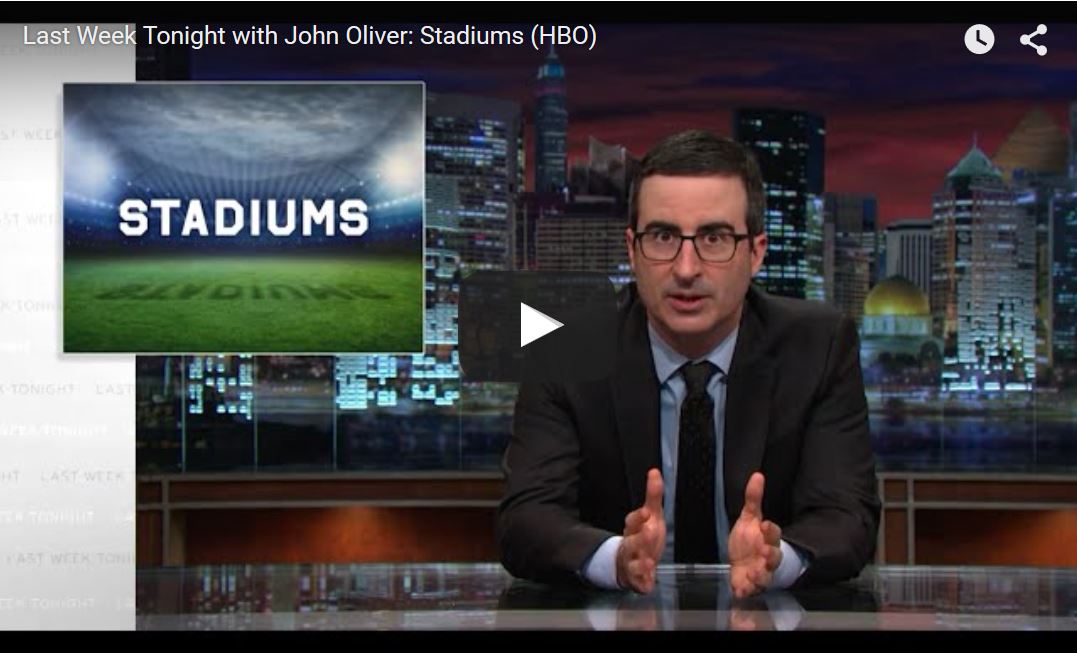
Last week, comedian John Oliver took on the public funding of sports stadiums on his popular HBO show, Last Week Tonight. The segment echoed the conclusions of economists and our previous writings: Stadiums do not generate economic development and are unlikely to expand tax revenue for cities. With a great deal of humor (and some off-color language), Oliver argues billionaire owners should pay for their own stadiums, and that Saint Louis is much more than just the Rams. Watch the video here.
Land Taxes and Columbia

This past Saturday, the Boone County Chapter 100 Review Panel approved a property tax abatement for Kraft Heinz so that it can modify its plant in Columbia. As I mentioned previously, this would be bad policy. But beyond saying no to awarding subsidies, is there anything Boone County should be doing to make it more affordable for Kraft (and other businesses) to expand and/or modernize?
Boone County could cut its property tax rate. This not only would help Kraft, but all the other property owners in the county as well.
Even better, Boone County could shift away from property taxes and toward a land value tax. Land value taxes are taxes levied against the unimproved value of land and not the buildings, personal property, or other improvements on that land. A broad spectrum of economists support the land value tax versus other types of taxes because it is non-distortionary (i.e., it doesn’t alter behavior, unlike income and sales taxes).
If Boone County imposed a land value tax instead of a property tax, companies like Kraft would not face increased taxes after improving their plant. Unfortunately, only Kansas City is allowed to levy land value tax. There would need to be a change to the State Constitution in order for Boone County to levy a land tax.
Boone County (like other counties and cities) faces a difficult dilemma. It either can erode its property tax base with abatements to select businesses or risk having those companies being lured away to locations that offer subsidies. A land value tax won’t completely eliminate that problem (a jurisdiction could offer to not tax the land at all or provide that business some type of tax rebate), but it will make it more financially viable for businesses to expand facilities already present. If the State Constitution were changed, counties would have another policy option available to retain businesses other than having to resort to tax abatement.
Mission: St. Louis Provides Summer Learning Opportunities
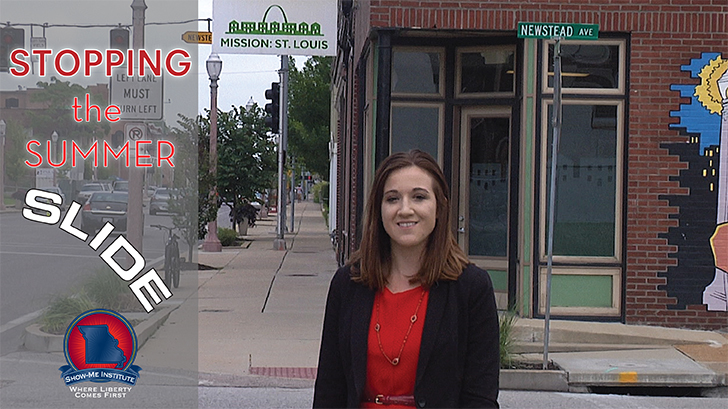
When Executive Director Josh Wilson founded Mission: St. Louis in 2006, he had a goal—eliminate poverty in Saint Louis City within six months.
“I was just really stupid. I just thought that if we had enough money, people, resources, we would eradicate all poverty in St. Louis,” he said. Of course, poverty persists.
“I think it comes down to really this idea of dignity. . . . I think the biggest mistakes that can happen is to go like, ‘Hey I feel sorry for you,’ and when . . . we’re motivated out of feeling sorry . . . I think we do way more harm,” Josh reflected.
Now Josh has a different plan—“empower people to transform their neighborhoods.” The organization has been successful. Since it’s founding, Mission: St. Louis has helped men like Eddie find employment, provided after-school support for students and families, and facilitated home improvements.
Additionally, Beyond School, a division of Mission: St. Louis, has developed a summer program to combat the summer slide.
The summer slide (or summer learning loss) occurs when students in low-income communities lack learning opportunities during the summer. Many students from wealthier backgrounds have summers filled with trips to museums, camps, and other enriching activities. Low-income students do not. In fact, one study showed that more than half of the achievement gap between low-income and high-income students can be explained by students’ experiences in the summer.
While some have rallied around policy reforms such as year-round schooling to fix this problem, Mission: St. Louis demonstrates that the key to closing the gap between high- and low-income students is not only providing low-income students with learning opportunities, but also by providing a choice in what those opportunities are. This leads to more investment from the student and an all-around more positive experience.
I encourage you to check out our new video about the summer learning opportunities provided by Mission: St. Louis.
Rank Hypocrisy from the Kansas City Star?

On July 10, 2015, the Kansas City Star editorial board bemoaned the state of mental health care in Kansas. Of the states system, they wrote:
Advocates argue convincingly that it is overburdened and underfunded at nearly all levels. A system that at one time was well regarded and innovative is staggering from high demand and too few resources.
The lack of options leaves families of mentally ill individuals in a fearful limbo. Police officers and jails end up dealing with people who should have access to doctors and hospitals.
Surprising no one, the city’s paper of record faulted inadequate funding:
But state funding for a network of outpatient community mental health centers—the first stop for many patients—has been cut in half since 2008. Patients often wait weeks for medications and a treatment plan.
We don’t take issue with the Star‘s conclusion. Tight budgets at every level mean that policymakers have to make difficult choices. What is unfortunate is the Star‘s request to be exempted from having to pay their own fair share of taxes—taxes that would go to support these programs. The Star is asking to extend for 15 years the tax abatement on its downtown printing press. As a result, the Community Mental Health Levy in Jackson County, Missouri, will be denied $245,000 over 15 years. That is a quarter-million tax dollars from the Star‘s single property.
This request comes after the Star had Jackson County reduce their assessment from $42 million in recent years to $22 million in 2015. The folks at the Star seem to have put a lot of effort into avoiding paying taxes on their downtown printing and distribution center. And it’s easy to see why; what the Star prefers not to pay toward mental health is small compared to what they would avoid paying toward Kansas City schools ($10 million), Kansas City ($2 million), and Jackson County ($1 million).
Certainly, corporations can and do make the case that county property assessments are too high. And many businesses in Kansas City benefit from corporate welfare and crony capitalism of some kind. But shouldn’t we expect better from our newspaper?
If the Star wants to call out local and state governments for cutting spending, giving tax breaks to the wealthy, or handing out sweetheart deals, shouldn’t they refrain from seeking the same for themselves? By advocating a kind of “taxes for thee, but not for me” position, the Star risks being accused of nothing less than rank hypocrisy,
Friedman’s Legacy

For years now, many Americans have acknowledged the shortcomings of the nation’s public school system. While the 1983 “A Nation at Risk” report is often referred to as the quintessential moment in education history when Americans realized the system was failing—one man had already realized the problem, and proposed a solution, decades before.
Milton Friedman first discussed the idea of educational vouchers in the 1950s, arguing that competition between schools would improve efficiency and drive down costs. The idea became popularized during the 1980 television series Free to Choose.
In voiced-over footage of high school-age children walking through metal detectors before entering an urban school, Friedman said:
Isn’t that awful? What a way for kids to have to go to school through metal detectors and to be searched. What can they conceivably learn under such circumstances? Nobody is happy with this kind of education. The taxpayers surely aren’t. This isn’t cheap education. . . . And what about the broken windows and the torn school books and the smashed school equipment? The teachers who teach here don’t like this situation. The students don’t like to come here to go to school. And most of all the parents. They are the ones with the worst deal. They pay taxes like the rest of us. They are just as concerned about the kind of education their kids get as the rest of us are. They know their kids are getting a bad education, but they feel trapped. Most of them see no alternative but to continue sending their kids to schools like this.
So while lawmakers have looked to improve education through top down policies like No Child Left Behind and Race to the Top, Milton Friedman was the first to acknowledge that parents should be in the driver’s seat of their child’s education.
Today, a majority of Americans support educational choice. The Friedman Foundation recently released the 2015 Schooling in America Survey, which found that 63 percent of school parents support educational vouchers. When asked to rank the actions a state government should take in intervening in low-performing schools, 41 percent ranked supply vouchers/scholarships as number one. Twenty-six percent ranked convert the failing schools to charter schools as the number two solution. Clearly, Americans favor options. Still, many do not know about the man behind the idea.
This is why the Show-Me Institute is celebrating Friedman Legacy Day on July 31 (register now). Oklahoma State Senator Jabar Shumate will discuss the effects of school choice on urban issues. Unlike Missouri’s legislature, Oklahoma’s policymakers have helped establish two private educational choice programs—a voucher program for students with disabilities and a tax-credit scholarship for low-income students.
Please register for this event now.
Krafting a Bad Subsidy Package in Columbia
Good news everybody, Boone County is looking to give a tax break to Kraft Heinz so it can modernize! Specifically, it will award Kraft Heinz a 75 percent property tax abatement, which will save the company $4 million in property taxes. But wait, there’s more. Once Kraft Heinz finishes work on the plant, it will end up employing 150 fewer employees.
You read that right. There will be fewer people at this plant when all is said and done. Companies are free to employ as many people as they deem necessary. However, giving out a subsidy to a company so that it can employ fewer residents just doesn’t make sense. Even if the tax abatement led to higher employment at the plant, Boone County would be hard pressed to justify the subsidy since it does not lead to the kind of economic growth that would justify it being awarded.
If Boone County really wants to become a place where it makes sense to locate a business or expand a current one, it should rethink how it taxes property (more on this in another post). There are potential tax improvements that could help not only Kraft Heinz, but all the other businesses in Boone County as well.
Boone County is following the example of many other counties and municipalities by granting subsidies to a local business. That doesn’t mean it’s a good idea. These types of subsidies don’t, in the long run, provide a boost to the local economy. They just make it more likely that the county will hand out more subsidies in the future.
Too Much Testing in Public Education – For Teachers
In recent years, the chorus of voices against standardized testing has grown ever louder. Many today believe that there is simply too much testing in public education. Unfortunately, almost all of the attention on testing has been at the student level. While there is room for good productive debate about the role and nature of standardized testing for students, there is also room for debate about the role tests play in shaping the teacher workforce.
Missouri, like all other states, requires teachers to pass a series of examinations before they can become a teacher. These tests act as a barrier to entry. As I have written before, barriers to entry are only effective if they do what they are supposed to do. In this case, the tests should keep out individuals who would be bad teachers. My research has shown that the relationship between performance on licensure exams and performance in the classroom is pretty weak. Despite this fact, Missouri’s Department of Elementary and Secondary education sees licensure exams as a key driver to improving the quality of the teacher labor force.
Education is not the only area in which tests are used to screen out candidates. For example, lawyers have to take the Missouri Bar Exam, which has three parts. Compare this to the sheer number of teacher licensure exams for those wanting to work in public schools (see below). Whether you are in bankruptcy law, civil rights law, criminal law, corporate law, family law, or any other field in the law profession, you take one exam—the bar exam. In education, however, we have constructed tests for just about every single thing.
Want to be a high school biology teacher? There is a test for that. Want to teach chemistry? There is a test for that. Want to teach earth science, general science, or physics? There is a test for each of those. Oh yeah, and you will also have to take a test of your disposition, the Missouri Educator Profile; a test of general knowledge, the Missouri General Education Assessment; and you’ll be evaluated in the classroom by the Missouri Performance Assessment.
It is understandable to want to ensure that prospective teachers have basic competencies. We will not change the quality of the labor force, however, unless we change the structure of the profession. We must begin rewarding great teachers and become more diligent on removing or remediating the bad ones. As it is, we’ve simply gone test crazy when it comes to teacher certification.
|
Tests to Become a Teacher in Missouri |
Tests to Become a Lawyer |
|
· Multistate Essay Examination · Multistate Performance test · Multistate Bar Exam
|
|
|
Missouri General Education Assessment (MoGEA) · English Language Arts · Writing · Mathematics · Science · Social Studies |
|
|
Early Childhood Education · Early Childhood Education
Elementary Education · Elementary Education Multi-Content o English Language Arts o Mathematics o Science o Social Studies · Elementary Mathematics Specialist
Middle School Education · Middle School Education: Language Arts · Middle School Education: Mathematics · Middle School Education: Science · Middle School Education: Social Studies
Secondary Education · Secondary Education: Agriculture · Secondary Education: Biology · Secondary Education: Business · Secondary Education: Chemistry · Secondary Education: Earth Science · Secondary Education: English · Secondary Education: General Science · Secondary Education: Marketing · Secondary Education: Mathematics · Secondary Education: Physics · Secondary Education: Social Science Multi-content o United States History o World History o Economics o Geography o Political Science o Behavioral Science · Secondary Education: Speech and Theater · Secondary Education: Technology and Engineering · Secondary Education: Unified Science – Biology · Secondary Education: Unified Science – Chemistry · Secondary Education: Unified Science – Earth Science · Secondary Education: Unified Science – Physics
K-12 Education · Art · Family and Consumer Sciences · Health · Library Media Specialist · Music: Instrumental and Vocal · Physical Education · World Languages: Chinese-Mandarin · World Languages: French · World Languages: German · World Languages: Spanish
Special Education · Blind and low vision · Deaf and hard of hearing · Early childhood special education · Mild/Moderate Cross Categorical Special Education · Severely Developmentally Disabled · Mild/Moderate Middle/Secondary Multi-Content o English Language Arts o Mathematics o Science o Social Studies
Student Services · Counselor · School Psychologist
School and District Leadership · Building Level Administrator · Superintendent
Professional Knowledge · Middle School · Secondary
|
|
|
Missouri Performance Assessments · Pre-Service Teacher Assessment · School Leader Performance Assessment · School Counselor Performance Assessment · Librarian Performance Assessment |
|
Use This Money: To Build a New Stadium
There has been a lot of back and forth about building a new riverfront stadium in Saint Louis. Putting aside for a moment the merits (or lack thereof) of publicly financing a new football stadium, there hasn’t been much said (if anything) on what it would take to privately finance a new stadium. A new report from the NFL can give some idea of how much someone would have to pay.
The NFL report analyzes the market conditions in Saint Louis and its ability to support an NFL franchise. Despite the report finding that Saint Louis fares poorly compared to other cities when it comes to attendance and ability to generate additional support for the team, it still had the ability to generate significant revenues for the team through Personal Seat Licenses and ticket sales. In fact, the report estimates that the sale of Personal Seat Licenses can generate a little over $200 million in revenue.
That’s not nearly enough to finance construction of a new stadium, but it is a start. Whether private investors can receive returns to justify spending a further $700-$800 million is an open question. However, if no private individual or group can find a way to make a profit off a new stadium, why should policymakers think that a new stadium would generate a net gain for taxpayers? Likewise, if the stadium was such a great investment, why bother with any private investment? Let taxpayers reap the whirlwind (if it exists).
This new report from the NFL indicates that there is at least some private money available to build a new stadium. Instead of working on ways to spend even more taxpayer money on stadiums, maybe policymakers should work on convincing private individuals to build a new stadium with their own money.
And the Beat Goes On . . .

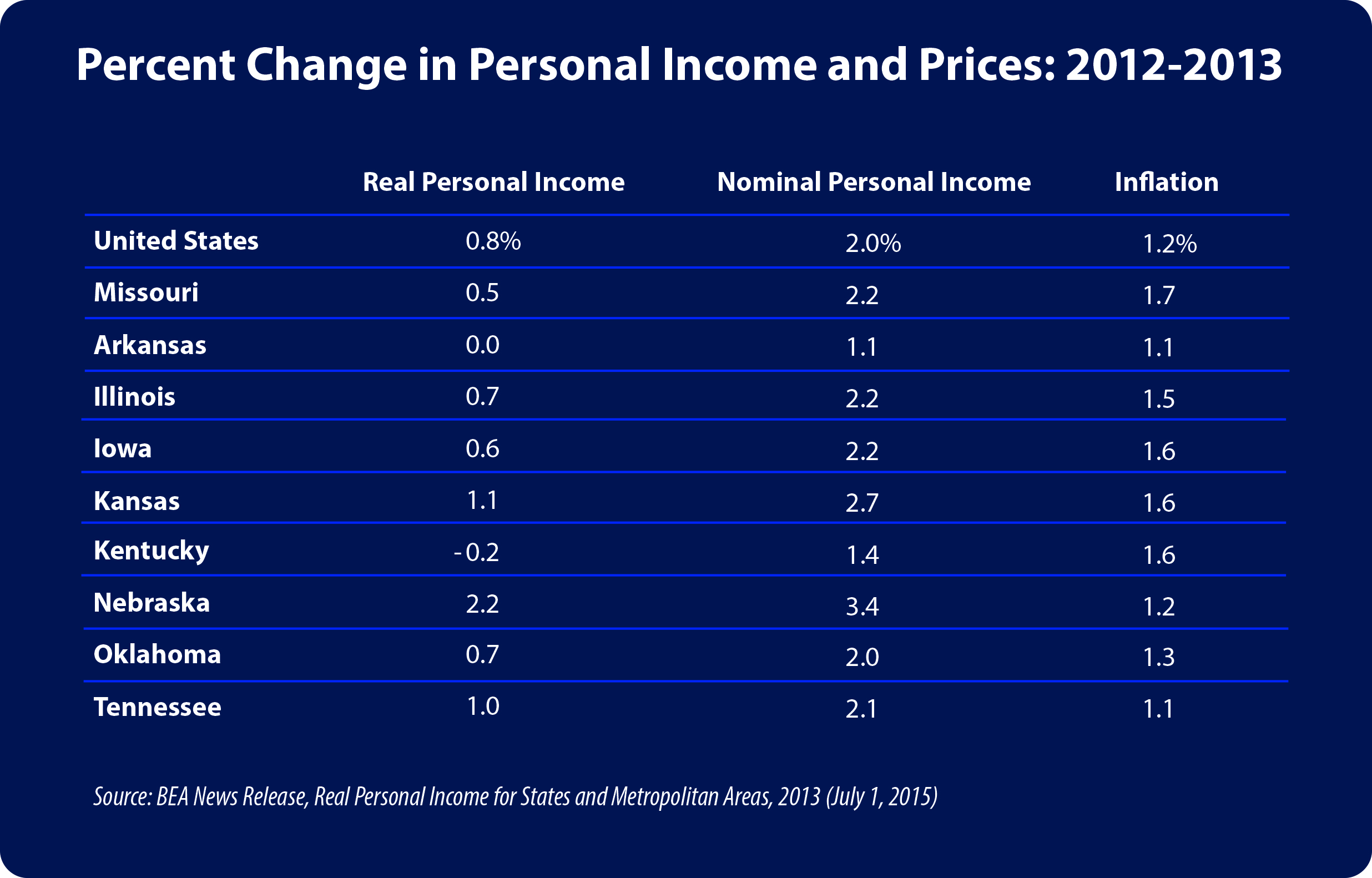
The Bureau of Economic Analysis (BEA) recently released its annual report on personal income growth and prices at the state level. The good news is that personal income in Missouri in 2013, the most recent year for which data are available, increased faster than the national average. Unfortunately, a substantial portion of that increase was eaten up by rising prices. Adjusted for inflation, personal income in Missouri increased slower than the national average.
Can’t we just enjoy the fact that income rose? Increases in income unadjusted for price changes—what economists call nominal income—can give a false signal of prosperity. Think of it this way: If your wage doubles, are you better off? If the prices of things you buy haven’t changed, then, yes, you are. But if the prices of goods and services also doubled, your higher wage buys no more than it did before your raise. So we really should compare changes in real personal income—the equivalent to your wage relative to what it can buy—to see if we actually are better off.
The table below reports the 2013 growth rates in real personal income, nominal income, and inflation for the United States, Missouri, and its neighboring states. The percentage change in real income is equal to the difference between nominal income and the rate of inflation. How did Missouri fare when comparing growth in real personal income?
Real personal income in Missouri increased at a 0.5 percent rate in 2013. This reflects the fact that even though nominal income increased at a healthy 2.2 percent rate, prices increased at a 1.7 percent rate. Though Missouri’s nominal income growth exceeded the national average (2.2 vs. 2.0 percent), the fact that the rate of inflation in Missouri was higher than the U.S. average (1.7 vs. 1.2 percent) explains why real personal income in Missouri rose slower than the national average (0.8 percent). This combination of income growth and inflation also explains why Missouri’s increase in real personal income was slower than in four neighboring states, about as fast as in two, and exceeded that for two others. Among the neighboring states, Nebraska was the clear winner, with Kentucky trailing the pack.
The story from the latest data is that while Missouri’s economy continues to grow, the pace of improvement lags the national average and many of its neighbors.