You Don’t Say

Telling people “I told you so” is probably not a good way to win friends and influence people. However, when you debate something contentious (like stadium subsidies), it’s tempting to gloat when the facts vindicate you.

Hence my struggles after reading this new story in the Post-Dispatch. The story reports that, according to emails from Budget Director Paul Payne, the St. Louis Rams are not generating enough tax revenue to cover the debts associated with the construction of the Edward Jones Dome. Due to the fact that Saint Louis City only collects taxes from the Rams during home games, the players and staff barely pay anything in earnings taxes to the city. This is something we’ve been talking about for months now. The Rams do not pay for themselves and to say otherwise is simply wrong.

Consider these three things:

1. The Dome has not lead to revitalization of the surrounding area.

2. Subsidies for sports stadiums do not generate economic growth.

3. The taxes generated by a new stadium project cannot offset the amount of the subsidy.

Given these points, what economic justification could there be to subsidize construction of a new stadium?

The truth is there is no economic justification for public money being spent on constructing a football stadium. If people want to make the case that football is a luxury good that residents can enjoy, they are free to do so. However, I don’t think it’s good policy to force people in Springfield, Kirksville, and Joplin to pay for a luxury good in Saint Louis.

Sometimes it isn’t fun to be right. Still, when the facts bear you out, it’s worth mentioning. I hope policymakers consider this when deliberating on whether more subsidies is the way to go.


Indiana Toll Road Sold to New Company for $5.7 Billion

On May 28, Industry Funds Management, an international infrastructure investment firm, purchased the lease (with 66 years remaining) of the Indiana Toll Road from the bankrupt Indiana Toll Road Concession Company (ITRCC) for $5.7 billion. The purchase, along with additional investment the firm plans for the toll road, is good news for the Indiana residents and states looking to use private capital to improve infrastructure.

We’ve written about the privatization of the Indiana Toll Road before. Long story short, in 2006 an international consortium paid Indiana $3.8 billion to operate the toll road for 75 years. They also agreed to make hundreds of millions of dollars in upgrades to the toll road. The consortium set up the ITRCC to manage the lease. When the recession hit, highway users fell far below projections and the company eventually went bankrupt. But all was well for Indiana residents, who saw their toll road improved and the $3.8 billion from the sale used for state highway upgrades.

Some critics of toll road privatization have used the example of the Indiana Toll Road to claim that privatization does not work. After all, companies can go bankrupt, and then what happens to the highway? In the case of the Indiana Toll Road, it has simply been bought by another company that agreed to abide by the original terms of ITRCC’s lease. Even better, the new company, Industry Funds Management, plans to invest at least $260 million into the toll road, modernizing toll plazas and repaving worn-out roadway.

For states like Missouri, the resolution to the Indiana Toll Road Concession Company’s bankruptcy should be a convincing example that privatization can work even if a particular private partner fails. What’s more, the sale price of $5.7 billion demonstrates that there is still significant private capital available for valuable infrastructure investments, if Missouri goes down that road.

Choosing a Major, Picking a Winner

As first appearing in the Southeast Missourian:

Several decades ago, earning a college degree—almost any college degree—was all it took to get a job. Now, many college students must strategically choose the right major in order to break into the field with the greatest growth potential. Experts say that majors in STEM (science, technology, engineering, and math), health care, and agriculture offer the surest path to rewarding careers. But how good are these “expert” predictions? Should state governments direct tax dollars toward these winning degrees?

For years, states have incentivized the pursuit of certain majors through grants and scholarships. Gov. Nixon signed a bill in April, for example, which will grant 80 $5,000 scholarships to agriculture majors who agree to work in the agricultural industry in Missouri after graduation.

“The overwhelming argument now for education—at all levels and from government—is that it’s a preparation to make you a better factor of production,” Hillsdale College President Larry Arnn told the Wall Street Journal recently.

It’s certainly true that students are no longer attending college to learn for the sake of learning, but before we continue our practice of picking winning and losing majors, there are a few things we should consider.

First, 80 percent of college students switch majors at least once. Though a student may pursue a degree through the assistance of a grant or scholarship, there is no guarantee the student will remain in that major, complete the degree, or pursue a job within that field of study. In many cases, students must repay loans for coursework they never use in their actual career.

Even if scholarship programs hold students accountable through loan repayment agreements, employment trends change. According to Will College Pay Off? author Peter Cappelli, “The odds of predicting correctly are zero to none.” By the time students graduate and enter the job market, a prediction might not pan out, or new “hot” jobs will replace old “hot” jobs. Cappelli cites the increase in the demand for petroleum engineers due to fracking. Ten years ago, the word “fracking” bore little significance to the public. Now petroleum engineering graduates have the highest projected median starting salary for the class of 2015.

Just as it’s not always clear which fields are expected to experience job growth, it’s also unclear if any of our attempts to attract specific students to certain fields have paid off. For example, Missouri offers the Minority Teaching Scholarship to students who agree to teach within a Missouri school for five years after graduation.

While attracting minority students to the teaching profession is a concern in schools everywhere, there are a lot of unknowns. How many students remain in the profession beyond five years? How many students decide to pursue a different career and become burdened with student debt? Do these students teach in high-need schools? Do these students become effective teachers?

We don’t actually know, because we aren’t tracking these investments. At this point, the state is about as good at predicting the future of the economy as an 18-year-old is good at picking a major.

This is not to say that investing in education isn’t worthwhile, but we should be cautious about expanding our practice of picking winning majors, especially if investing in certain degrees does not result in net gains for taxpayers and college graduates.

And the Top State Is . . .

Well, it wasn’t Missouri. CNBC recently released its annual America’s Top States of Business ranking. The ranking is based on 60 different measures grouped into 10 broad categories, such as Workforce, Infrastructure, and Technology and Innovation, among others. So how did Missouri fare?

In 2015 Missouri came in at number 26. Invoking the “well, it could have been worse” mentality, Missouri ended up, yet again, in the middle of the pack. In fact, Missouri has claimed this relative position in nearly every ranking since its inception in 2007. Except for a brief dip to the mid-teens during 2009-2012, Missouri and mediocre are becoming synonymous.

To put a positive spin on the news, where did we rank the highest? In 2015, as in 2014, Missouri took the 11th spot in the category Cost of Doing Business. This area accounts for factors such as a state’s tax climate, utility costs, wages, office and industrial rent, and state-sponsored incentives to lower the cost of doing business. If the last measure includes items such as TIFs and tax breaks, maybe being highest in the CNBC ranking isn’t actually a good thing.

Where did the state rank the worst? Scored on aspects such as crime rate, antidiscrimination protections, quality of health care, overall health of population, environmental quality, and other “livability” factors, Missouri came in at 47th in the Quality of Life category. In fact, since 2013 Missouri ranked 47th or 48th in this area. Doesn’t make us look like a real destination, does it.

I do not know if the CNBC ranking drives decisions by businesses, households, or policymakers. But achieving a lackluster performance on yet another ranking of business climate is becoming the norm for Missouri. Perhaps it helps explain why the state continues to record one of the slowest economic growth rates of any state and achieves at best mediocre predictions of future economic success.

Abatement Advisory Board Declines to Catch a Falling Star

It’s been a bad few days for the Kansas City Star. Last week, the Kansas City Business Journal reported that the Star was seeking a 15-year extension to the abatement it has on its downtown production facility, which ended last year. If approved, the extension would be worth millions of dollars for the newspaper.

But prospects for the Star’s extension dimmed a bit on Wednesday when the city’s Chapter 353 Advisory Board, in unexpectedly harsh terms, recommended the city deny the newspaper’s request.

Advisory Board Chairman Michael Duffy made the motion to recommend denial, giving two primary reasons. For one, Duffy said, Chapter 353 abatements were intended to be used as redevelopment incentives, “not as a bailout provision for a troubled business.” In addition, Duffy said, the Star’s request appears to be “an end run around an adverse county determination of fair market valuation.”

According to the Business Journal, without the abatement the Star’s property taxes could accelerate from less than $100,000 each year to around $1.3 million annually. That’s a hefty chunk of change to be sure, but remember: It’s a chunk of change that the newspaper hasn’t had to pay for the last decade. Put another way, the Star’s present abatement meant millions of dollars did not go to public services in Kansas City; denial of this extension would allow the newspaper to fully fund its obligations to the city’s schools going forward.

Chairman Duffy’s suggestion that an abatement shouldn’t be a “bailout provision for a troubled business” is exactly right. If an enterprise cannot make it on the strength of the value it brings to the market, it is not the obligation of taxpayers to make it profitable. If the government is the only thing that can make a business work, then the business isn’t working (*cough cough* convention hotels *cough*).

But this week’s news is unlikely to be the end of the Star’s abatement story. We’ll keep you posted.

Kauffman Foundation Releases New Education Data Tool

Are you looking for a new school for your child? Are you curious to know how your child’s school stacks up to others across the state? Do you want to know if your hard-earned property tax dollars are being put to good use? You’re in luck!

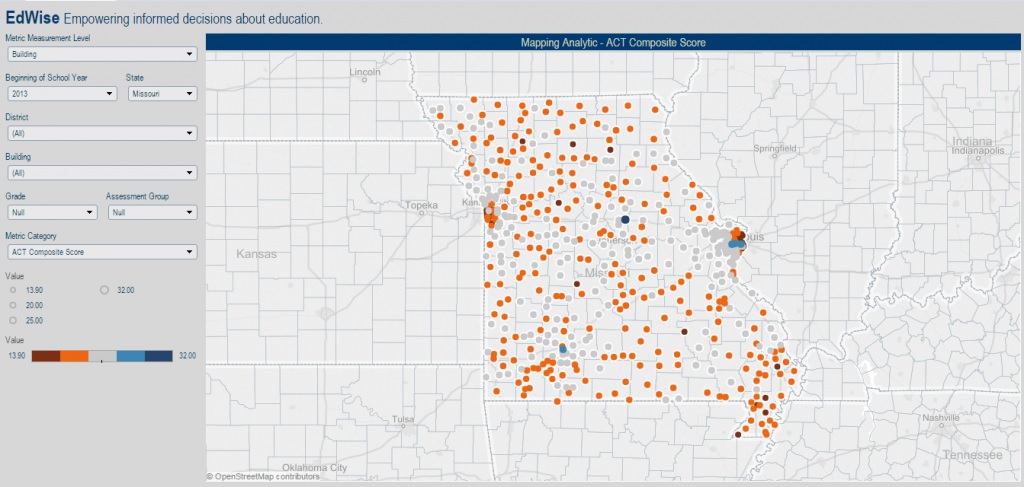
This week the Kauffman Foundation released Edwise, an “online tool to help parents, educators, school districts, policymakers, and the public make informed education decisions.” It has comparable data for every school and district in Missouri (and some in Kansas) on everything from ACT scores to enrollment to student-teacher ratios.

As school choice expands in the Show-Me State, access to information regarding schools must as well. While the Department of Elementary and Secondary Education (DESE) already provides data for every school district and charter school, their website is notoriously hard to navigate.

Increasingly, websites such as stlschools.org and greatschools.org are helping parents find a school that fits their child’s unique needs.

Edwise makes a great contribution with its easy-to-navigate map tool that makes data that could be daunting to comb through incredibly user-friendly.

I encourage you to check it out!

Minimum Wage Hike on Ice?

To say the proposed minimum wage hike in the city of Saint Louis has been controversial is an understatement. We’ve been on top of the issue since it was first proposed. I even got a chance to testify on the bill before the Ways & Means Committee. Needless to say, I was not the most popular guy in that room.

Still, Alderman Joe Vaccaro, the acting Ways & Means chairman, has announced he is cancelling all future meetings on the minimum wage, potentially killing the proposal. A recently passed bill from the Missouri Legislature, if signed by the governor, would prevent any local minimum wage increases from going into effect after August 28. Given that the Board of Aldermen go on summer break starting July 10, this puts the minimum wage bill in a precarious position and will make it difficult for any minimum wage increase to be enacted.

I applaud this decision, and I hope no increase is enacted. Increasing the minimum wage will destroy jobs and do little to help those in poverty. I want people across the city and state to earn more in wages. However, increasing the minimum wage is not the way to achieve such a goal. Thankfully, some in the Board of Aldermen feel similarly.

Nixon Vetoes Transfer Bill . . . Again

Today, Gov. Jay Nixon vetoed a bill to amend the transfer program for students in unaccredited school districts for the second time in two years. HB 42, this session’s version, would have expanded virtual and charter school options for students in failing schools in Jackson and Saint Louis counties, created a new accreditation process evaluating individual schools rather than districts, required students to transfer to an accredited school within an unaccredited district first, and restricted transfers to those students who have lived in a failing district for one semester.

The governor foreshadowed this move on Tuesday when he announced a new plan for the state’s two unaccredited districts. Twenty-two higher-performing districts will commit to offering a lower tuition rate for students transferring from Riverview Gardens and Normandy and will provide instructional support for the unaccredited districts. Apparently for him, that is enough for the students in Riverview Gardens and Normandy for at least another year.

But it is not enough for them. Students in these districts should be able to attend the school that best fits their needs, be that a charter school, a virtual school, or a private school. Even one year within a failing school can cause irreparable damage in the life of a student. Students shouldn’t have to wait for support from other districts or their own district to get its act together.

Last year, the governor vetoed the transfer bill because it allowed for the creation of a tiny school voucher program. Legislators cut that provision this year, and still the bill was vetoed.

Supreme Court Rules Against King v. Burwell Plaintiffs

Today, the U.S. Supreme Court ruled that federal subsidies may continue to flow to insurance plans sold in federal insurance exchanges, despite what the text of the Affordable Care Act might suggest. Readers can find the Court's ruling here and further background on the case here. The Court's decision is a disappointment not only to supporters of genuine reform to America's health care system, but also to the millions of Americans who will now be fully exposed to Obamacare's mandate and penalty provisions—including hundreds of thousands of Missourians. More to come; stay tuned.

Support Us

The work of the Show-Me Institute would not be possible without the generous support of people who are inspired by the vision of liberty and free enterprise. We hope you will join our efforts and become a Show-Me Institute sponsor.

Donate
Man on Horse Charging