Mission: St. Louis Provides Summer Learning Opportunities

When Executive Director Josh Wilson founded Mission: St. Louis in 2006, he had a goal—eliminate poverty in Saint Louis City within six months. 

“I was just really stupid. I just thought that if we had enough money, people, resources, we would eradicate all poverty in St. Louis,” he said. Of course, poverty persists.

“I think it comes down to really this idea of dignity. . . . I think the biggest mistakes that can happen is to go like, ‘Hey I feel sorry for you,’ and when . . . we’re motivated out of feeling sorry . . . I think we do way more harm,” Josh reflected.

Now Josh has a different plan—“empower people to transform their neighborhoods.” The organization has been successful. Since it’s founding, Mission: St. Louis has helped men like Eddie find employment, provided after-school support for students and families, and facilitated home improvements.

Additionally, Beyond School, a division of Mission: St. Louis, has developed a summer program to combat the summer slide.

The summer slide (or summer learning loss) occurs when students in low-income communities lack learning opportunities during the summer. Many students from wealthier backgrounds have summers filled with trips to museums, camps, and other enriching activities. Low-income students do not. In fact, one study showed that more than half of the achievement gap between low-income and high-income students can be explained by students’ experiences in the summer.

While some have rallied around policy reforms such as year-round schooling to fix this problem, Mission: St. Louis demonstrates that the key to closing the gap between high- and low-income students is not only providing low-income students with learning opportunities, but also by providing a choice in what those opportunities are. This leads to more investment from the student and an all-around more positive experience.

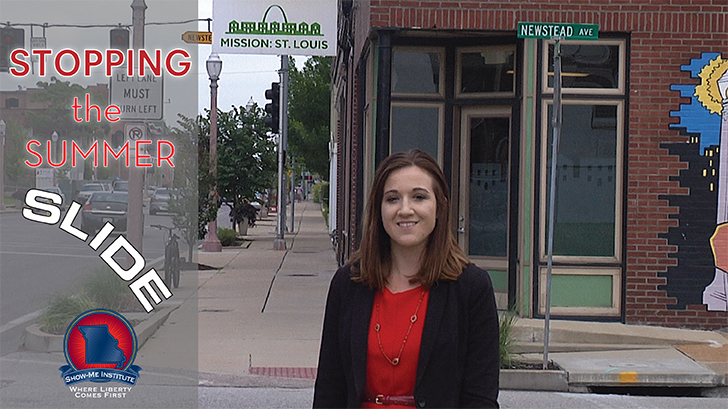
I encourage you to check out our new video about the summer learning opportunities provided by Mission: St. Louis.


Rank Hypocrisy from the Kansas City Star?

On July 10, 2015, the Kansas City Star editorial board bemoaned the state of mental health care in Kansas. Of the states system, they wrote:

Advocates argue convincingly that it is overburdened and underfunded at nearly all levels. A system that at one time was well regarded and innovative is staggering from high demand and too few resources.

The lack of options leaves families of mentally ill individuals in a fearful limbo. Police officers and jails end up dealing with people who should have access to doctors and hospitals.

Surprising no one, the city’s paper of record faulted inadequate funding:

But state funding for a network of outpatient community mental health centers—the first stop for many patients—has been cut in half since 2008. Patients often wait weeks for medications and a treatment plan.

We don’t take issue with the Star‘s conclusion. Tight budgets at every level mean that policymakers have to make difficult choices. What is unfortunate is the Star‘s request to be exempted from having to pay their own fair share of taxes—taxes that would go to support these programs. The Star is asking to extend for 15 years the tax abatement on its downtown printing press. As a result, the Community Mental Health Levy in Jackson County, Missouri, will be denied $245,000 over 15 years. That is a quarter-million tax dollars from the Star‘s single property.

This request comes after the Star had Jackson County reduce their assessment from $42 million in recent years to $22 million in 2015. The folks at the Star seem to have put a lot of effort into avoiding paying taxes on their downtown printing and distribution center. And it’s easy to see why; what the Star prefers not to pay toward mental health is small compared to what they would avoid paying toward Kansas City schools ($10 million), Kansas City ($2 million), and Jackson County ($1 million).

Certainly, corporations can and do make the case that county property assessments are too high. And many businesses in Kansas City benefit from corporate welfare and crony capitalism of some kind. But shouldn’t we expect better from our newspaper?

If the Star wants to call out local and state governments for cutting spending, giving tax breaks to the wealthy, or handing out sweetheart deals, shouldn’t they refrain from seeking the same for themselves? By advocating a kind of “taxes for thee, but not for me” position, the Star risks being accused of nothing less than rank hypocrisy,

Friedman’s Legacy

For years now, many Americans have acknowledged the shortcomings of the nation’s public school system. While the 1983 “A Nation at Risk” report is often referred to as the quintessential moment in education history when Americans realized the system was failing—one man had already realized the problem, and proposed a solution, decades before.

Milton Friedman first discussed the idea of educational vouchers in the 1950s, arguing that competition between schools would improve efficiency and drive down costs. The idea became popularized during the 1980 television series Free to Choose.

In voiced-over footage of high school-age children walking through metal detectors before entering an urban school, Friedman said:

Isn’t that awful? What a way for kids to have to go to school through metal detectors and to be searched. What can they conceivably learn under such circumstances? Nobody is happy with this kind of education. The taxpayers surely aren’t. This isn’t cheap education. . . . And what about the broken windows and the torn school books and the smashed school equipment? The teachers who teach here don’t like this situation. The students don’t like to come here to go to school. And most of all the parents. They are the ones with the worst deal. They pay taxes like the rest of us. They are just as concerned about the kind of education their kids get as the rest of us are. They know their kids are getting a bad education, but they feel trapped. Most of them see no alternative but to continue sending their kids to schools like this.

So while lawmakers have looked to improve education through top down policies like No Child Left Behind and Race to the Top, Milton Friedman was the first to acknowledge that parents should be in the driver’s seat of their child’s education.

Today, a majority of Americans support educational choice. The Friedman Foundation recently released the 2015 Schooling in America Survey, which found that 63 percent of school parents support educational vouchers. When asked to rank the actions a state government should take in intervening in low-performing schools, 41 percent ranked supply vouchers/scholarships as number one. Twenty-six percent ranked convert the failing schools to charter schools as the number two solution. Clearly, Americans favor options. Still, many do not know about the man behind the idea.  

This is why the Show-Me Institute is celebrating Friedman Legacy Day on July 31 (register now). Oklahoma State Senator Jabar Shumate will discuss the effects of school choice on urban issues. Unlike Missouri’s legislature, Oklahoma’s policymakers have helped establish two private educational choice programs—a voucher program for students with disabilities and a tax-credit scholarship for low-income students.

Please register for this event now.

Krafting a Bad Subsidy Package in Columbia

Good news everybody, Boone County is looking to give a tax break to Kraft Heinz so it can modernize! Specifically, it will award Kraft Heinz a 75 percent property tax abatement, which will save the company $4 million in property taxes. But wait, there’s more. Once Kraft Heinz finishes work on the plant, it will end up employing 150 fewer employees.

You read that right. There will be fewer people at this plant when all is said and done. Companies are free to employ as many people as they deem necessary. However, giving out a subsidy to a company so that it can employ fewer residents just doesn’t make sense. Even if the tax abatement led to higher employment at the plant, Boone County would be hard pressed to justify the subsidy since it does not lead to the kind of economic growth that would justify it being awarded.

If Boone County really wants to become a place where it makes sense to locate a business or expand a current one, it should rethink how it taxes property (more on this in another post). There are potential tax improvements that could help not only Kraft Heinz, but all the other businesses in Boone County as well.

Boone County is following the example of many other counties and municipalities by granting subsidies to a local business. That doesn’t mean it’s a good idea. These types of subsidies don’t, in the long run, provide a boost to the local economy. They just make it more likely that the county will hand out more subsidies in the future. 

Use This Money: To Build a New Stadium

There has been a lot of back and forth about building a new riverfront stadium in Saint Louis. Putting aside for a moment the merits (or lack thereof) of publicly financing a new football stadium, there hasn’t been much said (if anything) on what it would take to privately finance a new stadium. A new report from the NFL can give some idea of how much someone would have to pay.

The NFL report analyzes the market conditions in Saint Louis and its ability to support an NFL franchise. Despite the report finding that Saint Louis fares poorly compared to other cities when it comes to attendance and ability to generate additional support for the team, it still had the ability to generate significant revenues for the team through Personal Seat Licenses and ticket sales. In fact, the report estimates that the sale of Personal Seat Licenses can generate a little over $200 million in revenue.

That’s not nearly enough to finance construction of a new stadium, but it is a start. Whether private investors can receive returns to justify spending a further $700-$800 million is an open question. However, if no private individual or group can find a way to make a profit off a new stadium, why should policymakers think that a new stadium would generate a net gain for taxpayers? Likewise, if the stadium was such a great investment, why bother with any private investment? Let taxpayers reap the whirlwind (if it exists).

This new report from the NFL indicates that there is at least some private money available to build a new stadium. Instead of working on ways to spend even more taxpayer money on stadiums, maybe policymakers should work on convincing private individuals to build a new stadium with their own money.

And the Beat Goes On . . .

The Bureau of Economic Analysis (BEA) recently released its annual report on personal income growth and prices at the state level. The good news is that personal income in Missouri in 2013, the most recent year for which data are available, increased faster than the national average. Unfortunately, a substantial portion of that increase was eaten up by rising prices. Adjusted for inflation, personal income in Missouri increased slower than the national average.

Can’t we just enjoy the fact that income rose? Increases in income unadjusted for price changes—what economists call nominal income—can give a false signal of prosperity. Think of it this way: If your wage doubles, are you better off? If the prices of things you buy haven’t changed, then, yes, you are. But if the prices of goods and services also doubled, your higher wage buys no more than it did before your raise. So we really should compare changes in real personal income—the equivalent to your wage relative to what it can buy—to see if we actually are better off.

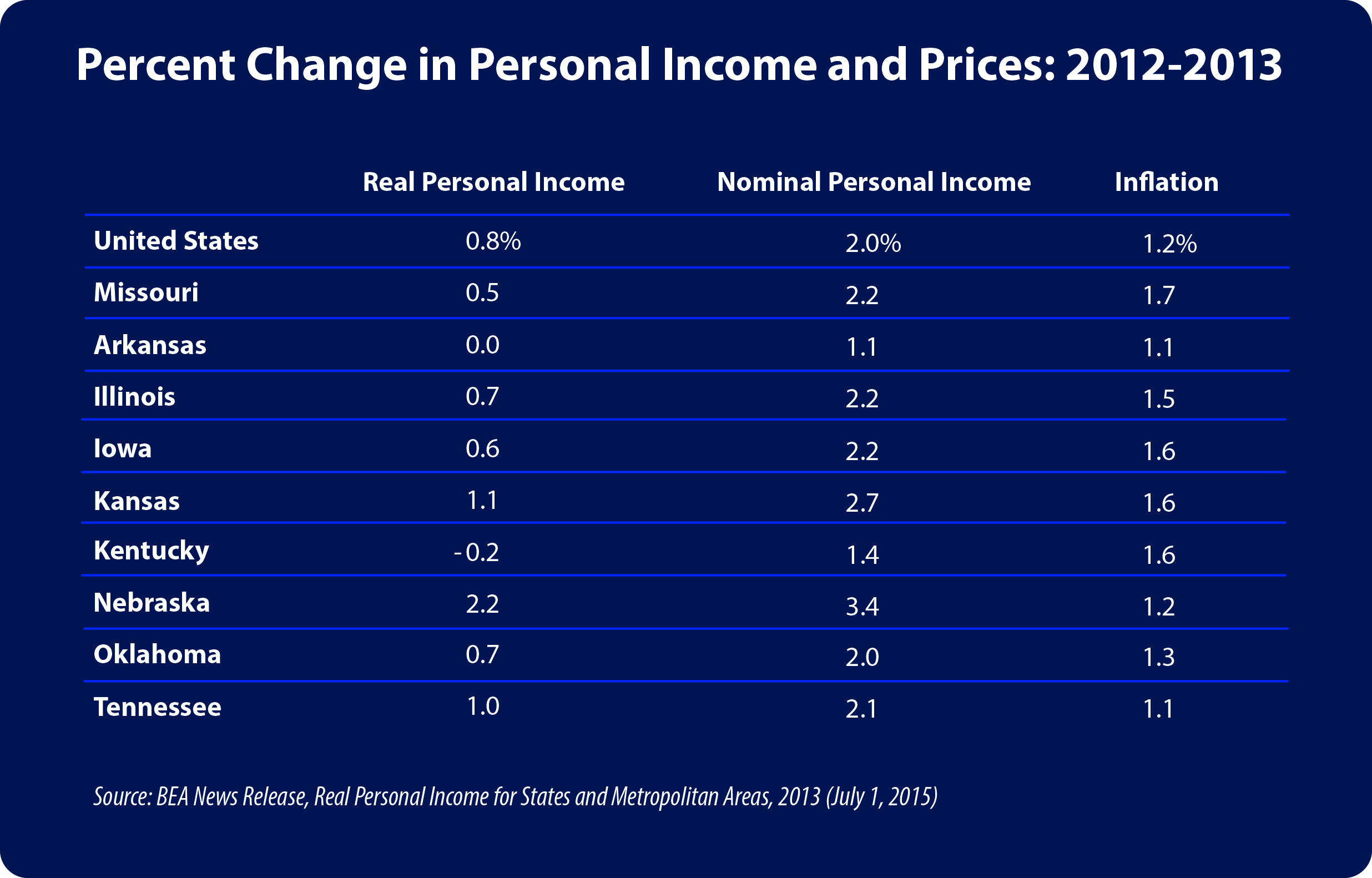
The table below reports the 2013 growth rates in real personal income, nominal income, and inflation for the United States, Missouri, and its neighboring states. The percentage change in real income is equal to the difference between nominal income and the rate of inflation. How did Missouri fare when comparing growth in real personal income?

Real personal income in Missouri increased at a 0.5 percent rate in 2013. This reflects the fact that even though nominal income increased at a healthy 2.2 percent rate, prices increased at a 1.7 percent rate. Though Missouri’s nominal income growth exceeded the national average (2.2 vs. 2.0 percent), the fact that the rate of inflation in Missouri was higher than the U.S. average (1.7 vs. 1.2 percent) explains why real personal income in Missouri rose slower than the national average (0.8 percent). This combination of income growth and inflation also explains why Missouri’s increase in real personal income was slower than in four neighboring states, about as fast as in two, and exceeded that for two others. Among the neighboring states, Nebraska was the clear winner, with Kentucky trailing the pack.

The story from the latest data is that while Missouri’s economy continues to grow, the pace of improvement lags the national average and many of its neighbors.

table

The Smallest District in Missouri Has Disappeared

Readers of the Show-Me Institute’s blog may remember me highlighting the tiny school district of Gorin R-III. With just 19 students, Gorin was the smallest district in Missouri and spent more per pupil than any other school district in the state, $26,821. Gorin will no longer have either of these titles in the 2015–16 school year, because the district no longer exists.

Unbeknownst to me until yesterday, voters in the Gorin School District approved a plan to be annexed by the Scotland County R-I School District. The vote was 49 in favor, 13 against. (Those are the actual votes, not percentages.)

Gorin voters made the right move, and they will immediately see the benefits. For starters, the property tax levy for schools in Gorin was $4.3744 per $100 of assessed valuation. Residents will now be taxed at the $3.36 rate of the Scotland County School District. Undoubtedly, students will receive a wider variety of educational options than before.

While I applaud the move by the voters of the Gorin School District, Missouri still has a glut of small school districts. 

2014-15 Student Enrollment Number of Districts
Fewer than 100 46
100 – 199 59
200 – 350 86
   
Total with 350 or fewer students 191


Of these, just 50 raised more than half of their funding through local sources. By and large, small school districts are expensive to operate and require a lot of financial support from the state.

Previously on the blog, I’ve asked, “Is school consolidation an issue of local control?” Whether you believe that it is or you believe that small schools should be consolidated by the state, maybe we can agree on one thing—state taxpayers should not be forced to pay extra for the decisions of small school districts. Currently, school districts with fewer than 350 students are guaranteed a specific amount of money. Remove this hold-harmless provision and chances are we’d see more districts like Gorin making a wise decision to consolidate. 

Governor Signs SB 5 into Law

On Thursday, the governor signed Senate Bill 5 into law, reducing the extent to which municipalities can rely on fines and fees to fund themselves. The bill would:

…within two years, bring down the total amount of general revenue a city could receive from fines and fees to 10 percent, excluding smaller cities outside of populous counties like Saint Louis. The bill makes it clear that any amended traffic fines would count toward that percentage. Furthermore, fines collected on Missouri interstates in excess of 5 percent of general revenue would also not be able to be collected by municipalities. As for enforcement, the bill makes it clear that municipalities have to provide an annual addendum to the state auditor regarding its compliance with the measure. Failure to comply triggers a vote for municipal disincorporation…

As we’ve argued before, these measures will disincentivize the use of local police and courts as tax collection agencies. They will also encourage limited government and inter-city service coordination. That’s good news for Saint Louis County and the state as whole. 

Support Us

The work of the Show-Me Institute would not be possible without the generous support of people who are inspired by the vision of liberty and free enterprise. We hope you will join our efforts and become a Show-Me Institute sponsor.

Donate
Man on Horse Charging