Taxi Commission Meeting Falls Apart, Without Reforms

Despite the hopes of many, the July meeting of the Metropolitan Taxicab Commission (MTC), which regulates for-hire vehicles in Saint Louis City and County, ended without regulatory changes that would allow cheap ridesharing to enter the Saint Louis market.

       However, the lack of results does not mean the meeting lacked drama. From start to finish, emotions were running high and irregular procedures were constant. Just some of the oddest moments:

  1. Commissioner Chris Sommers, who has been supportive of Uber, had not received any advanced copy of proposed changes to the taxicab code at the time the meeting started (although other commissioners and the mayor’s office apparently had. He had to ask for a copy on stage.
  2. Commissioners gave speeches to defend their actions and attack a perceived “PR campaign” out to smear the commission. One commissioner said he took the whole debate personally, and thought critics were implying the MTC was a bunch of “jamokes.”
  3. Following a non-statement from an Uber representative (who had not seen the proposed changes), the chair moved to cut off public comments after only about 25 minutes. This resulted in commotion from the audience. One audience member called the chairman a coward and others called on him to resign. The chair threatened, multiple times, to clear the room.
  4. A representative of the mayor’s office requested that the MTC not vote on rule changes (which we still have not seen), instead proposing new negotiations between Uber, the MTC, and regional political leadership. The chairman then put a stop to motions to vote on rule changes that day, over the objection of other commissioners. Commissioner Sommers also objected to voting that day, as he had had no time to read to proposed rule changes. The meeting abruptly ended to boos.

After a meeting like that, one has to ask, is Saint Louis best served by a commission that arbitrarily cuts off public debate and takes disagreement personally? By a commission that engages in offensive public infighting? By a commission whose leadership thinks the demand for ridesharing is “white privilege”?  Is this commission going to be effective in writing, and enforcing, sensible ridesharing regulations?

Taxicab Commission Refuses to Respond to Sunshine Request

At yesterday’s meeting of the Saint Louis Metropolitan Taxicab Commission (MTC), the commissioners began considering, but ultimately tabled, taxicab code revisions regarding ridesharing companies. We at the Show-Me Institute wanted to see those proposed changes, which were almost voted on.

Luckily, in Missouri, we have the Sunshine Law, which requires public bodies and public officials to disclose, among other things:

“…records, regardless of what form they are kept in, and to all meetings, regardless of the manner in which they are held.”

Our first step was to call the MTC, hoping that someone would simply send us the proposed changes. The MTC’s response: we have no such document. The MTC’s “custodian of records” claimed to have no knowledge of any proposed code changes.

To make matters clear, the document containing draft code changes certainly existed. A commissioner was given a draft at a public meeting, and even posted sections of the draft on the internet. Thus ignored, we sent an official sunshine request to the MTC, asking for any documents regarding the code changes, or if the custodian did not have the documents, contact information for the person who did. The MTC’s response to the message was a prompt: “We are not in possession of any records that match your request.”

The next day, we again called the MTC, asking how we could contact the Chair of the MTC, who almost certainly would have access to the document. Representatives at the MTC refused to divulge any contact information, and instead had us call the MTC attorney, who provided no information.

To make a long story short, MTC commissioners (who are members of the MTC), circulated a document that is almost surely subject to a sunshine request. But because they did not give the document to their custodian of records, and they instructed that custodian to not disclose contact information, the MTC does not have to divulge the information? That’s a neat trick, and, if legal, makes the Missouri Sunshine Law a joke. It is to suggest that government officials are immune from Sunshine requests, as long as they don’t give their documents or contact information to their custodian of documents. I’m not a lawyer, but I hope that this is not the case. As for the MTC, it’s disappointing that the organization refuses to be open with the public.


Health Care Price Transparency Report: Missouri Gets an “F”

Last year the Show-Me Institute published a report that explored some of the reforms Missouri needed not only to make Medicaid better, but also to make health care in the state better for everyone. One prominent reform mentioned was price transparency in medicine. One of the big reasons that prices for health care have spiraled out of control over the years is that, generally, patients don’t see the price of their care and don’t have clear incentives to price shop. You wouldn’t buy a cell phone without investigating what the fair price for it would be, and yet that’s largely what we do when we purchase health care.

Without price competition, properly valuing medical services is next to impossible, and findings from the Department of Health and Human Services in 2013 reiterate the point.

For example, average inpatient charges for services a hospital may provide in connection with a joint replacement range from a low of $5,300 at a hospital in Ada, Okla., to a high of $223,000 at a hospital in Monterey Park, Calif.

Even within the same geographic area, hospital charges for similar services can vary significantly. For example, average inpatient hospital charges for services that may be provided to treat heart failure range from a low of $21,000 to a high of $46,000 in Denver, Colo., and from a low of $9,000 to a high of $51,000 in Jackson, Miss.

Price transparency in American medicine is the exception rather than the rule when it comes to state policy, and a new report card from the Health Care Incentives Improvement Institute (which focuses a great deal of attention to transparency issues) and Catalyst for Payment Reform hammers this point home yet again. The researchers found that there has been “little progress since last year and, in some cases, regression” at the state level on price transparency matters, and most states received an “F” grade overall on the matter. Missouri was one of those states. The report doesn’t say a great deal about Missouri’s lack of progress on transparency issues in its national report, altough it does note that “a gag clause ban was introduced in Missouri, but failed to pass in February 2014.” That bill, SB 847, also included a wide array of other welcome transparency measures; unfortunately, the bill never made it out of committee.

As the HHS data lays out, the vast divergence in pricing in health care is a serious problem that isn’t explained by quality differences, but by limited information and, in general, limited incentives to mitigate the cost of one’s health procedures. If the state really wants to bend the cost curve of care in the state, Missouri needs to do better in the arena of price transparency and ensure that the prices charged for delivering health care in the state are more accessible to health consumers.

Higher Than Expected MoDOT Revenues Mean No Loss in Federal Matching Funds

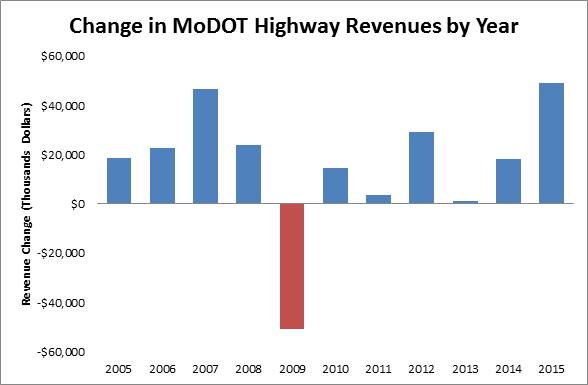
As we’ve written about many times before, MoDOT is facing serious financial difficulty. Soon, the department may not have the money it needs to maintain, much less improve, the state highway system. Until recently, it was assumed that MoDOT would be unable to match federal dollars in the next fiscal year, meaning the state would lose more than $160 million federal dollars, compounding its problems.

              But it appears now that MoDOT has had a reprieve. Revenue dedicated to the state highway system rose 4.5% in FY 2015, much higher than expected. That gives MoDOT an additional $47 million in state funding and saves $160 million in federal matching dollars that otherwise would have been lost.

This increase is mainly the result of the improvement in the economy and lower fuel prices. People are buying cars at a faster rate, increasing MoDOT’s motor vehicle sales tax and license revenue. Lower fuel prices, along with a resurgent economy, mean people drive more, increasing gas tax receipts. This is yet more evidence that long-term demand for personal vehicle use, and with it demand for state highways, is not in anything approaching decline.

Unfortunately, MoDOT’s revenues will need to continue to climb at this pace for the next few years to ensure that Missouri will match all federal dollars. This is unrealistic, as motor vehicle sales could easily stagnate and fuel tax revenue will likely fall as cars become more fuel efficient. Even worse, assuming MoDOT’s revenue does grow fast enough to match federal funds, the department will still not have the money to implement expensive, but necessary, improvement projects (like the reconstruction of I-70).

But just as the last few years were not a good time to panic, the recent news does not mean now is a good time for complacency. MoDOT’s user funding base is broken, and will only become more broken if left unreformed. With the reprieve MoDOT just received, policy makers have more breathing room to implement sensible reforms on the principle of user pay, user benefit. They should take the opportunity.

It’s Good to Be Home

Hi friends. My name is Mike McShane, and this week I’m starting as Director of Education Policy for the Show-Me Institute.  I couldn’t be more excited.

I grew up in Kansas City and love that town like only a prodigal son can. If you have lived in Kansas City all of your life, you just have to trust me that Arthur Bryant’s tastes so much better in the restaurant if you’ve been having the sauce mailed to you for a couple of years.  Hearing the crack of the bat at the K sounds more melodious when you’ve been watching a herky-jerky video stream on your laptop for the past few seasons. And coming over the crest of I-70 and seeing Downtown framed perfectly under that overpass after a long drive from the East Coast, well, there’s just nothing quite like it. It is so great to be back.

But being from Kansas City (and having gone to college in St. Louis) also makes me acutely aware of our great state’s shortcomings when it comes to providing educational opportunity for all of our children.  Rural, urban, city, town, suburb, exurb, we can and must and will do better.

I want to do my small part in our collective improvement.  That means researching, writing, and speaking about the most pressing issues facing our education system.  What might this look like? Well from me you can expect to see a few things:

  1. A devotion to better understanding, and helping others to understand, how school choice works, where it stumbles, where it succeeds, and how to make school choice programs better.
  2. Easily digestible analysis of education research, data, policy, and politics in Missouri and around the country.
  3. A relentless fight to expand the number of quality schooling options that families, particularly low-income families, have across the state.
  4. Stories of great schools and great teachers who are fighting against the odds every day to give children the quality education they deserve.
  5. Lots and lots of policy ideas on how to make Missouri’s education system better. My writing, I hope, will be a place for optimism.  We can learn from other states, other countries, and other sectors and bring the best of their ideas to the Show Me State.

Together we can learn and grow and debate and disagree and make Missouri a better place, for all of its citizens. I hope you’ll join me in this noble quest.

Charity Clinic Coming to St. Louis Area Next Month

Over the past few years we have talked a lot about the Volunteer Health Services Act (VHSA), which allows out-of-state medical professionals to more freely provide charitable care in Missouri. As a general matter, one of the priorities of state-based health care reforms must be to remove barriers to accessing care, and the state’s decision in 2013 to allow access to free care provided by qualified out-of-state doctors, dentists and other professionals was a very welcome one. Other states would do well to follow the leadership of Missouri and other states in this policy area; in fact, next month Missourians in the St. Louis area will get to see the benefits of VHSA-type reforms, albeit in neighboring Illinois. 

Remote Area Medical, one of the charity clinic pioneers in the United States, will be having a free health care expedition from August 14th through the 16th in East St. Louis, IL. As always, the clinic will be open to the public, and while I haven’t heard any indication that the group will be making any historic drone deliveries at this particular event, what is certain is that there will be a lot of people seeking help — and a lot of people giving up their weekend providing it. That events like RAM’s remain necessary in a state like Illinois, which has gone whole hog for Obamacare, is its own commentary. 

But setting that aside for the moment, I think the most important takeaway from the event for all of us is ultimately this: that people should be able to help one another without the undue interference of government. Both Missouri and Illinois deserve kudos for making these sorts of clinics more available to their citizens.

Show-Me Institute Presents: Breaking Down Revenue

City residents care about how much they pay for government services. For those in Saint Louis and Kansas City who are wondering how much they pay, they now have an easy resource to check. The Show-Me Institute presents a new case study: “Breaking Down Revenue: How Kansas City and Saint Louis Compare to Six Other Cities.”

This case study examines government revenue, per person, of Saint Louis and Kansas City along with six other comparison cities (Denver, Indianapolis, Louisville, Oklahoma City, Omaha, and Tulsa). It examines tax burdens on residents (in total and as a percentage of personal income), the amount of fees collected, and other tidbits of information that the general public might find interesting. Please give it a look.

Support Us

The work of the Show-Me Institute would not be possible without the generous support of people who are inspired by the vision of liberty and free enterprise. We hope you will join our efforts and become a Show-Me Institute sponsor.

Donate
Man on Horse Charging