New Superintendent Gives Kansas City Opportunity to Rethink School Organization

For the 5th time in 16 years, the Kansas City Public Schools are in the market for a new superintendent.  With the announcement that R. Stephen Green will be moving to Georgia, his name can be added to the list of Covington, Amato, Taylor, and Demps (and even more if we wish to look further back).

During Green’s tenure, Kansas City’s school district improved on some indicators.  Unfortunately, even with this growth, in absolute terms, the district is far from where it needs to be.  The graduation rate is only 67 percent.  As I wrote recently, that’s better than the 50 percent it was two years ago, but it’s still well behind our regional peers.  (Little Rock has a 75 percent graduation rate, and Chicago’s is 70 percent.)

Dr. Green’s departure gives the Kansas City community a chance to take a step back and think about the fundamental organization of the city’s schools.  Does a centralized bureaucracy, even led by someone with great talent, have the capacity to meet the needs of every child in the city? 

Look at New Orleans. Once considered home to some of the worst schools in the country, the Crescent City decentralized the operation of its schools and changed the role of city and state government to that of a funder and regulator. Since that time, the city has seen a marked improvement.

According to an article in the summer issue of the journal Education Next, in 2005, 64 percent of students in New Orleans attended a school designated as failing by the state of Louisiana. By 2015, it was only 9 percent.  High school graduation rates have grown from below 50 percent to over 70 percent.  What’s more, the gap between the performance of New Orleans’s schools and those in the rest of the state is closing—a more than 20 point gap among students scoring “basic” or above on state tests has shrunk to only four points. The expulsion rate is even below the state average.

The lesson from New Orleans and other cities around the country is that we should not build school systems that require a superstar at the helm in order to work.  In such a system, one great superintendent can move mountains, but one bad superintendent can jeopardize everything.

If the city were to move the operation of schools to independent and autonomous organizations and limit its role on funding and regulation, it would maximize the likelihood that the system could create the number and type of schools the children of Kansas City need. 

The city has already started down this path with a broad swath of charter school options, which clearly haven’t harmed the district.  It’s a great time to think about expanding those options to more Kansas City families.

Do the Math?

How many times has someone said “just do the math?” Unfortunately, too many children in Missouri are likely to respond with “I can’t.”

            On August 10, the Missouri Department of Elementary and Secondary Education released the MAP scores for 2015. Direct comparisons between this year’s results and those from previous years are problematic, because in the interim the state changed its standards. This makes it difficult to assess how much any particular school or district has improved student learning over time. If that’s not enough, the 2015 test results are based on Common Core, adding another layer of difficulty. Despite the challenges in making comparisons over time, we can take a snapshot of student performance, and that snapshot isn’t pretty.

            It turns out that elementary and middle school students did comparatively well in language arts and social studies. In both cases, over 60 percent of the test-takers had passing scores. However, the outcome was not as rosy when in math and science. Fewer than half of students achieved proficiency in math. For science, the one area where the standards remained unchanged from 2014, just under half of students (49 percent) achieved proficiency in 2015, a result little changed from last year.

            The overall results point out a continuing problem: poor scores in math and science. While some schools undoubtedly are producing students who are doing quite well, the fact is that even with changing standards, Missouri’s math and science scores have been low for some time. This is not a good omen for the future of Missouri’s economy. Mountains of economic research (see my essay, “Are Education and Economic Growth Related?”) show that a population’s math ability is directly related to its economic success. That is to say, countries and states in which the residents have more advanced math skills also tend to have higher levels of income and output per person.

Missouri’s future prosperity depends on the ability of our students to compete for high-quality, well-paying jobs. Those jobs will require math and science skills that our schools currently aren’t providing.

Missouri Needs to Learn to Prioritize Spending

As first appearing in the Columbia Tribune:

In a couple of weeks’ time, incoming college freshmen will get their first taste of independence. But with independence comes responsibility, and right about now parents are giving familiar advice on how to handle life without a safety net: Study for class. Eat healthy. Spend smart (read: don’t spend your rent money on pizza and beer). Most freshmen will find their footing, eventually. Some never really do, especially when it comes to budgeting properly.

But unrepentant spendthrifts should not feel so bad, because many of Missouri’s top policy makers never figured out how to spend smart, either.

A handful of state and Saint Louis officials want to spend close to $400 million of public money on a new football stadium in downtown Saint Louis in an effort to keep the Rams from moving to Los Angeles. Not only is Saint Louis’s existing NFL stadium, the Edward Jones Dome, a mere 20 years old, but virtually every economist who has studied the issue has found that NFL stadiums are a bad place to invest public dollars. They do not generate economic growth, spur urban revitalization, or greatly increase tax revenue.

Unfortunately for Missouri residents, the way Saint Louis funds its football stadiums makes this much more than a local or regional issue. Statewide residents already covered half the cost of Saint Louis’s Edward Jones Dome. In fact, the state is still paying $12 million annually on that stadium’s debt. One could be forgiven for thinking that Missouri taxpayers deserve a break from funding entertainment venues in Saint Louis City, especially when tangible economic benefits are so unlikely. But that’s not the case. Quite to the contrary, state taxpayers will be expected to cover more of the stadium costs than they did last time, with total state support topping $300 million—about three quarters of the total subsidy. That money will come straight from Missouri’s general revenue.

However, even as Missouri and the City of Saint Louis prepare to spend lavishly, yet again, on pro sports, every level of government claims it is broke. We are told how courthouses are crumbling. How highways are deteriorating. How the schools are underfunded. How the state parks have a $400 million maintenance backlog. How Missouri’s Amtrak routes need $32 million in upgrades to continue running. Even Saint Louis City officials claim that core departments like fire protection and police are short of cash.

When it comes to basic government services, there’s never any money in the budget. Residents instead have to vote on tax increases, or else. But when Saint Louis’s NFL status is threatened, hundreds of millions of dollars are suddenly available. As for a vote, that’s restricted to those who will vote “yes.” At the state level, it’s likely that the decision of the governor alone will be sufficient to authorize spending more than $300 million, and he is spearheading the stadium effort.

Right now, Missouri’s leaders sound a lot like college students calling their parents because they can’t afford groceries. And they’re making that call from a noisy bar in Cancun. It’s true—some people never learn to spend responsibly, whether they are freshmen or officials. Then again, most of the time, that’s because no one ever makes them.


With Improving Economy, Missourians Hit the Road

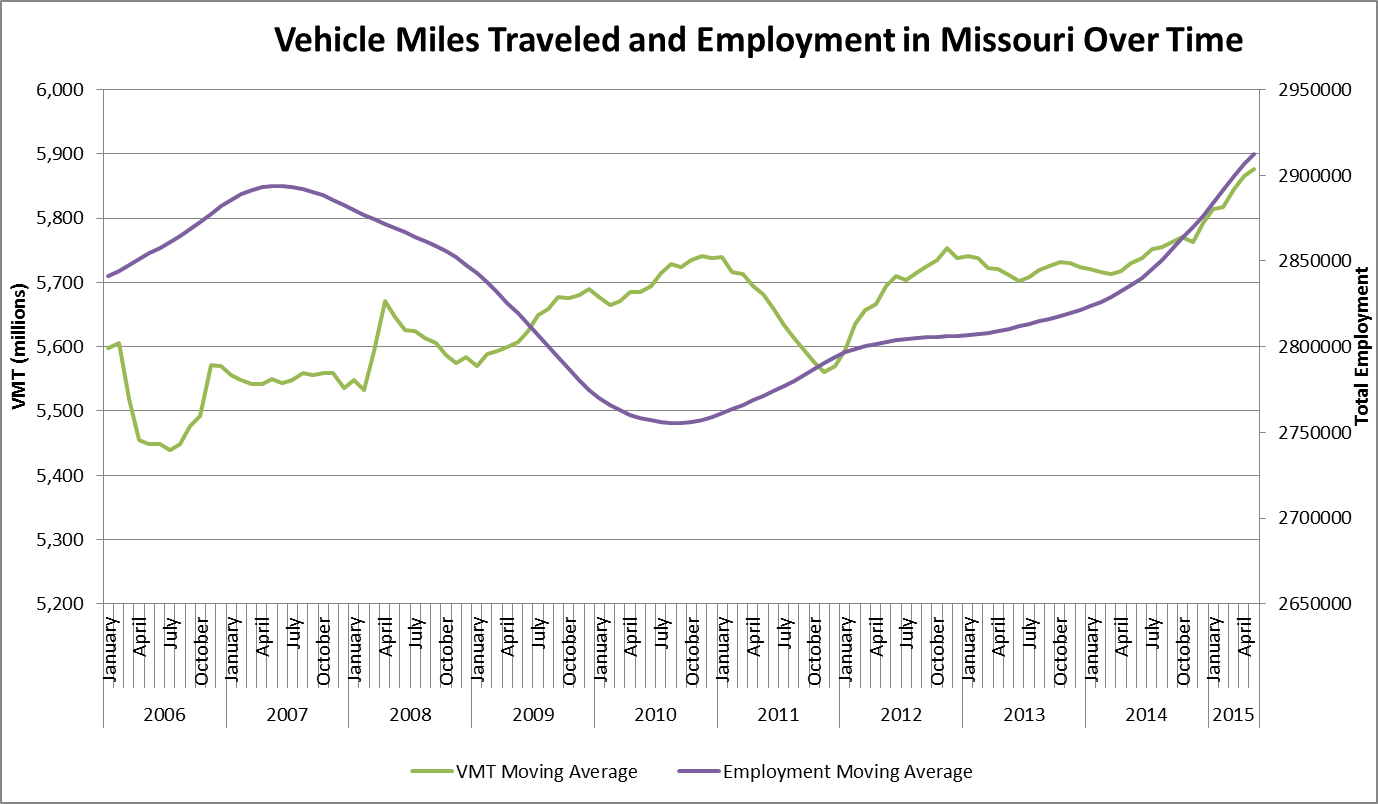
A couple months ago, I wrote about the misconceptions concerning driving trends in Missouri. Specifically, there was no evidence that demand for Missouri’s roads had fallen in any serious way. Total vehicle miles traveled (VMT) in Missouri was actually quite resilient through poor economic times, and with improvements in the economy VMT in Missouri had reached new highs.

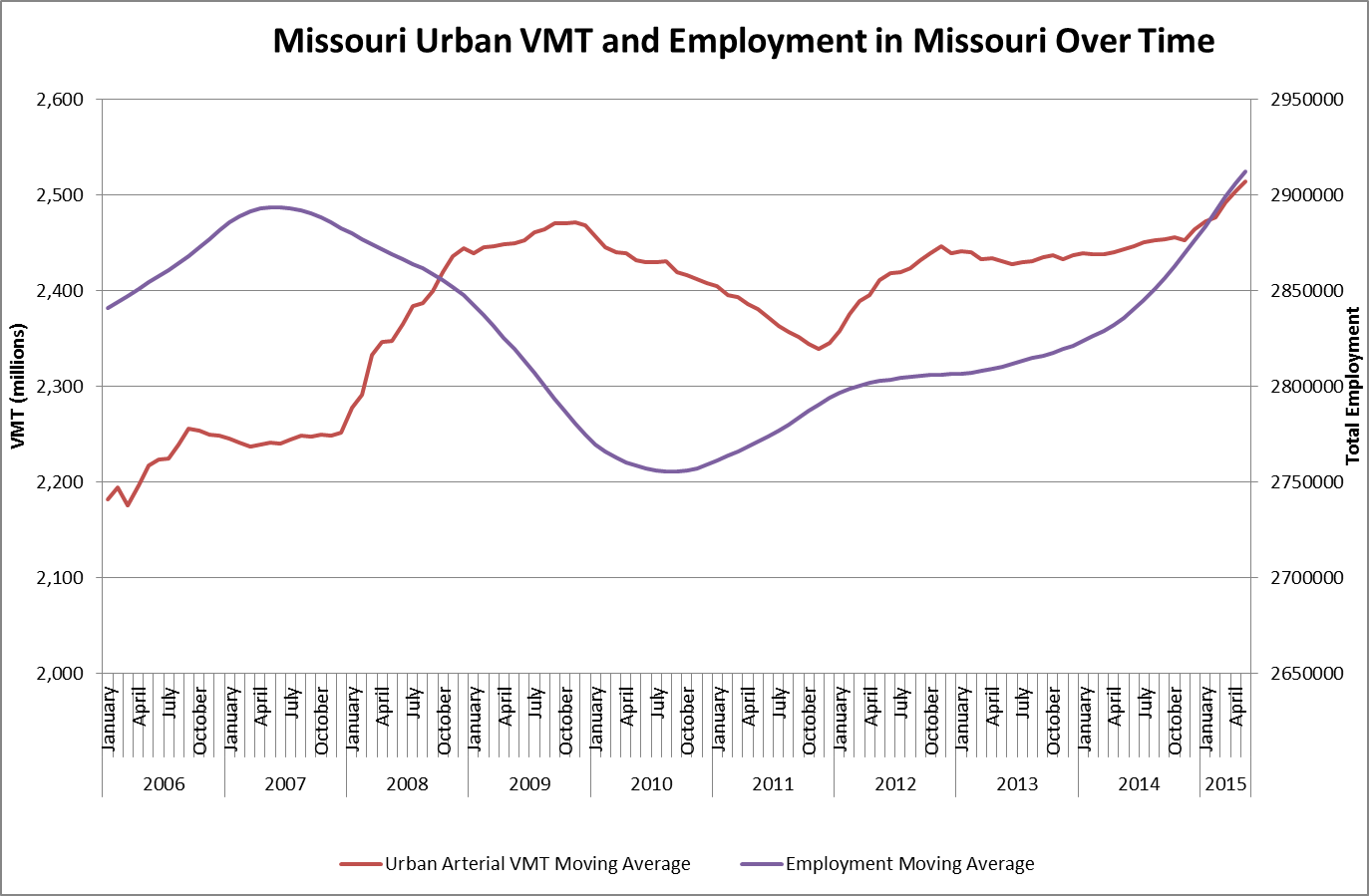
A recent release of Federal Highway Administration data only adds more support for this conclusion. As employment levels in Missouri increase, VMT on Missouri’s roads have begun a rapid increase, up almost 2.5% from May 2014 to May 2015. The increase has been even faster on Missouri’s major urban roads (2.8%):

Vehicle Miles Traveled

Missouri Urban VMT and Employment in Missouri

 Of course, these trends could reverse themselves if the economy begins to struggle or some as-yet-unobserved shift to nonvehicular lifestyles occurs. However, trends over the last few years suggest that better times will mean more driving, an eventuality urban planners and Department of Transportation officials should prepare for. It would be unfortunate if the costs of an inefficient transportation system mean that Missouri cannot fully benefit from improving economic conditions.


Professional Development: Neither Professional nor Development. Discuss!

If you ask a group of teachers what their two favorite words are, you’ll probably get a range of answers.  For some, it’s “snow day,” and for others it’s “spring break.” When I was a teacher, it was “Friday afternoon.”

The two least favorite, though, are ubiquitous: “professional development.”

A new study out by TNTP confirms what teachers will tell you: on balance, professional development (PD) does not help teachers improve their practice.

The researchers surveyed over 10,000 teachers, 500 school leaders, and 100 staff members and then compared a variety of PD experiences with several different measures of teacher performance.  The conclusion:

“No type, amount or combination of development activities appears more likely than any other to help teachers improve substantially, including the “job-embedded,” “differentiated” variety that we and many others believed to be the most promising.”

Not good.

But the real-eyebrow raiser is not just the ineffectiveness, but the cost.  TNTP found that on average the districts they studied spend $18,000 per teacher per year on PD. Yes, you read that right: per teacher, per year. In one of the districts they found that PD was a bigger budget line item than transportation, food, and security combined. Combined!

But it’s not just money, it’s also time. According to Kansas City’s teacher contract, teachers are required to attend 3 days of PD before school starts and one day during the year, and then 75 minutes of every Wednesday are earmarked for PD.  That adds up to around 10 days of their 185-day contract. This means that over five percent of teachers’ salaries (and who knows how much of their energy and good will) is dedicated to time that yields little return on investment.

Teachers want to develop professionally.  They want to get better at their jobs.  But we have done a terrible job in helping them do so.

(One brief addendum. Don’t forget this in the coming months when you are bombarded with rhetoric telling you that Missouri schools are “underfunded.”  I’m perfectly willing to admit that dollars are not going to the areas where they can be best used, but I’m not convinced that new, additional dollars will make that any better.)

New Report Gives High Marks to Missouri’s Urban Highways

Recently, TRIP, a national transportation research group, released a report on the state of urban roadways in cities across the country. Specifically, the group looked at the overall conditions of urban roads (measured in terms of smoothness) and calculated the additional costs for the average driver created by driving on roads in need of repair.

                Those who have followed our blogs on this topic will be unsurprised to learn that Missouri’s largest cities, St. Louis and Kansas City, rank well on these measures. In terms of overall smoothness, Kansas City and St. Louis rank 8th and 11th, respectively, among the nation’s 75 largest metro areas:

Rank

Urban Area

State

Poor

Mediocre

Fair

Good

Road Condition Index

1

Nashville-Davidson

TN

9%

11%

15%

65%

1.16

2

Minneapolis–St. Paul

MN

6%

19%

16%

59%

1.03

3

Raleigh

NC

7%

18%

26%

49%

0.92

4

Rochester

NY

11%

18%

31%

40%

0.71

5

Orlando

FL

8%

33%

2%

57%

0.67

6

Phoenix

AZ

13%

31%

2%

54%

0.53

7

Indianapolis

IN

17%

21%

20%

42%

0.49

8

Kansas City

MO

13%

27%

21%

38%

0.44

9

Atlanta

GA

18%

23%

18%

41%

0.41

10

Bakersfield

CA

7%

34%

29%

30%

0.41

11

St. Louis

MO

16%

29%

16%

39%

0.33

12

Louisville

KY

18%

26%

20%

37%

0.32

13

Cincinnati

OH

20%

23%

21%

36%

0.30

14

Buffalo

NY

14%

33%

16%

37%

0.29


70

Detroit

MI

56%

28%

2%

14%

-1.10

71

San Diego

CA

51%

34%

5%

10%

-1.11

72

Riverside–San Bernardino

CA

46%

41%

7%

6%

-1.14

73

Concord

CA

62%

30%

2%

5%

-1.42

74

Los Angeles

CA

73%

21%

3%

4%

-1.56

75

San Francisco-Oakland

CA

74%

20%

4%

2%

-1.60

                The relative smoothness of Missouri’s urban highways means lower costs for drivers. According to TRIP, the average driver in St. Louis and Kansas City paid $398 and $438, respectively, in annual additional vehicle operating costs from bad roads. That is far less than the U.S. large metro median ($640 per vehicle). San Francisco’s road conditions cost drivers the most, at an average $1,044 per year.

                The latest TRIP report underscores the fact that Missouri’s major roads are in comparatively good condition, at least in urban areas. However, to maintain and improve road quality, Missouri’s highways need regular maintenance and an adequate user-funding base to back that maintenance, which they currently do not have

A Canary in the Coal Mine?

Among the primary reasons for opposition to increasing the minimum wage is that doing so will result in job losses. Numerous academic studies show the negative effects of minimum wages on employment. New information from Seattle gives even more evidence that increasing the minimum wage will cost jobs.

In June of 2014, the Seattle city council passed a new law that will increase the city’s minimum wage to $15 an hour, with the increase being phased in over a period of years. The first increase (to $11/hour) came in April of this year. The American Enterprise Institute (AEI) studied restaurant employment in Seattle for the first 6 months of 2015, and what they found falls in line with what many other studies have shown.

According to AEI, between January and June of 2015 the Seattle Metropolitan Statistical Area (MSA) saw restaurant employment fall by 1,300 jobs—the largest decline since 2009 (during the Great Recession). It’s true that this figure counts job losses in months before the city minimum wage went up. However, the state of Washington’s minimum wage increased starting in January. In fact, after its latest increase, Washington has the highest state minimum wage among all 50 states.

AEI also found that the 1,000 jobs lost during May (which followed the city minimum wage increase in April) was the largest 1-month decline since January 2009.

During this same 6-month period, restaurant employment increased nationally by 130,700, overall employment in the Seattle MSA increased by 1.2 percent, and non-Seattle MSA restaurant employment in Washington increased by 2,800 jobs.

It should be noted that the Seattle MSA includes more than just the city of Seattle. Job losses could be occurring outside the city, and that could be skewing the results. But aside from the minimum wage increase, what economic/policy differences would account for the restaurant job losses in the Seattle MSA and the restaurant job gains that occurred in the rest of Washington?

Is Seattle the canary in the coal mine for the rest of the country? More time is needed to see what the full effects of the minimum wage increase actually will be. However, if these kinds of job losses are occurring in Seattle, which is much better equipped to handle a $15 minimum wage than Saint Louis, what does such a wage floor portend for Saint Louis? Instead of rushing to pass a minimum wage increase that could cost people jobs, Saint Louis policymakers should wait for more results to come in. 

How a Cheap Airport Helps Kansas City

The Kansas City Business Journal just published some good news for Kansas City:

On Tuesday, Allegiant Air announced it will start nonstop service from Kansas City to Orlando, Southwest Florida and Tampa in mid-November. The Las Vegas–based low-cost airline is operated by Allegiant Travel Co.

In an interview on KMBZ radio, Bill Grady asked airport administrator Mark VanLoh if this new service announcement raised questions about the real need for a new terminal. Mr. VanLoh replied, “I don’t see how the two are connected.”  

In fact, the two are very much connected.

The news of Allegiant Air is not only good news in and of itself, but it demonstrates exactly why Kansas Citians ought to be skeptical of taking on an unnecessarily large expense at the airport. Allegiant Air is a “low-cost” airline. According the The Memphis Business Journal

Allegiant often serves smaller markets like Orlando-Sanford International Airport instead of Orlando International Airport to avoid pricey landing fees.

Advocates of spending a great deal of money at the airport tell us that only travelers and airlines will pay the price. That is largely true. They also tell us that the prices airlines pay to serve an airport have little to do with ticket price; that may also be true. But pricey landing fees of the type that would follow an expensive rebuild or remodel may chase away airlines like Allegiant. And they would be a disincentive for bigger airlines like Southwest, too. A Southwest vice president said as much to the airport advisory group, “Higher costs can lead to less service, not more.” They have left other airports over similar price increases.

If Southwest wants to pour hundreds of millions of dollars into a new KCI, that might be welcome. But if improvements require issuing bonds resulting in higher fees to airlines, city leaders should think twice. A shiny new airport is of no use if airlines choose not to service it.


Is there evidence of a “teacher exodus” from Kansas?

If you take the media’s account of the state of the teaching profession in Kansas seriously, you’d think that there was a line of cars filled with teachers on I-70 headed east right now.  “Kansas’s Teacher Exodus,” blared the Atlantic.  NPR’s take? “Shrinking Kansas Budgets Push Many Teachers Across State Lines.”

Is such an out-migration happening? Let’s dig into the numbers.

One frequently hyperlinked story comes from Sam Zeff of KCUR.  (A transcript can be found here.)  Unfortunately, it only offers two real data points. First:

“With just six weeks to go before classes begin, there are about 700 open jobs in Kansas, double, Wilson says, the number they usually have this close to school.”

The problem with this statistic? It has no context. On Monday, The New York Times dedicated its front page  to a story on states all across the country struggling to recruit and retain teachers. As author Motoko Rich points out:

“In California, the number of people entering teacher preparation programs dropped by more than 55 percent from 2008 to 2012, according to the California Commission on Teacher Credentialing. Nationally, the drop was 30 percent from 2010 to 2014, according to federal data. Alternative programs like Teach for America, which will place about 4,000 teachers in schools across the country this fall, have also experienced recruitment problems.

This is a macro-trend in education right now, not just an issue for Kansas. To wit, the Times story focuses on California, where voters dramatically raised taxes via Prop 30 at roughly the same time Kansas was cutting them. They’re struggling just as much, if not more.

The second bit of hard evidence from the KCUR story is even more underwhelming:

“Data from the Missouri Department of Elementary and Secondary Education suggest there is indeed a migration of teachers from Kansas to Missouri. In 2011 before huge tax cuts were enacted, only 85 applications for Missouri teaching licenses were filed with a Kansas address. In the next three years, as school budgets were slashed, applications doubled.”

That would be around 170 teachers total, and only 85 more than normal.  For a little perspective, Kansas has 41,243 teachers, so those 85 teachers represent 0.2% of Kansas’s teaching force. I’m not sure “migration” is the right word for that.

Probably the second most cited resource is this AP report that found 3,720 Kansas teachers leaving either Kansas or the profession entirely last school year, compared to an unnamed date in the recent past when only 2,150 left.  

Again, context: Using the numbers above, 3,720 teachers make up roughly 9 percent of Kansas’s teaching force. According to the National Center for Education Statistics, 8 percent of teachers leave the profession nationally every year, and an additional 8 percent move to different schools.  That means Kansas’s numbers are right in line with, or possibly even better than, national averages.

Kansas has not been immune to national trends affecting the number of people becoming or remaining teachers, but I see little justification for Kansas-specific alarm. I know it doesn’t fit the preferred narrative, but the truth often doesn’t.

Support Us

The work of the Show-Me Institute would not be possible without the generous support of people who are inspired by the vision of liberty and free enterprise. We hope you will join our efforts and become a Show-Me Institute sponsor.

Donate
Man on Horse Charging