The Liberal Solution To Ferguson, Mo? More Liberalism

As first appearing in the American Spectator:

Speaking of the restoration of the centuries-old Bourbon monarchy — following the massively convulsive interlude of 22 years between French Revolution and Napoleon’s defeat at Waterloo in 1814 — Talleyrand quipped, “They [the Bourbons] have learned nothing and forgotten nothing.”

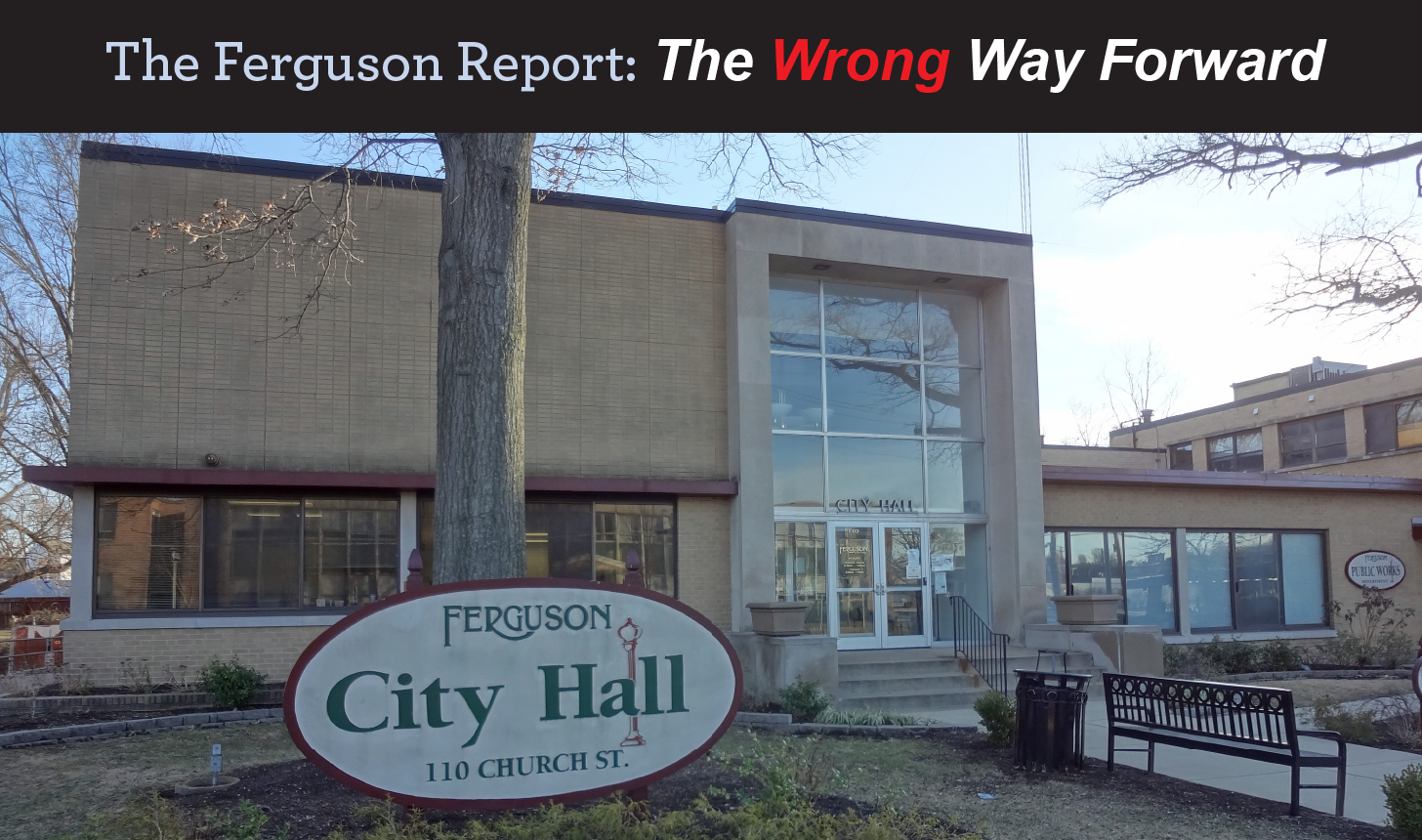
On a smaller scale, the same judgment applies to the lessons learned (or studiously ignored) in a lengthy report released last week into the “underlying issues” behind the riots and looting that erupted in the St. Louis suburb of Ferguson (pop. 21,200) following the shooting death of a young black man by a white police officer on Aug. 9, 2014.

Commissioned by Missouri Gov. Jay Nixon, the report is long on liberal pieties and dogma, including the advocacy of some policies that will only worsen existing problems, but short of practical suggestions for improving economic or social conditions in a close-in, big-city suburb that went from predominantly white to predominantly black in the space of two decades.

For example, the Ferguson Commission calls for expanded job opportunities for black youth. Who can argue with that? As the commissioners point out, for blacks aged 16 to 19, the unemployment rate (nationally) is 30.1 percent, compared with 15.5 percent for whites in the same age group. But then the report endorses calls for almost doubling the minimum wage to $15 an hour.

The adverse impact of a dramatic increase in the minimum wage on teenagers looking for their first jobs should be clear to anyone who stops to think about it. If a business is forced to pay $15 an hour to a worker whose true value to the enterprise is, say, $8 an hour, that amounts to a hidden tax of $7 an hour, or 87.5 percent, on the employment of that person — a tax that does not apply to people making, say, $20 or $30 an hour. Naturally, such a tax would encourage employers to invest in automation and concentrate their hiring on more skilled and experienced workers. As Milton Friedman put it, “The minimum wage law is most properly described as a law saying that employers must discriminate against people who have low skills.”

The commissioners call for concerted efforts to “enhance college access and affordability” through expanded scholarships and other means, but they ignore the biggest problem: poor test scores and a lack of readiness for college. In the Normandy school district — Michael Brown’s alma mater — 93 percent of students who took the standard college entrance examination scored below the national average. Normandy students taking the ACT test had an average score of 16 —not high enough to gain admittance to most four-year state institutions. It isn’t funding that is keeping these students from going to college. It is their abysmal K-12 preparation.

Predictably, the Ferguson Commission urges the state to invest in a universal pre-K program and move the compulsory education age down to 5 from 7. This would become a new (and hugely expensive) entitlement, while adding another layer onto K-12 schools that are not meeting the needs of low-income, African-American students (who make up 80 percent of Ferguson-Florissant students and more than 96 percent of students in nearby Normandy). How is expanding a broken system going to help anyone?

In its 198 pages, the Ferguson Commission Report calls for the expansion of a broad mix of other programs at multiple levels of government — ranging from food stamps and public transit to Medicaid and housing assistance — and it recommends a panoply of new programs to raise the awareness of police officers, teachers, and other public officials of the danger of unconscious or unintentional racial bias.

“In the 2011-12 school year,” the report notes, “14.3 percent of black elementary school students in Missouri were suspended, compared to 1.8 percent of white students.” It then adds, “Research suggests that some of the discipline gap may be attributed to teacher bias, which predisposes them to expect less of minority students and to discipline them more frequently and more harshly.”

However, the report makes no attempt to assess, or discuss, what part of “the discipline gap” — if any — may be due to other reasons — including the high incidence of low-income black children growing up in single-parent homes, with no live-in, working fathers.

Among the 189 “calls to action” contained in the report, one of the more startling recommendations is the complete elimination of all school suspensions and expulsions for disruptive behavior from kindergarten through third grade.

At the outset of the report, the commissioners give themselves a broad pass in describing their work as “a study of underlying issues — not an investigation of an incident.” They write:

This report is not in any way an investigation of what happened between Michael Brown Jr. and Officer Darren Wilson in Ferguson on August 9, 2014, nor is it an investigation of the response to the uprising that followed. Other bodies have been responsible for those investigations.

For the record, it should be noted that Officer Wilson was twice cleared of charges of any wrong-doing in the death of Brown: First, by the Saint Louis County grand jury’s decision not to bring murder or manslaughter charges against him, and second, in an 86-page report by the U.S. Justice Department in early March which supported that decision.

Over the past 12 months, numerous newspaper and magazine articles have called attention to the widespread misuse of local police and courts in Saint Louis County (including Ferguson) as de facto tax collection agencies — imposing heavy fines and fees for minor traffic violations and other municipal code infractions while often jailing people for failure to pay tickets.

The Ferguson Commission report rightly condemns such practices (as did the U.S. Justice Department in a separate investigation of Ferguson Police Department procedures). In July, Gov. Nixon signed a bill into law that greatly limits the extent to which municipalities can rely on fines and fees to fund themselves.

On balance, however, the Ferguson Commission fails in its stated purpose of “outlining a (new) path to racial equity.” For the most part, it is a compendium of tried-and-failed liberal policy recommendations.


Playing Games with Lives

There are reports that it took University City’s ambulance service up to 15 minutes to respond to an emergency call last week when a resident had a heart attack. Three to four minutes is the benchmark for this sort of emergency. A delay like this could have been deadly.

According to University City Council member Paulette Carr, the delay was caused by a lack of mutual aid. Ordinarily when there is an emergency call in University City, EMS personnel and firefighters from surrounding cities such as Clayton and Brentwood are available to help. Most of the fire departments in this part of the county provide relief for one another to help lighten the load and improve response times. This is how mutual aid works.

According to Carr, Clayton had an ambulance ready to go. Under these circumstances, a 15-minute delay was unnecessary.

We’ve been told by reliable sources that the other fire departments in the region recently blacklisted University City from the mutual aid agreement. University City contracted out for EMS with a private company earlier this month, against the wishes of some of the bosses in the county firefighters union. The result: if you don’t play by our rules, we won’t cooperate with you.

When there’s a labor dispute between a private sector union and a private business, it doesn’t cause this kind of problem. If UPS and the Teamsters can’t work well together, consumers can use FedEx instead. There is not an alternative fire service for citizens of University City to use. When it comes to the government, union executives cannot afford to let petty disagreements stop the delivery of services.

A handful of executives in the St. Louis County firefighters union seem to be playing games with people’s lives. If they can’t put service to the public above getting their way on every little thing, then perhaps they don’t belong in our government. 

Pope Francis Is Visiting a Catholic School. Maybe You Should, Too

Today, Pope Francis will visit Our Lady Queen of Angels school in East Harlem in New York City. It will be a bright spot at the end of a rough couple of decades for Catholic schools in the United States. In the last ten years alone, enrollment in Catholic schools has dipped from over 2.4 million students to just over 1.9 million students.

I taught at an urban, historically African-American Catholic school, St. Jude Educational Institute on the west side of Montgomery, Alabama. After 76 years of operation it closed its doors 2014, following the path of many other inner-city Catholic schools. 

You should be worried about urban Catholic schools closing, as they have for decades succeeded where other schools have failed.  Surveying the research, economist Derek Neal wrote, “Although many questions remain unanswered, one result seems clear. Black and Hispanic students in large cities often have the most to gain from private schooling, in particular, Catholic schooling.”

But the story of Catholic schools in America today is not all doom and gloom. Echoing what my good friend Andy Smarick wrote in National Review earlier this week, there are in fact, several promising trends in contemporary Catholic education. I’d like to highlight three:

  1. Innovative management strategies. Many dioceses have not kept up with the changing times. Some still rely on parish-based schools tied to neighborhoods whose demographics of both children and parishioners are changing. Others have decided to keep open a large number of under-enrolled schools rather than consolidate resources into a smaller number of more viable schools. Our Lady Queen of Angels is a great example of a school under creative leadership. It is part of the Partnership for Inner City Education, a management consortium of 6 urban Catholic schools in New York. The partnership has a laser-like focus on providing a great education for low-income students, and supplements the Archdiocese, which already has its hands full managing its diverse portfolio of schools. Organizations like this (which already exist in Washington DC, Philadelphia, and elsewhere) can help bring a much more coherent strategy to urban Catholic education and stretch limited dollars the furthest.
  2. Blended Learning. Multiple Catholic-school organizations have been working on blended learning models, which can help schools control personnel costs, a huge driver in the increase in the cost of Catholic schooling as the teacher workforce has shifted from priests and religious sisters to lay men and women. Seton Education Partners has implemented a blended learning model at six Catholic schools in San Francisco, Cincinnati, Los Angeles, Milwaukee, and Philadelphia. The University of Notre Dame’s Alliance for Catholic Education has piloted a blended learning school in Seattle. Even the much-vaunted Cristo Rey network has started a blended learning school in San Jose, California. These could change the delivery model of Catholic education, lower its cost, and make it available for more and more students.
  3. School Choice. Probably the single most promising development in Catholic education over the past two decades has been the emergence and growth of private school choice programs. Catholic schools in Indiana, Florida, and Wisconsin have swelled with students attending with state support in the form of a school voucher, tuition tax credit scholarship, or education savings account. Nationwide, enrollment in school choice programs has grown from less than 30,000 students in 2000 to over 300,000 today. That said, if more low- and middle-income students are going to be able to take advantage of a Catholic school education, more states will need to create or expand these programs.

It was the prophet Jeremiah who said “in this place of which you say it is a waste, there will be heard again the voice of mirth and the voice of gladness. The voices of those who sing.” For years now, many observers have written off Catholic schools as dying institutions that had failed to keep up with the changing times. But across America, voices are singing.

New Los Angeles Charter School Plan Stuns

What do you do when you’re fed up with your city’s public school system?

Most people might attend a school board meeting, but if you’re Eli and Edyth Broad and you’re fed up with the Los Angeles Unified School District, you would come up with a $490 million dollar plan to double the number of charter schools, challenge employee unions and charter school critics, and create 130,000 new quality seats by 2023.

The Broad Foundation plans to open 260 new charter schools over a 7-year period. A 44-page memo describing their plan outlines the growing demand for high-performing charters, describes teacher and school leader recruitment strategies, and calls for more charitable support for the new charters. L.A. Unified already has a large number of charter schools (they educate about 16% of the district’s total enrollment), but if everything goes as planned charter schools will reach 50 percent market share.

The LA Times reported:

Charters have proved popular with parents. The expansion campaign is shaping up to be something of a referendum on L.A. Unified's performance. The memo repeatedly criticizes the district for failing to prepare students for college and careers, robbing Los Angeles of a better-trained, smarter workforce.

"The opportunity is ripe for a significant expansion of high-quality charter schools in Los Angeles," the memo states. "Thanks to the strength of its charter leaders and teachers, as well as its widespread civic and philanthropic support, Los Angeles is uniquely positioned to create the largest, highest-performing charter sector in the nation. Such an exemplar would serve as a model for all large cities to follow."

In Missouri, only students in St. Louis and Kansas City currently have access to public charter school options. In 2014, public charter schools enrolled 29 percent and 42 percent of all public school students in Saint Louis and Kansas City, respectively. Still, a demand for more quality public options exists in both cities.

Time will tell if something like the Broad plan would be right for Missouri. Until then, here are some fixes to our current charter system, which require a little less heavy lifting:

(1)   Make it easier for charter schools to acquire abandoned buildings.

(2)   Allow charter schools to open statewide

(3)   Provide equitable funding for public charter school students.

(4)   Fast-track the process for quality charter school replication.

All four of these would cost a lot less than $490 million, and would do a world of good for students in Missouri.

Restoring Trust in Government

Gallup released a poll last week finding that 75% of U.S. adults see widespread corruption in government. According to Gallup, the perception that government is corrupt has risen in the last decade from 2 in 3 to 3 in 4 people saying that they perceive government as corrupt. Compared to other countries with a free press, we did slightly better than Poland, Taiwan, and Cyprus—and slightly worse than Israel, Slovakia, and Belize.

If so many Americans see government as an institution plagued by widespread corruption, perhaps we should minimize the role of government in our society.

According to the Tax Foundation, this year, 31% of the nation’s income will go toward paying taxes. This means we’ll spend the first 114 days of the year working to pay for government.

Things are not much better if you focus only on our state. Missouri is not a low-tax state. And we’re one of the top states when it comes to the government picking winners and losers through corporate handouts.

There are a number of ways to minimize our dependence on government at the state and local levels, including: shifting services from the public sector to the private sector, freeing ourselves from onerous regulations, ending the routine practice of government officials doling out assistance to well-connected businesses, and giving parents the ability to choose which schools their children attend.

And of course, rooting out corruption means ensuring that government is as accountable as possible. No more backroom deals between government officials and government unions. In order to do this, we need to close the loophole in our state’s transparency laws that allows government officials to hold meetings with union officials behind closed doors. Because government unions play such an important role in the delivery of public services, they need to be as transparent and as accountable as possible.

If Missouri can implement these modest reforms, we’ll have taken a few big steps toward minimizing our dependence on government. And, I believe, restored trust in government won’t be too far behind.


Pine Lawn Considers Disbanding Their Police Department

                Pine Lawn, a small city in North Saint Louis County, has begun exploring the possibility of disbanding its police department. If the city did so, it would likely turn over policing duties to the Saint Louis County Police Department (which already handles policing for more than a dozen municipalities along with unincorporated areas) or the new North County Police Cooperative, formed by Wellston and Vinita Park.

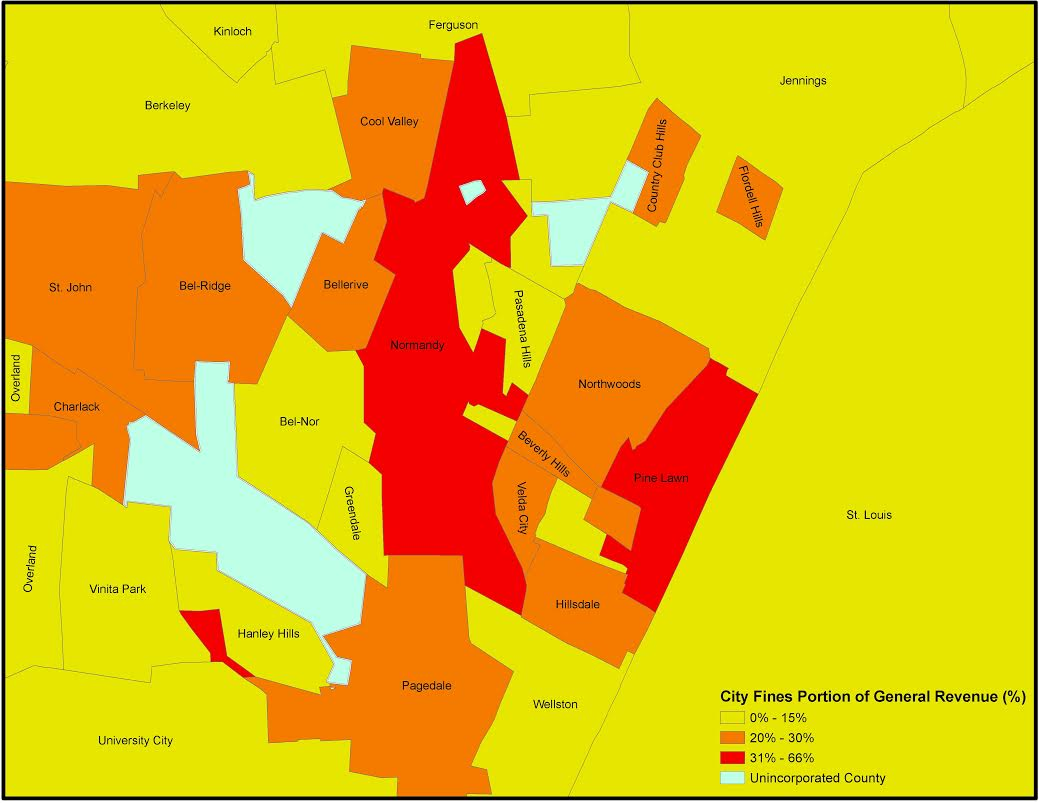
                While the process through which the city is considering such a change has created considerable controversy, there is little doubt that Pine Lawn is in serious need of reform. The city been a posterchild of civic dysfunction, with a former mayor indicted for corruption, irregularities in city expenditures, and a highly criticized criminal justice system that uses poorly trained officers to fund the city through citations. Specifically addressing the last point, a report from Better Together showed that as of 2013 Pine Lawn relied on fines and fees for almost 50% of its general revenue, making it one of the worst offenders of the Macks Creek Law (which capped fines to 30% of general revenue) in Saint Louis County:

                As we’ve written previously, until last this year the Macks Creek Law was regularly ignored and was without enforcement provisions. But with the passage of SB 5 in the last legislative session, things have changed. Cities like Pine Lawn can now collect no more than 12.5% of their general revenue via fines and fees. There are now regular reporting requirements, and failure to comply triggers a disincorporation vote.

                These new legal provisions spell trouble for the status quo in Pine Lawn. Instead of a cash cow, their police force is likely to become a financial burden. That has pushed Pine Lawn and cities like it to do what they should have done a long time ago: join with the county or other cities to provide cost-effective and professional policing.  

Ferguson Commission Misses the Mark on Unemployment

After weeks of deliberation, the Ferguson Commission released its report last week. The report contains a wide range of policy prescriptions, most of which are aimed at rectifying injustices facing the greater St. Louis community.

The report rightly makes the case that one of the biggest issues facing the St. Louis region is unemployment. It then goes on to recommend increasing the minimum wage to $15 an hour. Something doesn’t add up here.

Study after study has shown that minimum wage increases cause unemployment. Laws that drive up the cost of labor and lead to the elimination of jobs are the opposite of what Saint Louis needs.

Oddly enough, the report acknowledges the role of training positions in its discussion of unemployment. From the report:

Internships and apprenticeships are valuable programs to both help students succeed in their careers, and help employers ensure they have a competent, trained workforce. By expanding internship and apprenticeship opportunities for high school and college students, and fostering collaboration between educators and employers in the development of these programs, Missouri can support better learning and economic outcomes that benefit individuals, companies, and communities.

How do the report’s authors envision increasing training opportunities while at the same time doubling the amount that low skilled laborers must be paid?

The Show-Me Institute recently did a video on the revitalization effort of St. Louis’s Dutchtown neighborhood. In that video we tell the story of JJ, a young man from south St. Louis who worked his way to the front of the house at a local restaurant after starting washing dishes. For people without formal work experience, starting at minimum wage and learning skills on the job is the often the only way to train and gain experience. By pulling the bottom rung of the economic ladder up out of reach, a minimum wage increase will make it more difficult for people to move up in our economy.

It seems that the Ferguson Commission wants to propose policies that will help revitalize the underserved parts of our city and improve the lives of those that the system is failing. By calling for a minimum wage increase, they risk making things worse.

Myths of Education Reform

Show-Me Institute's new Director of Education Policy, Michael McShane, digs into the myths and facts about education reform in Missouri. Is there any truth behind common arguments like "St. Louis and Kansas City are the only places in need of reform," "Expanding charter schools would harm public schools," and "Missouri's Blaine amendment makes private school choice impossible"? Watch and find out!
 
Support Us

The work of the Show-Me Institute would not be possible without the generous support of people who are inspired by the vision of liberty and free enterprise. We hope you will join our efforts and become a Show-Me Institute sponsor.

Donate
Man on Horse Charging