New NCTQ Report Highlights Holes in Missouri Teacher Policy

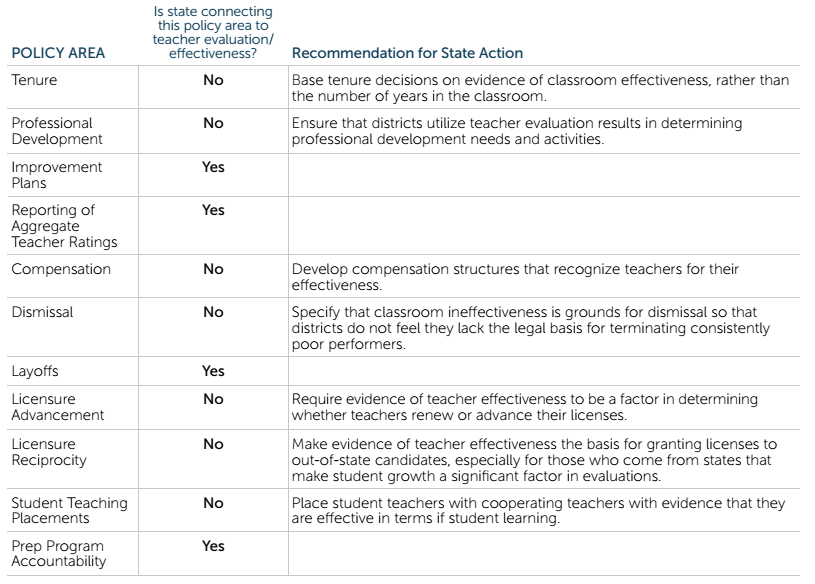
The National Council on Teacher Quality is out with its annual state-by-state report on teacher policy. I’m still digging through all of the findings, but I do want to bring your attention to the table shown above (which appears on page 63 of the report), wherein the authors take a big-picture look at Missouri education policy and ask if it is oriented toward identifying and rewarding the most effective teachers.

What does this mean?

·         Missouri does not base tenure decisions on demonstrated teacher effectiveness

·         Missouri does not ensure that districts use teacher evaluation results when selecting professional development activities.

·         Missouri does not pay better teachers more.

·         Missouri does not specify that ineffectiveness is grounds for dismissal for teachers or principals.

·         Missouri does not require that teacher effectiveness be taken into account when teachers are looking to renew their licenses.

·         Missouri does not make evidence of teacher effectiveness the basis for granting Missouri licenses for teachers with licenses from out of state.

·         Missouri does not place its student teachers in classrooms with teachers that have demonstrated effectiveness.

I’ll be the first to say that student test scores should not be the sole measure of a teacher’s effectiveness. An over-reliance on standardized tests has led to many unintended and unfortunate consequences.  But two course corrections working in tandem—rethinking what tests we give children and how we use the results, and rethinking how we help recruit, reward, and retain great teachers—have a great deal of potential for improving Missouri’s education system.

If we’re going to have policies like licensure and tenure, they should be based on teacher effectiveness, not simply how long someone has been in the classroom.  If districts are going to spend millions of dollars on professional development activities, the money should be in areas where teachers are struggling to improve student achievement.

Ultimately, a move towards a system with greater school choice would diminish the need for heavy-handed, centrally-driven teacher evaluation policies.  Individual school leaders would be responsible for putting together the best possible staff so families would want to send their children to that particular school. Parents, who have access to detailed information both about their child and how well he or she is doing, would be the ultimate arbiters of teacher quality. But until such a system is in place, we must work harder to identify great teachers, recruit them into our schools, and then do what is necessary to keep them here.


An Organization of Union Conservatives?

Terry Bowman had had enough. Sitting in his breakroom several years back, he saw an article in his union’s newsletter about “the healthcare policy that Jesus would’ve advocated.” A seminarian at the time, Terry knew his scripture pretty well, so the article caught his eye.

The article argued that Jesus would’ve supported Obamacare. Terry found the use of religion for partisan politics deeply offensive—especially when he was paying for it with his union dues. Terry knew he had to do something.

Terry Bowman would go on to start Union Conservatives, an organization “dedicated to bridging the gap between union workers and liberty, building an organization of like-minded voices, and strengthening unions through conservative principles.” Union Conservatives is a network of conservative union members across the nation who are pro-worker but are tired of union cultures that ignore the conservative perspective.

According to the group’s website, Union Conservatives’ mission includes “providing liberty to union members who have differing political views than their union leadership,” and “reshaping union policy to reflect the large numbers of conservative members.”

Ideally, a union is an organization that tirelessly represents the interests of all of its members. Unfortunately, many unions get involved in political causes that don’t directly benefit their members. Indeed, sometimes a union’s political activities are in conflict with the beliefs of a significant portion of its members. Groups like Union Conservatives are there to provide balance and bring together people who believe in both the free market and their union.

Direct Primary Care Makes a Splash in Springfield

Early last month the Springfield News-Leader published an excellent article about direct primary care, a topic we’ve covered extensively. Direct primary care (DPC) generally removes middleman insurers from the care equation, facilitating improvements not only in the cost of care, but also in the availability of care for the patients enrolled in DPC programs. And the title of the article explains the state of affairs in DPC well: “A different doctor’s office is on the rise locally—and it’s a critique of the traditional health system.” As you might expect, I highly recommend reading the whole piece.


But before you do, I’d like to highlight one quote from the story that is among the better explanations of the principles of not only DPC practices, but of substantive health care reform in general.


“The classic analogy of direct primary care is auto insurance,” said Dr. Shelby Smith, who will open Equality Healthcare with two fellow doctors in December. “Everybody needs auto insurance for a car wreck. You don’t use auto insurance for a car wash, or an oil change or new tires. Sort of what we’re doing in the primary care realm is saying that primary care in this country should be accessible, it should be affordable and the pricing should be very transparent.”


Bingo. Dr. Smith’s focus on access and the cost of care is not only what DPC practices are largely all about, but they are also what the focus of our public policy should be. “Coverage” is not care, and until policymakers more readily recognize this fact at the state and federal levels, we should not expect insurance rates to stop rising or insurance plans to stop failing en masse. DPC offers a blueprint for health care policy progress; hopefully lawmakers will study it closely.

Springfield May Be Ready for Uber, But Its Regulations Aren’t

Recently, an editorial in the Springfield Business Journal promoted the benefits ridesharing companies like Uber could bring to Springfield residents. The author of that article wrote about how he had used the service many times in other cities and enjoyed the experience. He also felt that demand in Springfield is there for Uber and companies like it to be successful. However, while the author and city residents might be ready to embrace new transportation options, the city’s regulations are out of date and, as written, could block ridesharing companies.

                The sections of Springfield’s municipal code that deal with for-hire vehicles (which are likely to encompass Uber) were not written with ridesharing in mind. The code is primarily concerned with the operation of taxis, limousines, and hotel courtesy vehicles, and has no language for companies like Uber. It also envisions an industry consisting of taxi/limo companies (which own and license the vehicles) and drivers (who are hired to contract to drive the vehicles). However, ridesharing companies do not own a set amount of vehicles that they let out to professional drivers; instead, they merely connect potential passengers with people driving their own personal vehicles.

                This means that as things stand, if Uber attempted to open up in Springfield, it would be unclear who had to register the vehicles and how they would be registered. Either option—taxi or limo—would create awkward requirements for part-time drivers, as the code requires that vehicle owners:

  1. Maintain a business address with telephone service.
  2. Maintain a daily log of all trips.
  3. File a balance sheet and income statement prepared by a certified public accountant that shows the “business” has not less than $5,000.00 in liquid assets.

The code also requires that drivers:

  1. Follow a dress code (slacks and a collared shirt).
  2. Complete first-aid training.
  3. Take a physical exam.
  4. Present evidence of previous taxi or driving experience.

Additionally, regulations regarding fares would block Uber’s surge pricing practices, an integral part of their business model.

Springfield’s for-hire vehicle regulations were written for a purpose, but times and market realities are changing. States and cities across the country have changed regulations so that Uber and companies like it can operate. This is a chance for Springfield to be proactive and write sensible regulations now, so that its residents will be able to enjoy ridesharing as soon as possible. 

Using Technology to Provide Low-Cost Union Elections

Once a government union comes to power, it can stay in power for an indefinite length of time. Public employees such as teachers and firefighters are trapped by labor laws that unionize a workplace after a one-man, one-vote, one-time election. In our newest study, The Low Cost of Labor Reform, we show how Missouri can provide public employees the ability to replace or retain their union every few years with union elections.

Last year the Missouri legislature considered a few bills that would’ve done this. Unfortunately the fiscal notes associated with these bills (basically a price tag for a new law) indicated that the elections would cost taxpayers hundreds of thousands of dollars. One of the problems with these analyses was the assumption that elections would have to be conducted by traditional ballots, manned by hundreds of temporary employees hired just for elections. Modern technology makes this unnecessary.

With traditional voting, paid or volunteer workers need to be on location working polls. Moreover, specialized voting equipment needs to be at every polling location. Telephone- and internet-based voting solve these issues. With telephone and internet voting, personnel do not need to be at every polling location, and the voting equipment is nothing more than a telephone or personal computer. A voter just dials a number or goes to a website, enters a PIN or password, and votes at his or her convenience.

Telephone- and internet-based voting give voters greater flexibility. Not only can you vote from anywhere with an internet connection or mobile phone reception, but polls can remain open longer without significantly increasing costs. Imagine having a week to vote and being able to vote late at night or early in the morning. Much better than heading to a poll, parking, standing in line, and then rushing back to the office.

Security is an issue with telephone- and internet-based voting, just as it is with traditional voting, but internet voting can be encrypted. 256-bit encryption, the same encryption many major banks use, is as cost effective as it is secure.

Price doesn’t have to stand in the way of a policy that would empower government workers. If we’re forward thinking and embrace technological innovation, union elections can held at a reasonable cost.

Government-Run Obamacare Co-ops Begin Their Downward Spirals

When the details of Obamacare were being ironed out, some in Congress wanted a “public option” in health care—a massive, government-run, single-payer health insurance system that liberals had dreamt about for years. When political realities made that a non-starter, many legislators threw their support behind the idea of government-backed nonprofit health insurance cooperatives that would be able to compete directly with private insurers in the insurance exchanges. The idea was that these essentially public cooperatives, run side-by-side with private insurers, could operate more efficiently while they simultaneously picked up poorer enrollees.


Well, it’s 2015, and of the 23 co-ops created, ten have already shut their doors. As PBS News Hour reports, the failure of the cooperatives came down to dollars and cents.


They had basically had solvency issues, financial solvency issues.


If they were the lower price point, that tended to attract sicker beneficiaries. That would drive up their costs. They had anticipated fairly large payments from the federal government to help offset the cost of those sicker folks.


But, of course, as we mentioned earlier, there was a change and their funding was cut early on in inception of the co-ops. And then, secondly, there was another legislative change that adjusted the amount of money that the federal government could pay them.


So the cooperatives attracted enrollees whose health was (in general) poorer and who couldn’t pay very much—a disastrous mix for an insurer—and then the cooperatives couldn’t survive after the government refused to give them the bailout they were expecting.


We’ve said it before, but it bears repeating: coverage is not care, and that fact is especially salient in the case of these cooperatives. Indeed, these government programs are failing the very vulnerable beneficiaries who they were specifically designed to attract. There are other, better ways forward on health care policy. More government is not the way.

Kansas City Obamacare Insurance Premiums Expected to See Double-Digit Hike

Earlier today I wrote about how government-backed insurance cooperatives around the country have begun to fail. The reason? Dollars and cents. The cooperative plans were not financially sustainable, and since they could neither substantively raise prices nor get the government bailout they expected, these plans—predictably—folded.


Missouri doesn’t have a “cooperative” plan, but it does have what amounts to for-profit equivalents experiencing adverse selection problems nearly identical to those of the co-ops. How are these Missouri insurance plans dealing with these financial problems? Rate hikes, of course.


New data for the 37 states that use the federal HealthCare.gov marketplace, rather than run their own exchanges, suggest that premiums for next year will be going up far more in the Kansas City area than in many other large cities.


The monthly premium for the benchmark silver plan will increase by an average of 6.3 percent for the 30 cities included in the new data from the Department of Health and Human Services. But in the Kansas City area, premiums for that plan will jump by 20.1 percent next year.


. . . Rates appear to have escalated in Kansas City because Coventry, which had the second-lowest-priced silver plan this year, raised its rates for 2016 by an average of more than 25 percent, said Ron Rowe, vice president for sales of Blue Cross and Blue Shield of Kansas City.


Simply telling people they have coverage is not the answer to America’s health care policy problems—a fact the ever-growing list of failed and failing Obamacare insurance plans bears out. Until we get a handle on the cost of health care as a country, it will be very difficult to substantively guarantee access to care to the people who need it most, whether in the private market or in a welfare program like Medicaid. We can, and must, do better.

Support Us

The work of the Show-Me Institute would not be possible without the generous support of people who are inspired by the vision of liberty and free enterprise. We hope you will join our efforts and become a Show-Me Institute sponsor.

Donate
Man on Horse Charging