Saint Louis teachers want a raise, and they have a point

On Friday, the Post-Dispatch covered a recent Saint Louis school board meeting where over 100 teachers vociferously argued for a raise.  Many have been stuck at the same place in the salary schedule for years, and the article mentions several popular, award-winning teachers who have left the district for other states or better paying schools in Saint Louis County.

The debate over how much teachers should be paid will never be settled.  We can, however, talk about teacher pay in the broader context of school funding and perhaps come to agreement on how teachers should be paid, if not how much.

Let’s walk through the numbers.  First, according to the Missouri Department of Elementary and Secondary Education (DESE), Saint Louis spends $14,093.21 per student per year. That reflects current expenses; it does not count capital costs, debt service, or several other significant line items. DESE also reports that the Saint Louis Public School District (SLPS) has a 1:18 classroom teacher: student ratio and a 1:12 total teacher: student ratio. 

That means that the average 18-student classroom brings in $253,677.78 in revenue per year.  Even looking at a 12-student classroom means $169,118.52 per year.  According to the Post-Dispatch, the average teacher salary is $46,163.*

Bottom line: A lot of money is failing to make it to the classroom.

How can this be? I’d have to dig deeper into the numbers for a full explanation, but even a quick glance points us in a couple of directions.  In no particular order:

1.       Administrative Bloat—According to DESE, SLPS has a ratio of 206 students for every administrator.  That compares to 272 students per administrator in Kirkwood, 274 in Lindbergh, 277 in Rockwood, 306 in Wentzville, and 321 in Mehlville.  Less money to administrators means more to teachers.

2.       A poorly designed salary schedule—Take a look at SLPS’s teacher salary schedule.   The big raises for teachers only come after they have earned degrees with dubious connections to actually improving student learning.  A great teacher who only has a bachelor’s degree tops out at just over $56,000 per year. Removing step-and-lane pay scales and empowering school leaders to compensate teachers based on quality could ensure that top teachers stay in the classroom.

3.       Pension contributions teachers won’t see—Saint Louis teachers are covered by the Public School Retirement System of the City of Saint Louis.  They are required to contribute 5% of their salary every year.  The district puts in an additional 16.5%. Now, if those teachers stay employed by the district until retirement, they can get a tidy pension, usually about 60% of their final salary (and they’re eligible for Social Security!).  The problem?  Teachers who don’t stay in SLPS for all 25 or 30 years of their career get only a fraction of that pension.  Indeed, it takes 5 years to “vest.” More than 60% leave before this time, and while they can take their contributions, they sacrifice what the district has contributed.  Contributing directly to a portable retirement account from day one of employment would ensure that every teacher gets his or her due.

Teachers are incredibly important, and they should be paid appropriately.  Unfortunately, the structure of teacher pay in Saint Louis and across the state prevents that from happening.

*Note: When originally posted, the average teacher salary was mistakenly listed as $41,163. The error has been corrected above.


Aviation Department Withholds Information from the Star

On September 11, The Kansas City Star Editorial Board called on the Aviation Department to end the practice of issuing free parking passes to local officials and a few others. The piece is worth reading in its entirety, and it includes this recommendation: 

City officials should pull the plug on a little-known perk that allows [Kansas City Council member Quinton] Lucas and 28 other people to park for free in the public garages at Terminals B and C. The passes are awarded by the Aviation Department’s parking division.

In advance of their editorial, The Star requested the parking pass records from the Aviation Department on September 4. On September 8 the Department responded with the list on which the editorial board based their September 11 column.

The Show-Me Institute was also looking into this data, but we also requested a copy of all passes issued since January 2011. The second list we received included additional names the Aviation Department did not share with The Star. They included passes issued to:

·         John McGurk, former chief of staff to Mayor James,

·         Buffy Smith, current staffer to Congressman Sam Graves

·         John Diehl, former Missouri House speaker,

·         Paul LaVota, former Missouri senator, and 

·         Tom Dempsey, former Missouri senator.·          


All of these passes were voided at 9:05 a.m. on September 8, right before the Aviation Department provided The Star with a list of active passes.

(Links to both lists provided by the Aviation Department can be found at the bottom of this post.)

It's unknown why the Aviation Department did not fully comply with The Star's straightforward request. What they withheld hardly amounts to much: a few recently-resigned state officials and some staffers. But it appears that their first instinct was to obfuscate; they didn't share the whole picture when asked. If the Department wants to be a credible source of information about the need for a new terminal, or much of anything else, they must be more transparent about their operations.

Charter Schools Do Serve Students with Special Needs

It’s been nearly two decades since Missouri passed a law allowing public charter schools to operate in St. Louis and Kansas City. You’d think that by now, charter schools would be old news. Unfortunately, a lack of understanding persists.

Most recently, in a Post-Dispatch letter-to-the-editor, a Ferguson resident responded to my commentary about expanding access to public charter schools. “Charter schools can pick and choose whom they allow in, unlike the public schools who, by law, must take in everyone including troubled and handicapped students,” he wrote.

It is true that typically charter schools enroll a smaller percentage of students with disabilities than traditional public schools. Some, like the above letter writer, believe that means charter schools only accept the “crème of the crop,” taking away the “best and brightest” from traditional public schools. But that isn’t the case.

One report found that students with disabilities are simply less likely to apply to attend charter schools. This may be because parents prefer the resources their children receive at their local traditional public school. It may be because parents are counseled away from the option either by a charter school or the traditional public school their child attends. More likely than not, parents may be unaware that their child can even attend a charter school.  That’s selection on the parent’s, not the school’s, part.

If a critic wanted to find out about charters serving students with special needs, they would need to look no further than St. Louis’ own EAGLE College Preparatory School. In its application, the charter school outlines the types of services it provides to students with special needs. Today, the percentage of students with disabilities at EAGLE is 13 percent. The statewide average incidence rate of students with special needs is 12.69 percent.

When I visited EAGLE, I had the opportunity to speak with Regional Special Education Director Elisha Ferguson, who told me, “Charter schools have gotten a bad rap, because people assume they don’t offer these (disability) resources. It’s a lack of information”

According to Ferguson, all students at EAGLE receive small-group support. Even students without disabilities who have been identified as needing additional help receive special attention. This is in contrast to the complicated and time-consuming process parents, teachers, and students must go through just for a child to receive an individualized education plan (IEP). Federal law and implementing regulations do not set a timeline for the IEP process—in some cases it can take months before a child receives special accommodations.

At EAGLE, you can’t tell which child has a disability and which doesn’t—every child is treated as having unique needs. This is the exact approach that we should be supporting, not stifling.

It’s unfortunate that misperceptions about charter schools still linger in Missouri policy discussion. Falsehoods that are spread through a lack of information, or exposure to misinformation, add nothing to the conversation. In fact, they may be preventing some children from receiving a quality education.

Saint Louis City Property Tax, Part 5: Problems Ahead

Saint Louis City Property Tax Blog Part V: Problems Ahead

In the first four blog posts in this series, we have seen how Saint Louis City’s property tax base is significantly curtailed because much of the city’s land is owned by governments and nonprofits, which pay little or no real property tax. Many other properties also receive special real property tax breaks, like TIF and Chapter 353 abatements, further reducing the number of parcels paying the city’s full property tax rate of $7.5850 per $100 assessed value (plus a $1.64 commercial surcharge). In total, an incredible 40% of the city’s property by value either is tax exempt or receives special tax breaks. The situation is worse downtown, where virtually any recent development has received tax breaks.

This situation has put Saint Louis City in a bind. Most cities rely almost entirely on property taxes and sales taxes to run government. But in Saint Louis, the city is forced to rely on an earnings tax to make up for the weak property tax base. Many economists and even Mayor Slay agree that earnings taxes are damaging to city growth and put Saint Louis at a competitive disadvantage. The mayor promised to look for ways to reduce the city’s reliance on the earnings tax in 2011. However, since that time Saint Louis’s reliance on the earnings tax has grown.

Another effect has been the creation of an unlevel economic playing field, especially for small businesses and depressed neighborhoods. Effective property tax rates vary from neighborhood to neighborhood, from block to block, and from building to building. If a business or development is big (or is setting up where civic leaders would like it to), it is almost certainly going to get a real property tax break. If a resident or a business doesn’t meet either of these criteria, it pays the full property tax rate. The homeowner in Southwest Garden pays full property tax rates, but the condo dweller downtown doesn’t. The laundromat in the Central West End pays full property taxes, but the Chase Park Plaza doesn’t. Fairness aside, the civic leaders are using the tax code to entice certain businesses or favor certain neighborhoods, in the hopes that these municipal champions will create trickle-down development. This prevents the city from charging broadly lower tax rates, which could generate more broad growth from the bottom up.

In the end, a good portion of the city’s property tax base problems are beyond its control. Parks, courthouses, schools, and cemeteries are tax exempt by state law or practicality. But much of the problem is the result of city policy. The city’s land bank, the LRA, has long dragged its feet over selling properties to willing buyers. Other city organs inappropriately own land on which private developments stand, like Busch Stadium. And when the city hands out tax breaks to any large developer that makes the request, even when their development plan is speculative at best, the hole gets deeper. With another vote on the earnings tax coming soon, now would be good time for the city government to stop hollowing out the tax base and reverse the damage already done.

Aviation Administrator Still Denying Reality

Kansas City Aviation Administrator Mark VanLoh is struggling to cope with reality, it appears. In a recent video interview given to Airport Revenue News and posted on their website on May 15 2015, VanLoh says the following [starts at 1:40]:

The challenges again would be educating the public on why we think we need a new single terminal. So many people—and around the country—think that aviation revenues should be spent fixing potholes or schools, where as you know airport revenues have to stay on the airport. And because we’re a department of the city that’s a tough sell.

First of all, I can think of no one who claims that aviation revenue should be used elsewhere in the city. It appears to be a red herring argument and it gives short shrift to the arguments that people have made against building a new terminal: Namely, that it will increase fees and therefore risk costing us flights, and that MCI is a great and convenient airport just as it is,

But even more importantly, VanLoh's claims that airport funds stay at the airport is wrong, and he knows it. After all, he signed the documents moving $10 million dollars from the Aviation Department to the City Finance Department, And he agreed to the amendment that extended the loan, too.

If the Aviation Department wants to convince Kansas Citians of anything, they first need to start speaking honestly about how they operate.

Where Did All of These Events Come From?

Joe Miller and I have already said a lot regarding the new study claiming that a new Rams stadium would have a positive fiscal impact on the city. However, there is still more to talk about. One thing that stands out is the number of events they think a new stadium will host.

The number of events matter because it factors into how the authors calculate additional sales taxes a new stadium would generate. They estimate that the new stadium development would host 123 events, including professional soccer and high-school sports. For the sake of discussion, let’s grant that a new stadium will keep the Rams here. What of these other events?

It is no sure thing that Major League Soccer (MLS) will locate a soccer team here. This is important because MLS spending makes up a quarter of the authors’ calculation. The authors should not be counting on soccer revenue without a guarantee that a new team will actually exist.

Beyond the MLS, how many concerts, high-school/college sports, and other events do the authors think are available for the stadium to host? Saint Louis is not lacking in venues. The Scottrade Center, Chaifetz Arena, and the Edward Jones Dome can all serve as hosts. How many net new events will this stadium attract? This study doesn’t say. Based on the authors’ other calculations, it’s possible that they would count any event as a net gain for the city, regardless of whether it came at the expense of another local venue.

Determining the number of events the proposed stadium development would attract is a difficult task. However, given the hundreds of millions in taxpayer dollars on the line, it would be more prudent to have conservative estimates. The region doesn’t need another development to fall short of expectations. 

Latest economic data paints same picture: Missouri in bottom half of states

The Bureau of the Census recently released its 2014 American Community Survey (www.census.gov/programs-surveys/acs/).   Based on two key measures—income and education—Missouri ranked in lower half of all states.

                The Survey provides a current, comprehensive look at various characteristics of American society, from economic to social to demographic.  The data are available at the national and state level.  Though there are hundreds of possible data sets to look at, I chose two that are key indicators of Missouri’s current and future economic health:  household income and educational attainment.        

Missouri ranked 36th in median household income when compared with all other states.  (The median means there are just as many households above this number as below.) The national median household income at $53,657, and the number for Missouri is $48,363.  At least we’re better off than Mississippi, where the median household income was only $39,680.  In terms of education, the percentage of adults with a bachelor’s degree or more shows how well Missouri is doing at producing (and keeping) or attracting from other places those individuals ready for the modern workplace.  Here again Missouri’s record is mediocre at best:  27.5 percent of Missouri adults have a BA or better, below the national average of 30.1 percent.  Missouri ranks 32nd on this measure of education.

                Are the two related?  The weight of evidence says yes: better educated people tend to earn higher incomes.  The 2014 Survey data show that of the top 25 states in terms of median household income, on average 32 percent of the adults had least a BA.  For the bottom 25 states (in terms of income) on average just a little more than one-quarter of the adults had at least a BA.  Moreover, if you statistically compare the median household income and BA attainment data, the correlation (how closely they are related statistically) between these two series is 0.83.  With a correlation of 1.0 representing one-to-one correspondence between the two, this suggests that median household income and education are related.

                Is this correlation reflecting the fact that more education is associated with higher income, or is it that higher income areas attract those with more education?  Either way, Missouri is coming up short.  We are not generating and keeping those with college degrees nor are we attracting them from other places.  Continued failure to do so will ensure a lackluster economic future.

The Ever-Growing Bureaucracy

St. Louis County intends to make landlords liable for the actions of their tenants. At least, that’s what will happen if St. Louis County passes a new ordinance requiring landlords in unincorporated parts of the county to be licensed.

Under the provisions of this ordinance, property owners seeking to rent to tenants will have to fill out an annual application so that they may receive this license. Proponents argue that only those who don’t keep their property up will have to worry about the contents of this ordinance. Yet, this ordinance creates many negative incentives for landlords as well as another hoop for them to jump through in order to do business.

A major issue is the provision that the license can be revoked if an occupant of the property is convicted of one of the following: selling drugs, selling alcohol, gambling, or prostitution. This encourages landlords to discriminate under the auspices of some possible future illegal activity. Even if the landlords didn’t discriminate, forcing them to evict people on the basis of committing a misdemeanor in order to keep renting property is excessive.

Even if the final ordinance lacked this provision, creating more paperwork for landlords is no way to encourage more people to enter to market. For example, this ordinance could push out people who don’t plan to be full-time landlords, but might want to rent out their house for a few months. Would renters be better off with fewer landlords out there renting out property?

Licensing requirements should be reserved for a few select professions (e.g. doctors). By requiring licensing for more and more professions—like landlords—the government closes out that profession to many new entrants and reduces consumer choice. Licensing landlords will do exactly that. 

What the Ferguson Commission Gets Right and Wrong About Public Transportation in Saint Louis

The Ferguson Commission recently released a report that outlined a series of problems and proposed solutions to racial disparities in the Saint Louis region. One of the areas that the commission looked at was transportation, specifically public transportation.

The commission rightfully pointed out that for those who do not have access to a personal vehicle, the Saint Louis region can be difficult to navigate. Few jobs are easy to get to via a short transit trips, and car ownership can be costly. The commission’s recommendations, channeling Samuel Gompers, can mostly be described as “more.” The group specifically recommended a North-South MetroLink expansion.

Unfortunately, the commission’s report does not get at the reasons why public transportation is of so little use in Saint Louis, reasons that will make a billion-dollar plus MetroLink expansion more window dressing than beneficial reform.

To start, it is important to understand that fast and effective transit relies on high workplace and population density. But in Saint Louis, employment and population are spread out across a wide geographic area, much of which the existing transit system (Metro) does not serve. The majority of residents do not live or work in the city’s urban core and most commutes are suburb-to-suburb. While this situation describes many American cities, in Saint Louis the problem is particularly acute. Saint Louis’s may rank 17th nationally in terms of total metro population, but it is only 31st largest when we look at population within 10 miles of city hall.  Despite the population dispersal, Saint Louis’s public transportation system is geared towards moving people into and around the city core, not between suburbs. It should come as no surprise that most people, even the economically disadvantaged, do not find the system useful.

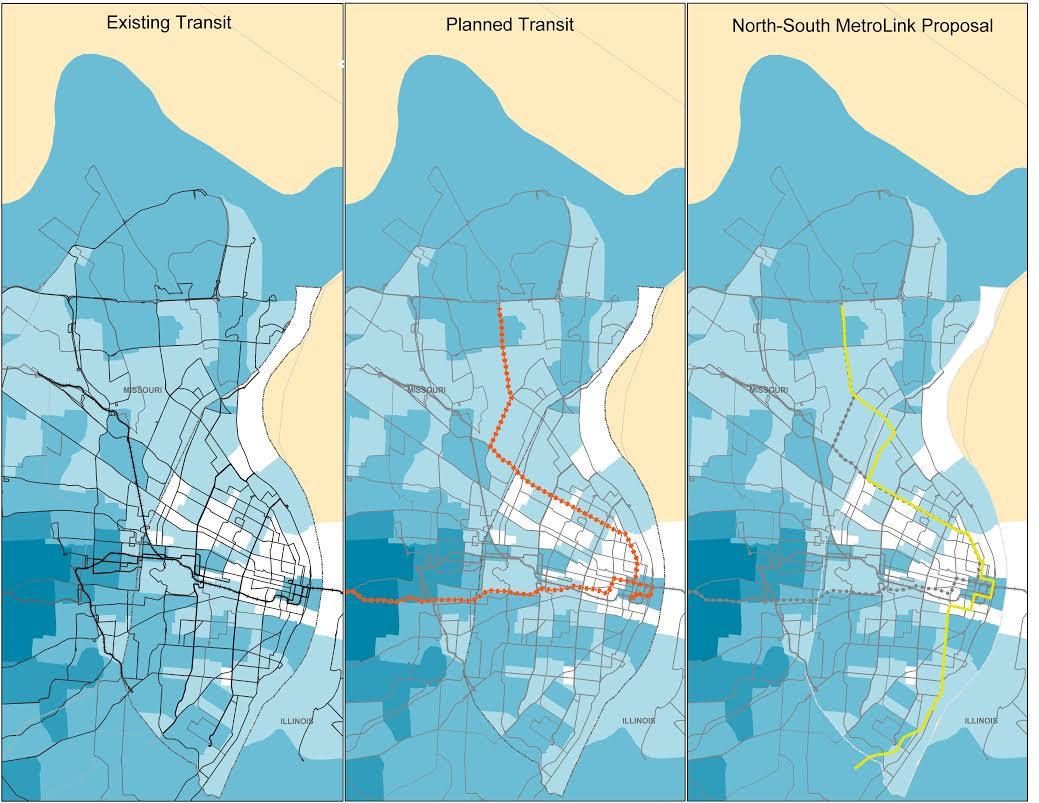
What effect will a MetroLink expansion have on this situation? Saint Louis already has an extensive (and expensive) public transportation system. That system is most readily available in the areas the proposed MetroLink expansion would serve, as the map below shows:

If the goal is providing new access to employment centers outside of the city center, the plan has little value. The line would of course speed up travel for some (and convince some who don’t use transit to ride more often), but that will mean only marginally lower commute times for transit users who do not live and work near the MetroLink.

While its impact on employment access will be low, the cost of a MetroLink expansion will be high, likely more than a billion dollars. Worse yet, if history is any guide, the expansion will be funded with general sales taxes, which are known to be regressive. If regional mobility and opening up more of the region to the poor is what the commission cares about, more bus routes with better service and more destinations are orders of magnitude less expensive to create. Rail enthusiasts often accept this cost disparity because rail lines are part of a grand urban rebirth vision, with immediate mobility gains taking lower priority (or ignored altogether). That the commission did not attempt to search for new transit solutions more germane to the problems at hand is disappointing.

Support Us

The work of the Show-Me Institute would not be possible without the generous support of people who are inspired by the vision of liberty and free enterprise. We hope you will join our efforts and become a Show-Me Institute sponsor.

Donate
Man on Horse Charging