Helping Charter Schools Get Buildings

The Citizens of the World charter school, slated to open next school year in Kansas City, is generating interest in education circles. Unlike top-down efforts to open schools, in this case a group of parents got together and issued a request for proposals from different charter school operators from around the country to find the school model that would best serve their kids.

The parents eventually settled on Citizens of the World, a network that started in California and focuses on purposely building a diverse student body and preparing children for both academic success and engaged citizenship.  If it ends up working as they hope it will, it will be the stuff of charter schooling dreams.

To date, one key detail is missing—a building. 

Unfortunately, Citizens of the World is not alone. All across the state, charter schools have struggled to find facilities, and particularly facilities they can get at a reasonable cost. Charter schools do not get a budgetary line item for facilities like traditional public schools do, and because they are only authorized for 5 years at a time, their borrowing rates are often quite high as lending institutions see them as risky investments.

But it doesn’t have to stay that way.  In fact, the Local Initiatives Support Corporation has identified strategies that states have used to help schools find facilities

According to LISC’s report:

1.       Eleven states make district facilities available to charter schools by requiring districts to provide space to charter schools, requiring districts to publish a list of unused facilities for charter schools to access, or by offering right of first refusal to charter schools to lease or purchase district buildings. Missouri is not one of those states, even though, as SMI has highlighted in the past, the state is rife with empty school buildings.

2.       Thirteen states currently fund a per-pupil line item similar to the one that public schools get specifically for facilities. Missouri is not one of those states.

3.       Eleven states currently appropriate funds for some form of capital grant funding for charter school facilities. Missouri is not one of those states.

4.       Four states allow charter schools to tap into local taxing authority through mill levy (a type of property tax) provisions. Missouri is not one of those states.

5.       Ten states have authorized and active publicly-funded loan programs. Missouri is not one of those states.

6.       Nine states offer some form of credit enhancement program, including moral obligation provisions or statewide credit enhancement programs. Missouri is not one of those states.

On the other hand, Missouri does offer two forms of support that LISC recognizes as helpful for schools seeking facilities funding.

1.       Thirty-six states allow charter schools to access tax exempt debt through conduit issuers. Missouri is one of those states.  But, to date, only three schools have taken advantage of this.

2.       Thirty-nine states allow charter schools to participate in one of their Q-Bond Programs (bond programs run through the federal Treasury Department). Missouri is one of those states. However, to date, only one charter school has taken advantage of it.

If we want more charter schools, and charter schools that are community-driven, we have to make it easier for them to access facilities.  The six policies above that Missouri does not utilize are a great place to start.
Under Pressure from SB 5, Charlack May Disband Police Force

For many years, the small north Saint Louis County municipality of Charlack (population 1,366), has relied heavily on traffic fines to run its city government. The micro-city has used its position along busy Interstate 170 to pull in millions of dollars in traffic fines over the years. Its questionable policing practices have long drawn the ire of regional residents, including former Show-Me Institute intern David Stokes, who wrote in 2010:

“The Post-Dispatch reports today that the city of Charlack is installing speed cameras along I-170 in near-north St. Louis County. The city is installing the camera on a state-owned bridge to give tickets for speeding on a federal/state highway. . . . The idea that the city will phase out the cameras once people drive more slowly is perhaps the most unbelievable statement I've heard a politician say in a long time. And who cares if they passed a budget that did not count on camera fines? All that means is that they can spend the money however they want once it starts flowing in.”

As of 2014, Charlack collected more than 20% of its total revenue from fines and fees.

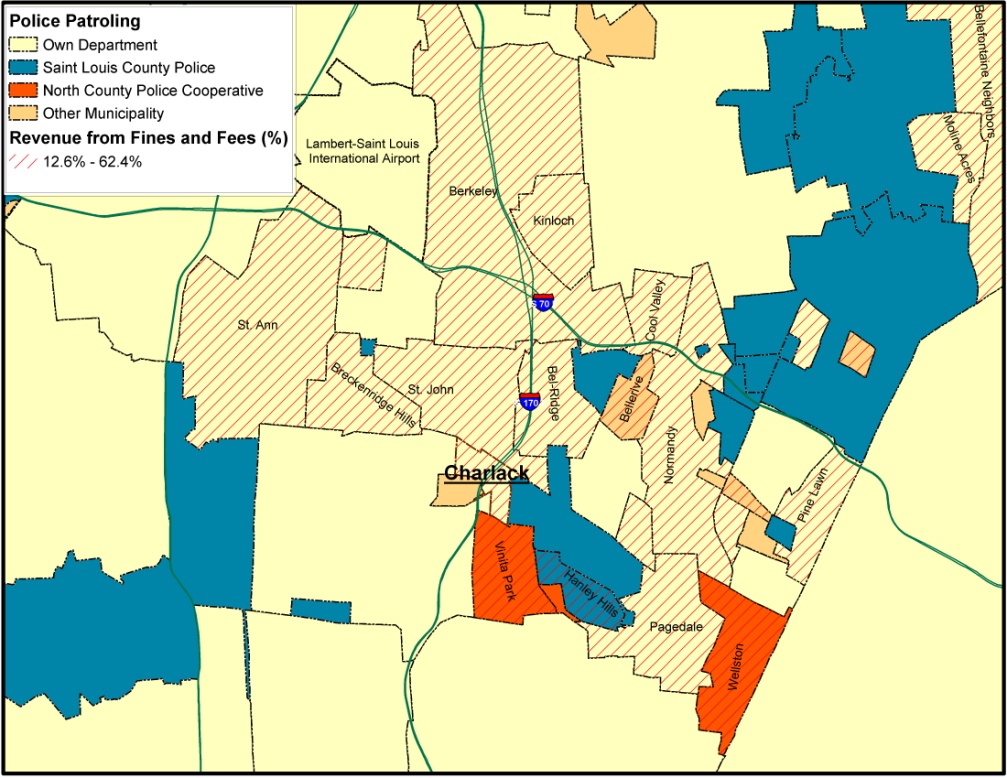
But with the passage of SB 5, which caps Saint Louis County municipalities' fine revenue to 12.5% of general revenue, Charlack is in trouble. In fact, the Post-Dispatch recently reported that the city’s police force was on the verge of disbanding. The city council plans to vote on joining the North County Police Cooperative (with Vinita Terrace, Vinita Park, and Wellston).

Charlack is not alone in its predicament. As of 2014, 24 of Saint Louis County’s 90 municipalities collected more than 12.5% of their general revenue from fines and fees. And while some can continue to provide services despite the reduction in fine revenue, many cannot. They will have to combine services such as policing in order to survive.

The good news is that sharing policing and other public services among cities is far from unprecedented in Saint Louis County. An example of pooling services is the aforementioned North County Police Cooperative. But in addition to that group, 17 municipalities contract with Saint Louis County, and a further 16 contract with another city for police, as shown in the map above.

When municipalities combine police services (especially with the County government), they can save money, improve services, and reduce incentives to use policing as a method of generating revenue. Charlack’s move towards disbanding may be long overdue, but it is another sign of the positive impact SB 5’s reforms are having. As the Charlack’s mayor put it:

“With Sentate Bill 5 passing, we knew it was going to be inevitable, and instead of it taking the next six months to figure out, we said, ‘Let’s just do it now and everybody can have a Merry Christmas…’ ”

Let’s hope that other municipalities follow Charlack’s example—because the more, the merrier.

Even Krueger Agrees: $15 Minimum Wage Too High

Alan Krueger, professor of economics at Princeton, has weighed in on the minimum wage debate.  Writing in the New York Times, Krueger fears that a $15 minimum wage “would put us in uncharted waters, and risk undesirable and unintended consequences.”  

Why is his opinion important?  Because he is the author of one of the most influential studies touted by those promoting an increase in the minimum wage.

Together with David Card of the University of California–Berkeley, Krueger analyzed the impact of an increase in the minimum wage on employment in fast-food restaurants. In 1992 New Jersey raised its minimum wage from $4.25 to $5.05 while Pennsylvania did not.  Their analysis found that fast-food restaurant employment growth in New Jersey was not adversely affected by the change.  This isolated case study from several decades ago has become, even though it is much criticized, the go-to piece of research touted by minimum wage advocates ever since. 

A proponent of raising the minimum wage, even Krueger recognizes that increasing it to $15 would likely do more damage to workers than good.  Especially to those workers at the low end of the pay scale.  Especially to those workers who live in a city like St. Louis, which is not a high-wage/high-cost city.  Increasing the minimum wage to $15 in St. Louis, as some have proposed, would devastate low-income workers in two ways.  First, some businesses would decamp to surrounding areas with lower minimum wages. And of the businesses that stayed in Saint Louis city, many would cut employees or reduce hours in order to control their labor costs. The trade-off for increasing the minimum wage to $15 is just too great to be sensible.

Krueger recognizes that there is a viable alternative to a minimum wage hike: the earned-income tax credit.  This tonic to the plight of the low-income family has been recommended by those on the left and the right as a better solution to the poverty problem than the use of a blunt tool like the minimum wage.  Christina Romer, another University of California–Berkeley professor and one-time chair of president Obama’s Council of Economic Advisors wrote in The New York Times in 2013 that the earned-income income tax credit “is very well targeted—the subsidy goes only to poor families—and could easily be made more generous.”

Krueger warns that the possibility of negatively affecting employment for low-income workers by raising the minimum wage to $15 “is likely to become more severe, and the risk greater.”  If proponents will not listen to the warnings of free-market economists, will they at least consider Krueger’s counsel before acting rashly?

You will be made to care: Sex Ed Edition

Conservative columnist and radio host Erick Erickson coined the phrase “you will be made to care” to describe the tendency of big government supporters to assume that all people should adopt their world view.

The Star’s “letter of the week,” titled “Sensible Sex Education Works,” provided a perfect example of this concept. In it, a retired healthcare executive from Johnson County, Kansas, implored the state to take action on preventing unwanted pregnancies.  Given that unwanted pregnancies are by definition unwanted, trying to decrease them seems like a good idea.

But he goes off the rails in his second recommendation when he argues that the state should “develop comprehensive sex education in our schools, with no opt-outs.”

No opt-outs.  Your children will be made to care.

Now, I don’t want to make a mountain out of a molehill here—it’s not clear that the author has any particular sway with any local education system.  Nor am I opposed to schools teaching sex education. But I am bothered by the principle that schools should be able to force certain value-laced information on children, parental preferences be damned.  

Kansas City would not be the first place where such a battle might be fought. In Fairfax County, Virginia, it took huge parental outcry to get an opt-out provision in the district’s sex education curriculum. Our friendly neighbors to the north have created mandatory sex education programs.  It’s not far-fetched to think that some school might try that here.

In 1925, the US Supreme Court ruled in Pierce v. Society of Sisters that children are “not mere creatures of the state.” Just because someone believes that a certain sex education program would decrease unwanted pregnancies, that doesn’t trump a parent’s right to shape their child’s education.  If that means opting students out of sex education class, so be it. 

But more than this, it should mean that parents have the right to opt out of the traditional public system entirely, and send their children to the charter or private school of their choice. 

More Hotel Documents Predict a Doubling of Conventions!

The Kansas City government has been slow to release documents pertaining to the convention hotel. Just recently they released a 2013 HVS report on a proposed 1,000-room convention hotel. Because city officials and the developer won't release documents in a timely fashion, we can't be sure if this is the report on which they based the assumptions for the current 800-room hotel under consideration. Two previous posts on the matter are here and here

Prior to releasing the 2013 report, the City sent me a 2010 HVS slideshow presentation on yet another proposed convention hotel deal, A copy of that document is available below. HVS considered the convention business that Kansas City bid on but lost from 2006 through 2009 (page 2). Based on the lost conventions it considered "winnable," HVS claimed that Kansas City would have gotten an additional 15 citywide conventions and just over 98,000 room nights if we had built a convention center hotel back then (page 3). 

According to VisitKC, Kansas City's convention and visitor's bureau, the city hosted 19 citywide conventions in 2014, 15 in 2013, 21 in 2012, 17 in 2011, and 20 in 2010. Is it reasonable that a city that hosts between 15 and 20 citywide conventions annually will jump to hosting 35 per year solely by building a new hotel? That's roughly a 100% increase. Furthermore, is it reasonable to conclude that the convention hotel will have a 68% occupancy rate without negatively impacting the existing hotels?

Convention hotel consultants have been notoriously wrong about the Kansas City market. No wonder the developer doesn't want to share the data. Let's hope that the current City Council demands a complete accounting before moving forward with taxpayer funds.

HVS Presentation – Economic Impacts – Kansas City 5-18-10.ppt

Saint Louis Minimum Wage Increase Put on Hold

 For those who have seen the James Bond movie Goldfinger, remember when James Bond stops the atom bomb from destroying Fort Knox with 007 seconds left on the timer? That scene was pretty high-tension. The scene in Saint Louis yesterday was not as tense as that, but if the recently passed minimum wage ordinance had taken effect, the result for many businesses (and their workers) would still be pretty bad. Thankfully, the Saint Louis Circuit Court struck down the ordinance only a few hours before it was set to take effect.

You can read the Court’s decision here. Basically, the Court ruled that the ordinance conflicted with existing state law and thus was invalid.

Mayor Slay has promised to appeal to ruling, but assuming this ruling stands, we are left with the question of how best to help those working families who are struggling to get by on the current minimum wage.

Increasing the minimum wage, either at the local, state, or federal level, is not the way to go. Instead, the state and/or federal government should look to expand the Earned Income Tax Credit (EITC). Economists across the ideological spectrum agree that the EITC is a program that is better targeted to helping the working poor.

The EITC is a better policy than increasing the minimum wage for at least two reasons. First, it is specially targeted toward low-income households. If the minimum wage goes up, a teenager from an upper-middle class family working a minimum-wage job would get the same benefit as a single mother of two. The EITC goes only to members of low-income families who are working. Second, unlike an increase to the minimum wage, the EITC does not increase labor costs for business owners. Thus, an expansion of the EITC would not cause businesses to reduce hours or lay people off.

A lot of people might be upset by the Circuit Court’s ruling yesterday. However, this ruling provides policymakers with an opportunity to enact policies that can better help those who need it. The EITC is one such policy.

Taxes Are Still Too High for Missouri

In his 2014 state of the state address, Governor Jay Nixon bragged that “Missouri’s a low-tax state—sixth lowest in the nation—and we like it that way.” In his letter vetoing tax cuts in 2013, the Governor reiterated this point. This claim about Missouri being a low-tax state is repeated as an article of faith by newspapers, legislators, lobbyists, and activists.

Despite the Governor’s claims, Missouri is not a low-tax state. We may have low taxes on gasoline and cigarettes, but when it comes to something important like your income, there are many other states with lower taxes.

Why focus on income taxes? Economic theory—and everyday experience—tells us that if you want less of something, you should tax it. That is the thinking behind carbon taxes. But while taxing carbon emissions may reduce the levels of CO2, taxing labor income will reduce the desire to work. That is, raise income taxes and people will work fewer hours, which will result in less output.

In the end, higher income taxes stifle economic growth—and the creation of wealth. That is why tax rates matter. There is hard evidence indicating that states (and counties) with lower income tax burdens perform better economically than states with higher tax burdens.

With that in mind, the important question becomes: How do Missouri’s income taxes stack up against those of other states?

To answer this question, Rik Hafer and I used standard tax preparation software to calculate how much a family of four earning the U.S. median income had to pay in income taxes across all 50 states This allowed us to compare the tax burden in Missouri to that in other states. (The full report is available at ShowMeInstitute.org)

Contrary to the claim that Missouri is a low-tax state, we found that this average family of four would have to pay more in income taxes in Missouri than in 27 other states. Closer to home, that family also would pay more in Missouri than in Oklahoma, Nebraska, Kansas, and Tennessee. Our results are just one indicator that Missouri’s income taxes are not among the lowest in the country.

The Tax Foundation has compiled information regarding the top marginal income rates for every state. According to their calculations, Missouri has the 22nd-highest marginal income tax rate in the country. While this does not mean Missouri has the highest tax rate, it does mean that Missouri is not one of the lower-rate states, either. This ranking can understate how Missouri’s rates compare for most people. For example, California’s top tax rate is much higher than Missouri’s. However, Missouri’s top rate kicks in after $9,000 of income, and California’s kicks in after $1 million. In fact, many Californians face lower tax rates than Missourians of similar incomes.

Taken together, these rankings suggest that there is room for Missouri to cut taxes in order to remain competitive with other states. Nine states, including Tennesse—which borders Missouri—do not tax labor income at all. Kansas, Oklahoma, and Illinois all have top marginal rates that are lower than Missouri's. There are ways to help lower income taxes for Missourians without causing large revenue shortfalls. This includes broadening the sales tax base and cutting down on issuing economic development tax credits. If Missouri wants to remain competitive with its neighbors, it needs to build on the tax cuts it has already enacted and pass more tax cuts.

People who claim Missouri is a low-tax state are ignoring the taxes that really matter, like income taxes. For Missouri to be a low-tax state, there is more work to be done.

$100 Million Here, $400 Million There-Are We Talking Real Money Yet?

Recently, the Saint Louis Business Journal reported that the Saint Louis Convention and Visitors Commission (CVC) is pushing for a $100 million improvement and expansion of the city’s convention center. To be clear, that would be different from and additional to $100 million in refurbishment for the Edward Jones Dome. It is also completely separate from the plans to spend around $400 million on a riverfront stadium for the Rams. The CVC claims it needs the upgrades to keep up in an ever more expensive convention center arms race taking place across the country.

So who is going to pay to make the CVC’s vision a reality? The first thought would be the city of Saint Louis, which already sets aside a 7% hotel tax and a 1% restaurant tax to pay for the current convention center (including the Edward Jones Dome). The problem here is that the city has already spent lavishly on the CVC, and is on hook for between $17.7 and $22.6 million in annual debt service until 2039, which far outstrips the city’s hotel tax and restaurant tax revenue ($14 million this year). If the riverfront stadium plan becomes a reality, the city will have to add an additional $6 million in debt payments for the next 30 years. Adding another $200 million to the city’s debt would mean new debt payments of $11 million per year. Will the city want to double its hotel tax to pay for that?

With the city’s convention center and stadium funding already about as high (or higher) than the public will put up with, the buck looks to be heading to Saint Louis County, which has a 3.5% hotel tax (or $8.5 million) that goes to fund debt on the Edward Jones Dome. Those bond payments are set to retire in 2021, which makes the county the perfect candidate to pick up slack in convention spending created by the city’s financial commitments to a riverfront stadium. The county executive is currently in talks with the CVC concerning upgrades.

We at the Show-Me Institute could point out that if it weren’t for all the spending being diverted to the riverfront stadium plan at the state and city level, there would be plenty of funding for convention center upgrades. We could also discuss how the economic impact of new convention centers is likely overestimated, or how the city’s rapidly increasing bread-and-circus spending has achieved few tangible gains thus far. But why do that, when we can just end with a “told you so” moment! From July 20:

Who pays for the $100 million-plus refurbishment of the Edward Jones Dome, along with its continued maintenance needs, when state and local bonds are repurposed [for the riverfront stadium]? (I’m looking at you, Saint Louis County, whose bond payments will “retire.”)

The Convention Hotel’s Promised Occupancy Rates Are Suspect

A 2013 consultant’s report on the proposed convention hotel has some pretty rosy projections that are likely unrealistic. We have to rely on the 2013 report because the city is not releasing any of the data specific to this proposal. Readers of The Pitch may recall that developer/attorney Mike Burke said he did not want the Show-Me Institute to see the reports at all. As a result, we must look at the consultant's previous work for an indication of its reliability. This is all because the city is not transparent in its dealings.

Now we know why.

The report, which is labeled a "summary of findings" (no word yet on whether the city will produce the full findings) is dated February 21, 2013—two and a half years ago. It considered a 1,000-room hotel, not the 800-room hotel we're dealing with today. That caveat aside, it makes claims about potential Kansas City convention business that are sanguine, to say the least.

Let's dig in to the report, available at the link below. Figure 1-2, on page 6, is labeled, "Primary Competitors – Operating Performance," and it lists three hotels. Only one of them is downtown— the Marriott—and it gets 45% of its business from conventions. (The other two hotels are in Crown Center and get only 10% of their business from conventions.) The Marriott's occupancy rates for 2010, 2011, and 2012 are 51%, 51% and 53% respectively.

Just below, in Figure 1-3, are listed the "Secondary Competitors." Two of them, the Crown Plaza and the Holiday Inn, are downtown and get at least a quarter of their business from conventions (25% and 40% respectively). Their occupancy rates for 2010 through 2012 average around 55%. In other words, the downtown hotel business in Kansas City is awful. The national average occupancy rate for all hotels is around 64%, and the report says the rate in Kansas City hovers around 60% (Figure 1-1).

According to documents previously released by the City, the expectation is that the convention hotel, which will go downtown, will have an occupancy rate of 68%. That’s quite a jump.

Basically, proponents of a new 800-room downtown convention hotel are arguing that by increasing supply, demand will jump. Is it really reasonable to believe that this hotel will beat the downtown hotel average by nearly 20 points? Perhaps more importantly, is it reasonable to believe that it would do so without cannibalizing existing (and depressed) hotel traffic? We think not. How many members of the previous City Council, who hurried to approve this project, had been shown this report and understood its implications?

It would be wonderful if a private builder wanted to take on this project—and all its risks—with his or her own money. But that hasn’t happened, so Kansas City taxpayers are being asked to foot a large portion of the bill. Given what we are starting to learn about the project, we can understand why no private hotelier will touch this; and why taxpayers should be just as hesitant.

HVS Study – Summary of Findings – DRAFT – Proposed Convention Hotel – Ka….pdf

Support Us

The work of the Show-Me Institute would not be possible without the generous support of people who are inspired by the vision of liberty and free enterprise. We hope you will join our efforts and become a Show-Me Institute sponsor.

Donate
Man on Horse Charging