Convention Hotel Field of Dreams

Proponents of a new downtown convention hotel are asking taxpayers to throw all of modern economic theory out the window—as well as the recent history of convention business in Kansas City and around the country—in favor of a "build it and they will come" Hollywood fantasy.

The two most important arguments in the debate over whether Kansas City taxpayers should subsidize a private convention hotel are made by the proponents:

  • First, they argue that it does not make business sense to build a hotel of this size in downtown Kansas City right now. Consequently, they need taxpayers to invest first, and they need taxpayers to invest to the point that it does make sense. (This is the argument with every TIF project, by the way.) The difference here is scale: the project requires the public to subsidize half the cost.
  • Second, they claim that demand will increase simply by increasing hotel room supply. The proponents are not doing anything else, such as increasing the visitor and tourism budget so that they can dedicate more resources to attracting conventions. They're just building a hotel. That's all.

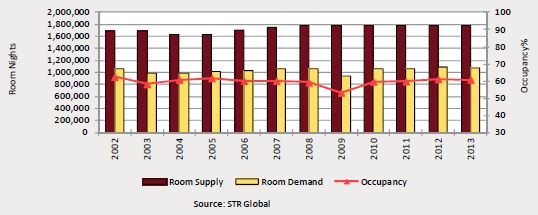
But Kansas City doesn't need more hotel rooms; we're already oversupplied. According to the same consultants hired by the developers for this project, the occupancy rates (the number of rooms sold divided by the number of rooms available) at existing downtown hotels is a paltry 50% to 55%. That means we're only selling half the rooms we have. According to the chart above, taken from an HVS report from 2015, hotel room supply has outpaced hotel room demand in all of Kansas City for years. 

Exactly how increasing room supply (represented by the red bars on the chart) by building a new hotel will increase demand (the yellow bars) or the occupancy rate (the red line), is unclear. But taxpayers are being asked to invest $165,000,000 on that very proposition.


Why Taming the Higher-ed Leviathan is Hard Going

College affordability may prove to be one of, if not the, defining education issue of the 2016 election cycle. More and more jobs require a college degree, more and more students are going to college, and the cost is creeping higher and higher.

There have been a slew of common-sense, market-oriented reforms that have been floated to help rein in the cost of college. No, not just making it “free.” Rather, opening up the college market to more experimentation, innovation, and competition to help hold prices in check.

In general, these reforms have gone nowhere. Why? Well, a new data visualization by Washington D.C.’s New America Foundation puts some great numbers to what  my old friend Andrew Kelly of the American Enterprise Institute has been arguing for years; college and universities are enmeshed in the economies and political ecosystems of the state and nation. That gives them an incredible amount of power to block or water down efforts to spur competition and reform.

New America breaks down the number of institutions, the number of employees, the amount of money institutions receive in Pell grants (federal scholarships for low-income students) and the total amount of money institutions spend by congressional district.

Here’s what Missouri looks like:

Congressional District

Number of Higher Ed Institutions

Number of Higher Ed Employees

Pell Grants

Total Spending

MO-1

28

22,555

$137 Million

$3.47 billion

MO-2

28

3,782

$66.1 million

$527.2 million

MO-3

18

2,741

$34.9 million

$285.6 million

MO-4

26

17,914

$153.5 million

$3.15 billion

MO-5

38

6,954

$71.1 million

$465.8 million

MO-6

24

5,293

$49 million

$597.2 million

MO-7

32

6,861

$118.1 million

$698.6 million

MO-8

19

3,833

$54.9 million

$285.5 million

TOTALS

213

69,933

$684.6 million

$9.48 Billion


Seventy thousand employees, nearly $10 billion in spending, and $685 million straight from the federal government . . . who wants to upset that apple cart? Somebody needs to, because the current trends are unsustainable.

School District Boundaries Are an Issue Here, Too

A public school rezoning issue is unfolding in New York City.

P.S. 199 is a National Blue Ribbon Award-winner with high state test scores, strong parent involvement, a high percentage of white students, and a low percentage of students qualifying as poor. P.S. 191 is made up of mostly poor, Hispanic, and black students from the public housing unit across the street. Because of overcrowding issues, P.S. 191, which sits within nine blocks of P.S. 199, may enroll wealthier students if the districts are rezoned.

Parental response has been mixed. Some want to erase the boundaries between the two schools altogether, allowing for a greater mix of students at each. Others say they’ll move to another school district or send their kids to private school if their children are sent to P.S. 199.

The story of P.S. 199 and 191 may sound familiar to residents of Saint Louis County and City. Here students may live within walking distance of one school but attend another, because of where boundaries are drawn.

For years, numerous groups have advocated for a unified district in the Saint Louis area, but as SMI’s James Shuls has pointed out, this solution is too pie-in-the-sky to make a difference for students who need better education options today. As an alternative, the St. Louis Post Dispatch Editorial Board proposed an open enrollment policy last November. “Districts would agree to a set tuition amount that would follow any student who wanted to cross boundaries. Transportation would be provided for those below poverty level,” they wrote.

Open enrollment policies have become more common over the past several decades. In 1988, Minnesota passed the first mandatory open enrollment law. By 2013, 21 states had allowed students to transfer from their home district to another school district. Some of these states, like Missouri, only allow students to transfer if their current district is failing.

But there are many reasons why a student would want to transfer to another school district aside from poor student achievement. A student might just live closer to a school within another district (this example also applies to students who live in rural parts of Missouri).

Another way to create more options for students would be to allow charter schools to operate anywhere in the region, and allow students to transfer across district lines to attend them. For example, if a charter school opened in the Bayless school district in Saint Louis County, students in the Affton, Hancock, and Lindbergh districts could apply to attend.

In the upcoming legislative session, I hope lawmakers consider the alternative to unifying school districts—expanding the state’s open enrollment policy to include not just students in failing schools, but all students in the Saint Louis area and across the state. 

Columbia Feeling “Blue” About IBM’s Job Numbers

The silver lining in this recent report regarding the continued underperformance of the IBM call center in Columbia is that taxpayers could have lost a lot more money than they already have.

Back in 2010, in an effort to spur job creation in Columbia, the city and state combined to award a $31.2 million incentive package to IBM so that it would place a new call center in the town. In return, IBM promised to create 600 jobs at the new center by 2013.                

Fast forward to March of 2015. Instead of 600 jobs, IBM had only created 453, far short of the number promised. Since then, things at the call center have deteriorated even further. Employment now stands at 388. This has prompted the state to withhold $800,000 in additional funding for the call center.

                Again, it’s good that the city and state didn’t give away the whole $31.2 million to IBM, but they’ve already have spent a lot of money (at least $10 million) on this project. Probably the most egregious part of the incentive package is the fact that the city of Columbia actually owns the building where the call center is located. This building cost the city $3 million and IBM’s rent is a miniscule $1 every year.

We were bearish on this plan when it was first enacted, and unfortunately for taxpayers, we were proven right. Tax credits are not a good economic investment, and their failure is not isolated to Columbia.

What is happening in Columbia is just another example of the consequences that occur when government picks winners and losers. If policymakers want to create economic growth, they should work to create a business environment that is welcoming to everybody and not just Big Blue. 

Cato Study Shows that Federal Employees Make More than Private Sector; Government Unions Furious

Underlying the American Federation of Government Employee’s (AFGE) claims that their members deserve higher salaries and more lavish benefits is the assumption that private sector workers are better compensated than government workers. Many people buy into this assumption and figure that government employees make up for the compensation gap with increased job security and a more relaxed workload.

A new study from the Cato Institute shows that average federal compensation is nearly double average private sector compensation. Do you think AFGE took this study in stride?

“Bogus!” cries AFGE in a recent release. Rather than acknowledging the fact that, yes, federal employees are very well compensated and enjoy generous health and pension benefits, AFGE resorts to name-calling,  describing the study as “a shameful piece of propaganda.” Ouch.

AFGE argues that it can be misleading to compare the entire private sector to federal employees because there’s so much diversity across job classifications. True, you need to be careful about the conclusions you draw from an average that lumps physicians in with custodians. Especially if the private sector employs many more unskilled workers than the federal government.

AFGE makes this argument, but you have to get through a lot of angry rhetoric and name calling to get to it. And the Cato authors deal with this objection in the study:

Some people argue that the government has a unique high-end workforce that deserves to be paid handsomely. But you can flip through the federal budget and find mundane bureaus where workers are paid highly for normal bureaucratic jobs. For example, average compensation in the Department of Commerce's Economic Development Administration—an agency that hands out business subsidies—is about $140,000. And average compensation in the Department of Agriculture's Office of Chief Economist is about $174,000. So it is not just rocket scientists that earn high wages and benefits, it is also federal workers in regular white-collar jobs.

The bottom line here is that we’ve got to bust this myth of the underpaid government worker. Yes, we want government employees to be well paid, but compensation should be reasonable. The government does not need to be the highest paid industry in our economy.

Expansive Commitments Drain MoDOT Dollars

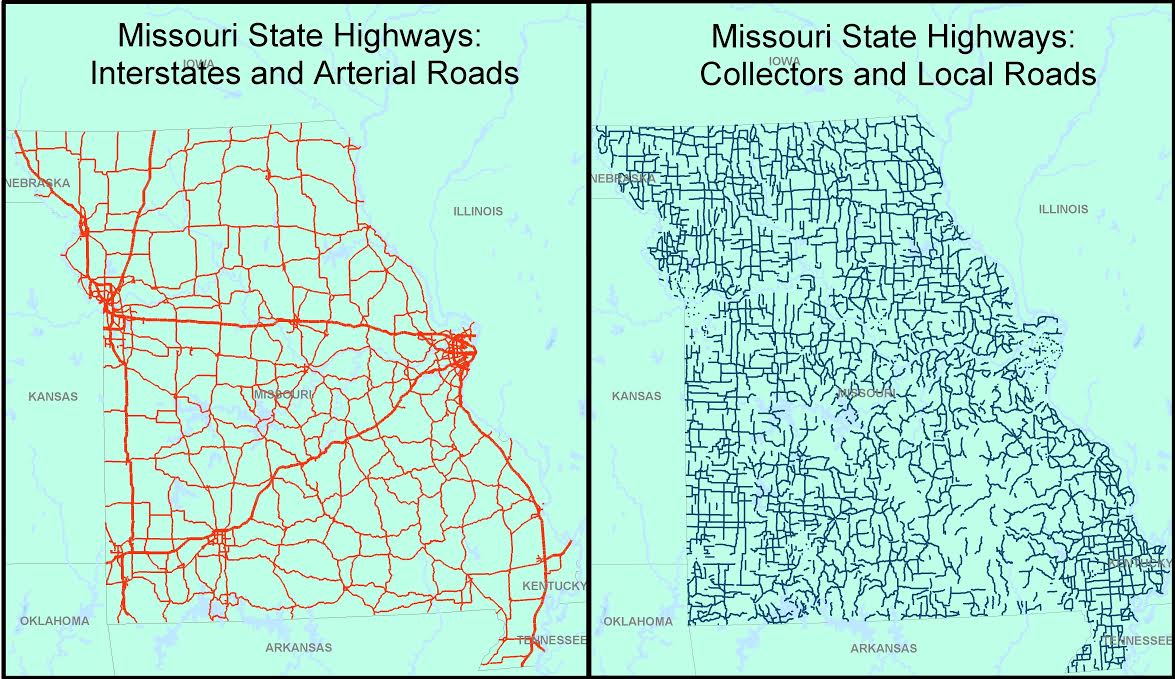
As we’ve discussed many times before, the Missouri Department of Transportation (MoDOT) faces a serious budget shortfall in the next few years. Specifically, the department will soon no longer have the funds to maintain, much less improve, the existing state highway system. While we’ve pointed out that the major contributing factor to this predicament is stagnation in the user-funding base, there’s a spending side to the equation as well: it’s clear that the sheer size of Missouri’s state highway system is putting undue strain on MoDOT.

As state officials are quick to point out (in arguing for increasing MoDOT funding), Missouri has the seventh-largest state highway system in the country by total miles. However, what they are less likely to point out is that Missouri’s state highways include many small and little-used routes that would be handled by cities and counties in most other states. For instance, despite the fact that Illinois’s highway system is less than half the size of Missouri’s, total traffic in that state is one-third greater than in Missouri.

Unfortunately for MoDOT, low traffic levels do not mean low costs. The mileage alone (~24,000) of Missouri’s least-used highways results in significant annual capital and maintenance spending. In 2013, for example, nearly 30% of the state’s total highway spending ($414 million) went toward work on routes that primarily serve short-distance, intra-county travel. Most states only set aside between 1% and 5% of total spending maintaining smaller roads, but because of our high number of local roads, Missouri uses about 16% of its funds maintaining these types of routes. That MoDOT is forced to spend so much on maintaining smaller local routes is especially difficult, because federal aid is much harder to acquire both for maintenance spending and ancillary routes (which are not part of the National Highway System).

Missouri’s abnormally extensive state highway system is the result of decades of state policy, with programs like “Get Missouri Out of the Mud” (starting in the 1920s), the creation of “Farm-to-Market” roads, and many other ad hoc decisions constantly expanding MoDOT’s responsibilities. While MoDOT officials have talked about stopping state highway growth, the percentage of MoDOT spending that goes towards maintaining Missouri’s smallest state highways has greatly increased in the last 20 years:

Year

1995

2000

2005

2013

% MoDOT Spending on Small Highway Maintenance

9.3%

10.8%

13.0%

16.0%

Given MoDOT’s financial constraints and the skepticism with which Missouri residents view any tax increase for the state highway system, it may be time for state policy makers to reevaluate the scope of Missouri’s state highway system. Returning routes that are local in character to local governments might both relieve much of MoDOT’s funding problem and give local residents the autonomy in prioritizing their own transportation needs. 

Support Us

The work of the Show-Me Institute would not be possible without the generous support of people who are inspired by the vision of liberty and free enterprise. We hope you will join our efforts and become a Show-Me Institute sponsor.

Donate
Man on Horse Charging