I Was a Good Teacher. I Could Have Been Better

For four years I was an elementary school teacher in southwest Missouri. Not to toot my own horn, but I was a pretty good teacher. Students and parents liked me. Several of my colleagues even requested me as their child’s teacher.

But you want to know the truth?

I could have been better.

The sad thing is, I didn’t have to be.

The structure of public education is such that anyone with a decent head on their shoulders can become a teacher and, with minimal effort, remain a teacher for rest of their career.

Compared to many other professions, becoming a teacher is relatively easy. In fact, many consider an education degree one of the easiest degrees to obtain. On average, students going into education as a college major have lower scores on college placement tests. In 2014, prospective educators scored an average of 20.4 nationally on the ACT, below the national average of 21.0. The people entrusted with educating our children scored more than three points lower, on average, than individuals going into engineering or English and foreign languages.

Despite having lower aptitude as measured by college admission tests, teachers receive incredibly high marks in their college courses. According to Corey Koedel, an economist at the University of Missouri, the average grade point average for undergraduate education courses is 3.8. What’s more, Koedel found that 20 percent of undergraduate classes in the college of education gave every student an “A.”

Students who graduate and get teaching jobs are rarely challenged to grow, because they rarely receive the types of evaluations that will truly motivate them and help them improve. In many districts, new teachers are only evaluated a handful of times. In most cases, these formal observations are announced in advance. Thus, teacher evaluations are based on snapshots of what should be a teacher’s best lessons. Little wonder, as a report by The New Teacher Project noted, that almost all teachers are given superb marks.

While the fear of losing his or her job may motivate a teacher to work hard, social norms and school staffing policies effectively counter this motivation. Teachers, unlike most workers, are typically paid according to a predetermined salary schedule. No matter how hard they work, a teacher cannot earn a raise. Truly motivated teachers who go above and beyond face considerable pressure to conform. Nobody likes a rate buster.

Over time, the fear of losing one’s job fades. A teacher who reaches tenure—after three years in most states— has what state statutes call an “indefinite contract” or a “permanent job.” Of course, those terms, “indefinite” and “permanent,” come with a small proviso that a teacher doesn’t do anything egregious to a student. Barring that, the job is basically secured.

These were the realities when I was a teacher, and they are the realities today. Had the structures of education been different; had I been motivated and challenged by administrators; had my performance been really evaluated; or had I had the opportunity for advancement, recognition, and raises, things may have gone differently. Maybe I would have improved from a good teacher to a great teacher. In fact, I might still be in the classroom. 

Ohio’s Medicaid Explosion Under Obamacare Is a Warning for Missouri

Instead of getting a handle on the cost of care and working to maximize access to medical professionals, the Affordable Care Act instead prioritized "coverage"—a strategy that not only threw millions of Americans out of their private health insurance plans, but also put millions more into broken welfare programs. Over the past few years in particular, analysts at the Show-Me Institute have written a great deal about the importance of reforming Missouri's Medicaid system to ensure that our neediest can find the care they need. Simply expanding "coverage" and dumping enrollees into already-failing government programs would not only burden taxpayers, but also would imperil care for thousands of Missouri's most vulnerable citizens.

Indeed, those risks are now playing out in Ohio.

Most of the Ohioans who entered Medicaid under the expansion are working-age adults without children or disabilities. Before Obamacare, Medicaid was restricted to children, the elderly, the disabled, pregnant women, and impoverished families.

Pitching Obamacare expansion to the Ohio General Assembly in 2013, the Kasich administration estimated 447,000 would enroll by fiscal year 2020. Actual enrollment exceeded 620,000 by the time fiscal year 2015 ended in June.

Kasich implemented Obamacare expansion after vetoing a legislative ban on the policy, despite publication of a National Bureau of Economic Research study finding Tennessee’s employment increased when the state removed working-age adults from Medicaid.

Money spent on these able-bodied beneficiaries is money that cannot be spent on unequivocally vulnerable populations. And perversely, as Ohio has expanded its Medicaid program to those not in poverty, it appears the state is also planning cuts to services for some of Ohio's neediest, including the disabled

Missouri's neediest beneficiaries deserve better than that, and Missouri taxpayers should be able to rest assured not only that their tax dollars are going toward help for those who need it the most, but that failed government policies—particularly those we are seeing fail in real time across the country—aren't brought home to the Show-Me State. We should reform Medicaid for Missouri's neediest. We should not expand it under Obamacare.

The Urban-Rural Divide in MoDOT Spending

Recently, the Post-Dispatch reported on area residents who want to direct more MoDOT funding to urban areas. Specifically, a League of Women Voters representative proposed that 90% of all highway revenues be spent in the county in which they were collected. According to the article,

“Moore [the representative] cited figures showing that Missouri spends the vast majority of its transportation funding in the rural areas of the state, even though more than 80 percent of the state's transportation dollars from gas and auto sales taxes come from the urban regions in and around St. Louis and Kansas City.”

Although Missouri does spend a significant amount on rural highways for structural reasons, MoDOT does not spend most of its money in rural areas, nor does it systematically underfund urban highways.

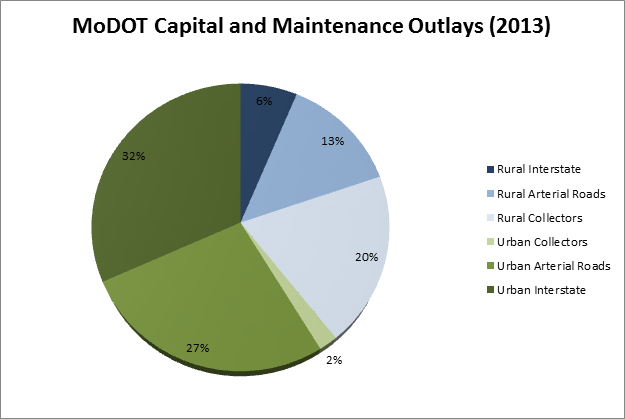
To show this, first we will look at total MoDOT capital and maintenance spending. As shown in the chart above, in 2013, 61% of total MoDOT outlays went to urban highways and 39% went to rural highways.

It’s clear that most spending happens in urban areas of the state, not rural ones. One might still think this is lopsided in favor of rural areas, as the vast majority of highway user fees come from urban areas. However, 86% of highway lane miles are in rural areas, and almost half of daily traffic in Missouri takes place in rural areas. Missouri’s rural highway system, mostly due to the Missouri State Routes (the letter routes), is the fourth largest rural highway system in the nation. While traffic per mile in rural areas is low outside of the interstates, roads need to be maintained and bridges need to be replaced.

Even though Missouri spends a significant amount of money on its rural highways, urban areas have not been starved. In fact, the latest Federal Highway Administration data shows that, whether one looks at how much money MoDOT spends per lane mile or vehicle, the state’s urban highway spending is at about at the national average.


Spending Per Lane Mile

Daily Vehicles Per Dollar Spent


      Rural

Urban

Rural

Urban

Missouri

  $7.91

$77.66

116.0

84.5

National Median

$25.02

$77.66

  53.4

75.4


Furthermore, MoDOT’s spending in Missouri’s largest urban areas has achieved enviable results. Both Saint Louis and Kansas City have significant highway capacity and low congestion. In Kansas City and Saint Louis, 80% or more of major highways are in good condition. That's excellent for a large metropolitan area and far better than cities like Indianapolis (62%), Milwaukee (38%), or Los Angeles (16%).

MoDOT’s continuing funding problems should prompt Missouri policy makers to consider the extent of the state highway system. Many lesser-used routes might be better handled at the local level, as they are in other states. Such a reform would allow to MoDOT to fund improvements and maintenance on both critical rural and urban thoroughfares. However, there is little evidence that MoDOT is starving its urban system as measured either by spending or current highway conditions.

No Government Program is Perfect

I’ve spilled a lot of electronic ink over the minimum wage. It’s a bad policy that, though well intentioned, would do more harm than good to the people it is intended to benefit. On occasion I have pointed out that the Earned Income Tax Credit (EITC) would be a superior policy alternative to increasing the minimum wage. However, some free market supporters are not fans of the EITC and think it too should be abolished.

Chris Edwards of the Cato Institute and Veronique de Rugy of the Mercatus Center wrote a report that was highly critical of the EITC and called for its abolition. They raise several points that are worthy of discussion.

First, they say that contrary to claims that the EITC encourages work, the program does not do much toward this end. “In sum- the overall work incentive effect of the EITC is mixed…”.  I would say that even if the EITC’s effect on work incentives is neutral, it is still superior to increasing the minimum wage, because higher minimum wages will likely reduce employment.

Second, the authors criticize the EITC as being overly complicated and prone to large errors in making payments to recipients. I agree with this point. The Government Accountability Office has as well. It’s something that policymakers should consider when deciding whether to enact or expand the EITC.

Third, the report says that paying for the program would force tax increases, thus damaging the economy. It’s true that raising taxes would damage the economy, but are tax increases the only way to pay for an expanded EITC? The first place I would look to as a way to pay for an expanded EITC would be to cut spending on other welfare programs. The main purpose of the EITC is to alleviate poverty for working families. If recipients are no longer in poverty, then they should need fewer welfare benefits. Therefore, before raising taxes to pay for an expanded EITC, how about cutting welfare spending?

Overall, this report does highlight important issues regarding the EITC. It is clear that the program is not perfect, but it does deliver positive benefits to recipients. I wonder—if the authors had to choose between increasing the minimum wage or expanding the EITC, which would they choose? Despite its issues, I still think expanding the EITC is a better policy option than increasing the minimum wage.

Just How Low Cost Is Labor Reform?

If you’ve been following our work, you know that once a government union comes to power, it can stay in power for an indefinite length of time. Public employees, such as teachers and firefighters, are trapped by labor laws that give a union tremendous power after a one-man, one-vote, one-time election. In our newest study, The Low Cost of Labor Reform, we show how Missouri can provide public employees the ability to replace or retain their union every few years with union elections.

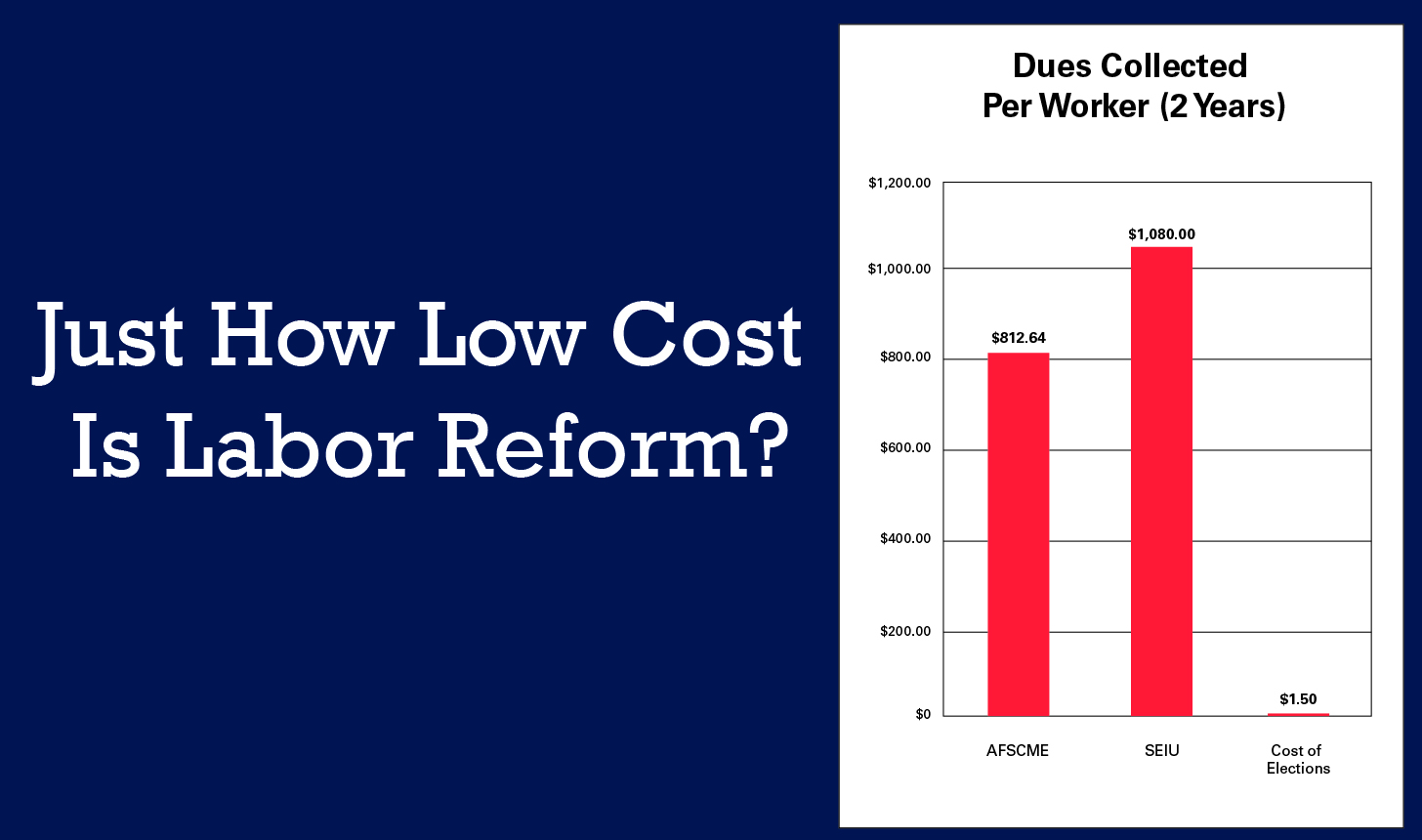
So how low cost are union elections? If the state contracts out with a company that specializes in providing elections, the price tag could be less than 1% of union dues.

When Wisconsin contracted with the American Arbitration Association (AAA) to provide union elections for its public employees, the cost was about $1.50 per voter per election. AAA is a well respected arbitration firm, but there are other options. For example, a service called “Election Buddy” by Event IQ, Inc., conducts elections for Harvard and Yale Universities and thousands of other companies internationally for approximately 9 cents per voter. $0.09 to $1.50 is a wide range, but even at the top end of that range, elections are inexpensive.

For comparison purposes, consider the dues charged to state employees by some of the major government unions. The American Federation of State, County and Municipal Employees (AFSCME) charges Missouri state employees $16.93 per pay period, or $406.32 per year. The Service Employees International Union (SEIU) charges patient care professional employees $22.50 per pay period, or $540 per year. Even if the state contracts with a more expensive arbitration firm, rather than a relatively less costly corporate election firm, and ends up charging each union around $1.50 per voter, with an election every two years that’s less than two dollars out of the $812.64 AFSMCE collects per person during that period or the $1,080.00 SEIU collects.

Contracting out for union election is just one way of saving money. By contracting out for elections, the state will not need to hire additional staff, pay for increased travel expenses for staff conducting elections, or purchase new voting equipment. The savings will allow the state to charge a much lower fee to unions for conducting these elections, saving public employees money.

New Study Suggests Missouri is Still Stuck in the Middle

By almost every academic outcome measure, Missouri’s educational system ranks in the middle of all the states. This shouldn’t shock long-time readers of the blog, as I’ve written about it here, here, and here.  Despite efforts to get Missouri in the “Top 10 by 20,” it appears we may be falling further behind.

A new study by Matthew Chingos, a senior fellow at the Urban Institute, examines the changes in scores from 2003 to 2013 on the National Assessment of Educational Progress. Chingos adds to this analysis by adjusting the growth according to each states changing demographics.  It is no secret that some groups of students, such as students with special needs or students living in poverty, score lower on standardized exams.

When adjusting for state demographics, Missouri ranked 29th in overall performance on the 2013 NAEP.  In terms of growth from 2003 to 2013, Missouri ranked in the bottom ten. In other words, we are not moving towards the top ten; we’re moving towards the bottom.

The 2015 NAEP results are being released today (Oct 28th.). Missouri appears to be no closer to the top ten than we have been in the past.

The Great Race: Taxi v. Uber v. Metro Link

With UberX finally available in Saint Louis, Show-Me Institute staff decided to hold a race to see how the service can add to the city’s transportation options. The contestants, Nathan Coursey, Joseph Miller, and Brittany Wagner, took a taxi, an Uber car, and the MetroLink, respectively, from the Show-Me Institute office in St. Louis's Central West End to Mr. Curry’s downtown. Watch the video to see who prevails!

Missouri’s Waterways Receive Bad Marks for Transportation

An organization named “America’s Watershed” recently released a report card on the country’s inland waterway systems, three of which are important to Missouri (the upper Mississippi, the lower Mississippi, and the Missouri River). Unfortunately, Missouri’s waterways received poor marks (Ds and Fs) for transportation and infrastructure condition, which could lead to Missouri missing important opportunities for growth in the coming decades.

While organizations that release infrastructure report cards are almost universally pushing for greater investment (and therefore tend to be alarmist about current conditions), there is little doubt that Missouri’s waterway infrastructure is in a poor state of repair. Nearly every lock and dam on the upper Mississippi is well past its useful life. While many don’t think of the rivers as important carriers of freight, Missouri’s rivers carry almost 50 million tons of freight annually. Rivers are especially important for shipping agricultural products and commodities to international markets. And with the expansion of the Panama Canal nearly completed, the Mississippi River may become a more important conduit for Missouri’s exports in the future.

The federal government is primarily responsible for maintaining and improving waterway navigability, specifically through the Army Corps of Engineers. Theoretically, funding for the Corps’ projects should come from a 29 cent per gallon tax on barge fuel. When the Corps takes on a new project, it is also supposed to split the costs 50-50 with barge companies.

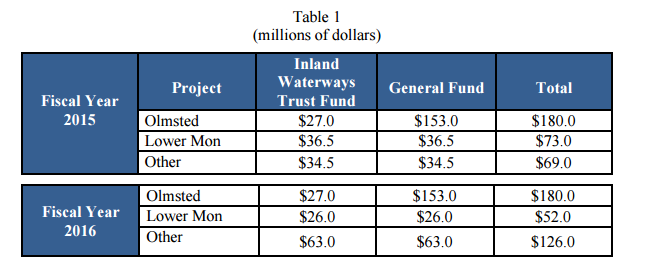
In reality, barge fuel tax revenue is insufficient for such a system to work. Even with a rate increase last year, the tax will bring in only about $100 million in revenue in 2015. Individual lock and dam projects usually cost hundreds of millions—if not billions—of dollars to complete. Thus, while dozens of projects require repairs, the Corps can only address a few projects at any given time. And even these require heavy taxpayer subsidies. In 2015, general funds accounted for 70% of federal spending on inland waterways. Worse yet, 50-50 cost splits with barge companies are honored more in the breach, because Corps projects regularly run over budget. Overruns are handled by taxpayers, not barge companies. The table below lists the two largest lock and dam projects and shows the division of costs for each.

A federal body notorious for cost overruns and funded with insufficient user taxes is unlikely to build and maintain an efficient, modern, inland waterway transport system. The shipping companies and exporters that would directly benefit from an improved system could, with federal coordination, make the necessary investments. But until they do, Missouri will not be in a position to see large economic gains from the Panama Canal expansion and can expect low marks for its waterways in the future. 

Show-Me Institute Presents: Comparing Income Tax Liability Across States: Where Does Missouri Rank?

There has been a lot of back and forth regarding whether Missouri is a low-tax state. The truth depends on which tax one looks at. Missouri has the lowest cigarette taxes in the country, but its combined state and local sales taxes rank amongst the highest in the country.

My colleague Rik Hafer and I decided to compare Missouri’s income taxes to those of other states. In our anaylysis, we went beyond looking at states’ top marginal income tax rates or income taxes collected per capita. Using tax preparation software, we examined how much an average family of four would have to pay in income taxes in each state. This is a new way to look at how income taxes actually affect households by giving people an idea of how much they would owe if they were to live in a particular state.

So where does Missouri rank? Give our paper a look and find out.

20150814 – Compairing Income Tax Liability Accross States – Hafer_Rathbone.pdf

Support Us

The work of the Show-Me Institute would not be possible without the generous support of people who are inspired by the vision of liberty and free enterprise. We hope you will join our efforts and become a Show-Me Institute sponsor.

Donate
Man on Horse Charging