NAEP 2024: Declining Scores and Rising Concerns with Nat Malkus

Susan Pendergrass speaks with Nat Malkus, senior fellow and deputy director of education policy at AEI, about the troubling 2024 NAEP results. They discuss declining reading scores, stagnant math performance, the rise in students performing Below Basic, criticisms of NAEP, and more.

Listen on Spotify

Listen on Apple Podcasts 

Listen on SoundCloud

Timestamps:

0:00 Understanding NAEP: A Vital Educational Metric
1:54 Post-Pandemic Performance: A Troubling Reality
5:41 The Role of State Education Systems
7:45 Accountability and Its Impact on Education
12:19 The Influence of School Choice on Test Scores
18:40 The Honesty Gap: NAEP vs. State Accountability
24:44 Looking Ahead: Future Scores and Educational Strategies

Download Episode Transcript

Produced by Show-Me Opportunity

An Update on Land Banks in Missouri: From Bad to Worse

What do you do with a program that has failed repeatedly and led to corruption and cronyism? Well, if you are government in Missouri, you expand it of course.

St. Louis County wants to follow the example of the City of St. Louis and create a land bank. This land bank will allow the county to become more aggressive about acquiring and selling property, primarily through tax auctions. If the examples in St. Louis and Kansas City are any indication, the land bank will fail in its goal of getting property back to the private sector. Creating a land bank will, however, increase opportunities for corruption and hold property off-market as a favor to politically influential developers. In case you have forgotten, here is the story on land bank corruption:

[Former Alderman] Boyd admitted accepting a total of $9,500 from Doe for his help convincing the city’s Land Reutilization Authority to accept a lower bid from Doe for a commercial property on Geraldine Avenue in Boyd’s ward. The LRA ultimately accepted Doe’s $14,000 bid. The LRA initially listed the property as worth $50,000. Boyd then worked to get a property tax abatement for Doe.

Inexplicably, the state authorized land bank expansion last year. St. Louis County is moving ahead with it. This is really the worst move the county could make and it isn’t going to end well for St. Louis County.

On the other side of the state, when St. Joseph created its land bank several years ago, the authorizing legislation included elements to help protect against corruption. It prevented people who might have a conflict of interest, such as anyone affiliated with St. Joseph city government, the land bank itself, or relatives of land bank staff or St. Joseph city government, from buying land from the land bank. Keep in mind that family members of the Jackson County Executive were able to purchase and flip land bank properties in Kansas City under questionable circumstances, to say the least. From the Kansas City Star:

No houses were built, and the company formed by Frank White’s stepsons Joseph, Darrel and Jordan Hurtt more than doubled its initial $3,700 investment by selling just four lots to a woman who lived near the properties on Montgall.

Now that it’s been several years since the St. Joe land bank was created and it has accomplished nothing, there is a bill in the legislature to remove those protections against corruption. It’s astonishing. What is the thought process here? Do St. Joseph city officials want to flip a few empty houses so badly that allowing those with inside information to profit is suddenly alright in St. Joseph? When something isn’t working under honest means, the answer is not to try it with dishonest means.  I hereby award House Bill 717 the title of the worst bill in Jefferson City this year.


Missouri’s Tough Road Ahead

On January 28, Missouri’s newly sworn-in governor Mike Kehoe delivered his State of the State address. His remarks were well within the normal limits. These speeches are often just a list of priorities, but they can be of some value, especially at the beginning of a term in office.

Kehoe committed to reducing Missouri’s income tax, which is welcome. Missouri needs to be more competitive with the states around us who are also working to attract families and businesses—including those already living and working in Missouri.

But he also introduced a budget larger than previous years, and detailed a number of places where he wanted to increase spending. Those increases included a number of items regarding public safety, such as $10 million for the Blue Shield Program, $2.5 million to support the sheriff’s retirement system, a new crime lab in Cape Girardeau, and boosting spending on the Blue Scholarship Program for law enforcement basic training.

Kehoe indicated he wanted $10 million to support childcare providers, $15 million in additional funding for career and technical centers in addition to $5 million more on an annual basis for their operational costs, $800,000 in funding for Future Farmers of America, and $55 million in new bonding for state fair facilities.

Regarding education, Kehoe indicated he wanted to spend $200 million more for the education foundation formula, $370 million to fully fund school transportation, $33 million for teachers’ salaries, and $30 million in grants for rural schools.

He also asked for an additional $10 million to be spent to support Veterans Homes.

The tab comes to $53.4 billion, $450 million more than the previous year. He did not mention any cuts to spending. But he did commit to ending the state’s income tax, “once and for all.”

All the programs the governor wants to support may be good and worthwhile. But it doesn’t take an experienced budget analyst to see the problem: one cannot continually increase spending while promising to zero-out an income stream that accounts for almost 60 percent of the state’s general revenue according to the state’s Office of Administration (see page 25).

Missouri’s financial position is all the more difficult because Kehoe’s predecessor, Mike Parson, spent money like a blue state progressive.

Reducing Missouri’s income tax to zero is necessary because of the economic benefits that will accrue. But if the effort is to be successful, Missouri needs to reduce spending. A lot.

I do not envy the incoming governor and those tasked with cutting spending—but there is no other way forward.

Patriotic Education or Federal Overreach? With Chester (Checker) Finn

Susan Pendergrass speaks with Chester (Checker) Finn, Distinguished Senior Fellow and President Emeritus at the Thomas B. Fordham Institute, about the recent federal executive order Ending Radical Indoctrination in K-12 Schooling. They discuss the balance between patriotic education and federal overreach, the limits on Washington’s role in curriculum, the latest NAEP scores, and more.

Read Checker’s piece here: “Trump should stay out of what students learn in school”

Listen on Spotify

Listen on Apple Podcasts 

Listen on SoundCloud

Timestamps: 

03:00 The Current State of American Education
06:11 Federal Role in Education: Weaponization vs. Minimization
08:56 Reading Proficiency Crisis Among Students
11:57 Impact of Disbanding the Department of Education
15:03 The Need for Stronger Accountability in Education
17:59 School Choice and Funding Challenges
21:03 Optimism and Pessimism in Education’s Future
24:03 Addressing Chronic Absenteeism and Disconnected Youth

Download a transcript of this episode here. 

Produced by Show-Me Opportunity

Medicaid’s Checkup: Part 3

Now that I’ve covered how expensive Medicaid expansion has proven to be, it’s time to explain why things may be even worse than they seem.

In part two of this series, I briefly mentioned that in Missouri’s recent period of overwhelming Medicaid growth, the only eligibility category that had a reduction in enrollment is people with disabilities. Today, there are approximately 125,000 disabled Missourians enrolled in the Medicaid program, which is down 50,000 since its peak in 2023, down 25,000 since 2019, and is actually lower than at any point in the past 20 years (which is as far back as the data goes).

What could possibly explain this sudden shift? One explanation, as I referenced in part one, is that Missouri is still catching up on processing thousands of program eligibility redeterminations that were paused for several years during COVID-19. But the problem with that theory is that you wouldn’t expect many people with disabilities to lose Medicaid coverage once they qualify. They, unlike several other populations such as healthy adults or pregnant women, are less likely to only need coverage temporarily or just until they can get back to work. This is why I think it’s likely that disabled individuals are simply receiving their coverage through different means.

One way this could happen is through what I’ve called “PTD shifting,” which is something that I’ve been warning about since early 2020. PTD (permanent total disability) shifting was a key component of Medicaid expansion supporters’ claims that adopting the proposal would be costless for Missouri taxpayers. PTD shifting occurs when states exploit the way Medicaid is financed to shift a significant portion of disabled enrollees’ costs to the federal government. Given that people with disabilities often have a variety of complex medical issues, providing them health coverage can be very expensive, which in turn means that shifting these high costs to the federal government could save states a lot of money. The problem is that the federal government has explicitly stated numerous times that this practice is not allowed.

To be clear, I don’t have any definitive proof that Missouri’s Medicaid agency is doing anything wrong, but the latest program enrollment data should be raising some eyebrows. If my fears are confirmed, and Missouri is practicing PTD shifting, state taxpayers might soon be on the hook for an enormous Medicaid bill. This is because once the federal government discovers a state has been wrongfully receiving extra federal funds to support its Medicaid program, the feds could require state taxpayers to pay them back, which in this case could amount to hundreds of millions of dollars.

Needless to say, Missouri’s Medicaid program deserves a closer look from our state’s elected officials as soon as possible. The longer it takes to get to the bottom of what’s going on, the more difficult and expensive the fix is likely to be.

On Hold for Telemedicine

After a disappointing end to the 2024 legislative session, when Missouri’s policymakers missed the call for telemedicine reform, there’s reason to hold on to hope that 2025 will yield different results.

Once again, several bills have been filed that would drastically improve Missouri’s telemedicine laws. As I’ve written before, Missouri was one of the best places in the country for telemedicine a few short years ago. Patients and providers were given a plethora of options for how they communicated, which greatly expanded access to health services across Missouri. But after the emergency declaration for COVID-19 ended, Missouri reinstated a variety of measures that needlessly restrict telemedicine access.

According to a report from the Cicero Institute, Missouri’s telemedicine laws are lacking in three key areas. First, our state is not what Cicero calls “modality neutral.” What this means is that Missouri’s telemedicine laws don’t allow for several modes of communication that have shown to be successful in other states. At least one bill filed this year attempts to move our laws closer to modality neutral by allowing telemedicine services to be provided via audio-only (not video) technologies. This is something mental health providers are very interested in.

Second, Missouri restricts telemedicine access across state lines. If you’re in St. Louis and need a doctor, why shouldn’t you be able to see a provider over telemedicine who practices in Illinois? With so many Missourians struggling to find the healthcare they need, expanding telemedicine access to any licensed provider who’s willing to treat Missourians seems like it should be a no-brainer.

Finally, Missouri makes it unnecessarily difficult for providers to write prescriptions for their patients, especially if they’ve only ever seen them over telemedicine. The process is even more cumbersome if the provider is an advanced practice registered nurse (ARPN). Clarifying the prescribing process and making it easier for APRNs to treat patients via telemedicine should be a benefit to both patients and providers. Fortunately, there are several bills filed this year that tackle these issues.

It’s time for Missouri’s elected officials to recognize that it’s not 2019 anymore. Telemedicine has come an incredibly long way in recent years, yet Missouri’s laws still treat the service as if things are the same as they were pre-COVID-19. Hopefully, this is the year Missouri’s policymakers take notice and take the actions necessary to expand telemedicine access.

2025 Economic Trends for the U.S. and Missouri with Aaron Hedlund and Elijah Haahr

In December 2024, in Springfield, Missouri, the Show-Me Institute and Show-Me Opportunity hosted an event featuring Dr. Aaron Hedlund, Chief Economist at the Show-Me Institute, and Elijah Haahr, former Missouri Speaker of the House and host of The Elijah Haahr Show on KWTO.

The discussion focused on the 2025 economic outlook for Missouri and the U.S., exploring issues such as unsustainable government spending, the growing national debt, and the Federal Reserve’s role in shaping inflation, housing, and labor markets.

This episode is a recording of that event.

Listen on Spotify

Listen on Apple Podcasts 

Listen on SoundCloud

Produced by Show-Me Opportunity

Celebrate Educational Freedom: A Lesson from Florida

I recently learned that Florida was ranked first on the 2025 ALEC Index of State Education Freedom. That ranking did not surprise me. What surprised me was who posted it—the Florida Department of Education (DOE). The Florida DOE and the state’s education commissioner were celebrating the state’s ranking.

Florida’s embrace of educational freedom is no accident. It reflects decades of policy decisions prioritizing parental choice and innovation. From robust charter school laws to universal education savings accounts, Florida has created an ecosystem that empowers families to choose what works best for their children. It’s no wonder it tops the list.

Missouri ranked fairly well at 14th overall. The Show-Me State was bolstered by its strong showing in homeschooling (tied for first) and virtual education (tied for third). These are bright spots worth celebrating. However, Missouri was dragged down by an F grade in open enrollment laws. While some districts allow students to cross attendance boundaries, there is no statewide policy ensuring families have this option.

This is a missed opportunity. Open enrollment doesn’t just give families more flexibility; it also encourages schools to improve by fostering healthy competition. States like Florida understand this, and their success is a model worth following.

As a longtime advocate for school choice, I’ve been skeptical of Missouri’s new Department of Secondary and Elementary Education (DESE) commissioner, Karla Eslinger. Her record as a member of the legislature and her statements since taking the helm haven’t exactly signaled a bold embrace of educational freedom. However, she has an opportunity to change that perception.

If Commissioner Eslinger wants to demonstrate that she’s serious about putting students first, she should champion policies that expand educational freedom—especially open enrollment. By working to eliminate the barriers that restrict families to specific districts, she could transform Missouri’s education system and move the state up the rankings.

Florida’s celebration of its success on the ALEC Index shows the power of leadership and vision. Missouri should take note. If we want to improve outcomes for students, we must stop clinging to the status quo and embrace educational freedom. Let’s aim for the top of the list and ensure every child in Missouri has access to the education they deserve.

Missouri Public Schools Have a Very Serious Reading Problem

Test scores on the Nation’s Report Card were released on January 29th, and Missouri faces a dire future if we don’t right the ship. The Nation’s Report Card is a biannual assessment given by the U.S. Department of Education. The same assessment is given to students in every state and the framework remains the same. So we can use these scores to compare states to each other and over time.

The 2024 results indicate that 4 in 10 Missouri 4th graders scored below the Basic level on the assessment. What does that mean? According to a researcher from the University of Virginia, “students performing below NAEP Basic level have less vocabulary knowledge and less world knowledge, which would limit their inferencing and comprehension capability.” Another researcher describes it thusly: “Below Basic on the NAEP means that a student is performing below the minimum expected level of academic achievement for their grade, indicating a lack of foundational skills and inability to demonstrate even basic mastery of the subject matter being assessed.”  The 42 percent of Missouri 4th graders who scored at below Basic last year are most likely now in the 5th grade trying to figure out what the heck their textbooks in any subject are trying to teach them.

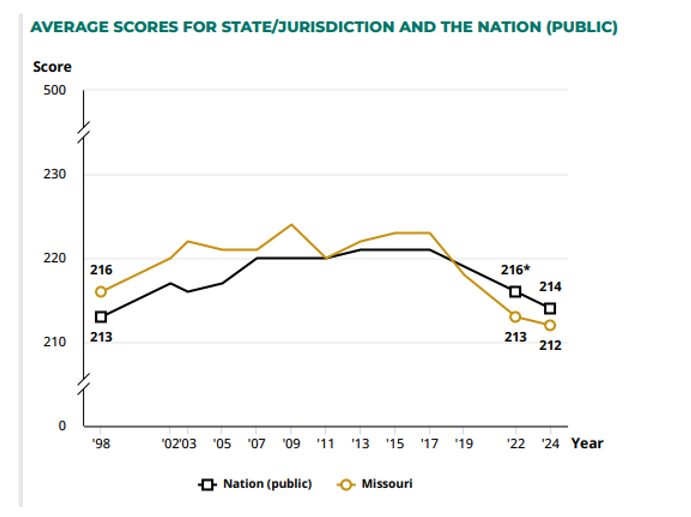
Here is how the performance of Missouri 4th graders has changed over time.

This graph shows scale scores (NAEP is on a scale from 0 to 500). While Missouri was hovering just above the national average until 2017, we then began a steep slide that is barely leveling out.

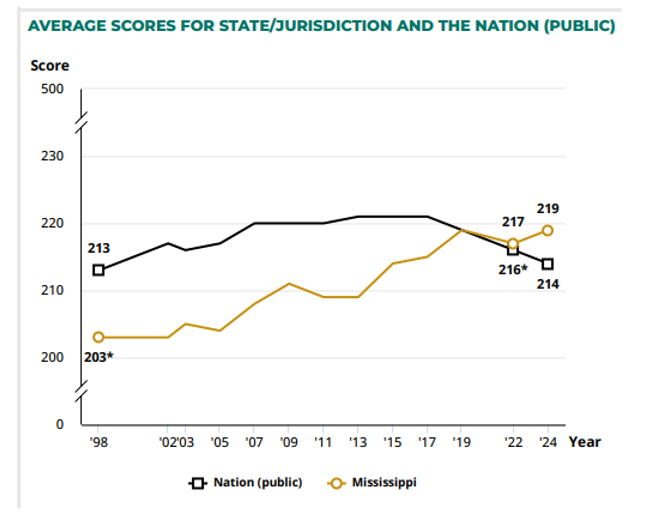
But scores everywhere have declined because of COVID, right? Not so. In 2024, we outperformed just five states—Oregon, Alaska, New Mexico, Oklahoma and West Virginia. Here is the same chart for Mississippi.

Twenty six years ago, we outperformed Mississippi by 16 scale score points. Now, it’s ahead of us by seven.

What will Missouri look like in 15 years, when almost half of 25-year-olds are barely literate? We have a new governor and a new commissioner of education. Perhaps these questions should be put to them.

Support Us

The work of the Show-Me Institute would not be possible without the generous support of people who are inspired by the vision of liberty and free enterprise. We hope you will join our efforts and become a Show-Me Institute sponsor.

Donate
Man on Horse Charging