Earnings Tax Opponents Already Getting Results

On April 5, Kansas Citians will vote on whether to retain the 1% earnings tax. This vote was brought about a few years ago by a statewide petition requiring regular votes on the earnings tax in Kansas City and St. Louis. City leaders and their corporate cronies have bemoaned the effort since it was launched, and regularly resort to ad hominem attacks on one of the lead supporters of the effort, a founder of the Show-Me Institute.

Recently, Kansas Citians have been examining how the city spends their money. They don't seem impressed. This has resulted in petition challenges to the airport, convention hotel, and a crossroads TIF. A KCPT documentary added fuel by focusing on the city's poor record of addressing blight. Voters on the east side—who bear the brunt of the city's neglect—seem fed up with being asked to support every tax, such as the earnings tax, and getting little in return. All this has sent city leaders scrambling to demonstrate that they can deliver basic services. For example, the Mayor has announced a new effort to tear down over 800 dangerous vacant homes in the city. It's not as if the Mayor was just made aware of the houses; he promised to address the situation in his first campaign.

It remains to be seen how the city will define "dangerous buildings" and the degree to which the various agencies make good on their promises. But does anyone doubt that this is happening because city leaders are required to defend the earnings tax and how they spend the proceeds?


Intercity Bus Service on the Rise in Missouri, Nationally

I often find myself traveling to Chicago to visit family, and when I do I have a number of transportation options available to me. When it is not possible for me to drive, I could always fly or take the train. But more often than not, when I can’t get a ride, I find myself taking the bus.

And I’m not the only one. According to a new study, intercity bus routes carried more than 60 million passengers in 2015, more than twice Amtrak’s total. And passenger levels have been growing fast. In 2008, total intercity bus passengers were only around 45 million. That means that in just seven years (tough times for other transportation services), long-distance bus passenger levels grew by 36%. That vast majority of the growth is in express services, like Megabus, which went from serving 2.3 million passengers in 2008 to 11.6 million passengers in 2015.

Why someone might opt to use Megabus or other express services is easy to understand. Compared to flying, it may take much longer, but the bus is considerably cheaper.  Compared to the Amtrak, travel times can be near equivalent. And in terms of cost, despite massive subsidies for rail, taking the bus is still generally cheaper than riding the train:

SAINT LOUIS to CHICAGO

Service

Number of Departures

Travel Duration (hours)

Price

Train

7

5.5–6

$27–$52

Bus

7

5.75–6.25

$20–$24

Airlines

17

1.25–1.5

$102–$224


Megabus and companies like it have upped the game for intercity bus travel. Not only do they provide competition to air and rail services, but they have also forced legacy services like Greyhound to match their speed and onboard amenities. In the end, it’s market innovation creating benefits for travelers in Missouri and across the country. 

Soccer Mania Strikes Saint Louis County

Soccer, professional and otherwise, is big business across the country and around the globe. The MLS is even considering putting a team in Saint Louis. And now Saint Louis County has decided that it wants to get involved in that business. That’s why late last week county officials announced they reached a deal with the city to spend $14 million on new soccer fields at Creve Coeur Park in hopes of bringing youth soccer tournaments to the Saint Louis region.

The idea of building new soccer venues in Saint Louis County is not a new one. Multiple projects were in the works during Charlie Dooley’s term as County Executive. But there’s always been the question, which has yet to be satisfactorily answered, of whether Saint Louis County ought to be getting into the soccer business. The new agreement with the city will allow some of the hotel/motel tax revenue the county uses to support the convention center and stadiums downtown to fund soccer fields in the County. Officials claim this will allow the County to get the fields without using any “new” taxes.

For anyone who reads this blog, alarm bells should be going off with any mention of the hotel/motel tax. The fact is, the hotel/motel tax revenue stream drives the most expensive shell game in the Saint Louis region. These taxes supposedly support the America Center, the Edward Jones Dome, the Convention Center Hotel, and Busch Stadium, among others. But the yearly revenue stream from both the city and county’s hotel taxes (less than $20 million) is nowhere near enough to cover annual cost of all these projects (more than $30 million). And that’s before considering the estimated costs of rehabbing the Dome, renovating the convention center, and improving the Scottrade Center. Restaurant tax and general revenue in the city, along with sizable state subsidies, cover the funding gap.

So why would the Saint Louis Visitors and Convention Commission (CVC), which coordinates these expenditures, allow money it does not have to go toward new fields in the County? According to the Post-Dispatch, this may be part of a larger deal. About half of the County’s hotel taxes currently go to pay debt on the Dome. Both that debt and the tax that supports it are set to retire in the next few years. The idea is that promising money for something the County government wants may induce County officials to keep the hotel tax in place—and its revenue flowing to the CVC. In essence, spending money on soccer fields is about being able to spend more money on convention centers.

While the idea of the County going all in on soccer and convention center gambits is unappetizing enough, it gets worse. According to the manager of a similar set of soccer fields in Kansas City, the County’s $14 million cost estimate is much too low, and the plan is “a drag-a-long, tag-a-long boondoggle that will end with county taxpayers funding the difference between the projected and real cost.” Not like we haven’t seen that before.

So Long, Farewell . . .

Every year since 1993, Atlas Van Lines has analyzed interstate moving patterns among U.S. households. Their Migration Patterns report shows which states are experiencing net inflows and outflows of households. The latest report rehashes a familiar story: In 2015, more Missouri households moved out (1,068) than moved in (918).

When I say the story is familiar, I’m not kidding. Have a look at the table at the end of this post, which reports household migration data for Missouri and its neighboring states since the end of the Great Recession. An outbound figure over 50 percent indicates that there are more moves out of than into the state.

Not only has Missouri experienced a net loss of households over the 5-year period, but it did not have a single positive year during that time. In this context, consistency is hardly a virtue.

The Atlas report provides the newest evidence of the difficulty Missouri has had in keeping residents here and attracting people from other states, but Atlas’s data makes up just one voice among a growing chorus. Others include data from the Census Bureau, the IRS’s Statistics of Income, and even data from another moving company (United Van Lines).

In an earlier analysis, Michael Rathbone and I found that all of these studies sing a song we should be tired of hearing: Missouri households are voting with their feet and seeking other, more attractive economic environments.


Average for 2011–2015

State

% Inbound

% Outbound

Arkansas

48.0

52.0

Illinois

41.3

58.7

Iowa

46.7

53.3

Kansas

45.9

54.1

Kentucky

51.0

49.0

Missouri

45.7

54.3

Nebraska

42.5

57.5

Oklahoma

52.2

47.8

Tennessee

56.8

43.2

Source: Atlas Van Lines Migration Patterns, 2016.

Belton Schools have been getting shorted $500,000 per year. There is a lesson here.

The Cass County Democrat Missourian has a great story on the Belton School District learning that it was getting almost $500,000 less in property tax revenue than it should due to miscalculated TIF values.

As it turns out, the error might have been in the system since 1991, making it older than all of the students in the Belton School District.  Pretty embarrassing.

But there is also a lesson we can learn from this.

In SMI’s 20 for 2020, we recommended requiring clear tax incentive reporting by cities on their financial statements. As we wrote:

“Consistent with recommendations from the Governing Accounting Standards Board, Missouri cities should clearly identify in their financial statements the projects that the city is, and will be, subsidizing.  Moreover, each city should be required to publish every tax incentive liability that it has incurred, proving this information either as a part of a city’s financial statement or as an annually produced and readily available separate document. If local officials want to spend taxpayers’ money on other taxpayers, that money should be clearly and regularly disclosed.”

Perhaps if the city and county had made these figures easier to access, such an error—that over time cost the children of the Belton School District a huge sum of money—would have been caught earlier.

Save Bright Flight Scholarships

The Post-Dispatch published a story this week detailing the efforts of an advocacy group to end the Missouri Bright Flight scholarship program. That program awards scholarships of up to $3,000 to students who score in the top 3% of graduates on the ACT. Bright Flight scholarships are designed to keep high-achieving students in the state, but advocates argue that the money would be better spent on need-based scholarships. I think they’re wrong, for several reasons.

Bright Flight works with—not against—need-based aid. It is good that Missouri universities promote diversity in their student body, whether that’s diversity of race and gender or diversity of income. Think of Bright Flight as promoting diversity of academic achievement. Having high-flying students, regardless of their background, makes universities more well-rounded and interesting places. That’s why Missouri has a basket of scholarship programs (of which Bright Flight is a small part) to try and recruit diverse students into our universities.

Not just “wealthy” kids get Bright Flight Scholarships. In the advocates’ literature, they use not qualifying for free and reduced-price lunch or attendance at a private school as a proxy for wealth. That is not necessarily the case. In Missouri, you qualify for reduced-price lunch if your annual household income (for a family of 4) is $44,863. You could fail to qualify and still be far from wealthy. There are also lots of middle- and low-income kids who attend private schools in Missouri through large financial aid awards from those schools. (I was one of those kids, who also received a Bright Flight Scholarship, for what it’s worth). Their families will struggle to afford college, and might not get as much need-based aid as those who are less well off, so a Bright Flight scholarship could mean a lot to them. Why take that away?

Merit is something we should encourage. One would think that in America this would go without saying, but I guess not. We should be pushing our students—poor, middle-income, or wealthy—to try and do as well in school as possible. Those high-achieving students are our future innovators and leaders, who can help make the state better for all of us. I don’t care if the person who can make the next great breakthrough in medicine or forge a new era of good government was born rich or poor. I just want them doing it here!

Bright Flight isn’t the reason that low income and minority students are not succeeding in Missouri Universities. Let’s look at the Missouri statistics on college readiness for African-American students (from this report): Only 6 percent scored college-ready in all four tested subjects on the ACT, only 2.7 percent graduated high school having passed at least one AP exam, and a whopping 68% enrolled in remedial coursework when they got to college The real scandal, and where we should focus our reform efforts, should not be scholarships for Missouri universities, the K-12 education system in our state that fails to prepare our low-income and minority students for success in college.

Ultimately, I think the campaign against Bright Flight is misguided. We do need to do a lot more to help our low-income and minority students succeed in college, but getting rid of Bright Flight isn’t going to accomplish that. I’d rather focus my energies on the levers that can actually help more students do better rather than punishing kids for doing well on the ACT exam. 

Hair Braiders’ Hands Tied by Missouri’s Twisted Regulations

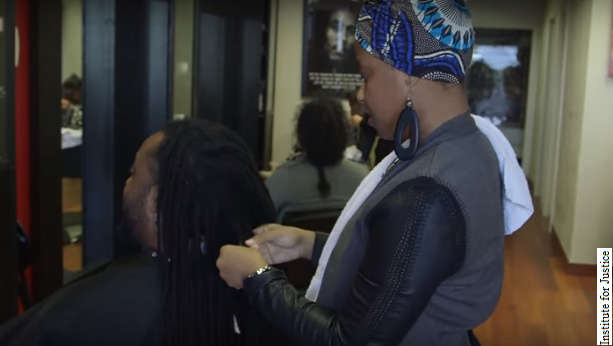
Joba Niang and Tameka Stigers are two successful entrepreneurs who provide African-style hair braiding for their communities. They’re also both fighting the Missouri government for the right to practice their trade.

African-style hair braiding, or natural hair care, is a traditional hair care practice where hair is twisted, braided, and weaved without the use of chemicals or heating. It’s often practiced by Africans, African-Americans, and immigrants. In Missouri, anyone who handles hair is required to get a cosmetology license from the government. This license requires thousands of dollars and at least 1,500 hours of cosmetology training—and teaches you nothing about African hair braiding.  

The Institute for Justice has helped Joba and Tameka file a lawsuit to allow them to continue practicing their trade without government interference. “The U.S. Constitution protects every individual’s right to earn an honest living in their chosen occupation free from pointless government interference,” says Greg Reed, an Institute for Justice attorney.

African-style hair braiding is just one example of government overreach through occupational licensing and regulation. I’ve written before about the state’s interference with yoga teacher training. We’ve also commented on proposals to license street performers, landlords, and of course the regulation of taxicabs to keep competitors like Lyft and Uber out of the market.

For further information, the Institute for Justice’s video on the licensing of African hair braiders is available here.

A Tale of Two Taxes

If you drive in the Show-Me state, you pay two gas taxes—one of 18.4 cents per gallon to the federal government, and the other of 17 cents per gallon to the state of Missouri. Both taxes were set up in the early 20th century to fund highways, and neither tax has been increased since the 1990s. Now, at both the federal and state level, policymakers are looking to raise the gas tax. But the similarities end there. The tax increase proposed by the Obama administration and those proposed in the Missouri legislature are far apart in scale, and are philosophically opposed as well.

Take the Obama administration’s plans for a $10 per-barrel tax on oil, which could translate into a whopping 25 cent per gallon fuel tax increase, more than doubling the current rate. That might not seem like an outlandish proposal given that the federal highway trust fund has been broke for years and the price tag to reconstruct aging interstate highways could be over a half a trillion dollars in the coming decades. But that’s not where all the money would be going. Instead, at least half of those funds, $32 billion a year, would go to “green infrastructure,” or any project that could plausibly reduce the country’s use of fossil fuels.

With 20% of the federal gas tax already going to transit, the link between the federal gas tax and federal highway spending is strained. The Obama administration’s plans would break the link and turn the federal gas tax into just another source of money to spend on grand plans for the American economy.

Contrast that with the efforts of the Missouri legislature. State lawmakers are proposing a modest 1.5 cent per-gallon gas tax increase (and a 3.5 cent per-gallon increase for diesel fuel) to correct serious funding issues at the Missouri Department of Transportation (MoDOT). Policymakers fear that without additional revenue, MoDOT may not be able to keep the highway system in a good state of repair or take on necessary reconstruction projects. Raising the fuel tax just a couple of cents per gallon would raise almost $60 million for MoDOT, and millions more for local road departments. [See here for a comprehensive analysis of the challenges facing Missouri's transportation infrastructure and several possible solutions.

Because Missouri’s constitution stipulates that all fuel tax revenue must be spent on roads, none of the money can go to transit or bike trails or “green infrastructure.” Raising the fuel tax would shore up the highway system’s user funding base and make sure that those who benefit from roads the most will pay for them.

Alternative state-level proposals, like Amendment 7 (the transportation sales tax), would have had Missourians pay for highways regardless of how much, or how little, they drive. Missourians overwhelmingly rejected Amendment 7, but even now some policymakers have proposed taxing tobacco and diverting general revenue to fund highways. While they are not fuel tax increases, policies like Amendment 7, which subsidize highways along with local pet projects, have more in common with Obama’s proposed oil tax than the proposed state gas tax increase.

In Missouri, a small tax increase would have drivers pay a little more for roads, and could also head off proposals that would force all Missourians to subsidize driving. At the federal level, the gas tax would more than double, with drivers bankrolling grand attempts to transform the economy.

Sometimes similar proposals have far different implications. Let’s hope that in this case, their legislative paths have very different endings.


MLS Stadiums Dig Deep Into Public Coffers

Late last week, the MLS announced that it was beginning to search for a place to put a new soccer stadium in downtown Saint Louis, which presumably would mean the city will be on the short list for an expansion team in 2020. While this is great news for soccer fans, residents should be concerned that we may be in for yet another push to publicly fund a stadium.

A new soccer stadium could cost anywhere from $40 million to more than $300 million, depending on the design. One might hope the lower price tag, especially compared with the NFL and other major sports leagues, would prompt MLS owners to pay for these stadiums without public support. Unfortunately, that has not been the case. Only two MLS stadiums, the Stubhub Center in Los Angeles and the Columbus Crew Stadium in Columbus, Ohio, were built without any public support in the last fifteen years. And for anyone who hoped that a new Saint Louis team could play in the now-vacant Edward Jones Dome, no dice. Soccer-only stadiums are in vogue, and an MLS team has not located to a stadium not built specifically for soccer since 2002.

As with other pro sports ventures, many hope that increased tax revenue will justify public subsidies for an MLS team. But there is no good evidence for that. In fact, there is the counter-example of Toyota Park (IL), the home of the Chicago Fire, which is quickly bankrupting the small suburb of Bridgeview.

While professional soccer would be a welcome addition to Saint Louis, there is no reason residents should have to pay for a stadium with tax revenue, especially in light of the big asks the city is already getting for the Scottrade Center and the Convention Center.  Let’s leave the construction of soccer stadiums to league owners and soccer fans. 

Team

Venue

Year Built

Real 2014 Cost (Millions)

Percent Publicly Financed

Soccer Specific?

Houston Dynamo

BBVA Compass Stadium

2012

$98

32%

Y

Portland Timbers

Providence Park

2011

$38

39%

Y

Sporting Kansas City

Sporting Park

2011

$210

75%

Y

New York Red Bulls

Red Bull Arena

2010

$217

20%

Y

Philadelphia Union

PPL Park

2010

$130

58%

Y

Toronto FC

BMO Field

2010

$70

71%

Y

Montreal Impact

Saputo Stadium

2008

$52

58%

Y

Real Salt Lake

Rio Tinto Stadium

2008

$132

41%

Y

Colorado Rapids

Dick's Sporting Goods Park

2007

$149

50%

Y

Chicago Fire

Toyota Park (IL)

2006

$115

100%

Y

FC Dallas

Toyota Park (TX)

2005

$97

52%

Y

Chivas USA

Stubhub Center

2003

$193

0%

Y

Los Angeles Galaxy

Stubhub Center

2003

$112

0%

Y

New England Revolution

Gillette Stadium

2002

$427

17%

N

Seattle Sounders FC

CenturyLink Field

2002

$565

65%

N

Columbus Crew

Columbus Crew Stadium

1999

$40

0%

Y

Vancouver Whitecaps FC

BC Place

1983

$299

100%

N

D.C. United

RFK Stadium

1961

$190

100%

N


Support Us

The work of the Show-Me Institute would not be possible without the generous support of people who are inspired by the vision of liberty and free enterprise. We hope you will join our efforts and become a Show-Me Institute sponsor.

Donate
Man on Horse Charging