TIF in a Flood Plain–A Recipe for Trouble

High noon approaches as the Saint Louis region awaits Stan Kroenke’s development proposal for Maryland Heights.  For those unfamiliar with the situation, Kroenke and a business partner want to transform 1,800 acres of flood plain into a new mixed-use district and will most likely seek public dollars to do so.   While Kroenke's name alone evokes strong emotions in Saint Louis, there is much more than civic pride involved when we say this development would be both fiscally and environmentally irresponsible.

The partners have expressed interest in developing a vast retail, commercial, and residential district that, if subsidized, could cost taxpayers millions. Unfortunately, history in the Saint Louis region shows that if you ask you shall likely receive, even if the project is of questionable merit. A prime example of this occurred in 2010 when a Walmart located in both Saint Ann and Bridgeton (two adjoining suburbs of Saint Louis) relocated a spot in Bridgeton 2 miles down the road in order to capture $7 million in public subsidies. Kroenke's plan would not only be costly for Maryland Heights residents; it would also likely move economic activity from other areas in the region, rather than creating new activity.

Periodically reshuffling existing businesses across the metro area was not the original purpose of tax increment financing (TIF). TIF was intended to encourage the development of blighted areas in need of economic growth. Instead, it is often used as a subsidy to attract businesses to areas that are already economically healthy, forcing other government entities like school districts to shoulder the costs of those decisions.

Then there is the separate question of whether it's wise to subsidize construction in a flood plain.  Flooding is still a threat in the areas where the Kroenke development would be built. In fact, as recently as last year hundreds of families were forced to evacuate their homes as a result of flooding. Saint Charles County and the Great Rivers Habitat Alliance (GRHA) have sued Saint Peters over flood plain developments in the past for environmental endangerment, and David Stokes, executive director of the GRHA and a former Show-Me staff member, contends that further development on the flood plain “will just make the [environmental] problems we’ve experienced in the past even worse.” 

Fortunately, Saint Louis is beginning to acknowledge the TIF problems we’ve been discussing for years at the Show-Me Institute.  In the past, municipalities could simply override a county veto with a two-thirds vote and proceed with the projects of their choice, but this year legislation passed both the House and Senate that would limit municipality overrides to financing costs of demolition and clearing land. If this law goes into effect on August 28 as expected—the governor has not technically signed off on it yet—then the seemingly limitless public financing of projects like Kroenke's might be scaled back considerably. 

If subsidizing construction on the flood plain is economically questionable, would hurt local school funds, and could actually threaten the safety of nearby residents, shouldn’t the flood plains be left alone?  

To Pay for North-South MetroLink, the City Will Need the County

Recently, regional leaders in Saint Louis have gotten into a spat over plans to expand the MetroLink. Saint Louis County has been independently exploring (and spending money exploring) various MetroLink expansion options. However, County Executive Steve Stenger feels this process has been short-circuited, “surreptitiously,” as the city and transit authorities have already applied for federal aid for their preferred “North–South” expansion without getting buy-in from the county. In protest, Stenger issued a harshly worded letter to the FTA and has publicly denounced the project. The Mayor’s office has tried to diffuse Stenger’s criticisms, with one official calling the County Executive’s actions “embarrassing.” However, given Stenger’s opposition, the city needs to confront the fact that funding a MetroLink expansion without the county’s participation is a nonstarter.

To see why this is the case, remember first that building the proposed North–South MetroLink expansion may cost upwards of $2 billion, not including the increased costs of operating the system. That’s a huge price tag, one that the region would likely not consider if not for the possibility of getting federal grants, which can cover as much as 50% of transit infrastructure costs. However, getting these grants is a competitive process, and the County’s vocal opposition could harm (if not destroy) Saint Louis’s chances. No federal dollars would all but guarantee no new MetroLink.

However, let us imagine that the city moves forward over the county’s objections and, despite the disharmony, the federal government agrees to cover half the costs of MetroLink’s expansion. Even then, the city’s ability to go it alone is questionable. The city would still need to cover a billion dollars in capital costs and increased MetroLink operating expenses, requiring a new city-wide sales tax of more than 2 percent. Such an increase would put the city’s total average sales tax above 10 percent, with many areas in the city charging a tax of more than 12 percent on all goods and services. Even if the state legislature would allow a vote on it, Saint Louis’s residents and businesses would likely reject a tax hike of that size.

The other prime option for circumventing County opposition, the use of a transportation development district (TDD), is also unlikely to succeed. Creating a new taxing district near the proposed route could help fund the expansion, but creating a district large enough to raise a billion dollars would be difficult. TDDs, by state law, can charge a maximum of a 1% sales tax and a property tax of 10 cents on each $100 of assessed valuation (imposing the property tax would require a supermajority approval) in the district’s boundaries.  To fund a MetroLink expansion, the TDD would have to extend well beyond the city and reach economically productive areas in Saint Louis County, all of which would be far away from the North–South expansion’s route. These areas would be less likely to vote in favor of a high-tax TDD.

Unfortunately for the city, the only logical way to fund a multibillion-dollar MetroLink expansion is the same method used to fund past expansions: sales tax increases in both the city and the entire county, to tune of 0.5%. The city might find Stenger’s opposition embarrassing, but what’s more embarrassing here is that the MetroLink, with its massive expense and low ridership, requires financial support from those who will rarely, if ever, ride. In the end, if the city and transit activists want more rail, they are going to have to start begging the county, as they are now begging the federal government, to get on board. 

The Never-Ending School Finance Wars

Just like school years come and go and spring fades into summer, controversy over how we fund our schools has been a part of our political landscape for what seems like eternity.  Most recently, the Kansas Supreme Court has threatened to keep the state’s schools closed if the legislature does not change the way it funds schools to provide more money for low-income districts.

Kansas is not alone. At the end of its session this year, the Texas Supreme Court came down with a decision on the constitutionality of its school finance system. Not long ago, the Missouri Supreme Court was asked the same question, and given the changes to the school funding formula this legislative session, it is entirely possible that the state might be taken to court again.

Years of lawsuits and millions of dollars in legal fees have been devoted to 15 words in Article Six of the Kansas constitution “The legislature shall make suitable provision for finance of the educational interests of the state.” In Texas, it’s a few more, but conveys the same message. In Missouri, our Constitution at least gives some benchmark, saying that we can spend no less than 25% of state revenue on our public schools, but even that has been challenged over the years.

These cases have well-compensated lawyers, expert witnesses, and consultants trying to force courts to read minute detail into constitutional language. Complicated studies are conducted to place an exact dollar amount on what constitutes “suitable provision,” so that a penny less is seen as violating the constitution.

This is not how we should determine what to spend on our schools, for two reasons.

First, no one really knows exactly how much we should be spending on education. Costing out the precise dollar value of a quality education is beyond the knowledge base of social science today. We simply do not know that spending X amount of money will yield Y level of achievement. What’s more, we have a belief that low-income students, students with special needs, and students who have to learn the English language cost more to educate—but how much more? We simply don’t know.

Second, for all of its faults, the legislature is better qualified to make funding decisions than the courts are. Courts are not in a good position to weigh the complicated tradeoffs that legislatures must make when they appropriate state tax dollars. We don’t live in a world of unlimited resources. As a result, legislators have to weigh the needs of schools against other needs, like roads, healthcare, and everything else that the state supports. Courts are rarely, if ever, asked to determine how their decisions might affect these other priorities. And depending on whether judges are appointed or elected, they may be harder to hold accountable than legislators, who must run for re-election.

Not everyone is going to agree with the decisions that the legislature makes, and their complaints will be justified in some cases. But that is why we have elections. Calling on the courts should be an absolute last resort, reserved for the most egregious cases. In most instances, the only thing that will be accomplished by including the courts will be to make lawyers and consultants richer, not improve educational outcomes for children.

Lessons to Be Learned as Former Saint Joseph Superintendent Heads to Jail

Dan Colgan, longtime superintendent of the St. Joseph public schools, has been sentenced to one year and one day in federal prison for his role in improperly awarding himself bonuses and stipends during his time at the helm of the school district. Colgan’s downfall was one result of a broader sweep of the district’s practices that also led to the firing of former superintendent Fred Czerwonka after it was revealed that he had given out 54 $5,000 stipends to administrators without permission from the school board.

All in all, it was a depressing affair. But, as it moves from the present into the past, we do have an opportunity to try and learn from what happened. I can think of two key lessons:

Lesson 1: Audits are essential

Little if any of the malfeasance in this case would have been brought to light had it not been for an audit of the system’s finances by the state auditor. That process uncovered almost $40 million in misspent funds and led investigators to the guilty parties. It’s not difficult to imagine that if comprehensive audits of all of the state’s 520 school districts were conducted, the state could uncover other cases of wink-and-nod arrangements and misspent funds.  What was found in St. Joseph is reason enough to suspect that similar cases might well be out there, and the state should make auditing at least some sample of districts a priority.

Lesson 2: Basing pensions off the last three years of earnings, even if legal, is a bad idea.

Missouri calculates a teacher’s pension based on the average of their final three years of employment. By awarding himself extra compensation during those years, Colgan was not only adding to his present paychecks, but also increasing the amount of money he would receive in retirement. What Colgan did was illegal, but plenty of teachers and superintendents goose their pensions by taking on administrative roles or other positions in their final three years of employment to increase the value of their pensions.  We want the best people for these jobs, not just folks who want more in their retirement checks. By taking a teacher’s entire career into account when calculating their pension, we can avoid such problems.

It’s easy to shrug St. Joseph off as an isolated, ugly case of abuse of power, but we do so at our peril. We will pay for our mistakes in any case; the only question is whether we will learn from them.

Missouri’s Weak Employment Mirrors Weak Economic Growth

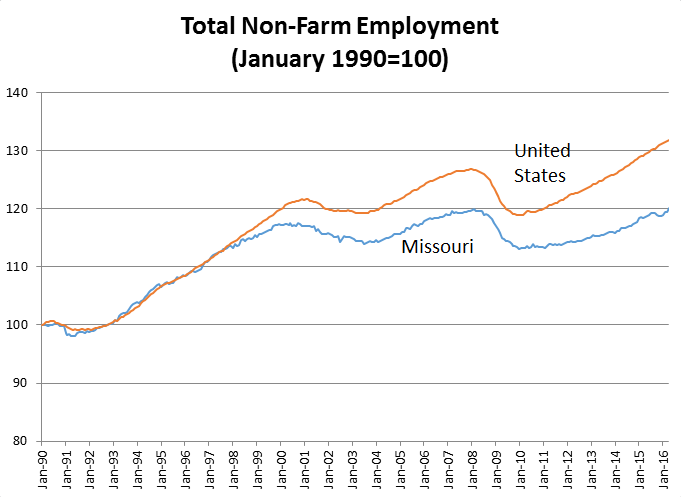
Last week I posted a comparison of output in Missouri to that of the United States. The bottom line is that since the late 1990s Missouri has lagged behind the nation when it comes to producing goods and services. With the most recent employment figures out, it appears that Missouri isn’t doing any better there, either.

The Bureau of Labor Statistics’ monthly release of employment data revealed that there has been meager growth in Missouri jobs over the past year. Between May 2015 and May 2016 there was an increase of about 24,000 jobs, or less than a one-percent increase. Is this slow increase a recent phenomenon or something more persistent?

The chart above plots total non-farm employment since 1990 for both Missouri and the United States. To make the two series comparable, each is indexed to their January 1990 values. The two lines show that jobs in Missouri and the nation both react to changes in economic activity. They both expanded during the economic boom of 1992. Conversely, employment fell during the recession that occurred in 1991, and during the so-called Great Recession, which lasted from 2007 through 2009, employment dropped significantly.

What makes the chart interesting is the fact that while Missouri’s job growth kept pace with the nation for most of the 1990s, it has lagged far behind since then. From the beginning of 2000 to the beginning of 2016, employment at the national level increased by about 9 percent. Missouri, in contrast, has seen employment increase by less than 2 percent. And while the nation has rebounded from the Great Recession with employment higher now than what it was in 2007, total employment in Missouri has changed very little.

To answer the question posed above, Missouri’s lack of job growth is a persistent phenomenon, one lasting well over the past decade. 

Is Kansas City Using TIF to Mask Policy Consequences?

The Urban Land Institute invited me to speak on a panel the other day to discuss Kansas City’s use of financial incentives to developers. I was grateful for the invitation, and I think all the attendees enjoyed the discussion.

Most of the arguments for and against incentives were familiar, with one exception. Bob Langenkamp, the President and CEO of the Economic Development Corporation (EDC) of Kansas City, said that taxpayer subsidies such as TIF were often used to compensate for such things as minimum wage requirements and women- and minority-owned business contracting policies. “They impact attractiveness,” said Langenkamp.

Although Kansas City did not raise its minimum wage, the Council wanted to. It’s easy to imagine a business considering a development in Kansas City seeking to have those additional costs defrayed by taxpayers. Less clear is the impact of the City’s requirements for hiring women- and minority-owned contractors. But whatever the issue, those requirements were significant enough for the head of the EDC to mention them.

Langenkamp’s general point seems that the City sometimes sets policy in ways that harm its attractiveness for development. This by itself is not problematic; governments often enact social justice or public safety laws despite their economic impact. But rather than accept the consequences of their decisions, Kansas City is using taxpayer subsidies to shift the costs from developers onto taxpayers and residents.

It's good that someone in Kansas City’s leadership recognizes there's a problem with the city’s policies. But if those problems need to be solved with taxpayer money, wouldn’t a more straightforward way be to simply ask taxpayers directly for the money (and explain why it was needed) rather than take the roundabout TIF approach?

Leadership Lessons from Attila the Hen: Margaret Thatcher on Europe-and the United States

It was a vintage if ill-advised display of firmness.

A quarter of a century ago, Margaret Thatcher threw the British House of Commons into an uproar when she mocked the concept of a United State of Europe in no more than three words. Punctuating each one, she said:

“No. No. No.”

This wasn’t just verbal overkill.  More precisely, she was saying “No” to a European Parliament comparable to the U.S. House of Representatives, “No” to a European Council of Ministers comparable to the U.S. Senate, and “No” to a European Commission approximating the power of the White House and executive branch.

Nevertheless, senior members of her party railed at her vehement rejection of a new conventional wisdom.  They challenged her leadership—and forced her resignation.

After eleven years (the most of any British prime minister in the 20th century), she was booted out of office on the issue of European integration. She resigned on Nov. 28, 1990.

Since her departure, every British PM (two Conservatives and two Laborites) has waved the pro-Europe flag. Support for the European Union (EU)—supplanting what began as the European Common Market—has been the consensus view of the British political establishment EST (Ever Since Thatcher).

However, with the “Brexit” vote last month, this era may also come to an abrupt close. After 26 years, will the British public  have swung around to her thinking? 

Thatcher foresaw many of the difficulties today’s Europe.

In 1975, as opposition leader, she campaigned to keep Britain in the Common Market. However, after winning a third term as prime minister in 1987, she worried about the metamorphosis of the Common Market from free-trade zone into the “Babel Express”—a new super-state with many different languages and national identities. Ironically enough, the EU was taking shape just as an older super-state (the Soviet Union) was falling apart.

A new super-state centered in Brussels, Thatcher thought, would be as antithetical to democratic freedom and democratic accountability as the older one centered on Moscow.  In her memoirs she wrote: It would have “the same inclination toward bureaucratic rather than market solutions” . . . and it would make distant and unelected elitists the masters rather than the servants of the people.

“Ultimately,” she wrote, “there was no option but to stake out a radically different position from the direction in which most of the Community seemed to be going, to raise the flag of national sovereignty, free trade, and free enterprise—and fight.”

Here are eye-opening excerpts from a major speech she gave less than two years out of office.  At the Hague, she predicted worsening problems of:

Insecurity—because Europe’s protection will strain [relations with the U.S.] on which the security of the Continent ultimately depends.

Unemployment—because the pursuit of policies of regulation will increase costs, and price Europeans out of jobs.

National resentment—because a single currency and centralized economic policy . . . will make [people in various countries] feel angry and powerless.

Ethnic conflict—because the wealthy European countries will not be the only ones faced with waves of immigration from the south and east.

Suffice it to say that all she predicted has come to pass.

Support Us

The work of the Show-Me Institute would not be possible without the generous support of people who are inspired by the vision of liberty and free enterprise. We hope you will join our efforts and become a Show-Me Institute sponsor.

Donate
Man on Horse Charging