
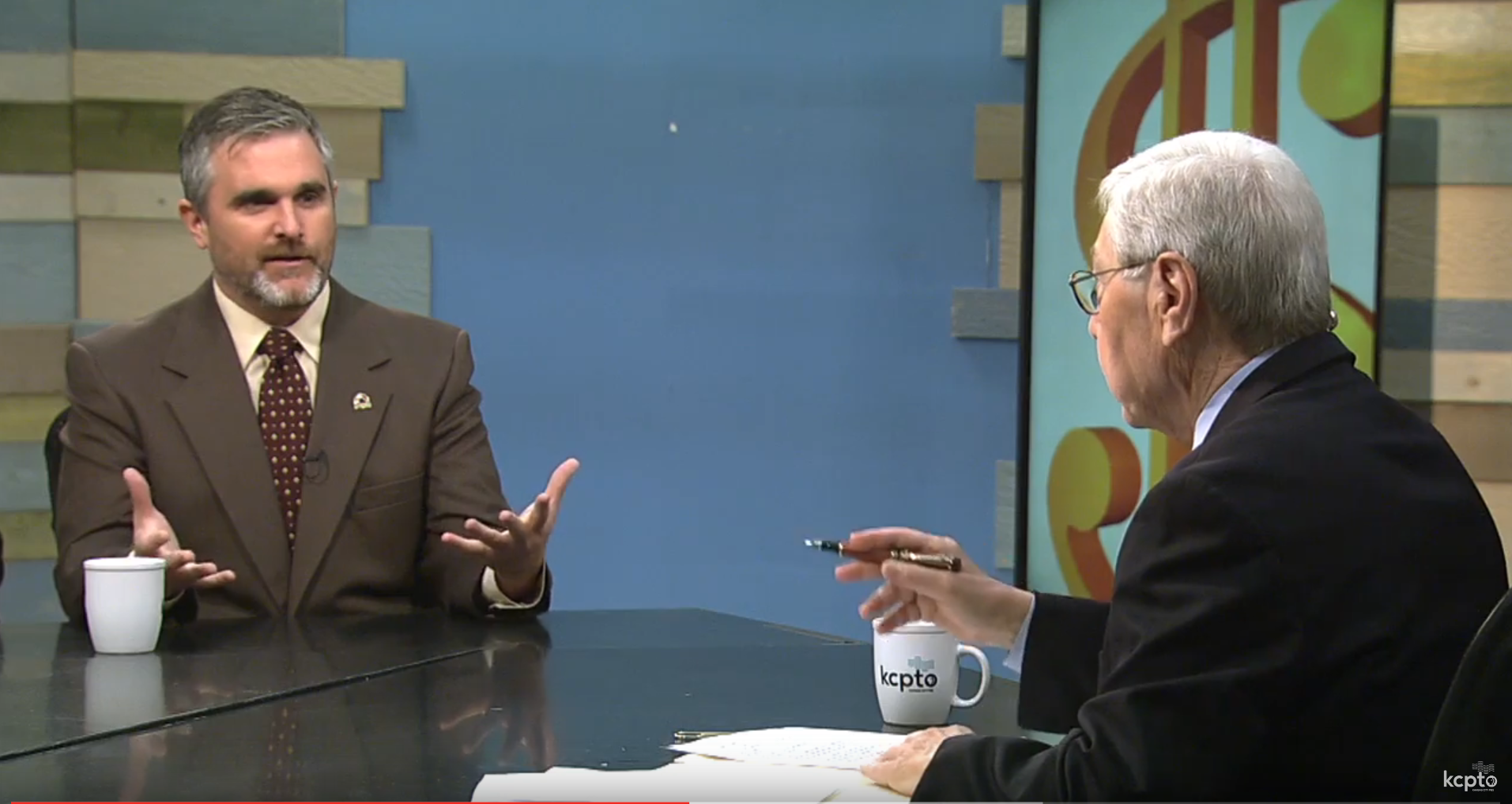
On Thursday, October 6, the Show-Me Institute’s Patrick Tuohey appeared on Kansas City Public Television’s Ruckus to discuss the Kansas City Police Department's 90-day trial of body cameras and efforts to extend the streetcar line. Click on the link to watch the entire show.
Making Health Care Better Through Licensure Reform

Today the Show-Me Institute released our latest health care policy paper, "Demand Supply: Why Licensing Reform Matters to Improving American Health Care." The paper looks at supply-side health care reforms, particularly those dealing with physician licensure.
Making health care more available and affordable requires attention not only to health insurance and care demand; it requires that we also take a hard look at provider supply, and try to find ways to expand the care opportunities available to patients that are currently obstructed, unnecessarily, by government.
Physician licensure reform is an important step toward that end. There are over 900,000 state-licensed physicians in the United States, and yet today only about 3% of those doctors can substantively see Missouri-based patients, thanks to the way our current physician licensure system works. The paper's argument is straightforward: if you are a medical doctor who is licensed and in good standing in your home state, Missouri should not be stopping you from practicing in our state and helping Missouri-based patients.
With the maldistribution of primary care physicians we see both nationally and at the state-level, there are many underserved communities in Missouri that would benefit from the opportunities of interstate licensure, especially in the telemedicine context. Importantly, rather than pursue a system like the Interstate Medical Licensure Compact promoted by many state medical boards, policymakers should look at the Nurse Licensure Compact as a guide to making care by a physician more available and affordable to Missouri patients.
The paper builds on our previous work with the direct primary care and Medicaid reform issues.
The Unscientific Claims of Streetcar Boosters

Let’s play a game. It’s called “Pick the scientist,” and here’s how you play: I’ll provide two quotes, and you try to guess which is from a scientist and which is not.
Quote 1: “Trolleys are a proven catalyst for residential, commercial and recreational development in cities like Memphis, Little Rock, Tampa and Portland.”
Quote 2: “The evidence for the streetcar’s development effects is limited, controversial, and yet widely believed among many streetcar proponents.”
. . . Well?
If you guessed Quote 2, you’re right. It’s from a recent report by the Mineta Transportation Institute at San Jose State University. Quote 1 is from rail proponents on the Delmar Loop Trolleys’ website.
Despite the lack of empirical evidence, boosters of the Trolley—a 2.2-mile vintage streetcar line slated to begin service this spring—claim it will spur economic development. But as the authors of the Mineta report (and this one) explain, there is no solid link between streetcars and development.
And the development prospects look especially grim for the Loop Trolley.
Research shows that of all kinds of mass transit, ‘vintage’ or ‘heritage’ streetcar lines like the Loop Trolley are the least likely to generate development. That’s because of their low ridership and limited service. If the trolley doesn’t effectively serve as a transit amenity—for example, by getting people to work or school—it won’t attract economic activity. But the trolley is only projected to carry a paltry 800-1,200 passengers a day and won’t even start running until the lunch hour! To put that in perspective, a busy Metro bus route can carry anywhere from 5,000-9,000 passengers a day, and operates nearly 24 hours a day.
Trolley boosters might respond that the streetcar has already spurred development, including a new residential tower. But this response ignores the point driven home in the scientific literature: subsidies, relaxed zoning, and other perks do more of the spurring than the rail does. (In the case of the new East Delmar residential tower, the project received a 16-year tax abatement.) As a recent paper in the Journal of Public Transportation states, “The real explanation for Portland’s apparent redevelopment success is most likely a combination of these factors [namely, financial incentives and regulatory inducements], combined with a desirable location and a vibrant local real estate market” (p. 44).
The truth is, the Loop real estate market is doing just fine. Delmar is not blighted, and didn’t need a $51 million vanity streetcar to grow. And if our community wants to drive development east of Skinker, it will have the most success by lowering tax and regulatory burdens, not because it has a vintage trolley creeping by.
Just How Expensive Is “Free” Tuition?
I have to give some serious credit to the Campaign for Free College Tuition. They are unapologetic advocates for making college tuition free, but rather than rely on some rosy projections about how much it might cost to make that a reality, they commissioned an impeccably credentialed and skeptical researcher to make a full accounting of what exactly free college would costs states.
The numbers he found were large. Very large.
If Missouri were to make all public 2-year and 4-year colleges free to in-state students, the total yearly price tag would come in at a staggering $808 million—on top of everything the state already spends. And if growth in college costs continues at its current rate, this number should only increase.
The paper also estimates the need for additional appropriations should the enrollment patterns of students switch as a result of this policy change. That is, students who might otherwise attend a private school in the state might decide to switch to a public school because tuition there would be free. If just 5% of each cohort switched from private to public, and thus got their entire tuition covered, Missouri would spend an additional $5.5 million per year. If 10% did, it jumps to an additional $11 million.
So what does roughly $815 million look like in the context of the state’s budget? Well the entire general revenue request for higher education from the Governor’s 2016 budget was only $913 million, so free college could essentially double that. The instructional budget of the whole University of Missouri system is only $650 million, so free tuition would cost substantially more than that as well. Absent massive federal subsidies, providing free college to Missouri students would require radical reallocation of state resources, resources currently spent in K-12 education, healthcare, infrastructure, and a host of other causes.
The Campaign for Free College Tuition deserves praise for their honest accounting, but the numbers their study produced makes it hard to support their goals. A more fruitful path to expanding college opportunity would be to work to drive down the cost of college and make it more affordable for more students. Stay tuned for some research we have cooking on this very topic!
Breaking Out of the Public Education Box

What does student success look like to you? That was one of the questions asked last week at the eighth Regional Meeting on Education hosted by the Missouri Department of Elementary and Secondary Education at Pattonville High School. The school’s cafeteria was packed with parents, community members, teachers, principals, and superintendents, all of whom were asked four guiding questions by DESE officials. They were then given an opportunity to discuss with others sitting at their table and later share their thoughts with the audience.
The attendees at the meeting described an education system I think all of us would want for our children: a system that meets the unique needs of every student and prepares each one for college, careers, and life. The attendees wanted students who are prepared to be engaged citizens, programs that offer arts and cultural enrichment, and work that equips students for the real world. Hard to argue with any of that.
The problem is that you can’t get there from here.
Think about it for a minute. In a room filled with people heavily invested in education, there was almost universal agreement that what we are doing isn’t working. Participants at the meeting repeatedly spoke out about the need for less rigidity in the education system; less reliance on test-based accountability systems. They spoke about innovation, creativity, and the need for thinking outside the box. I suspect DESE officials have heard similar responses at every one of these regional meetings.
So why aren’t we there already? Our education system isn’t the one we envision because it can’t be. And it can’t be that ideal system because it wasn’t designed to be. We wall off schools with artificial boundaries, and we assign students to those schools. People have no way to hold their school accountable for delivering the type of education they expect, so we regulate through rules, regulations, and laws. There is no other option. We will never get the type of schools that you or I envision through this system.
The only way to get there is to fundamentally reorganize the system. If, instead of centrally determining which students attend which schools, we were to empower parents with school choice, we could replace centralized accountability systems. Teachers would be free to teach, school leaders would be empowered to lead, and parents would have the ability to choose. No need for cumbersome regulations or stifling standardized tests. If you want the schools that we all envision, that’s how you get there.
For some reason educators and politicians have been taught to fear school choice. But it is only through school choice that we will ever create the type of schools that educators and parents want; schools that are responsive to the needs of students and where teachers are empowered to use their creative abilities.
Kansas City’s Convention Hotel’s Collapsing Foundation

Despite years of failing to deliver on promises of convention business, Kansas City leaders still want another convention hotel. Badly. But building a convention hotel in downtown Kansas City is apparently a bad business decision, so developers want taxpayers to subsidize the deal until it is a good investment for businesses.
So far that’s not the case. We learned from a recent story in The Kansas City Star that almost as soon as the deal was announced in May 2015, “the development team approached the city after that announcement to ask if it would consider guaranteeing bond debt on $62 million in catering revenues.” The more alarming part of the Star story, however, are the other obstacles to the deal.
· The land the city wants to contribute to the hotel deal has a lien on it.
· The private owner of the remaining quarter of the site has not yet reached a deal to sell.
· The building contractor has not yet provided a construction price for the whole project.
Yet in testimony before the City Council on October 15 of last year, financier Steve Rattner said that the project was “ready to go” (starts at 2:20:28, emphasis added):
[Councilman Quinton Lucas:] Is it fatal to the project that you have a six or seven month delay?
[Steven Rattner:] We are ready to continue—every day we’re spending money to meet our obligations that we have with the city under the contract. We know we can get the financing today. We know what the cost of the project is. So we have the sources and uses. I cannot guarantee you that if we delay this six months that something will happen that will kill the project. Construction costs could go through the roof, and we don’t have that budgeted in so that could kill the project ‘cause you can’t raise enough equity. . . .
This project is ready to go now, right? And we have it under contract now. So can I say without a doubt it is going to kill the project? No. But I cannot guarantee you that the project will happen.
We learn now—a year later—that few of these things are true even now. They certainly weren’t true then. The developers don’t have the financing, they don’t know the cost of the project, they don’t have the land. The project is not ready to go now. City Manager Troy Schulte, who sat in on this hearing, should have known these things. The same is true for developer Mike Burke. Why did they not speak up to correct the record?
No one should be surprised that the convention hotel deal is viewed with such skepticism. Past promises failed to materialize, and testimony such as that quoted above only serves to further erode public trust.
Education Policy for Our Fractured Republic

Like most observers of American society and politics, I am trying to make sense of our current political moment.
Two recent books have helped me in my struggle. One, J.D. Vance’s outstanding Hillbilly Elegy (which was ably discussed in these pages by Robert Pondiscio), directly and vividly describes the injuries, many self-inflicted, that the white working class has suffered in the last half-century “reacting to bad circumstances in the worst way possible.” He puts a deft personal touch on the often underreported story of the economic and social circumstances of a huge swath of American voters. If there is any downside to the book (that is by no means the fault of the author), it is that it leaves the reader with little hope that the situation is going to get much better.
Luckily, a second book, Yuval Levin’s equally outstanding The Fractured Republic, might just offer a way forward for the white working class and everyone else.
Levin convincingly weaves historical and sociological analysis, arguing that in the decades since World War II, our society has become increasingly “decentralized, diffuse, diverse, and dynamic.” This has been both good and bad. The material condition of the vast majority of our fellow citizens has improved, and people of different races, ethnicities, and sexual orientations have seen increasing acceptance and integration into our society. But at the same time, diffusion and dynamism have wreaked havoc on communities like the one where J.D. Vance grew up.
Rather than getting stuck into believing some halcyon past is going to return, Levin argues for policies and politics that are suited to today’s issues. He argues that solutions to social problems can be found “in the intricate structure of our complex social topography and in the institutions and relationships that stand between the isolated individual and the national state.” These “concentric rings” of human existence start with the family, move outward to interpersonal relationships of the school, workplace, church and neighborhood, expand further into the state and region, and finally move to the level of the nation.
If we re-center our search for solutions with subsidiarity—“putting power, authority, and significance as close to the level of the interpersonal community as reasonably possible”—in mind, our diffusion and diversity becomes a strength, not a weakness.
So what does subsidiarity look like in education? Well, it looks a lot like the Cristo Rey Catholic schools.
The first Cristo Rey school was started on Chicago’s near southwest side in 1996 to offer a high-quality high school education to low-income students. To help offset a portion of their tuition, students agree to work one day per week in a job placement organized by the school. What began as a single school has now grown into a network of 32 schools in 20 states and the District of Columbia educating more than 10,000 students.
In a world where the social fabric is fraying, Cristo Rey weaves it back together. Businesses, schools, churches, families, children, and communities all come together in the mutual pursuit of providing quality education. As a result, students enjoy a more diverse experience than they would get in a traditional educational setting; co-workers get to meet, mentor, and learn from students who may come from a different background than their own; support for the school is cultivated in the community; and families are able to afford an education that they would otherwise be beyond their reach. Each supports the others.
Subsidiarity also looks like Florida’s Gardiner Scholarship Program.
Patrick Gibbons recently wrote a heartwarming account of Malachi Kuhns, a seven-year-old child born with spina bifida in Ethiopia and orphaned before his third birthday. Malachi was adopted by a family from Florida and uses the state’s Gardiner Scholarship Program to attend Ruskin Christian School in Ruskin, Florida. The Gardiner Scholarship is an education savings account program that places state funding for education into a flexible use spending account that parents can use to purchase educational services for their child. This could be tuition at a private school, tutoring, therapy, or a host of other approved expenditures.
By empowering parents to make decisions for their children and giving them the flexibly to piece those services together from multiple providers, education savings account programs help connect and leverage decentralized providers and unite varying aspects of the community around a common goal.
Unfortunately, much of the education reform movement seems to distrust subsidiarity. One must look no further than the degree to which state and federal agencies want to dictate the types of decisions that parents are allowed to make, or the types of groups that are allowed to participate in educating children.
Distrust of subsidiarity has a cost. The more the outer concentric circles undermine the inner circles, the more we push individuals and families to see our society as consisting solely of citizen and state, further atomizing and fracturing our communities.
There are no easy answers or ready-made solutions to today’s problems. A subsidiarity-driven social policy means serious debate about what is good and right, which in turn leads to difficult conversations about values and expectations. But if today’s political moment has taught me anything, it is that it is high time that we, as a nation, have these debates and discussions, difficult though they may be. If we don’t, we open the door for demagoguery, identity-politics, and a host of ills we may just lack the resources to withstand.
TIF Requests in Affluent Areas: The Beat Goes On
If you drive by the St. Louis Galleria on any given day, you’ll find the area is a hive of activity. I’ve spent my fair share of time looping around the Galleria’s parking lot in search of a spot. Yet despite the area’s vitality, the company redeveloping a piece of property across the street from the Galleria is asking for $18.7 million from taxpayers to subsidize the cost of moving in.
This development, Phase II of The Boulevard development, was set to take place years ago, but plans were put on hold due in part to the recession. Now the land is being sold to another investor, and tax increment financing (TIF) is on the table. The Boulevard’s prime location—across the street from the Galleria and at the intersection of I-170 and I-64—is one reason for the developer’s high expectations. Another reason is the average household income of $92,581 within three miles of its location. Residents of Richmond Heights might well ask why a project with a prime location in an affluent area needs to be subsidized by taxpayers.
TIF was designed to reduce the costs of private developers investing in blighted or economically unattractive areas, but the Boulevard development is far from the first instance in which TIF has gone toward a project in an area that would hardly be considered “blighted.” A recent study on incentive use in St. Louis City found that roughly two-thirds of all property tax abatement and TIF has gone toward areas with strong housing markets.
The Boulevard development is representative of the misguided use of incentives in St. Louis during recent years. When well-off neighborhoods are asking taxpayers to subsidize their investments and truly blighted regions are being ignored, it may be time to reevaluate our spending priorities.
Could KC Streetcar Expansion Drain Regional Resources?
What could make the tax bills Kansas Citians might have to pay for an expanded streetcar system any worse? The opportunity cost of the quarter-billion-dollar project.
| Revenue Source | Amount (2019 $) |
| Bonds (backed by TDD taxes) | $129,500,000 |
| Federal Grant | $100,000,000 |
| STP/CMAQ Grant | $14,500,000 |
| TOTAL REVENUE | $244,000,000 |
| Capital Costs | Amount (2019 $) |
| Construction | $227,150,000 |
| Contingency | $16,850,000 |
| TOTAL COSTS | $244,000,000 |
The table above shows the projected revenue sources and costs of the proposed streetcar expansion. Note two things: (1) The expansion is over 20% more expensive per mile than the existing 2.2-mile downtown line; and (2) $14.5M of the required revenue would come from Surface Transportation/Congestion Mitigation–Air Quality (STP/CMAQ) funds.
STP/CMAQ grants are federal dollars allocated throughout the region by the Mid-America Regional Council (MARC), a consortium of government officials. These funds are used to build streets, bridges, trails, and other transportation projects. Jurisdictions from Platte to Cass counties rely on these funds to meet their basic infrastructure needs.
By targeting these funds, streetcar advocates are asking that the streetcar be given higher priority than other regional projects—much higher priority. During the next two-year STP/CMAQ funding period, roughly $42M in funds will be available. So the $14.5M grant that rail advocates are after could gobble up more than a third of the total funds. As a result, other regional priorities could wait years until funding becomes available again. The request for STP/CMAQ funds also demonstrates that rail proponents are trying to offload even more of the cost of their expensive project on taxpayers far outside city limits. (Note the $100M federal grant listed among the revenue sources.)
Rail advocates might reply that even if a grant is awarded to expand the streetcar, funds would still be available for other projects. While it’s true that some funds might still be available, this response overlooks the opportunity cost of funding the extension, not to mention the opportunity costs already incurred for the downtown line. In 2013, the downtown line received an unprecedented $17.3M in STP/CMAQ funds. The streetcar has already pushed projects to the back of the line before—why should it do so again?
So while rail advocates seek out another multi-million-dollar grant, public officials should ask themselves: Is the streetcar project the best use of regional funds?
