A New School and Governance Model for the New School Year in Kansas City

In just a few weeks, a new public charter school is opening in Kansas City. The Kansas City Neighborhood Academy will be the first of its kind, operating as a partnership between a non-profit organization (the Urban Neighborhood Initiative, or UNI) and the Kansas City Public Schools. UNI will operate the school and KCPS will be the sponsor, overseeing the progress of the school and holding its leadership accountable for performance.

The effort has not been without controversy. Some have argued that a school district that struggles so mightily to provide a basic level of education to its students should not expand its portfolio or take on new initiatives until it has its core functions under control. I am certainly sympathetic to that argument.

However, ultimately I think KCNA is an interesting experiment in educational governance that is worth giving a shot. My colleagues and I here at the Show-Me Institute have argued for years that schools are more likely to succeed when school districts take a step back from trying to fund, regulate, and operate schools and leave the day-to-day education of children to independent, autonomous organizations.  By focusing simply on funding and regulating schools, school districts can limit themselves to what they are able to do well. That is what KCPS appears to be trying here.

Should KCNA be a success, it will offer an alternative to the traditional district–school relationship, one that can provide more autonomy for educators and more choices and better options for students.  It has the opportunity to be a win–win.

I’ll be following KCNA’s progress and will report back when we learn more!

Privatization: Still a Good Thing in Education

About two years ago, I wrote a piece titled “Privatization in Education—Not as Scary as Some Think,” in which I explained how public schools regularly outsource services to private entities. This use of privatization helps improve services for students and reduces costs for taxpayers. For example,

Nixa Public Schools outsourced maintenance to Sodexo, based out of Paris, France. St. Louis Public Schools contract with First Student, “the largest bus company in North America,” for transportation services. More than 100 public school districts contract with Chesterfield, Mo.-based Opaa! to provide food service for public school students.

I was reminded of this piece last week when I read an interesting story by Dale Singer of St. Louis Public Radio, Outsourcing substitute teachers deemed a success.” Singer shares how several Saint Louis area school districts, including Parkway, Normandy, and Maplewood Richmond Heights, now use Kelly Educational Staffing to find substitutes. 

This arrangement of privatized substitute services has been beneficial for everyone. In Normandy, for example, a district that has had its fair share of trouble over the past few years, the district has struggled to fill classrooms when the teacher is absent. According to Singer, “the rate of filling classrooms with substitutes had been in the 55-60 percent range; that figure rose to around 90 percent” with Kelly Educational Staffing.  The arrangement also means school districts can cut down on administrative costs in the central office.

The system is even great for retired public school teachers who wish to teach. In Missouri, a retired teacher can only work 550 hours for a school district while collecting their pension benefits. When substitute teachers are outsourced to Kelly, they no longer work for the school district. They work for Kelly Educational Staffing. This means they can work more and still draw their pension.

This is just another example of how privatization can be a good thing. As I wrote in my piece two years ago,

Opponents of school choice like to throw out the word privatization as if it was a bad thing. Yet, public schools contract with private providers in nearly every aspect of our K-12 education system.

If the goal is to provide a world-class education to students, policymakers need to avoid the knee-jerk reaction against school choice and recognize that the private sector can help deliver on the promise that every child should have access to great schools.

Why Education Matters

Does more education help predict higher future income? In a study to be published by the Show-Me Institute, my co-author, Gail Heyne Hafer, and I compare educational attainment by adults 25 years ago to median family incomes in 2015 across all Missouri counties. What we find is that, yes, past education is a good predictor of future income.

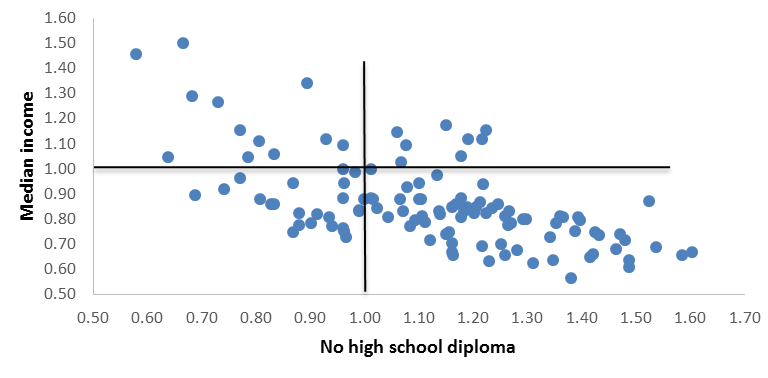
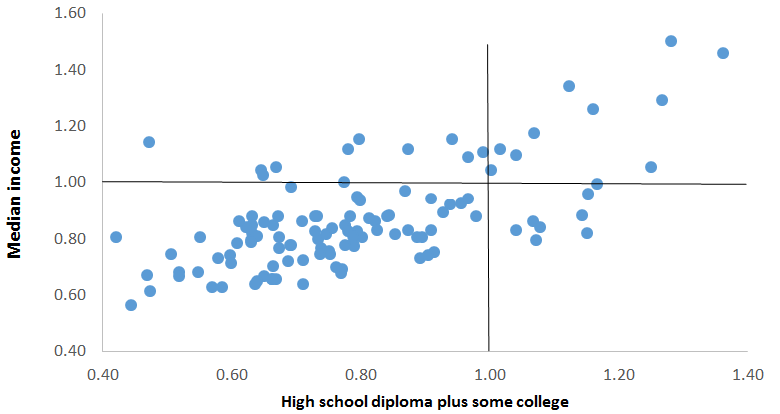
To illustrate the education–income relationship we use scatter plots, reproduced below. Each dot represents a county in Missouri. Let us explain how each county is located in the plot. Each county’s value (income or education) is measured relative to the state average. If a county’s median income is equal to the state average, its median income value in the plot is 1.0. If the county’s median income is less than the state average, its median income value is less than 1.0; if it is greater than the state average, its value is larger than 1.0. A similar technique is used to measure educational attainment across counties. The combination of a county’s relative median income and relative educational attainment value locates it on the scatter plot. If a county is just like the state average on both measures, it would be located at the intersection of the black lines. The vertical axis is county median family income relative to the state average in 2015. The horizontal axis is one of two education measures in 1990, again relative to the state average.

Two measures of educational attainment are used. In the top scatter plot, education is measured as the percent of adults with no high school diploma: In effect, someone who got no more than a high school education. In the second panel educational attainment is measured by adults in each county who graduated from high school and obtained some college. “Some college” is two or fewer years, which can occur at a four-year college, community college, or at technical school. By comparing the outcomes using these two education measures, what we are asking is whether counties that have more adults with educational beyond high school in 1990 are counties that generally have higher median family incomes in 2015. Does education matter for future income?

Comparing current median family incomes across these two educational outcomes shows that the average county with a higher proportion of adults who in 1990 did not finish high school (upper panel) is likely to have a lower median income today relative to the state. That relationship flips when education is extended to include some college (lower panel). The positive slant of the dots in the lower panel means that if in 1990 a county had a higher proportion of adults who had obtained some college training it is more likely that in 2015 median family income in that county is higher than the state average.

The relationships illustrated below support for policies aimed at raising educational attainment. Completing high school is important. It may be even more important economically to extend that preparation to include some post-high school training. At a minimum, policymakers should understand the positive long-term implications of funding post-secondary education.


Note: Each dot represents a Missouri county. The axes compare county values to the state average. If a county’s median income is equal to the state average, its median income value is 1.0. If the county’s median income is less than the state average, its median income value is less than 1.0; if it is greater than the state average, its value is larger than 1.0. A similar technique is used to measure educational attainment across counties. The combination of a county’s relative median income and relative educational attainment value locates it on the scatter plot.


Has MetroLink Spurred Development?

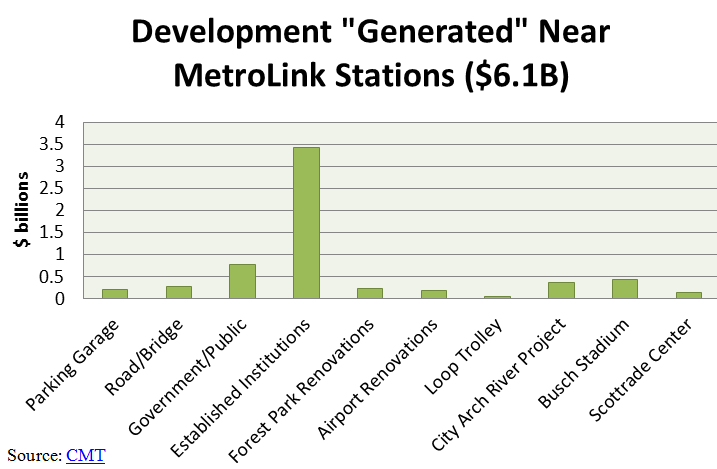
Metro, St. Louis’s transit agency, claims (p. i) MetroLink has helped spur $2.2 billion in development. However, Citizens for Modern Transit (CMT)—the region’s major transit advocacy group—thinks Metro is being far too modest. According to CMT, “transit generates growth. To date, more than $16 billion in new development has occurred within a ten minute walk of MetroLink.” Hopefully, CMT isn’t trying to imply that MetroLink is responsible for all, or even most of that development. A quick look at some of these projects will show how tenuous the connection is between MetroLink and the development that CMT cites. For example:

  • Over $440 million in road, bridge, and parking garage investments. That’s right, asphalt to drive and park your car on. (Most curious are improvements to Interstates 64 and 70.)
  • $3.4 billion in renovations and expansions of established institutions like Barnes Jewish Hospital, Washington University, Saint Louis University, and the University of Missouri–St. Louis—investments that likely would have occurred with MetroLink or without.
  • Another $785 million from government agencies and publicly funded sources—not the privately funded, mixed-use development rail advocates promise.
  • CMT even associates another transit project—the $51 million Loop Trolley—with MetroLink.

Who, besides those ideologically wedded to rail, would think MetroLink is primarily responsible for these projects?

The chart below shows other developments that CMT associates with MetroLink. Even charitably assuming a causal link between rail investments and development, much of the economic activity CMT cites is tangentially related—at best—to MetroLink. So, be wary of claims about the economic payoff from rail investments. If MetroLink was so good at driving development, its advocates wouldn’t have to cast such a wide net for evidence of its success.

Legislature Should Be Recording All of Its Public Meetings

On Tuesday the Missouri Western District Court of Appeals affirmed a lower court ruling that Progress Missouri, a liberal activist group, did not have a right to record Senate committee hearings under Missouri's Sunshine Law. That's a problem; if our elected officials are going to have blanket discretion to put the kibosh on recordings intended to keep them honest and the public informed, that luxury will come at the cost of the public interest and the public trust.

The Kansas City Star reports: 

Missouri law says a public governmental body “shall allow for the recording by audiotape, videotape, or other electronic means of any open meeting” and “may establish guidelines regarding the manner in which such recording is conducted so as to minimize disruption to the meeting.”

Senate rules give committee chairmen the discretion to allow cameras so long as they don’t disrupt the decorum of committee meetings. And the Missouri Constitution says each legislative chamber “may determine the rules of its own proceedings.”

The lawsuit by Progress Missouri says it was denied permission to record four Senate committee hearings last February and March, and on several occasions the Senate did not record the meetings either. [Emphasis mine]

As we noted two years ago, one of the key elements to ensuring good government is transparency, and while we do not agree with Progress Missouri about much, the documentation of public meetings is one issue where our positions align. Missouri law is very clear that recordings shall be allowed at public hearings, and that their regulation should ensure only that such recordings are not overly obtrusive.

The public should be able to record these hearings as they choose, but if they do not, then the Senate should be recording every public hearing they have. That the Senate is not already recording each hearing covered by the Sunshine Law itself is cause for concern, but that our elected representatives would go on to dispute the rights of private individuals to do so in their place is even more alarming. The Senate should change its recording policies to carry out the intent of the Sunshine Law: to ensure the public can see and hear what its government is doing, and why.

They Fought the Feds, and the Feds Lost!

Pop quiz time: Who said the following in response to the Obama Administration’s 2009 Race to the Top Program?

“The basic assumption of your draft regulations appears to be that top down, Washington driven standardization is best…. You are funding teaching interventions or changes to the learning environment that promise to make public education better, i.e. greater mastery of what it takes to become an effective citizen and a productive member of society. In the draft you have circulated, I sense a pervasive technocratic bias and an uncritical faith in the power of social science.”

Was it:

(A)   Then Kansas Senator (now Governor) Sam Brownback

(B)   Then Texas Governor Rick Perry

(C)   Then California Attorney General  (now Governor ) Jerry Brown

(D)   Missouri Governor Jay Nixon

If you guessed Sam Brownback, you would be wrong. It was actually Democrat Jerry Brown.  Yes, that Jerry Brown.

This quote resurfaced in an interesting piece by Matt Barnum of education website The 74 about California’s long-running opposition to federal education policy. Brown’s riposte was a harbinger of the showdown that California ultimately had with the Department of Education in 2013, when California suspended its standardized testing and school rating system. The feds said they couldn’t do it and threatened to withhold funding. Brown responded more like a Texan than a Californian and dared them to come and take it.  The feds backed down.

I think there are two interesting lessons to take away from this story (which is worth reading in full).

First, states can stand up to the federal government. It obviously helped California that it is the most populous state in the union and is one that will reliably deliver Democratic votes, but even with that said, it is clear that the federal government is loathe to pull funding that overwhelmingly benefits poor students and students with special needs. That is not to say that they wouldn’t, but states are probably in a stronger bargaining position than they realize.

Second, the issue itself matters. California picked a smart issue on which to go toe to toe with the Department of Education. Had the feds been opposing standardized tests and the states supporting them, the calculus would probably be much different. A hardline stance might not work with an issue with more divided opinion or one where the federal government has the majority opinion on its side.

I don’t know if what California is doing is right or wrong. I’m by no means a technocrat, but I think they probably swung too far in the opposite direction on testing and school accountability. That said, part of respecting local control of education is realizing that not everyone is going to make the decisions that you would have made had you been part of the process. Agree or not, we can learn from California about what states can do when they feel they have been pushed too far, and we can recognize the need for states to have a game plan in place in case they are asked (or ordered) to do things expressly against the will of their citizens.

Regarding Centene’s Outrageous Corporate Welfare Demands

For those unfamiliar with the company, St. Louis-based Centene Corporation is a managed care organization with a specialization in Medicaid. As you might suspect, providing government services can be big business, and that's helped make Centene a profitable enterprise and the largest Medicaid Managed Care Organization in the country. Centene loves Obamacare; Obamacare loves it right back.

But as it turns out, the company may be looking to get even more money from the big spenders in government—this time, from state and local officials.

Centene Corp. is seeking $147 million in taxpayer help for its proposed $771.8 million, multibuilding expansion project in downtown Clayton.

Under the company’s plan, described in a document submitted to the Missouri Development Finance Board, much of the taxpayer help would come from the city of Clayton, which over a period of years would provide nearly $95.6 million in property tax abatement on Centene’s huge downtown investment.

Centene also wants from Clayton nearly $3.2 million in personal property tax abatement and a $2.5 million commitment from a transportation development district.

The full proposal can be found here at the St. Louis Business Journal. In addition to the individual incentives described above, Centene is seeking an additional $35.7 million in state "Mega Works" tax credits, which lawmakers created three years ago by consolidating several existing (and failed) tax credit programs. At least $10 million in BUILD bonds have already been approved for the project, and if the region's track record of incentive profligacy is any indicator, the remaining tax incentives will probably to be approved without much delay.

Centene's subsidy demands may be "business as usual" in Missouri's broken tax-incentive universe. Yet, that Centene's business model is already highly reliant on extravagant public spending puts the company's latest tax incentive plan into a whole new class of corporate welfare and cronyism.

University of Missouri System Reformed Pensions in 2012. Other Plans Should Follow Suit

In 2010, a group of University of Missouri faculty and staff members from the four campuses were given a task: examine the University of Missouri’s retirement system and offer suggestions for improvement.  Though it wasn’t unanimous, the committee ultimately proposed a shift from a defined-benefit (DB) pension plan to a hybrid system which used both DB and defined-contribution (DC) components. The system followed through on the proposal and launched a new hybrid plan in 2012.

Often, people who propose reforming public employee pension systems—people like me and the scholars at the Show-Me Institute—get painted with a very negative brush. In 2013, the American Federation of Teachers listed the Show-Me Institute and two other organizations as personae non gratae for pension fund managers, suggesting that plans should disinvest from funds affiliated with the Institute. In 2015 (and at various other times), Steve Yoakum, executive director of the Public School Retirement System of Missouri, attacked SMI in a letter to retirees. He wrote, “As has become a pattern, ‘studies’ done by the Show-Me Institute and their attendant comments tend to mislead both participants and Missouri citizens and this was no exception.”

What’s interesting is that the report from the University of Missouri faculty makes many of the exact same arguments that we have made at the Show-Me Institute for years. For example, the committee noted that DB plans can provide excellent retirement security for individuals who work a full career at the university. However, few actually do this . Indeed, the report noted “that only 16% [of employees] reach 20 or more years of service.”

What the majority of the members of the committee came to realize was that the standard DB pension plan was simply too risky. The system was shouldering a burden that it could ill afford to carry. So, they suggested a change.

Pension reform is not a crazy conspiracy to rob retirees, as some might have you believe. It is simply common sense planning. It is time for other DB pension systems in Missouri to follow the University of Missouri system’s lead. 

Support Us

The work of the Show-Me Institute would not be possible without the generous support of people who are inspired by the vision of liberty and free enterprise. We hope you will join our efforts and become a Show-Me Institute sponsor.

Donate
Man on Horse Charging