Kansas City’s Convention Hotel’s Collapsing Foundation

Despite years of failing to deliver on promises of convention business, Kansas City leaders still want another convention hotel. Badly. But building a convention hotel in downtown Kansas City is apparently a bad business decision, so developers want taxpayers to subsidize the deal until it is a good investment for businesses.

So far that’s not the case. We learned from a recent story in The Kansas City Star that almost as soon as the deal was announced in May 2015, “the development team approached the city after that announcement to ask if it would consider guaranteeing bond debt on $62 million in catering revenues.” The more alarming part of the Star story, however, are the other obstacles to the deal.

·         The land the city wants to contribute to the hotel deal has a lien on it.

·         The private owner of the remaining quarter of the site has not yet reached a deal to sell.

·         The building contractor has not yet provided a construction price for the whole project.

Yet in testimony before the City Council on October 15 of last year, financier Steve Rattner said that the project was “ready to go” (starts at 2:20:28, emphasis added):

[Councilman Quinton Lucas:] Is it fatal to the project that you have a six or seven month delay?

[Steven Rattner:] We are ready to continue—every day we’re spending money to meet our obligations that we have with the city under the contract. We know we can get the financing today. We know what the cost of the project is. So we have the sources and uses. I cannot guarantee you that if we delay this six months that something will happen that will kill the project. Construction costs could go through the roof, and we don’t have that budgeted in so that could kill the project ‘cause you can’t raise enough equity. . . .

This project is ready to go now, right? And we have it under contract now. So can I say without a doubt it is going to kill the project? No. But I cannot guarantee you that the project will happen.

We learn now—a year later—that few of these things are true even now. They certainly weren’t true then. The developers don’t have the financing, they don’t know the cost of the project, they don’t have the land. The project is not ready to go now. City Manager Troy Schulte, who sat in on this hearing, should have known these things. The same is true for developer Mike Burke. Why did they not speak up to correct the record?

No one should be surprised that the convention hotel deal is viewed with such skepticism. Past promises failed to materialize, and testimony such as that quoted above only serves to further erode public trust.

TIF Requests in Affluent Areas: The Beat Goes On

If you drive by the St. Louis Galleria on any given day, you’ll find the area is a hive of activity. I’ve spent my fair share of time looping around the Galleria’s parking lot in search of a spot. Yet despite the area’s vitality, the company redeveloping a piece of property across the street from the Galleria is asking for $18.7 million from taxpayers to subsidize the cost of moving in.

This development, Phase II of The Boulevard development, was set to take place years ago, but plans were put on hold due in part to the recession. Now the land is being sold to another investor, and tax increment financing (TIF) is on the table. The Boulevard’s prime location—across the street from the Galleria and at the intersection of I-170 and I-64—is one reason for the developer’s high expectations. Another reason is the average household income of $92,581 within three miles of its location. Residents of Richmond Heights might well ask why a project with a prime location in an affluent area needs to be subsidized by taxpayers.

TIF was designed to reduce the costs of private developers investing in blighted or economically unattractive areas, but the Boulevard development is far from the first instance in which TIF has gone toward a project in an area that would hardly be considered “blighted.” A recent study on incentive use in St. Louis City found that roughly two-thirds of all property tax abatement and TIF has gone toward areas with strong housing markets.

The Boulevard development is representative of the misguided use of incentives in St. Louis during recent years. When well-off neighborhoods are asking taxpayers to subsidize their investments and truly blighted regions are being ignored, it may be time to reevaluate our spending priorities.  

Could KC Streetcar Expansion Drain Regional Resources?

What could make the tax bills Kansas Citians might have to pay for an expanded streetcar system any worse? The opportunity cost of the quarter-billion-dollar project. 

Revenue Source Amount (2019 $)
Bonds (backed by TDD taxes) $129,500,000
Federal Grant $100,000,000
STP/CMAQ Grant $14,500,000
TOTAL REVENUE $244,000,000
     
Capital Costs  Amount (2019 $)
Construction $227,150,000
Contingency $16,850,000
TOTAL COSTS $244,000,000

The table above shows the projected revenue sources and costs of the proposed streetcar expansion. Note two things: (1) The expansion is over 20% more expensive per mile than the existing 2.2-mile downtown line; and (2) $14.5M of the required revenue would come from Surface Transportation/Congestion Mitigation–Air Quality (STP/CMAQ) funds.

STP/CMAQ grants are federal dollars allocated throughout the region by the Mid-America Regional Council (MARC), a consortium of government officials. These funds are used to build streets, bridges, trails, and other transportation projects. Jurisdictions from Platte to Cass counties rely on these funds to meet their basic infrastructure needs.  

By targeting these funds, streetcar advocates are asking that the streetcar be given higher priority than other regional projects—much higher priority. During the next two-year STP/CMAQ funding period, roughly $42M in funds will be available. So the $14.5M grant that rail advocates are after could gobble up more than a third of the total funds. As a result, other regional priorities could wait years until funding becomes available again. The request for STP/CMAQ funds also demonstrates that rail proponents are trying to offload even more of the cost of their expensive project on taxpayers far outside city limits. (Note the $100M federal grant listed among the revenue sources.)

Rail advocates might reply that even if a grant is awarded to expand the streetcar, funds would still be available for other projects. While it’s true that some funds might still be available, this response overlooks the opportunity cost of funding the extension, not to mention the opportunity costs already incurred for the downtown line. In 2013, the downtown line received an unprecedented $17.3M in STP/CMAQ funds. The streetcar has already pushed projects to the back of the line before—why should it do so again?   

So while rail advocates seek out another multi-million-dollar grant, public officials should ask themselves: Is the streetcar project the best use of regional funds?  

Another Misguided Legal Attack on School Choice

Here at the Show-Me Institute, we talk a lot about barriers to education reform and school choice. Last legislative session, the Missouri Senate was unable to pass a tax credit scholarship program before the session ended. In Florida, challenges to their school choice programs are taking place in the courts.

 A lawsuit before the Florida Supreme Court potentially could oust over 92,000 students from private schools across the state. Despite lower court rulings that the plaintiffs had no legal standing, the Florida Education Association (FEA) continues to challenge Florida’s Tax Credit Scholarship (FTC) program run by Step Up for Students.

 FEA, Florida’s largest teachers union, and other groups filed the lawsuit claiming the program takes funding away from public schools and violates the state constitution by giving taxpayer money to religious schools. The district court ruled that the plaintiffs could not prove they had been harmed by the program because the FTC program concerns the state’s taxing power and not its appropriations.

 Step Up for Students, a state-approved non-profit organization, handed out nearly 100,000 scholarships for the 2016–2017 schoolyear. Along with administering the Gardiner Scholarship, which helped Malachi Kuhn and 5,843 other special needs students, Step Up for Students provided scholarships for a record 92,011 low-income students this year to attend private schools.  

 While the Gardiner Scholarship is funded from Florida’s state appropriations, the FTC program is completely funded by private donations. This tax credit, established in 2002, allows corporations to receive a dollar-for-dollar tax credit for their donations to Step Up for Students. 

 The result? $2.2 billion donated and 572,237 scholarships funded in the past 14 years.

 While remaining optimistic, parents are getting ready to defend the program and the educational opportunity it creates for their children. For low-income families, the FTC program provides an alternative to the public schools that are in many cases failing to offer quality education.

 How does Florida’s FTC program relate to school choice in Missouri? If the Florida Supreme Court upholds the FTC program as constitutional, that ruling could bolster the case for any similar program in Missouri against possible constitutional challenges, opening the door of opportunity for tens of thousands of Missouri students. This summer, Marty Lueken and Mike McShane released an essay estimating that a tax credit-funded scholarship program in Missouri could provide over 12,000 scholarships and, contrary to the claims of groups like FEA, save the state and local districts around $8.3 million per year.

 The FTC program has made a tremendous impact on low-income and minority communities in Florida. Hopefully the program will be upheld in court and school choice programs will continue to spread throughout the nation. 

Entrepreneurship in Missouri, Part 2: Where Is the Job Growth?

A week ago I wrote of the decline of entrepreneurial activity in the nation, Missouri, Kansas City, MO, and Saint Louis, MO. The share of workers in firms aged five years or less has steadily dropped in the U.S. and Missouri. However, the rate in Missouri has fallen faster than the national average since 2001.

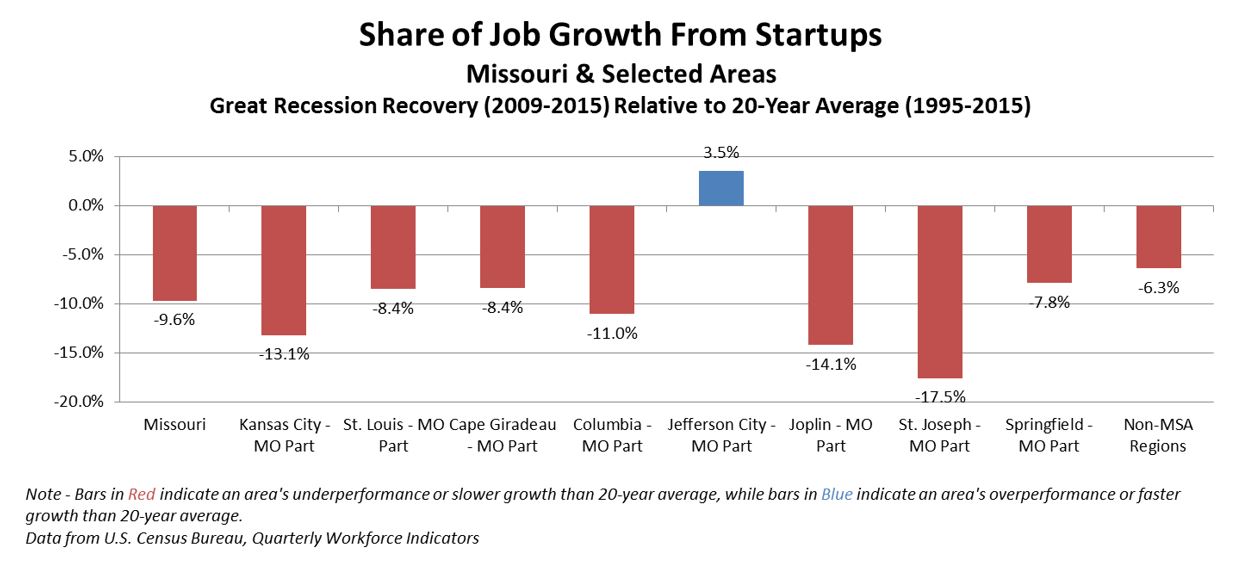
Why are there a smaller percentage of workers in startups, considering the state is at a new record high level for the number of non-farm jobs? Data suggest that Missouri startups are taking less of that job growth pie than they did before. Since 1995 to 2015, job growth from startups was near 72% of all job growth in the state of Missouri. If we look at this 20-year performance as a “normal” share of job growth from startups, then seeing a startup share at 62.5% should come as a disappointment. Of course, growing shares of workers in large, established firms can also spur growth. However, there are specific advantages that startups bring to a region that can be more difficult for established firms to provide. For example, research has shown that increased prevalence of startups can bring more innovation through increased competition (pp. 2–3) , allow for better adoption of new information, can create new industries (pp. 328–330), and improve labor productivity.  The graph below lists the share of startup job growth of Missouri, its metropolitan statistical areas (MSAs), and non-MSA portion relative to its 20-year average.

From the graph, we observe that Missouri currently runs below its 20-year average by more than 9 percentage points. Unfortunately, this statewide drop comes from underperformance in nearly every population center; with strongest losses coming from Kansas City, Joplin, and Saint Joseph. 

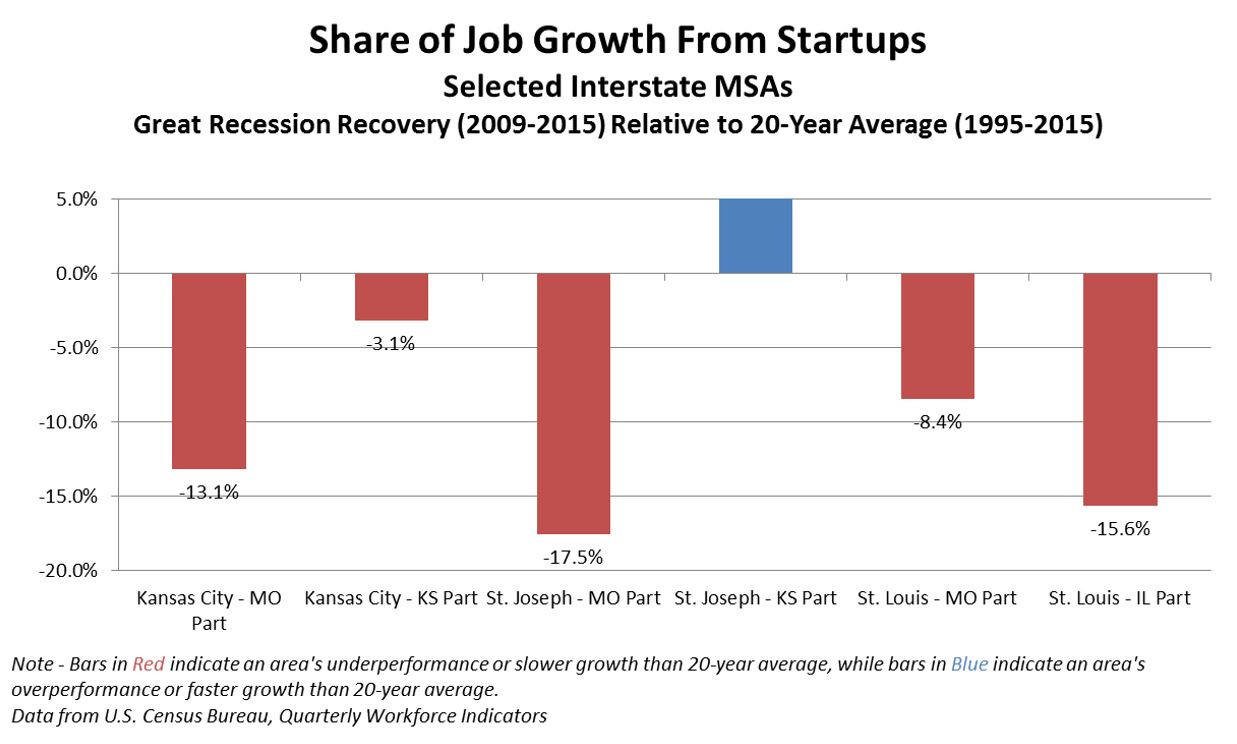
Interestingly, two of those three MSAs include areas in both Missouri and Kansas, a state that improved its tax climate by lowering individual income taxes by 30% for its residents and eliminating income taxes for personal businesses. The Saint Louis metro area shares a border with Illinois, a state suffering from population loss and which hiked corporate income taxe levels from 2011 to 2015 to more than 3 percentage points above Missouri’s.  A look at the Kansas side of the KC Area shows that it also underperformed its long-run growth, albeit by a smaller margin. In the Saint Joseph area, the Kansas side is currently exceeding its long-run trend and is seeing exceptional growth. There is good news however; the Missouri side of the Saint Louis area is outperforming the Illinois side.

What factors entice entrepreneurs to move or start their business in a new area? Could it be overall migration flows, or how cheap it is in an area to start and grow a business? Part 3 of my “Entrepreneurship in Missouri” will review a study published by the Brookings Institution that may shed some light on reasons as to why entrepreneurship is falling. 

How Can Schools Raise Property Taxes Without Voter Approval?

Last month, school districts throughout the state set their tax levies for this school year. I suspect most people believe that taxpayers vote to approve a certain property tax rate, and that the rate just stays the same until they vote to change it again. In reality, it’s a bit more complicated.  For example, the Eldon School District will be increasing the property tax levy by two cents this year; while the School of the Osage’s tax levy will increase 11 cents. Both of these increases were possible without voter approval—kind of.

When you vote to raise your local property tax for schools, you are essentially voting to raise the district’s property tax ceiling. This is the maximum rate the district can use to collect local revenue for schools.  The district may be forced, however, to lower the rate during times of economic growth thanks to the Hancock Amendment in Missouri’s Constitution.  Basically, school district revenues collected from existing real property cannot increase beyond the rate of inflation.  If an increase in taxable property values outstrips the pace of inflation, the district rolls back the property tax rate.

Rollbacks create a gap between the tax rate ceiling and the tax rate used by the school district. Thus when districts have space under the cap and their property values are flat, the school board can choose to raise the rate without voter approval because the voters have previously given approval.

Despite the tax rate increases this year in Eldon and School of the Osage, each district will remain under its tax rate ceiling.  Moreover, each school district’s tax rate will remain below the state average. In Eldon, the rate was $3.54 per $100 of assessed valuation in 2015; it was $2.849 for the School of the Osage.  The state average tax rate for operating and capital expenses was over $4.

School funding is complicated, but we are here to help. If you want to know more about how schools are funded in Missouri, check out our Funding Formula Primer. And, if you have questions don’t hesitate to contact us.

Out with Football, in with Fútbol?

With the Rams on the West Coast, many Saint Louisans have shifted their attention to other sports. The Blues had a spectacular season this past year (though it ended a few games earlier than I had hoped), but not everyone thinks that hockey and baseball alone can fill the void. MLS2STL is working to attract a Major League Soccer (MLS) team to the region in 2020, and while a new stadium may be built in hopes of securing a team, research tells us that such expenses rarely pay off. 
 
An estimated 20 acres would be needed for construction, and the search for locations has been narrowed to three places, including one just west of Union Station. It might be more cost-effective to use the now-dormant Edward Jones Dome than to build a new stadium, but soccer-specific stadiums are becoming the norm, so the odds of re-purposing the Ram’s old home don’t look good. 
 
I should note that MLS has not committed to bringing a team into Saint Louis yet, so we shouldn’t get ahead of ourselves. But in any case, the overwhelming majority of research shows that sports stadiums do not generate significant economic growth and the revenues they bring in are insufficient to justify the use of public funds. 
 
Of course, there is much more to having a team than just turning a profit. People take pride in having a team put their city on the map, and rallying behind a successful enterprise can be a fantastic experience. Saint Louis has a soccer fan base that will be understandably excited if the MLS decides to expand here. but as to how a new stadium should be funded, the research speaks for itself. 
Support Us

The work of the Show-Me Institute would not be possible without the generous support of people who are inspired by the vision of liberty and free enterprise. We hope you will join our efforts and become a Show-Me Institute sponsor.

Donate
Man on Horse Charging