Outsourcing Public Education

We ask a lot of our public schools. We ask that they not only educate children, but also transport them and feed them. Many provide before- or after-school care for students. We expect schools to serve students regardless of their learning needs. They must maintain buildings, parking lots, and playing fields. When a teacher is sick, they have to find temporary staff to fill the gap.

Many public schools are unable to do all of this. To meet the needs of students, they often—to borrow a word from the business world—“outsource” jobs. Just like your paycheck gets printed by an outside company or your office is cleaned by an independent janitorial service, schools often hire a private company to manage the district’s bus services, to provide before- and after-school care, to cook children’s meals at lunch time, and to clean the buildings. Schools contract with outside healthcare professionals or private schools to meet the needs of students with special needs. A district can even contract with an outside management firm to run the school if they want. Some schools are even outsourcing who teaches your children, at least when they have a substitute teacher.

Filling all of the vacant classrooms when teachers are absent can be a challenge for school district officials. Some districts hire full-time aides who act as floating subs, filling in here and there as needed. Others employ a cadre of retired teachers, individuals looking to gain experience in the profession, or others simply looking for part-time work. The process of recruiting, hiring, and placing substitute teachers can be cumbersome. Rather than hire an assistant superintendent or other central office staff member to take on this responsibility, some schools have begun outsourcing this job to a private company.

In Saint Louis, for example, Kelly Educational Staffing provides this much-needed service to several school districts. As Dale Singer of St. Louis Public Radio reports, the privatization of substitute teachers has been a success. In Normandy, a district that has had many struggles in the past few years, “the rate of filling classrooms with substitutes had been in the 55–60 percent range”; with Kelly, “that figure rose to around 90 percent.”

Time and again we see benefits from outsourcing public services to private companies. Yet, many fail to see how private school choice programs, such as vouchers or tax credit scholarships, could yield the same benefits. Indeed, the same principles apply to both situations.

When a public school chooses to outsource services, they make a voluntary decision. Companies compete for their business and district administrators choose the company that they believe will best meet their specific needs. If the company fails to perform, the representatives of the school district can choose to take their business elsewhere. The same can be said for school choice. When parents have options, they are able to choose the school that will meet their needs. That’s the beautiful thing about a market—it allows people to voluntarily get the services they need.

We should celebrate when public schools find a way to better deliver public education by collaborating with the private sector. Similarly, we should celebrate when parents are given the ability to choose their child’s school.

While Missouri currently allows public schools to outsource just about everything, it does not extend that opportunity to parents. It is time for that to change. Parents should be given the opportunity, through vouchers or tax credit scholarships, to enter into the educational marketplace and contract with the school that is going to best meet their child’s needs. 

Tax Credit Scholarships Can Help Kids and Save Money

Today we’re releasing a paper I co-authored with Marty Leuken, Director of Fiscal Policy and Analysis at the Friedman Foundation for Educational Choice. The paper estimates the fiscal impact of a hypothetical $50 million tuition tax credit scholarship program in the state of Missouri.

We’ve been talking about scholarship tax credits here at the Show-Me Institute for some time now, but for those who might be new to the topic, such a program would give a tax credit to individuals or organizations that donate to a nonprofit that grants scholarships to K-12 students. That is to say that (with a 100% credit) if you owe the state of Missouri $1000 but you donate $1000 to a scholarship-granting organization, you would pay zero in state taxes. There are currently 21 tax credit scholarship programs in 17 states across the country educating almost 225,000 students.

We estimate a variety of results based on different assumptions about how many students might participate and how many scholarships would be offered, but the long and the short of it is that most likely such a program would save states and districts money.

How is this possible? It is actually pretty straightforward. As long as the value of the scholarship that students receive is less than what the state currently spends per student, the state will come out ahead. Given the structure and uptake rates of similar programs around the country, this is the most likely scenario for Missouri. Additionally, while districts would receive less funding from the state if children leave public schools to take advantage of scholarship opportunities, districts will also have fewer students to educate, which has the opportunity to have more money, per pupil, remain in district coffers.

Scholarship tax credits are controversial, but they really shouldn’t be. Structured appropriately, they can give students better options and save money at the same time. Families win, schools win, taxpayers win. It’s a slam dunk.

Missouri Drops in CNBC Ranking

CNBC has just released its annual ranking of America’s top states in which to do business.

After comparing more than 60 measures across states, all from publicly available data, CNBC put Missouri at a mediocre 31st in 2016. This is down five notches from its 2015 position of 26th. (Utah gained the top spot; a complete listing is available at http://www.cnbc.com/2016/07/12/americas-top-states-for-business-2016-the-list-and-ranking.html.)

Where a state lands in CNBC’s annual ranking may not be that important. But if that state is headed in the wrong direction or seems mired in the lower tiers, that could well signal that something is amiss. The table below reports Missouri’s overall rankings in the CNBC study since 2012. In all five years Missouri has had a middling outcome, though its 2016 showing is the worst. And the last three years show a downward trend.

The table also shows the areas where Missouri did its best and worst since 2012. The state has done well in the areas of “cost of doing business” and “infrastructure.” The former category looks at a state’s tax climate and government incentives to lower costs of doing business. This is a double-edged sword: Providing companies with corporate welfare may lower costs of doing business but it also impairs market forces. Infrastructure focuses on transportation: lower commuting times, the value of shipments by air, water and land, and the quality of roads and bridges improve a state’s score in this category.

On the negative side, Missouri often ranked nearly dead last when it comes to “work force” and “quality of life.” Workforce captures the education of the workforce, the ability to retain and attract workers, and workforce productivity. Quality of life encompasses factors like crime rates, quality of health care, and overall population health. While some measures included in quality of life are based on subjective survey responses (e.g., local attractions) most of this category gets to the idea that when businesses plan to relocate, there are noneconomic aspects at work.

Even though state boosters may discount CNBC’s ranking, consider the fact that three of Missouri’s neighbors—Iowa, Kansas, and Nebraska—attained a higher overall rank than Missouri every year since 2012. Suppose their promoters will use this information to our disadvantage?

Missouri’s Ranking in CNBC’s Top States for Business

 Year

Overall rank

Highest rank

Area

Lowest rank

Area

 2016

31

9

 Infrastructure

49

 Workforce;  quality of life

 2015

26

11

 Cost of doing business

47

 Quality of life

 2014

23

11

 Cost of doing business

48

 Quality of life

 2013

26

5

 Infrastructure

48

 Workforce

 2012

27

12

 Cost of doing business

38

 Workforce


It Could Be Worse. Not Much Worse, but It Could Be Worse.

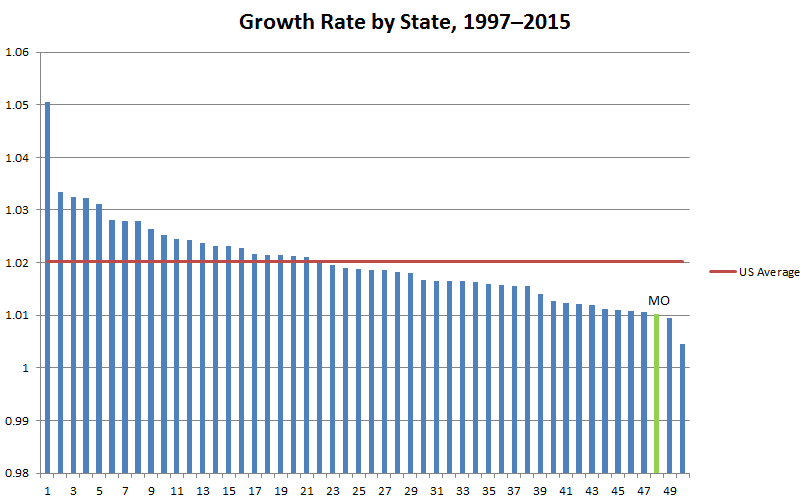
The Bureau of Economic Analysis recently released data on real GDP for all 50 states. Since Missouri’s growth in recent years has been nothing short of dismal—it was the 49th-fastest-growing state for the period 1997 through 2014—I thought it would be worthwhile to review the most up-to-date data for clues about what’s going wrong, and how it might be fixed.

The chart below plots the average annual growth rate for each of the 50 states and for the United States as whole for the period 1997 through 2015. The good news is that Missouri’s average annual growth rate increased from 0.93 percent when computed over the 1997 through 2014 period to 1.02 percent when computed over the 1997 through 2015 period. Missouri reported a 1.29 percent growth rate in its real GDP between 2014 and 2015. No one really jumps for joy when growth rates are reported at 1.3 percent for a year; however, Missouri did manage to stagger its way one rung up the ladder, from 49th-fastest to 48th-fastest growing state economy over the period from 1997 through 2015.

Overall, the story for Missouri is little changed compared to a year ago. Since the late 1990s, Missouri’s economy has increased at half the rate of that of the United States as a whole. Eighteen years is not a terribly long time, and we all hope that Missouri’s future will be brighter. But the question remains: Why has the Missouri economy reported such slow growth over the past eighteen years?

The answer is not simple. Note that the ten fastest growing states are: North Dakota, Texas, South Dakota, Oregon, Utah, Colorado, California, Idaho, Arizona, and Oklahoma. There is no one clear feature shared by these ten states that can account for their economic success. Some of them do have natural resources and have benefitted from being able to dig a hole in the ground and extract things that are valuable to the rest of the world. But that is not the only explanation. For example, Arizona, Idaho, Oregon, and Utah (at least) do not fit the oil/natural gas story. Alternatively, the ten states with the lowest growth rates are Michigan, Louisiana, Missouri, Mississippi, West Virginia, Maine, Ohio, Kentucky, Illinois, and New Jersey. No single attribute these states might have in common would account for their struggles, either.

Income tax rates cannot, alone, explain the differences in growth rates. The nine states with no earned income taxes (followed by rankings) are: Alaska (40), Florida (20), Nevada (16), New Hampshire (25), South Dakota (3), Tennessee (30), Texas (2), Washington (13), and Wyoming (11). The nine states with the highest marginal income tax rates (followed by rankings) are: California (7), Hawaii (37), Oregon (4), Minnesota (17), Iowa (23), New Jersey (42), Vermont (26), New York (29), and Maine (46). The mean rank for the nine states with no income taxes is 17.8 while the mean rank for the nine states with the highest income tax rates is 25.7.

Overall, the evidence does not prove, but does suggest, that income tax rates do matter for economic growth. Of course, a host of other factors matter as well. In order to assess the role of income tax rates on growth, the ideal test would involve holding everything else constant. In other words, you would want to examine a parallel version of New Jersey, for example, but one with a lower income tax rate. Holding everything else constant, economic theory suggests that New Jersey would grow faster.

The broader message is that lots of factors that influence a state’s economic growth rate. Each state is an experiment in which tax rates, school quality, and various government services are provided endogenously by state policymakers. The bundle of policies and regulations is too large and complicated for us to identify how each one matters. And on top of the political attributes, there are the things that lie underground, or on the ground itself (or the ocean front—or lack thereof), that people living in each state can consume. All policymakers can do is to try and manage the factors they can influence in a way that will help their state grow faster.

In case you are wondering, Kansas ranked as the 29th-fastest-growing state over this period. So, why can’t Missouri grow at least as fast as its neighbor? It’s a frustrating question, because we have a Gordian knot of regulations, laws, and policies that make it difficult to determine specific causes of our stagnation. Not only have policymakers failed to move Missouri in the right direction in the 21st century, but the complexity of our state’s problems prevents us from understanding why various initiatives have failed to produce their intended results. In my view, it seems like a good time for Missouri to review its entire spectrum of policies. For instance, we have not had a constitutional convention in this state since 1947. Maybe it is time for an institutional overhaul.

Kansas City Losing Downtown Millennials

All the money Kansas City is pouring into downtown doesn’t seem to be working. At least, when it comes to attracting young, tech-savvy millennials, there appears to be no appreciable success.

The city spends (or diverts) millions each year on streetcars, apartment buildings and luxury condos, and entertainment districts in a breathless effort to attract millennials. Initially there was some evidence to suggest this was working. Data from 2000 and 2012 showed that although city-wide Kansas City was not attracting those aged 25 to 34 on pace with national average, the downtown area was doing okay.

But that may be changing. A new report from CBRE Research, “2016 Scoring Tech Talent,” shows that from 2009 through 2014, Kansas City’s population of millennials ages 20 to 29 living downtown dropped 5.3%. St. Louis saw a drop of 3.5%; the national average was an increase of 3.1%. This is despite findings that Kansas City is very competitive on wage and rent obligations for tech firms, rents per square foot for offices and apartments, and the rent-to-wage ratio.

Add this to our recent finding that market values along the streetcar Transportation Development District are lower today than they were in 2012, and the city’s downtown policies aren’t looking so smart. What makes this worse is that the dollars being spent to lure millennials are coming at the cost of money to schools, libraries, basic services, and infrastructure.

Fall Internships

The Show-Me Institute is pleased to offer internship opportunities for Fall 2016.

  • Internships are open to current undergraduate and graduate students, as well as recent graduates.
  • Internships last approximately four to five months. The exact starting and ending dates are flexible, but we anticipate that each internship will run from September 6 until December 16.
  • Fall interns will work a part- or full-time schedule (9 a.m. to 5 p.m.).
  • Interns will be involved in many aspects of the Institute’s operations and will work closely with senior staff on a wide variety of projects. They can expect greater responsibility and personal attention than they would receive at larger organizations.
  • Interns will assist staff members with a range of tasks that may include researching public policy topics, organizing events, and writing and editing op-eds, newsletters, studies, and other documents. Some administrative and clerical work also will be required.
  • Policy internships as well as communications and development internships are available.
  • A Show-Me Institute internship is an excellent opportunity to improve your research and writing skills. Each intern will produce regular blog posts and an op-ed on a public policy topic of interest to him or her. Each intern will receive feedback and assistance from SMI staff members throughout the process.
  • Internships are available at the office in St. Louis or Kansas City.
  • Interns will be paid on an hourly basis.

Those wishing to be considered for an internship should submit an application and the requested supporting materials. The deadline for applications is August 12, 2016. However, we will begin conducting interviews as applications are received. Applicants can expect a decision in mid- to late August.

Rolla Considers TIF Plan

In January, the Phelps County TIF Commission began a series of public hearings to foster discussion about bringing the Westside Marketplace Redevelopment Project to life in Rolla—with $22 million in public tax incentives, of course. In May the TIF Commission approved the proposal despite public opposition. The proposal will next go to the Phelps County Commission for final approval.

Proponents say the development will raise property values and increase sales tax revenue in Rolla through the construction of a Menards and four smaller retail stores yet to be named. But while new shopping options could be exciting for local residents, the financial impacts might not be.

Missouri law requires any developer asking for TIF to show that the project wouldn’t be undertaken without financial assistance. In the case of the Westside Marketplace proposal, justifications for the subsidies include inadequate street access, an old barn that may be unsanitary, and (here’s the real kicker) a portion of the TIF area being classified as a Special Flood Hazard Area with a 26% chance of flooding in the next 30 years.

Flood risks aside, the location is ideal from a commercial standpoint with Kings Highway steering in plenty of traffic. Still, if the potential for flooding is enough to make the developer reluctant, maybe it should make taxpayers think twice as well.

In addition to depriving the county of tax revenue, subsidizing a Menards that will compete with other home improvement stores is unfair. Stores such as Lowe’s and Meek’s that already operate in Rolla without subsidies will lose business to Menards, and the local community will lose tax revenue from any reallocated spending. This selection of winners and losers shouldn’t fall under government jurisdiction—something the Phelps County Commission should take into account when deciding if this TIF is worth the risks that come with it.

Progress on TIF Reform

Last Wednesday, Governor Jay Nixon signed into law HB 1434, a measure that—effective August 28—could deal a blow to Missouri’s game of corporate welfare.  History shows that in the Show-Me State, subsidies such as tax increment financing (TIF) are granted to just about anyone who asks. This is thanks to the choice currently facing city councils regarding subsidization:

1.       Offer TIF in order to attract a business into your municipality and grow, or

2.       Say no to subsidizing a business, watch a neighboring municipality say yes, and then suffer as your economic growth is shifted into a neighboring city

This race to the bottom among neighboring communities has created an environment where municipalities feel obliged to hand over corporate subsidies, but the grass is looking greener around St. Louis.

In the past, even if a county government determined that a TIF development might be damaging to the region, an individual municipality within the county could easily override the veto with a two-thirds vote, essentially leaving the county voiceless on developments that impacted it.  Under the new law, if a municipality chooses to override, it will only be allowed to use tax incentives to finance the costs of demolition and clearing land.  Starting in August, affected counties will be able to significantly limit funds going toward developments that aren’t in the wider region’s best interest. 

TIF was originally developed to assist areas that were struggling economically—areas that would otherwise have difficulty attracting investment.  Sadly, this has not been the trend in recent years.  With the threat of big businesses relocating to tax-friendly municipalities, TIF has instead been used to attract well-connected businesses to areas where development might well have occurred without any subsidies.  The new TIF law will not restrict development subsidies unless the overarching county determines that a project will be damaging to the region as a whole.  It’s a much healthier approach to decision making than pitting one municipality against another. 

TIF reform has been discussed for many years at the Show-Me Institute, and the new law  is a win for Missouri’s economic well-being.  There are other reforms that should be discussed, such as applying checks and balances to the rest of Missouri (the override limitation only pertains to Saint Louis, Saint Charles, and  Jefferson counties), but limiting the powers that municipalities abuse to the detriment of their counties is a step in the right direction.

Support Us

The work of the Show-Me Institute would not be possible without the generous support of people who are inspired by the vision of liberty and free enterprise. We hope you will join our efforts and become a Show-Me Institute sponsor.

Donate
Man on Horse Charging