How Low Can We Go?

No, this isn’t about the Presidential election. It’s about the Missouri economy’s lack of economic vitality. And what I will show is that the lack of vitality is not a recent development.

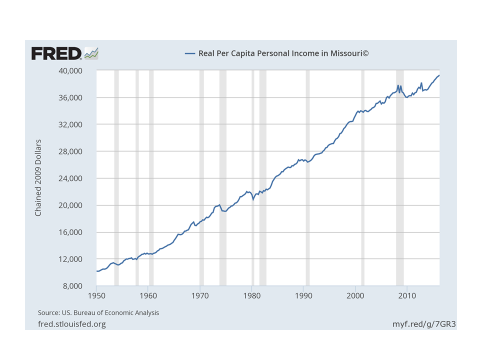
The two charts below tell the story. The first chart shows real personal income per capita (hereafter income), measured in 2009 dollars, for Missouri since 1950. In that year income stood at $10,168. By 2015 it had risen to $38,612. That almost-fourfold increase means that individuals today are, on average, much better off than they were in 1950. That’s the good news.

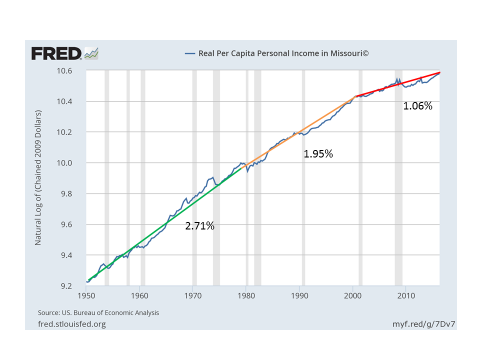
The second chart uses the same data, this time shown using a log scale for income. That means we can look at the slope of the line to better see how fast income has been growing over time. I have picked out what look to me like three fairly distinct stages of decline. The first runs from 1950 through 1979, and is highlighted with a green line. During these three decades Missouri income increased at an annual average rate of about 2.7 percent. The next period runs from 1980 through 1999 and is delineated by the amber line. During this period income in Missouri grew at an average annual rate of less than 2 percent, a notable drop from the previous period. The final stage, shown by the red line, is the period since 1999. So far in this century, income in Missouri has increased at an average rate of just slightly more than 1 percent per year. Income in Missouri today is increasing at about a third of the pace that it did 40 years ago.

If you are not used to thinking about growth rates of income, you might think that such changes are not really important. But they are, and some context shows why.

The slower the growth rate, the longer it takes for income to double. For the first period, that growth rate implies that income would double approximately every 26 years; for the second period the time to double increases to every 37 years; and the current growth rate means that it would take 68 years for income to double. The slower income growth means that it will take much longer for Missourians’ standard of living to increase.

Another way to think about what these growth numbers imply is to ask “What would income be today if the growth slowdown had not occurred?” Recall that income in 2015 was $38,612. Starting with the level of income in 1979, if Missouri's economy had continued to grow as fast as it had from 1950 to 1979, income today would be over $57,000. Or, suppose we use the 1999 level of income, which was $32,524, and ask what it would be in 2015 if income had increased at its slower 1980–1999 rate. The answer is about $44,300. In either case, income today would be appreciably higher that what it has turned out to be. Slower economic growth translates into lower standards of living.

The upshot is that ever-increasing layers of regulations that have impeded business formation, an increasingly complex tax structure that reduced incentives to work or expand businesses and, perhaps most important, a dysfunctional educational system all help explain Missouri’s slowing rate of income growth. If we continue down a current policy path that perpetuates this dismal performance, we will sentence future generations—at least those that choose to stay—to ever-diminishing standards of living.
Come Together, Right Now, on Charter Schools

When the editorial boards of the  Washington Post and the Gray Lady, as well as opinion pieces in National Review, Reason Magazine, and the St. Louis Post-Dispatch all agree on supporting an issue, you know they’re probably on to something.

What is that issue, you ask? Is it that puppies are cute? That apple pie is delicious? That Ken Bone is the hero we desperately need?

Nope, its Charter schools. Specifically that charter schools help low income and minority children.

The research literature is unambiguous. While suburban and rural charter schools are often statistically indistinguishable from their neighboring traditional public schools, urban charter schools consistently demonstrate significant positive results for their students. Yes, there is a distribution, with some performing far better than others. No, they cannot single-handedly solve every social ill of inner-city communities. But on average and in aggregate, they provide a better education for students than those children would have without charter schools in the mix.

This is why lawsuits trying to stop charter schools are bad for poor kids. This is why limiting charter schools to within the boundaries of the Kansas City and St. Louis school districts is short sighted. This is why major advocacy organizations for African-Americans taking stances against them is potentially harmful.

In a time of deep division, charter schools are an issue where we can come together. Let’s get to it.

Public Pensions Hadn’t Planned for This

The last thing a soon-to-retire worker wants to hear is that his retirement plan is in financial trouble.  And the last thing taxpayers want to hear is that they have to make up for any losses.

Last week Missouri’s State Auditor found that, as of plan year 2015, the City of Bridgeton’s Employee Retirement Plan was only 67% funded and had unfunded liabilities of nearly $14 million.  Bridgeton’s defined benefit (DB) plan was retired in 2012, but insufficient contributions from the city and lower-than-expected investment returns coincided with a lack of government oversight (the Finance Commission did not hold a single meeting from 2012–2014) to create the perfect storm.  The plan’s current funding trajectory apparently leaves Bridgeton with two options: reduce payments to retirees, or put future taxpayers on the hook for the $14 million gap. 

Mayor Terry Briggs spoke of the funding crisis, saying “If you were guaranteed that pension, you’re going to get that pension.  We will have to scrape and come up with other means which may be . . . to contribute more money into it.…”  Defined benefit (DB) plans typically guarantee monthly payments for life, so any financial risk falls upon taxpayers.  In Bridgton’s case there may be no legal obligation to pay benefits if the plan’s funds are insufficient, but a recent local hotel tax increase indicates that Bridgeton policymakers acknowledge their obligation to retirees.

Bridgeton is not the only city that has been confronted with unfunded liabilities.  The Pew Charitable Trusts has valued the shortfall between promised pension benefits and available funding at nearly 1 trillion dollars nationwide. 

One alternative that avoids any possibility of incurring this funding gap is a defined contribution (DC) plan.  In a DC plan—think 401(k)—benefits are not paid out indefinitely to retiring employees. Instead, contributions are invested during an employee’s career; upon retirement the funds are made available to the employee.

DC plans can protect municipalities and future taxpayers from devastating budget shortfalls, and protect retirees from the possible bankruptcy of municipalities. Bridgeton moved to a DC plan in 2012 to curtail the growth of its potential liability; other cities in Missouri should consider doing the same.  

Missouri and the Lukewarm, Tepid, So-So, Unexceptional Personal Income Growth

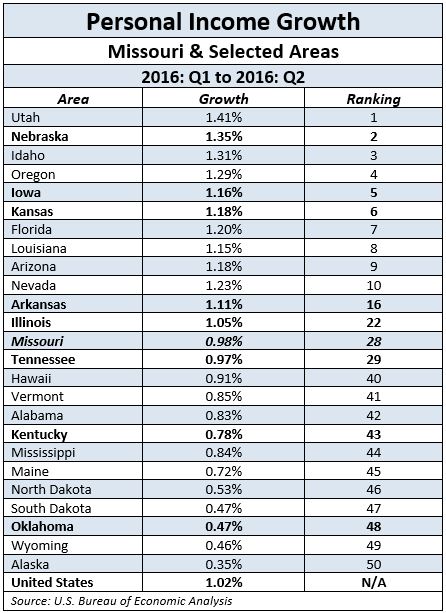
For the state of Missouri, every quarter seems to be an unremarkable quarter of personal income growth. And this latest quarter was just as plain-vanilla. U.S. Bureau of Economic Analysis (BEA) just released personal income growth estimates for the second quarter of 2016 and Missouri was middle of the road with a pedestrian 0.98% growth over last quarter. Missouri’s growth rate was just below that of the nation as a whole, and we ranked 28th out of the 50 states.

If you have a high-skill occupation, you’re probably doing better than the BEA data indicate at first glance. The largest contributor to growth came from professional, scientific, and technical jobs; management of companies; and health care and social assistance jobs. On the other hand, moderate- to low skilled jobs showed little or no growth (see Table 3a and Table 3b on the “Tables Only” link here). While it is understandable that every state can have an unimpressive quarter, those with a vested interest in the state’s economic environment shouldn’t be satisfied with a consistent mediocre performance.

The TIF Tax

On the November ballot, many Clay, Jackson, and Platte County residents will be asked to increase their property tax levy by 8 cents to support the Mid-Continent Library system. We calculate that passage would result in an increase as high as $10 million per year. These counties already have high property taxes according to the Brookings Institution, so a further increase is worthy of examination.

The Mid-Continent Library system spends just short of $44 million each year. As far as we at the Show-Me Institute can tell, they appear to be managing their budgets well. The library itself makes an additional point:

In addition, tax incentives and abatements by local government have impacted the revenue that would generally result from the growth of the Library’s tax base. The Library’s budget has been essentially flat for the past 8 years.

It appears that the cost of those tax incentives and abatements given to private developers—which we’ve discussed elsewhere–amounts to about $7 million a year in lost income to the library. The levy will replace that lost income.

We don’t have a view on whether voters should approve the levy increase, but it is clear that municipal handouts to wealthy corporations such as Cerner and Burns & McDonnell are not free. (To add insult to injury, these same corporations won’t have to pay this increased rate, either.) A levy increase such as this, which seeks to recoup diverted funds, can rightly be described as a TIF tax.

Free to Ride and Free to Earn

I recently spoke to an Uber driver who was arrested and booked for dropping a customer off at Lambert International Airport.  Unfortunately, more Uber drivers may suffer the same fate in the near future, and ridesharing could come to a screeching halt in St. Louis.

A forthcoming decision from a St. Louis County Court could restrict the ridesharing company Uber from operating in the region. The Metropolitan Taxi Commission (MTC) is seeking a restraining order against Uber, and Uber claims the MTC has breached anti-trust law. A decision could be issued this month.    

In short, the MTC is trying to stifle competition. Firms like Uber and Lyft provide innovative services consumers overwhelmingly prefer to traditional taxis. In an effort to save their own skins, taxi companies are trying to impose on ridesharing firms the same outdated, burdensome regulations they comply with (rather than push for a reform of current regulations).

But the MTC and taxi companies aren’t alone. Some commentators claim firms like Uber (and others in the so-called ‘gig economy’) are bad for consumers and workers alike, threatening not just public safety, but also the financial well-being of ordinary workers. Despite the lack of evidence for either of these claims (see here and here, respectively), there is a more fundamental  question these detractors ignore: Why shouldn’t  people  have the right to choose to ride or work with Uber?

And by the way, if Uber is dangerous, why are Missouri cities without it continually pressuring regulators to bring it to town? If Uber is bad for workers, why is the President of the Saint Louis NAACP urging the MTC to let it operate, so as to provide jobs for those with fewer economic opportunities? If Uber is so terrible that the MTC is trying to bar it from operating, why are consumers calling out for it?

Economists estimate that Uber produces nearly $7 billion in social value annually. It’s time regulators step out of the way  and let riders and drivers in St. Louis get a piece of that pie.

Support Us

The work of the Show-Me Institute would not be possible without the generous support of people who are inspired by the vision of liberty and free enterprise. We hope you will join our efforts and become a Show-Me Institute sponsor.

Donate
Man on Horse Charging