Riding the Dream-Train to Development Bliss

We’re no real-estate experts, but what you see above (the Sunnen Station on the MetroLink Blue Line) clearly isn’t “beachfront property.” For some reason, rail boosters would disagree—according to them, this is what everybody in town wants.

A recent article in the Post-Dispatch insinuated the lifeblood of St. Louis was at stake in efforts to expand the MetroLink. Because MetroLink is such a successful (???) driver of mixed-use development, by not expanding it into depressed or underdeveloped areas, we’re letting the urban core languish. At least that's the story. Reality is quite different.

Here are some uncontroversial facts.

  • MetroLink has failed to significantly spur development (and especially the dense mixed-use development that planners dream of).
  • MetroLink is incredibly expensive and inefficient. As my former colleague Joseph Miller has pointed out, since 1992, MetroLink has cost St. Louis taxpayers $3 billion, and despite system expansion, MetroLink is at a decade low for ridership, with just 2.55 riders per revenue mile.
  • On top of this, MetroLink expansions—and rail projects in general—tend to go far over budget.

Despite all this, regional leaders and rail proponents continue to argue that expanding the MetroLink will catapult the region into some utopian age of livable-community bliss. Having vibrant, “walkable” communities is a noble goal, but if rail proponents really think they can just build a train and turn the region around, they’re woefully misunderstanding the fundamentals of economic and neighborhood development.

The fact is that driving sustainable development is hard. Neighborhoods like the Central West End and Soulard don't just pop up because politicians and planners put in rail lines. In reality, when development does occur around rail stations, those projects are, nearly without fail, accompanied by generous tax subsidies, relaxed zoning, and other government perks. To think rail is some development silver bullet is to confuse the powers of a whole subsidy package with just one of its constituent parts. If economic development really is the goal planners have in mind, they would do better by removing hurdles to business and growth and save the cost of expanding MetroLink.

The truth is that a $2.2 billion expansion of the MetroLink won’t spark a development frenzy, but it will create a massive new taxpayer burden. 

North-South MetroLink Expansion: Snake Oil for Saint Louis

Mayor Slay and many—but not all—regional leaders are peddling a curious elixir: a $2 billion expansion of MetroLink. The expansion would create a new line running from north Saint Louis County, through downtown, to South County. But what condition is this elixir supposed to treat? Well that’s unclear, as the list of ailments that light rail allegedly cures is long and seems to change depending on the patient.

What is clear, though, is that the north–south MetroLink expansion isn’t the panacea advocates claim it is.

It isn’t a solution to automobile dependence. Saint Louis’s low population density and dispersed employment centers make the city a bad fit for light rail. Popular, cost-effective light rail systems require population densities upwards of 20,000 people per square mile, but Saint Louis City has fewer than 5,000 per square mile. And experience with existing MetroLink routes demonstrates our region’s preference for the car. Today, a lower percentage of Saint Louisans use transit than in 1990, before MetroLink even operated. Even more embarrassing, MetroLink has lower ridership today than it did in 2005, the year before the Shrewsbury line opened.

It isn’t a solution to poor transit service, either. Firstly, the proposed north-south line operates along a route already served by numerous bus routes. Secondly, the reason less than 4% of Saint Louisans commute on transit isn’t because they have trouble going from North City to downtown. It’s because the antiquated “hub and spoke” model Metro uses makes travelling from North City to employment centers in Central and West County a multi-transfer odyssey. If regional leaders truly want to improve mobility, they’d do better by advancing bus-rapid-transit (BRT) lines. BRT uses sleek, rail-like vehicles, well-appointed and generously-spaced stations, and exclusive rights-of-way to deliver service comparable to light rail. For just a fifth of the local cost of expanding MetroLink, the region could construct the five BRT lines in its long-range transportation plan.

Nor is MetroLink a cure for anemic urban development. Despite claims of rail advocates, the economic consensus is that light rail is not a catalyst for economic growth. Even putting aside the wildly inflated figures touted by rail advocates, we can see with our own two eyes that MetroLink has failed to spur development in Saint Louis. Far from rejuvenating depressed areas, MetroLink has even failed to prevent decline in areas that seemed to be on the rise in 1994 when the first lines opened, like Union Station and Laclede’s Landing. Nor did it ever bring the fantastically improbable golf course to East Saint Louis.

And MetroLink will not solve historic segregation or achieve the nebulous goal of “connectedness.” There simply is no evidence, save the endless, unfounded repetition of rail advocates, that light rail is a solution to economic, social, or racial segregation. (Just think: how might riding a train downtown, where so few jobs exist, make life better for an average North City resident?) And if “connectedness” means residents and visitors have the ability to travel from North or South County to downtown, then we’ve achieved it, as these areas are already connected by bus and bikes routes, streets, and sidewalks. No, these areas are not connected by rail—but if the argument is that we need rail because we don’t have rail, then advocates are running in circles.

Soon, the Mayor and rail proponents will stop begging the question and start begging for money. When they do, Saint Louisans should carefully consider what benefits could possibly justify a $2 billion MetroLink expansion, and whether or not it’s just an expensive “remedy” to treat problems for which we already have more sound solutions. 

20 for 2020: An Agenda for Missouri

In 20 for 2020, Show-Me Institute analysts and researchers present 20 policy ideas covering a broad range of issues—from education to health care, and from tax policy to transportation. Together, they have the potential to move Missouri toward greater liberty and prosperity. Individually, each one represents an opportunity to make a meaningful, positive change for our state in the coming decade. Read the entire agenda by clicking on the link below. 

What’s a Nice TIF Like You Doing in a Place Like This?

Public subsidies have taken on an increasingly prominent role in new developments across the St. Louis region, and KP Development is looking for $57 million that would continue the cozy relationship between developers and the government. In this case taxpayer money would go toward redeveloping the retired Chrysler Plant in Fenton. While tax incentives can, in theory, help resolve problems of intractable poverty and underdevelopment, in practice they are often used for less noble purposes.

The project in question, known as the Fenton Logistics Park, would transform the former Chrysler Plant property that was demolished in 2011 into a mixed-use development with industrial, office, and retail space. KP Development estimates the total cost of restoring the land and improving surrounding streets at $17 million, and they’re requesting that it be paid for through the use of tax increment financing (TIF). In addition, the proposal asks for another $34.6 million from TIF and state subsidies to be put toward soft costs and professional fees.

But it’s worth asking whether incentives are required for this project. If the blighted area were restored to its condition from before the Chrysler Plant was constructed almost 60 years ago, the land would seem ripe for investment. Given its proximity to the interstate and railroad, the expansive land base located in a growing industrial market appears to be an excellent place to develop, with or without incentives. KP Development even admits that without TIF the site would generate a 4.92 percent return; however, with TIF the projected return jumps to 8.79 percent, which “developers are accustomed to on similar projects.”

That’s precisely the sort of revelation that should make policymakers leery. The idea that a profitable investment should become more profitable through the use of public tax dollars doesn’t make much sense. Nonetheless, last week the Saint Louis County TIF Commission voted in favor of the plan by a 9–1 margin. The beat goes on.

The government shouldn’t be in the business of guaranteeing bigger returns on investment for private actors. The Saint Louis County Council should reflect on the appropriateness of tax incentives when they make a final decision on subsidization.

Moving Missourians from Welfare to Work

If most Missourians receiving Temporary Assistance for Needy Families (TANF) benefits are required to take part in work-related activities, but fewer than 20 percent actually do so, do we have a problem? The provisions of recently passed SB 607—a measure to stop payments to those no longer eligible for benefits due to death, moving out of state, or incarceration—are a necessary step toward welfare reform, but what about those receiving benefits while not meeting the work requirements?

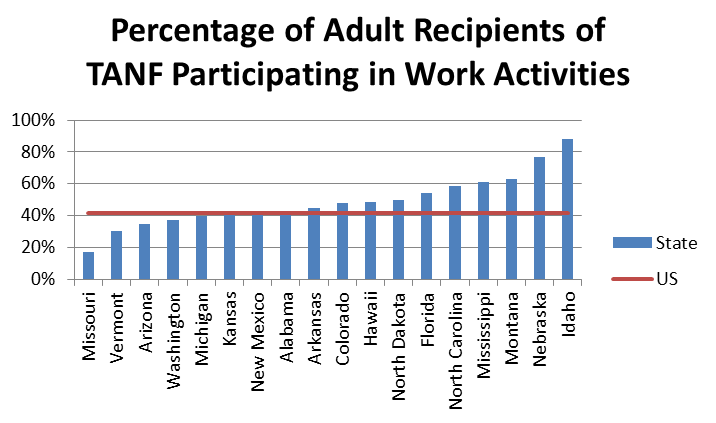
“Work-related activities” include both paid employment and things like job training and public-service work. The chart below shows participation rates among TANF recipients, and Missouri is dead last in the nation at 17%. (For clarity, the chart shows only 18 states, but the participation rates of all the omitted states fall between Missouri and Idaho.)

Idaho has the highest participation rate (87.9%). Why is Idaho’s rate over four times higher than Missouri’s? Part of the reason might be in how the two states explain the eligibility requirements to recipients. Missouri and Idaho each have websites set up for this purpose. Idaho’s website provides a clear list of acceptable work activities:

  • Unsubsidized employment
  • Subsidized private sector employment
  • Subsidized public sector employment
  • Job search and job readiness (limited to not more than 6 weeks in a federal fiscal year with not more than 4 weeks consecutive).
  • Community service
  • Work experience
  • On-the-job training
  • Vocational educational training (limited to 12 months for an individual)
  • Caring for a child of a recipient in community service Supplemental Activities
  • Job skills training directly related to employment
  • Education directly related to employment (for those without a high school or equivalent degree)
  • Completion of a secondary school program

Missouri has only an explanation of how many hours per month that an aid recipient needs to devote to work-related activity but no information about what that activity entails:

  • The required average employment and training activities for a federal month for a single-parent household are:
  • 20 hours if the children are under age 6
  • 30 hours if the children are over age 6
  • The required average employment and training activities for a federal month for a two-parent household are:
  • 35 hours if the children are under age 6 and the household is not receiving federally funded childcare on the household members, and
  • 55 hours for all other recipients

There is a link to the Missouri Work Assistance Program website, but even that site lacks specifics about what is expected of aid recipients.

When recipients in Missouri don’t engage in required work activities, benefits are supposed to be halved and then stopped. This rule should be enforced for people who aren’t making any effort, but our real goal is to stop paying benefits to people because they have jobs and can support themselves without government aid. Clear guidelines about required work-related activities for aid recipients might help—they seem to be working in Idaho.


What’s $65 Billion between Friends?

We teach kids the value of properly saving when they’re young, but when it comes to public pensions, retirement funds might not be quite what we once thought. In June the Mercatus Center published the 2016 edition of its annual “Ranking the States by Fiscal Condition” report. Missouri ranked 14th overall, but the red flag from this report regards nationwide pension plan funding (or lack thereof).

For those unfamiliar with the current pension debate, here’s a crash course: A pension plan’s funding ratio is the value of its assets (contributions to date) divided by the present value of its liabilities (discounted sum of its future payments). Between today and when the future payments are due, contributions will be put in and investment returns will be realized on the plan’s assets. Of course, the future contributions necessary to ensure a fully funded plan depend on the returns that are realized. In other words, if a plan’s returns fall short then contributions will have to fill in the gap. Current General Accounting Standards Board practices allow a pension fund to discount its future payments at the rate that fund managers expect returns to achieve, but in recent years economists have argued against valuing a plan’s funding ratio this way due to the simple fact that while investments might reach the expected goal, the funds for retiring employees must be paid.

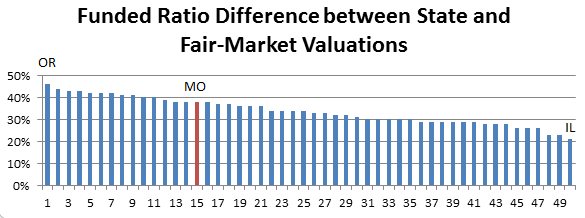
Many economists note that current estimations don’t guarantee goals will be met, and that the safer way to estimate how well-funded a plan is involves discounting future payments as if they came from risk-free investments (i.e., treasury bonds). Mercatus listed each state’s funding status, first according to the state’s assumed investment return rate and then according to the risk-free rate, revealing a staggering gap. The graph below shows the difference between the ratios using the assumed rate and the risk-free rate for each state.

When determining a state’s funding ratio, the two methods produce an average difference of 34%. Missouri’s funding ratio drops 38%, with a difference of 64.84 billion (yes, that’s billion with a B). To be clear, this chart does not mean taxpayers will have to make up all or part of the difference, but the discrepancy in valuation shows the drastic potential costs taxpayers could be burdened with if investment returns don’t live up to their current expectations.

The types of investments that pension plans hold are up to the discretion of their managers, but these numbers are no small chunk of change. If states are going to guarantee retirement funds, they may want to consider a risk free measurement system that will ensure they are prepared to pay employees what is promised.

Making Strides toward Welfare Reform

It’s only fair to insist that for someone to receive welfare benefits in Missouri, they should at least be alive, actually reside in the state, and not be in prison. Missouri SB 607, which takes effect on August 28, is intended to help the state enforce these basic requirements. It requires the Department of Social Services (DSS) to contract out verification of Missourians’ eligibility for welfare benefits such as the Supplemental Nutrition Assistance Program (SNAP), Temporary Assistance for Needy Families (TANF), and MO HealthNet, to a private firm by January 1, 2017. Both DSS and the contractor will have to file an annual report with the Governor concerning eligibility data. This system should help ensure that those receiving benefits are actually entitled to them, a topic we have written on before.

While DSS retains final authority, the contractor will evaluate recipients’ eligibility more often than DSS has previously. SB 607  requires the contractor to evaluate welfare eligibility based on “income, resources, and assets”  at least quarterly and “identify on a monthly basis any program participants who have died, moved out of state, or have been incarcerated longer than 90 days.” SB 607 is patterned after a law Illinois adopted that, once implemented, has removed 120,000 people thus far who should not have been on the welfare rolls.

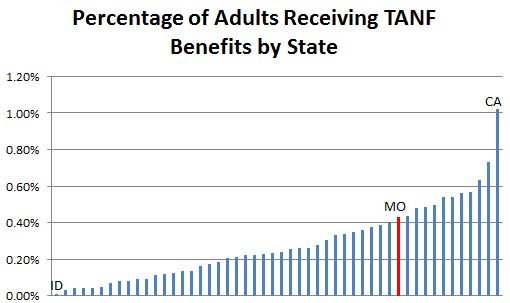
Currently, DSS only determines eligibility annually. Thus someone could move to another state between eligibility checks and could continue receiving benefits for up to a year. As of 2014, Missouri had a large percentage of the adult population on welfare compared to other states, ranking twelfth in participation rates (see the chart above).

Supporters believe this measure could save taxpayers as much as $25 million by 2019. Maybe we should use the money we will save to experiment with successful welfare-to-work programs that other states have implemented

North Kansas City Proposes A “No Tax Increase” Bond Issue

The North Kansas City School District is asking voters to approve the issuance of a $114 million bond for the construction of new facilities to meet the needs of a growing population. The Show-Me Institute has no position on whether the district ought to take this project on; we just quibble with the misleading argument in favor of it.

The Kansas City Star editorial board, not entirely surprisingly, supports the bond, and concludes its editorial with:

The district’s current debt service levy of $1.29 per $100 of assessed valuation won’t retire for about 20 years. Approving the bond issue in August would extend the debt levy 10 more years. Because of the extension, taxes that residents and businesses pay to the school district will neither go up nor down whether the measure passes or fails, officials say.

Two years ago, my colleague James Shuls addressed this very argument. He wrote,

Bonds work in much the same way and school districts can “refinance” to extend the term of the bond. They market this to the public as a “no tax increase” bond issue and claim that your payment will not go down or up whether the issue passes or not. Your tax payment will not change, but you will be paying for a longer period of time.

The bond issuance may be the exact right idea to meet North Kansas City’s needs. Shuls suggests calling such efforts “no tax levy increases” because, in fact, the new bonds will require the expenditure of more tax dollars. Proponents know better, and would be more credible if they just leveled with voters rather than spin fanciful yarns.

Support Us

The work of the Show-Me Institute would not be possible without the generous support of people who are inspired by the vision of liberty and free enterprise. We hope you will join our efforts and become a Show-Me Institute sponsor.

Donate
Man on Horse Charging