On July 22, Missouri Attorney General Catherine Hanaway filed a lawsuit against Kansas City for violating anti-discrimination laws. A copy of the suit is available here.
For some background, I recommend you read my June 18 column for The Kansas City Star. In short, I detail a city council session in which the city’s own consultants report that after reviewing seven years of contracting data, they could find no evidence to support the need for the city’s race- and sex-conscious contracting preferences. In fact, the consultancy’s director of research told the council bluntly, “You just don’t have the factual predicate” required to continue such set-asides.
What that really means is that the city has no defense against a lawsuit.
Members of the council were not pleased with the report’s findings. They could have viewed this as a huge victory for Kansas City—having reached a point where such discriminatory programs were no longer necessary. Instead, council members chose to question the results and the methodology. Mayor Lucas even offered a novel legal theory: “The courts suck.”
We know that column, the only reporting I have been able to find about the consultants’ report, played a role in Hanaway’s suit because she tells us so. Not only does the lawsuit track with what I wrote, including Lucas’s petulance, but she explicitly cites the column in the suit’s footnotes.
Following up on my column, on June 26, I spoke with Lee’s Summit–based civil rights attorney Jonathan Whitehead on KCMO Talk Radio’s Mundo in the Morning. Whitehead details the legal history regarding race- and sex-based discrimination, the rules it put in place for allowing such programs, and how the findings in Kansas City may put the city in legal jeopardy.
As with the Star column, you won’t find any such in-depth interviews on the topic anywhere else.
Gov. Mike Kehoe recently signed House Bill (HB) 3231, a broad economic development package that revives the Missouri Downtown Economic Stimulus Act, better known as MODESA.
According to the Kansas City Business Journal, the revived program could help finance an expansion of CPKC Stadium, a possible new Royals ballpark, and billions of dollars in additional development connected to Kansas City’s Power & Light District and St. Louis’s Ballpark Village.
There are other provisions in the bill, including incentives for converting vacant office buildings into housing and programs tied to designated “innovation zones.” But the return of MODESA deserves particular attention because Missouri taxpayers already have some experience with the program. In Kansas City, that experience includes the Power & Light District.
Kansas City helped champion the original MODESA program in 2003, when downtown was struggling and city leaders were looking for ways to encourage investment. The program allowed new state tax revenues generated by qualifying developments to help finance projects, including public infrastructure associated with Power & Light.
The new version could be even more generous. The Business Journal reports that MODESA could redirect 50% of incremental state sales and employee income taxes generated by qualifying projects for as long as 30 years. For certain projects, that figure could rise to 70%. Local governments also would be required to provide substantial matching incentives.
Supporters believe the program can unlock investments that otherwise might not happen. The Cordish Companies, for example, says the legislation could help support $2.5 billion in new investment in Missouri, including an expansion that could “basically double” the size of the Power & Light District.
Perhaps. But before Missouri helps double the size of Power & Light, it is worth looking at how the financing of the original project has worked.
The district undoubtedly helped change the face of downtown Kansas City. It brought restaurants, bars, and entertainment venues to an area that badly needed investment. But it didn’t create new investment—it merely redirected economic activity at bars and restaurants from elsewhere in the city to downtown.
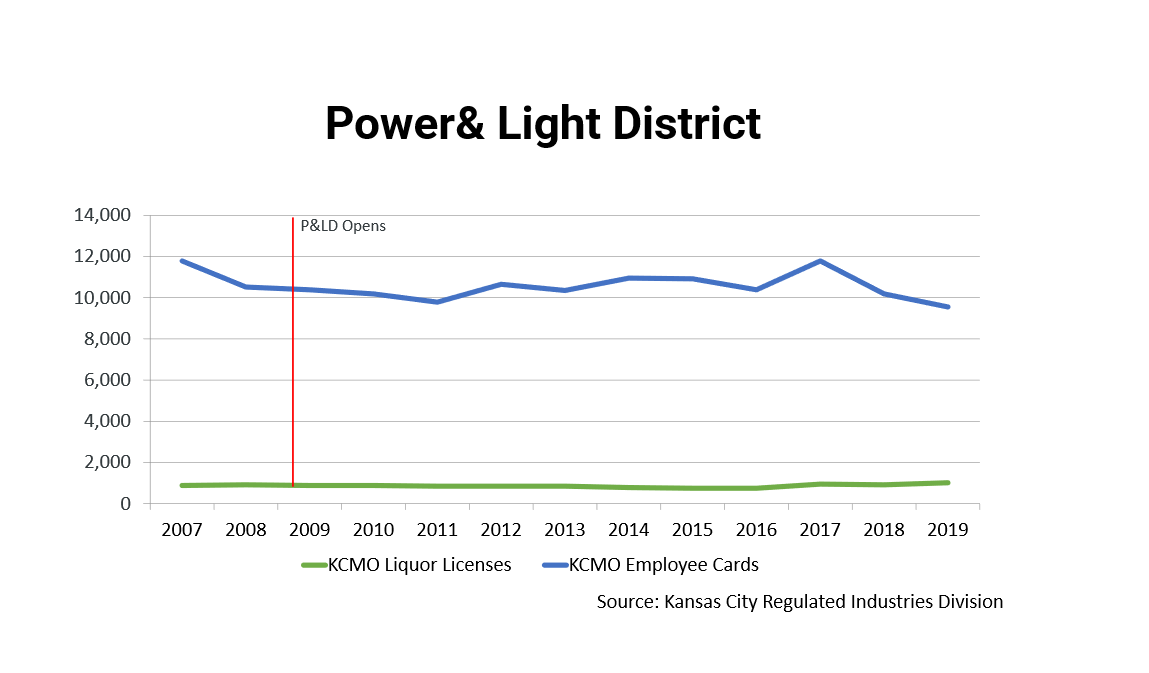
We know this because data provided by the city’s Regulated Industries Division shows us that the number of liquor licenses and employee cards required of bartenders and waitstaff remained flat after Power & Light opened. Despite new shops downtown, there was no growth citywide.
To make matters worse, the district has not generated enough revenue for Cordish to cover its debts. Because then-Mayor Kay Barnes was foolish enough to put taxpayers on the hook for debt payments, Kansas Citians have been paying out about $12 million each year over and above the tax revenue we divert back to the developer.
Kansas City is considering using the revived MODESA program as part of financing packages for an 18,000-seat expansion of CPKC Stadium and potentially a $3 billion Royals ballpark development at Crown Center. The city already has signaled its willingness to consider as much as $235 million in local incentives associated with the current project and $600 million for the Royals.
The state incentives are not insignificant, either. According to the Business Journal, the fiscal note for HB 3231 estimates the legislation will cost Missouri more than $62 million annually once fully implemented in 2034.
As Missouri leaders take on the task of cutting spending so that they may reduce and eventually eliminate the state income tax, these types of subsidies are not a sign of fiscal seriousness.
We’ve been here before. The effort failed. Why are we doubling down?
Missouri received a “B” on a national report card evaluating state policies on cell phone use in schools. This grade, available at phonefreeschoolsreport.org, places Missouri in the top half of states.
The primary reason for Missouri’s strong grade is its bell-to-bell ban on student cell phone use during the school day. State law also protects school employees from liability when they act in good faith to enforce the policy.
Missouri fell short of an “A” grade because students are allowed to store their phones in an accessible place during the school day. Only four states received “A” grades—Indiana, Kansas, North Dakota, and Rhode Island. They all require phones to be stored in an inaccessible location.
Overall, Missouri’s “B” grade is good news. Our lawmakers deserve credit for moving early on an issue where both common sense and research point in the same direction. Removing phone access during the school day is a straightforward solution to the obvious distractions that students’ devices bring into the classroom.
That said, our policy can be improved. When phones remain within arm’s reach—inside backpacks or pockets—there is temptation to use them. Requiring inaccessible storage would make enforcement easier and reduce classroom disruptions further. It would also align Missouri with the strongest policies in the country.
Missouri has taken an important step toward phone-free classrooms. Strengthening the law to require inaccessible storage would help get the most out of our students during school.
Susan Pendergrass speaks with Jude Schwalbach, senior policy analyst at Reason Foundation, about declining K-12 enrollment nationwide and what it means for the future of open enrollment. They discuss why enrollment dropped in 40 states since the pandemic, how districts have responded to increased competition from charter, private, and homeschooling options, why open enrollment tends to cause far less disruption than critics predict, the case for Missouri to catch up with its neighboring states, and more.
Susan Pendergrass (00:00):
Thank you so much. Jude Schwalbach, you’re back, I think for the third time, from the Reason Foundation. We appreciate you joining the Show-Me Institute Podcast once again, taking the time.
Jude Schwalbach (00:09):
Yeah, thank you for having me. I’m always excited to join.
Susan Pendergrass (00:26):
We were chatting for a second before we started recording. I talk about open enrollment a lot in Missouri. We don’t have it. In so many places in this country, kids choose where they go to school. They don’t just look at their utility bill, or their parents make this life-or-death real estate decision where they have to look at all the schools before they buy a house so they can pick where they go. Missouri has been really reluctant to let anybody choose a school over being assigned to one. I’ve been saying for some time that we have this phenomenon happening simultaneously: we don’t have as many kids anymore. I’ve talked to demographers on this podcast. We know that birth rates topped out in 2009, kindergarten enrollment topped out in 2013, and graduating high school seniors topped out a year or two ago. It’s a fact you can see all through the pipeline: there are fewer kids. In my mind, that’s going to make open enrollment more attractive, because we’re going to have districts that, for no explainable reason, just don’t have as many kids. Some of our top-performing districts, like Clayton, used to have 2,500 kids and now have 2,000. I keep thinking districts are going to wake up and realize they either have to fire teachers or get in the open enrollment game and actually have faith that they’ll attract students. You recently wrote about this, and that’s why I wanted to bring you on. Tell me what’s going on nationally with these enrollment trends and how you think that impacts this idea of whether kids should be assigned or allowed to pick.
Jude Schwalbach (01:51):
Yeah, so the latest national data we have on K-12 enrollments is from fall 2024. What we see is that in 40 states, K-12 enrollments dropped, by about 1.4 million students between 2019, right before the pandemic, and 2024. However, 10 states did manage to avoid those drops. In two of them, Florida and Utah, enrollments remained flat, they didn’t gain or lose students. The other eight states, places like North Dakota, Delaware, Alabama, and Texas, gained students. They really stand out because they gained students when literally everyone else lost students. They didn’t gain a ton, those eight states together gained around eighty thousand students, but when everyone else is losing and you’re gaining, you look pretty good. There are probably three factors driving this. As you mentioned, there are just fewer kids. The number of births in every single state except Florida
Susan Pendergrass (02:39):
Right.
Jude Schwalbach (02:53):
had dropped between 2014 and 2019, and those are the corresponding kindergarten cohorts five years later, 2019 to 2024. So there are just fewer kids. There’s also migration. There’s plenty of domestic migration occurring. In some states, especially the ones that gained students, they received quite a few new residents from other states. There’s also states, I think it was North Dakota actually, that lost a lot of residents through domestic migration but received a bunch of new residents from abroad, which reversed their general population decline and had them gain students. Presumably those families from abroad brought students with them, which is part of why they’re not losing students.
Susan Pendergrass (03:41):
Mm.
Jude Schwalbach (03:53):
There are various economic factors driving those things. But another component is that satisfaction with public schools is at an all-time low, especially post-pandemic.
Susan Pendergrass (03:50):
Yeah.
Jude Schwalbach (03:53):
Families are starting to choose schools other than public schools at a much higher rate than they used to, because they have more options. There are states with universal private school choice programs now, which ten years ago were just a pipe dream. You could achieve a small, targeted private school choice program, but not much more. Then there are families choosing homeschooling. This has created a much more competitive education marketplace. And it’s not just states with robust private school choice programs where you see increased private school enrollment. Places like California and New York, which have no private school choice, have also seen their private schools increase in popularity in the interim while public enrollment has been declining. So if you’re going to be in this tighter market with fewer students and increased competition from homeschools and private schools, you’re going to want to provide some flexibility within the public system to make it more attractive to families. Flexibility like open enrollment. Sorry, that was a really long answer.
Susan Pendergrass (04:59):
No, I think it’s perfect. It makes me think of the cliche of skating to where the puck is going, rather than where it is right now. I feel like a lot of the pushback from folks is they’re just looking at where the puck is right now. They’re like, well, we’ve got lower teacher-student ratios, fewer kids in every classroom, this is great. Or, bringing in a whole new topic here, the federal tax credit that’s looming for private school choice, where people can donate their tax dollars to a scholarship organization, and you have leadership in the teachers unions telling Democratic governors, you better not do this, because the way we’re going to keep the kids in the public schools is to lock them in. That seems so short-sighted to me, when, like you just said, we can look at the enrollment trends and know that while there are fewer kindergartners today, ten years from now there’s going to be another five to ten percent drop-off in kindergartners. Who are we kidding?
Jude Schwalbach (05:58):
Yeah. As that market gets tighter, the funding those students produce is going to become more important to public schools. If you look at California, there’s a report by their Legislative Analyst’s Office that found that districts initially losing students through open enrollment, where students were transferring to other districts with better test scores, or maybe they wanted different academic opportunities like AP classes, those districts reached out to families and said, what can we do to get you to stay? Families said, actually, we don’t want to leave the district, we just want to go to a different school inside our district. Or they said they wanted a language immersion class or something along those lines. The districts responded to families’ frustrations, and not only did some of them stop the bleeding, they actually gained students from other districts because they were doing something good that families wanted. So when you create a more flexible system, you shouldn’t just assume you’re going to lose students. There’s real opportunity to gain students as well.
Susan Pendergrass (07:09):
Yeah, I’ve certainly heard superintendents say it forced them to stop and think about what they offer. What is our mission? What do we offer? When you have a captive enrollment zone, you don’t need to do that. I studied this a long time ago in Massachusetts, and people would say, well, you can’t really prove that districts respond to competition. But I did research on it and talked to superintendents. They said, we moved the date of our orientation so kids would come visit our school first, or we redid parts of the school that parents had been complaining about. There are these little micro-responses, which is to say they realized that this is no longer a guaranteed monopoly. They have to start responding to families. And in the end, everyone kind of wins.
Jude Schwalbach (08:01):
Yeah, another good example that builds on what you were just saying is Minneapolis Public Schools. For the past ten years, their enrollments have been in decline, largely because of competition with charter schools and other public schools in the area. But recently they reversed that ten-year decline and gained new students, because when they were doing school tours, they started following up with parents, saying, we just want to remind you what you thought, and these are the options we offer that other districts nearby don’t.
Susan Pendergrass (08:24):
Yeah. What’d you think?
Jude Schwalbach (08:33):
This is what makes us a unique education option. I think it’s no surprise that families liked that personal touch and started enrolling in Minneapolis Public Schools.
Susan Pendergrass (08:40):
Yeah, we need it. I know you study school finance a lot too. I wonder, in Missouri anyway, certainly within St. Louis County but across Missouri generally, the number of teachers being hired has only continued to increase. There’s this belief that spending on public education should only go one direction, up, regardless of the number of students, and that the number of teachers should only go up. Our state education agency, one of their only five goals is more teacher certifications, more, more, more, as though there’s an ever-expanding pool of students without looking at the reality. Oddly, I just did a podcast on Social Security and they’re doing the same thing. They’re not looking at the reality of the number of workers, they’re just operating on the assumption that there will always be more. Our schools are doing bond referendums to build new schools in Columbia, Missouri, even though the new ones they just opened are under capacity. Their enrollment is down two or three percent and expected to go down more, but
Jude Schwalbach (09:50):
Yeah, I think state policymakers should take steps to encourage districts to be more thoughtful about how they’re using taxpayer dollars. Indiana, where I live, did something a couple of years ago where districts have to prepare for permanent closures if one of their school facilities has lost ten percent or more of its students over a five-year period. It’s basically saying, look, if you’re not able to attract new students, if your local enrollment is declining, we shouldn’t be keeping these facilities open and draining taxpayer dollars. To be fair, this is a really painful decision for communities. No one likes to close schools, no one likes to rearrange staff. But it’s not fair to taxpayers to keep funding and maintaining buildings that are really only educating a small fraction of students. Florida also publishes a report on school facility capacity, but most states don’t even make this information public. A good first step is just making this sort of data available so families and taxpayers, when they get approached about bonds or hear about decisions to hire more staff, can ask, if your enrollment is declining and your buildings are half empty, why are you doing this? This sort of information helps hold district administrators accountable.
Susan Pendergrass (11:13):
Yeah, and the way schools are funded, and have been for at least a hundred years, these are very long-term commitments, because school districts are in the real estate business. They buy the land, build the building, fund it over fifty years rather than leasing, like a lot of charter schools do. They’re in the business of buying land and building buildings. And teachers, that’s a twenty-five or thirty-year commitment too. That’s also hard to adjust down. There are ways to do it, but districts are making these long-term commitments without paying close attention to the trends happening right under their nose. It’s a very odd situation to me, because you can see this coming, and we’re not getting a response out of the system. And to your earlier point about school choice programs taking students, they’re taking the blame. They’re blaming school choice for the fact that they have to close schools when that’s not actually the reason.
Jude Schwalbach (12:15):
Yeah, there’s a really interesting paper, I think published by Thomas Dee from Stanford in the last couple of years, where he looked at why 1.8 million students left the public school system since the pandemic. He looked at increased competition from private school choice, homeschooling, and changing demographics, whether it’s families moving across state lines or lower birth rates. What he found is that he couldn’t explain why one-third of those students exited the public school system. It’s just unexplained. There are demographic factors, there’s increased competition, those certainly matter, but they aren’t the only reasons. We don’t even fully know why some of these students are exiting the public system. But you can’t change the fact that they are.
Susan Pendergrass (13:00):
And you don’t address it by locking the door. They want to close the gate and lock it to stop it, and that to me is the most short-sighted approach.
Jude Schwalbach (13:09):
Yeah, I think locking students within a particular system without allowing them any agency in school selection is really unfair. If states are going to require you to go to school, you should have some agency in what that school is, because education is a really personal experience.
Susan Pendergrass (13:27):
Mm-hmm.
Jude Schwalbach (13:28):
Maybe you don’t get along well with a particular teacher, or their teaching style isn’t a good fit for you, or maybe you’re being bullied at school. But where you go to school shouldn’t ultimately depend on your parents’ largest financial investment, which is very much constrained by their income. Increasing open enrollment options, where if there’s space available,
Susan Pendergrass (13:45):
Yeah, yeah.
Jude Schwalbach (13:50):
we’re not talking about building new facilities or hiring new teachers to accommodate these students, these are spots that are actually open right now, and allowing students who don’t live in that district or attendance zone to attend that school, I think that’s just a common-sense reform.
Susan Pendergrass (14:05):
Do you think declining enrollment is going to spur that into action more? Is it going to have an impact on whether states like Missouri consider open enrollment?
Jude Schwalbach (14:17):
It seems like it could go either way, honestly. If there’s declining enrollment, that means there are spots available and districts would have an incentive to try to attract new students from other places. But on the flip side, individuals don’t always see the opportunity, they only see the cost, which is, we could lose students. What’s interesting is that when you look at open enrollment programs across the nation, especially the largest ones with the most established data, places like Wisconsin, Colorado, or Florida, you don’t see massive enrollment fluctuations when these programs are launched or even soon afterward. Instead you see small, incremental change, which means districts have plenty of time to adjust. In some cases it could mean they actually reverse course and start gaining students. I know in Missouri there’s a lot of concern in rural areas that they’ll only lose students. But the irony is that if you look at Wisconsin, which also has a lot of school districts, around four hundred, their rural districts actually gained students on net in their most recent open enrollment report. Sure, they lost some students, but they ended up attracting more students from their suburban counterparts. I think rural districts can absolutely compete successfully
Susan Pendergrass (15:22):
Yeah, we have over five hundred.
Jude Schwalbach (15:44):
in a more competitive education marketplace.
Susan Pendergrass (15:47):
We actually just released a report saying exactly what you just said, by my colleague Dr. Cory Koedel, showing that there isn’t a massive, or really much of any, enrollment disruption in the first three or four years after these programs pass, in states that have had them for a long time or even a short time. There really isn’t a disruption in the way that, when a bill gets a committee hearing in Missouri, folks from the school boards association or superintendents association say, oh my god, we won’t be able to keep up, the kids will be coming and going, it’s going to completely throw off our enrollment. But we’ve found there really isn’t a massive disruption. On the one hand, you have a pretty low cost to districts. On the other hand, as you mentioned, there’s a really large benefit possible for an individual family who has a child they have to force onto the bus every day because they dread going to school due to their teacher, bullying, or whatever. It’s a big benefit at the individual level for those families, and the cost is really quite small or very dispersed.
Jude Schwalbach (16:49):
Yeah, one thing I’ll note is that it benefits districts as well. In California there are small rural districts that actively rely on K-12 open enrollment to keep their doors open. One administrator basically said, look, this doesn’t let us hire new staff, we’re not making money off this program, but we aren’t letting staff go either. We’re keeping our doors open and the lights on in our schools. If they didn’t have open enrollment, that would not be happening. They’d have to shut the school or let go of staff. It’s really important to remember this is a real opportunity for districts to gain students.
Susan Pendergrass (17:30):
Yeah. As Cory points out all the time, if you have a fourth grade classroom with ten students and you can add two or three more, your marginal cost is almost zero. You probably already have the textbooks, the computer, the desk is sitting there, it’s literally idle assets. And those three students, even if they don’t bring a lot of money with them depending on how the funding follows the student, that’s a very low marginal cost for some marginal revenue. I think the more districts see it that way, because I don’t think in Missouri that funding for education is going to continue to just go up. We have a tight budget and we know enrollment is going down. That’s going to be a whole new horizon for folks to accept. And partly, similar to the findings across those forty states, we have more old people. We have fewer young people, more old people, and older people are expensive and need a lot of services. So schools and assisted living facilities are going to be competing against each other in a sense, and I think the trend would suggest assisted living wins out because there’s more of those people and fewer children. Some of these trade-offs are going to have to be considered in a way that no one
Jude Schwalbach (18:44):
Yeah.
Susan Pendergrass (18:48):
seems to want to do. So is open enrollment growing across the country, stagnant, or on the decline?
Jude Schwalbach (18:49):
Yeah, I think that’s certainly correct. Since 2021, eighteen states have strengthened their open enrollment policy in some capacity.
Susan Pendergrass (19:06):
Okay. I know our neighbor Kansas did, right? Oklahoma too, our other neighbor.
Jude Schwalbach (19:10):
Yeah, Kansas did it, Oklahoma too. Several of your neighbors have improved their open enrollment policies.
Susan Pendergrass (19:17):
Well, Oklahoma has complete universal school choice. If you move across our northern border, you can pick public or private. If you move across our western border, you can pick any public school. The big pushback on that was that the highest-quality, most desirable districts would see a rapid influx, and they haven’t. In Oklahoma you can either pick a public school or take a tax credit for private school. Then we have Arkansas as a neighbor, and they’re also universal. We’re kind of getting surrounded by it and we’re just holding out as the last bastion
Jude Schwalbach (19:43):
Yeah.
Susan Pendergrass (19:51):
of assigned public schools.
Jude Schwalbach (19:52):
Yeah, I think Illinois and Kentucky are about on par with Missouri, but I think their programs are actually slightly better. Not by much, but
Susan Pendergrass (20:03):
We sort of write off Illinois, like, at least we’re not Illinois, but they have a lot of public sector problems. Yeah, we have no open enrollment, very limited charter schools, and a very small scholarship program. So ninety-five percent of our kids are going to their assigned public school with no other option besides virtual.
Jude Schwalbach (20:23):
Yeah. But to answer your question, I think there’s a real opportunity for open enrollment to continue to grow, especially in states, I think Nevada is a good harbinger of what could be coming. They passed a strong within-district open enrollment policy last year, and that was a bipartisan bill, championed by the governor and Senate leadership that was Democrat. I think part of the reason they wanted to do that was to strengthen their public school system, to ensure that students had a reason to invest in their public schools, especially low-income ones, and one of the ways they wanted to do that was through creating flexibility within the public system.
Susan Pendergrass (21:12):
Yeah.
Jude Schwalbach (21:12):
That was one of the compromises that occurred there. You also see that in Kansas. That was an earlier reform, but also a compromise. That one was passed by increasing funding for public schools, and Republicans got increased flexibility within the public school system for students.
Susan Pendergrass (21:18):
Yeah. I mean, when you poll parents it’s ridiculously popular. Everybody clearly wants to pick.
Jude Schwalbach (21:37):
Yeah, families really want these policies. I think residential assignment works for some people, that’s the form of school choice they like. They like being able to purchase a home in a district and be guaranteed a spot. But if there are extra seats, there should be students who can fill those seats, especially when funding is flexible and portable.
Susan Pendergrass (22:03):
I believe declining enrollment is going to motivate open enrollment. I have a very optimistic view of this: superintendents and school boards are going to wake up and say, our enrollment is declining, the only way we can turn this around is to try to get kids from across the lines. In St. Louis County we have more than a dozen school districts within one county, for reasons that would take a two-hour podcast to explain. It’s very easy for a child to just cross the street and be in a different district, and I feel like districts are going to have a wake-up call and start trying to get those kids from across the street rather than making their parents move. Because it’s going to be that or lay off teachers. You can only keep your teaching staff for a limited amount of time if your enrollment is going down and your schools are staying open.
Jude Schwalbach (22:58):
I think you’re right, Susan. When you look at the NCES projections, which are a little dated at this point, they anticipate losing millions more students by 2031.
Susan Pendergrass (23:08):
Yeah, yeah. So our heyday in Missouri, you could kind of say we had a million students, we had about 952,000 or so. If you wanted to round up, you’d say Missouri has about a million students. Now we have, depending on how you count pre-K and ungraded, somewhere between 830,000 and 850,000. And the NCES projections you just mentioned project that Missouri will be below 800,000, more like 785,000. We can’t even round up to a million anymore. We’re going to be more like 780,000. That’s more than a twenty percent loss, and that’s a lot.
Jude Schwalbach (23:58):
Yeah, enrollment declines aren’t new to the US. This happened in the seventies and eighties, but it took almost two decades for districts to recover their lost enrollment. That’s a long time, and it means you can’t hang on to buildings or staff in that interim when you don’t have the enrollment to justify them.
Susan Pendergrass (24:19):
Yeah, and I think in Missouri, good.
Jude Schwalbach (24:19):
I don’t think they returned to 1970 enrollment levels until 1997, if I remember correctly. There’s the baby bust,
Susan Pendergrass (24:31):
Wow, because the baby boom went through and then there’s a baby bust. But we don’t have a baby boomlet on the other side. There’s no evidence of one right now based on global trends.
Jude Schwalbach (24:39):
Yeah, it was fifteen years later before they even saw that sort of resurgence in births. They didn’t know either, and we don’t know either.
Susan Pendergrass (24:47):
Yeah. Yeah. I like that, that’s hopeful, that’s true. It just frustrates me, because if Missouri wants to hold out as the last residential-assignment state in the era of declining enrollment, I just feel like, there’s a professor from SLU, Ness Sandoval, who talks about Missouri demographics a lot, and he’s not optimistic about where we’re headed. One thing I think we could do to turn it around is throw open the doors on school choice to try to get families to locate here, but we’re kind of doing the opposite. Well, thanks so much. I appreciate you coming on and explaining it. I think it’s pretty interesting stuff, and I think we’re going to have to talk about this more as more enrollment numbers come in and we see how folks respond. I’m hopeful that Missouri legislators will get it and will press for it in the 2027 session. We’ll be pressing for it at the Show-Me Institute, but maybe I’ll use all of your data, Jude, and hope they read it and see what’s on the horizon. That would be awesome. Thank you so much, I appreciate it.
Jude Schwalbach (25:47):
That would be great. Thank you, Susan.
Imagine getting a large one-time bonus, then using that money to buy an expensive new car. There are some obvious parallels to Missouri’s budget.
Shortly before the June 30 deadline, Governor Kehoe signed Missouri’s more-than-$50-billion budget for fiscal year 2027, which began on July 1. He also issued about $53 million in vetoes and more than $400 million in spending restrictions. While the vetoes are generally in line with recent years, the expenditure restrictions are much larger than have been necessary in more than a decade. The restrictions also indicate that the governor believes the legislature approved roughly $400 million more in spending than projected state revenues can support.
Unlike a veto, a spending restriction doesn’t permanently eliminate an appropriation. Instead, it temporarily withholds the authority to spend it. Missouri’s constitution requires the governor to keep the budget balanced throughout the fiscal year, so if projected revenues won’t support all the spending approved by the legislature, the governor must reduce authorized spending through vetoes, restrictions, or a combination of both. The difference is that vetoes are permanent unless the legislature overrides them, while restrictions can be lifted if revenues improve. The governor then decides which restricted appropriations, if any, are ultimately released.
Perhaps the most interesting part of the governor’s budget signing was the explanation he provided for this year’s actions. Kehoe reiterated something he’s said before: Missouri has a spending problem rather than a revenue problem. He also said the state needs to reduce its reliance on what are called general revenue pickups. General revenue is the state’s primary operating fund, supported largely by income and sales taxes. A general revenue pickup occurs when a temporary funding source disappears, leaving general revenue to cover an ongoing expense. That’s exactly how temporary spending becomes a permanent obligation.
The governor’s explanation reflects two concerns I’ve written about repeatedly. First, Missouri’s spending has been growing faster than its revenues. As the auditor has highlighted, between fiscal years 2020 and 2025, general revenue collections increased 45.8 percent. During that same period, general revenue spending increased 53.4 percent, more than double the rate of inflation.
Second, lawmakers treated the surge in temporary federal COVID relief and an extraordinary period of state revenue growth as an opportunity to expand ongoing commitments. As those temporary dollars disappeared, the state became increasingly reliant on general revenue pickups, shifting costs that had once been covered by other funding sources onto Missouri taxpayers.
Remember the car? If soon after your purchase you found you couldn’t afford your new car, nobody would say you had an income problem. They’d rightfully say you spent too much. Missouri’s budget shouldn’t be viewed differently. The good news is that Governor Kehoe’s actions indicate he has correctly identified the problem. Now it’s up to lawmakers to get serious about solving it.
Most schools embraced digital learning during and after the COVID pandemic, dramatically increasing students’ screen time during the school day. Combined with the long hours many children already spend on screens outside of school, the result has been an unprecedented amount of daily screen exposure.
But people are starting to push back. More than half of states have policies that limit or fully ban cell phones in schools. And many states and school districts have also enacted, or are considering, policies that limit screen use for instruction. Patrick Johann recently reviewed an instructional-use screen time policy adopted by the Los Angeles Unified School District, which is scheduled to take effect this upcoming school year.
Missouri is part of this broader trend. Last year the state banned cell phone use during the school day, and lawmakers debated the Student Screen-Time Standards Act during the 2026 legislative session, which would have curbed screen use for instruction. The Student Screen-Time Standards Act didn’t pass into law, but similar legislation will almost surely be introduced in 2027.
The rationale for cell-phone bans is that cell phones are a distraction. For laws that limit screens for instructional use, the idea is that screen-based instruction simply does not produce as much learning as face-to-face teaching. Technology offers many benefits, but it has been unable to replace the human interaction that many students—especially those from disadvantaged backgrounds—need to thrive in school.
If we had a robust market for school choice, I would welcome schools that make technology central to their instructional model. Some students will undoubtedly flourish in those environments, and technology can support a level of personalized instruction that is difficult to achieve in a traditional classroom. Alpha School is an interesting model with promising early results.
But in states like Missouri, where most students are still required to attend their residentially zoned public school, school districts should not use learning models that don’t benefit most students.
A recent article at The74 discusses an unlikely ally in all of this: students themselves. The article explains how many students describe their relationship with technology in terms that resemble addiction. The author writes:
They don’t want to be on their phones eight or nine hours a day. They don’t want to use AI to complete their assignments and short-circuit their ability to learn and grow. They know their attention span is stunted. But in so many circumstances, they simply can’t resist.
When the pandemic hit, schools shifted quickly toward technology-based instruction. It all happened very fast. However, as is often the case in such circumstances, the pendulum may have swung too far. Perhaps the clearest sign is the growing consensus for a course correction—from parents to teachers to policymakers and, increasingly, to students themselves.
The federal government will roll out a new tax-credit program in 2027 to expand school choice. Taxpayers will be able to receive a dollar-for-dollar federal tax credit for donations of up to $1,700 annually to a scholarship-granting organization (SGO) in Missouri—or any other participating state. The SGO then distributes scholarships to families seeking alternatives to their residentially assigned public schools.
In a previous post I wrote about the new program, focusing on the challenge of deciding which educational expenses should qualify for scholarship funding.
Over at Education Next, Rick Hess has a thoughtful piece on other aspects of the program. As both a school choice advocate and an advocate of fiscal responsibility, he opens with a concession, acknowledging the potential loss of tax revenue the program could create at a time when the federal debt is growing rapidly.
He then makes what I think is the right point: While it is unfortunate that the federal budget is off the rails, it is hard to get too worked up about this program when (a) it is a drop in the bucket compared to our broader fiscal problems, and (b) so much of our debt-financed spending benefits older Americans. If we’re going to keep borrowing, why not direct at least a small share toward expanding opportunities for children?
I share Hess’s bottom-line sentiment. I wish the federal government managed its finances more responsibly. But since that does not appear likely anytime soon, investing a bit more in the children who will ultimately inherit—and help repay—that debt seems sensible to me.
Turning to the program itself, Hess raises an important practical concern. Even though this is a dollar-for-dollar tax credit, which means it is effectively costless for taxpayers to participate, we should not assume it will be widely used. Many taxpayers may be unaware the credit exists. Others may doubt they’ll actually receive it or may not know how to make a qualifying donation to an SGO. Even modest uncertainty or inconvenience can discourage participation.
These are legitimate concerns. The new scholarship tax credit has the potential to generate substantial resources to expand school choice, but realizing that potential is not automatic. As Hess puts it, “I don’t put a lot of stock in the casual assurance that taxpayers will jump through hoops to give money away simply because, as one very prominent champion explained to me, ‘It’s a good thing to do.’”
Hess’s piece points to one of the program’s biggest implementation challenges. Helping taxpayers understand the credit—and making participation as simple as possible—could make an enormous difference. Show-Me Institute analysts will certainly be doing our part, and I hope many others will as well.
Susan Pendergrass speaks with Thomas C. Albus, United States Attorney for the Eastern District of Missouri, about public safety and criminal justice reform in the St. Louis region. They discuss the limits of risk assessment tools in bail decisions, why the city of St. Louis and St. Louis County have such different homicide rates, the case for judicial discretion over algorithmic recommendations, the connection between education, social capital, and crime, and more.
Susan Pendergrass (00:02):
Thank you so much for joining us, Tom Albus, the U.S. Attorney for the Eastern District of Missouri. The Show-Me Institute, in the last year or so, we’ve been digging into the issues of public safety and criminal justice reform, because one of our goals is to make Missouri a growth state where people want to raise their families and businesses want to come and open. Clearly, if our cities are perceived as being a place where you can’t walk to your car at night and put your groceries away, then people won’t want to do that. We’ve been trying to understand what’s going on mostly in the St. Louis metropolitan area and have realized that a lot of the issue is a disconnect between what’s actually happening and people’s perceptions. People just perceive St. Louis as a dangerous city. I did a podcast recently with Doug Burris, and he had some encouraging things to say about our prison system. I appreciate you coming on and giving us another perspective, because the most important thing for me is to try to understand this.
Tom Albus (01:20):
Thank you very much for having me. Just so everyone understands, I know Doug Burris very well and think very highly of him. He ran the probation office here in federal court for many years. When I was an assistant US attorney, I was a line prosecutor for many years before I got this job, and immediately before that, I was a circuit judge in St. Louis County, so I was a judge in the state system compared to the federal system. Doug came and helped run the county justice center, and he’s a very innovative, thoughtful person. So I don’t mean to argue with him, but I listened to your podcast with Doug, and one of the things he was talking about was getting people off probation faster, which is fine. You might remember the example he used, the first-degree robber versus the grandmother who cashed her deceased husband’s Social Security check. Those shouldn’t be treated the same, and of course they’re not treated the same now. Alternative probation is a great option for somebody like that grandmother rather than sending her to prison. But bear in mind, if you explain to Mr. and Mrs. John Q. Public that this lady cashed $75,000 worth of Social Security checks, do you want to do anything to her? We probably don’t want to incarcerate that person, but the alternative would be probation with a requirement to pay the money back to the extent she can. So no one’s suggesting treating that person the same as a violent criminal, but people do need to have accountability.
Susan Pendergrass (03:13):
About this idea of applying a risk assessment when somebody’s arrested or convicted, so that we’re sure to lock up dangerous criminals and aren’t simply using building more prisons as our policy solution, what do you think is the more efficient use of government resources when it comes to making people feel safer?
Tom Albus (03:42):
You’re absolutely right. We use this risk assessment in St. Louis County. I didn’t learn any of this in law school, but I did feel like it was common sense: does this person have a prior conviction, that person is riskier to let out on bond before trial; is this person under a certain age, that person is riskier. Social scientists create these risk factors, and frankly, I think intuitively anybody, whether they have legal training or not, would apply something similar. They’re fine as far as they go, but when we were in St. Louis County, no matter how many priors the offender had, no matter how young they were, no matter how frequently they had priors, the recommendation was always, well, you’re going to let this person out on bond, and it was just a matter of how many accoutrements to the bond, how frequently they had to check in, and so on. There was no part of the risk assessment where it said this person should be detained before trial, which to me didn’t seem sensible. Some people need to be detained before trial. Another thing these risk assessments didn’t take into account was the strength of the evidence against the person. What if the person was found by police with the smoking gun over the body of the victim? Shouldn’t you take that into account? These risk factors don’t. A lot of times the risk assessment tools are being pushed by NGOs and foundations that, if you look at their website, say their goal is to get everybody out of prison. Again, this is social science, not chemistry. Everybody has a point of view that should be considered, but we have to consider the point of view of the groups pushing to reform how probation credit is counted or to add these risk assessments, because everybody in the criminal justice system has their own point of view.
Susan Pendergrass (05:58):
So what is the reality with the prison population in Missouri? Is it growing or declining?
Tom Albus (06:04):
I believe, and I’ll have to check these numbers, that the Missouri Department of Corrections population is roughly one-third less than it was ten years ago. I believe the United States Bureau of Prisons, the people in prison for federal crimes, is one-quarter less than it was ten years ago, between COVID, a different approach, and the First Step Act. Now, I know you’re very interested in educational policy. What if we had a one-third increase in fourth-grade reading scores in Missouri? Everybody would be pretty happy with that. So here we have these great statistics, but to the extent everything else is equal, if crime is the same and the prison population is down, everybody wants that. But is crime down, and is it down to a level we’re satisfied with?
Susan Pendergrass (07:04):
And is it? People are talking all over the place, including leadership in St. Louis, about how much crime is down. But when we’ve talked to people on the street or had public events, people don’t feel like crime is down. People still see panhandling and graffiti and public disorder. People still don’t want to park their car and walk to a baseball game downtown. Everyone knows you leave your car unlocked because you’re going to get smashed and grabbed anyway. There isn’t a perception that St. Louis feels safer.
Tom Albus (07:38):
Right, and it’s a complex situation regionally. The city of St. Louis, to its credit, has reduced homicides from the mid-200s in 2020 to about 140 in 2025. That’s 50 homicides per 100,000 people. The national average is in the high single digits, so it’s still very elevated in the city of St. Louis. Now you go across Skinker to St. Louis County, where I was a judge, and we’re sitting at roughly the national average in the high single digits. A trend you don’t hear much about is that’s a much elevated rate over the last 10 to 15 years in St. Louis County, maybe 2x or 3x higher than it was 10 to 15 years ago. Then you go across the Missouri River to St. Charles County, and they’re looking at about one murder per 100,000 people. So it’s a big difference as you proceed west on Highway 70, and one size doesn’t necessarily fit all.
Susan Pendergrass (08:50):
What’s been going on in St. Louis County that it’s gone up?
Tom Albus (08:56):
I don’t really know the source of it, but we are dealing with a lot more violent crime in St. Louis County than we did, say, twenty years ago. For example, even though we’ve got approximately four times more people living in St. Louis County than in St. Louis City, we only have about one-third as many homicides every year as the city. Yet we’ve got 200-plus people awaiting trial for homicide in St. Louis County. That’s really the focus of the prosecutor’s office, and rightly so, but they didn’t have the capacity twenty years ago to handle the rate of homicides they’re seeing now, and this backlog is a consequence of that, in my view.
Susan Pendergrass (09:48):
Plus clearance rates haven’t really improved. A lot of the crimes identified as murders aren’t getting solved.
Tom Albus (09:56):
If you look at it, the City of St. Louis Police Department would say their clearance rate has gone up quite a bit, and those are statistics the city updates every day on the police department’s website. At some points they’ve recorded a clearance rate of over 100 percent in the last year because they’re solving historical cases in addition to new cases as they come in. So they’ve gotten their clearance rate very high, and that’s important too, not only for how long you’re going to sentence someone, but because people need to understand that if you commit an offense you’re going to be called to account. Chief Tracy in the city is proud of his clearance rate going up, and he’s right to be.
Susan Pendergrass (10:39):
What are your thoughts on mandatory minimums when judges have discretion?
Tom Albus (10:46):
Mandatory minimums exist in state and federal crime. You could say someone is in prison for second-degree murder and subject to a mandatory minimum of ten years, that’s true, but I don’t think that’s what people are really thinking about when they raise this issue. There are very few people incarcerated in the Missouri Department of Corrections who are there only because of a mandatory minimum that the judge would have preferred to sentence below but wasn’t able to. There was a lot of that when I first became an assistant US attorney 25 years ago with the crack cases, where you could get a five-year mandatory minimum for a very small amount of crack. That was passed by Congress in the Crime Act of 1994, and those ratios have since been changed by Congress. People will talk about nonviolent offenders, but a drug dealer, to me, is not a nonviolent offender. We’re not talking about crack as much anymore. We’re talking about fentanyl, and everybody knows what happens when you come into contact with fentanyl, roughly two hundred Americans a day die from fentanyl overdoses. I would consider that a violent crime, not to mention that firearms and violence often go along with drug dealing. The whole point of my visit with you is just to say these are not easy questions to answer. But if somebody came into your neighborhood and was dealing fentanyl to anybody who wanted it and had money to pay, I would be concerned. Maybe strictly speaking that’s not a violent crime, but it’s a very dangerous, antisocial crime.
Susan Pendergrass (12:42):
So you see these nonprofits and NGOs saying, let’s clear the prisons, let’s put more people on ankle monitors, let’s stop building these massive prisons, Arkansas is building a billion-dollar prison, and there are a lot of foundations saying we could be smarter about this. It sounds like you don’t completely align with that thinking.
Tom Albus (13:13):
Everybody should know where everyone is coming from. You probably recall about ten years ago, when Governor Parson first became governor, Missouri was in the same boat. They said they didn’t have a lot of money, certainly not enough to build new prisons, and Governor Parson said we’re just not going to go down that road. As I said, we were able to reduce our DOC population in Missouri substantially, by a third, and the need for those new prisons went away. Statistically speaking, we’re doing better in 2026 than we did in 2020, notwithstanding the fact that we have a third fewer people in prison. That’s a good thing. But if a foundation comes in and says, well, we have this risk assessment tool, and it’s just science, nothing to it other than science, I’d suggest everyone go to that foundation’s website and see what their mission statement says. This is social science, not physics or chemistry or biology. Everybody has their political point of view, and there’s nothing wrong with that, but we need to disabuse ourselves of the idea that it’s a no-brainer, that you just use this risk assessment, let everybody off probation, and everything gets better and cheaper, a win-win-win. I just don’t subscribe to that.
Susan Pendergrass (14:45):
I saw a case, not in Missouri, of a guy accused in a terrible case involving a child, whose risk assessment was very low, but the nature of the crime was terrible. He was let out and reoffended. I remember thinking the risk assessment didn’t do its job because it didn’t pick up on this particular person’s potential for criminality. In a world with finite resources, what do we do to make St. Louisans feel safer?
Tom Albus (15:31):
That’s what’s so thorny about it. When I was sitting as a judge, sometimes I’d think, what would my wife think, or my mother, or a friend, about this particular person, risk assessment tool aside. For example, if someone’s on bond for a felony and then arrested for a new felony, that gets them a point on their risk assessment. But I think a lot of Missourians would say, I don’t care if you get one point or ten points or thirty points, if we’ve already let you out on bond and you committed a new offense, that’s it, you’re not getting another chance. And then we get into, well, was it a violent crime? If he stole a car on Monday and then steals another car the following Monday, some people would say we just can’t accept that, it’s absurd. I think people are at least entitled to that opinion, even though it’s contrary to what is supposedly following the science.
Susan Pendergrass (16:32):
So do we put more discretion in the hands of judges?
Tom Albus (16:35):
Again, I don’t think anyone’s suggesting the judge can’t override the assessment. I overrode it all the time, and my colleagues did too, because that’s the role of the judge. One thing that came up, you may have followed, there was a juvenile assessment tool that was frequently followed, and the juvenile officer or judge was very reluctant to go against the risk assessment for the juvenile. That got the police up in arms, and there may have been some legislation around it. But the judge should always be able to go against the risk assessment. And as I mentioned earlier, what about a written confession? There’s no question the person did it. You’re presumed innocent at trial, but we can weigh the facts against the person in terms of setting the bond.
Susan Pendergrass (17:34):
Yeah, I think my biggest issue with the perception of public safety in St. Louis, when I lived right between Skinker and DeBaliviere, near Delmar, was just a lack of the rule of law around me. People ran stop signs and stoplights, and there were smash-and-grabs, and someone could commit a crime and get on the MetroLink and get away. We all kind of agree that the MetroLink stations feel really dangerous. We’ve all just accepted that we have to keep floodlights on the outside of our house. Living in the city of St. Louis, which I love, you just develop this tolerance for the fact that crime is going to happen around you and there’s nothing you can do about it. I didn’t feel like the police were really enforcing the small things, and people were getting away with big things too. I wonder what the fix is for that.
Tom Albus (18:40):
Right, and another thing being debated is that you need police officers, and we have perhaps fifty percent fewer police officers policing the city of St. Louis than we did ten years ago. That’s not a good thing. I am in favor of having police officers in the neighborhood. When I was an AUSA, I would go to neighborhood meetings and try to understand what was going on. I never heard anybody say we want fewer police in our neighborhood. I always heard people in every neighborhood saying we want more police, this corner’s a problem, please take care of it. It’s a challenge for the city of St. Louis, and I wish them nothing but the best in getting as many more police officers as they can.
Susan Pendergrass (19:28):
Yeah, and 911 is a bit of a problem too. People complain about not being able to get through. We have 28 different systems, and the city-county line makes it all very confusing. Talks of merging the two always seem to result in nothing, but as you just mentioned, the difference in the murder rate between one side of the line and the other, something needs to be done to fix that.
Tom Albus (20:01):
I always go by the murder rate, because those all get called in. There’s also a difference in how frequently a car break-in might get called in across different areas of our region, so you can’t necessarily rely on all statistics. But homicides get called in, and homicides are a good indicator of the overall safety of a community.
Susan Pendergrass (20:24):
So generally, if you could wave a magic wand, what would you do? Is there anything you would change within the probation, pretrial, and prison system?
Tom Albus (20:38):
No one likes to think about building more prisons because it’s very expensive and it’s kind of the last tool in the toolbox. But in the city of St. Louis, they took out of service and knocked down the medium-security institution known as the Workhouse. That’s not available anymore. So the only place state court judges in the city have to put offenders being detained pretrial is the Justice Center downtown, and that’s at capacity. I would want a lot more police officers, and I probably would want some more places to put the real repeat offenders, the antisocial people, certainly the violent people, so they are incapacitated and out of our community. People who commit Class A or Class B felonies, or new felonies while on probation, parole, or pretrial detention, they still get bond because we’re out of places to put these people. And as we all know, we’re talking about a very small percentage of our community committing these serious crimes. Then we could go back to people having more social capital in the community, people looking out for them, and not letting teenagers or young people be directionless. I see a lot of that when I sit in a courtroom in the city or county, people who just don’t have a plan for their lives and don’t have people in the courtroom supporting them. That’s what I would really change.
Susan Pendergrass (22:17):
Yeah. I mostly study education policy, and St. Louis Public Schools has a chronic absenteeism rate of about 55 percent. I don’t think they even know where those kids are. Until we fix some of those things and somebody’s keeping track of these teenagers, I don’t see their propensity for committing crime going down. I believe first you fix the education system, before they get to the criminal justice system, but unfortunately we don’t have that right now in St. Louis. Well, I appreciate you coming on and giving a different perspective. I’ve heard more than one person, not just Doug Burris, say that risk assessment is going to be the way to fix the problem, and it’s good to hear a different perspective that it comes with a lot of caveats, at minimum.
Tom Albus (23:09):
Right. There are a lot of good people working on this problem, but it’s just not a problem that has a silver bullet, that I’ve seen in 25 years.
Susan Pendergrass (23:18):
Good to know. Well, thank you so much, Tom. I really appreciate it.
Tom Albus (23:21):
Thank you very much, Susan. Thanks for having me.
Many Missouri counties have a property tax that funds senior services. However, almost all of them passed it before the senior service property tax freezes were put into place, so at least senior citizens paid the taxes that funded the services. That is not how it works in Jackson County, which adopted the tax freeze and then passed the senior service tax in 2024, and is not how it would work in St. Louis County if voters approved this tax. Senior citizens who get the services would be exempt from paying the new tax if they own their home. Yes, seniors who rent would possibly pay the new tax through their rent payments, but keep in mind that many seniors who don’t live on their own live in senior communities, which are sometimes non-profits (entirely, or in part) that also won’t pay the new tax.
It is bad enough that seniors now vote, thanks to the freeze, on tax increases that they don’t have to pay. But to create a new fund specifically to fund senior services from a new tax they (mostly) won’t pay is truly entering the tax policy Twilight Zone. (Note that seniors who own their homes will be exempt from this tax if it passes. People saying it won’t apply in this instance, such as in this story, are wrong.)
Support Us
The work of the Show-Me Institute would not be possible without the generous support of people who are inspired by the vision of liberty and free enterprise. We hope you will join our efforts and become a Show-Me Institute sponsor.