
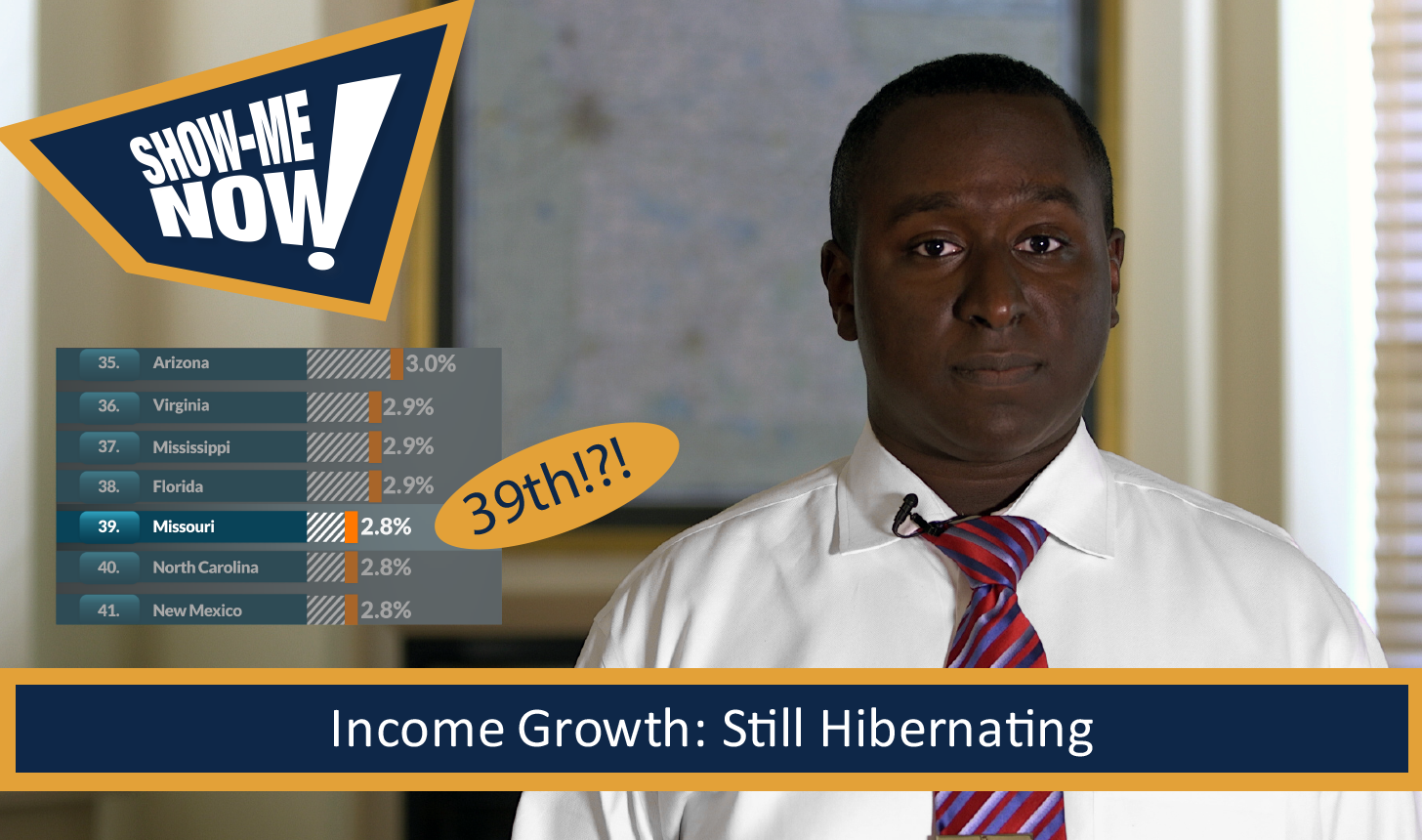
In the 2nd quarter of 2016, Missouri ranked 28th among the states for income growth. Looking at the state’s performance since 2010, Missouri ranks 39th. This disappointing performance is a cause for concern.
Company Births and Deaths: “Churn” and State Economic Growth

The continual birth and death of companies is a natural byproduct of competition in the marketplace. But is the rate at which this "churn" takes place related positively or negatively to the growth of our state's economy? Show-Me Institute Chief Economist Joseph Haslag explores the importance of churn for state growth in his new essay. Click on the link below to read more.
Michael McShane Appears on Ruckus To Discuss the New Nominee for U.S. Secretary of Education
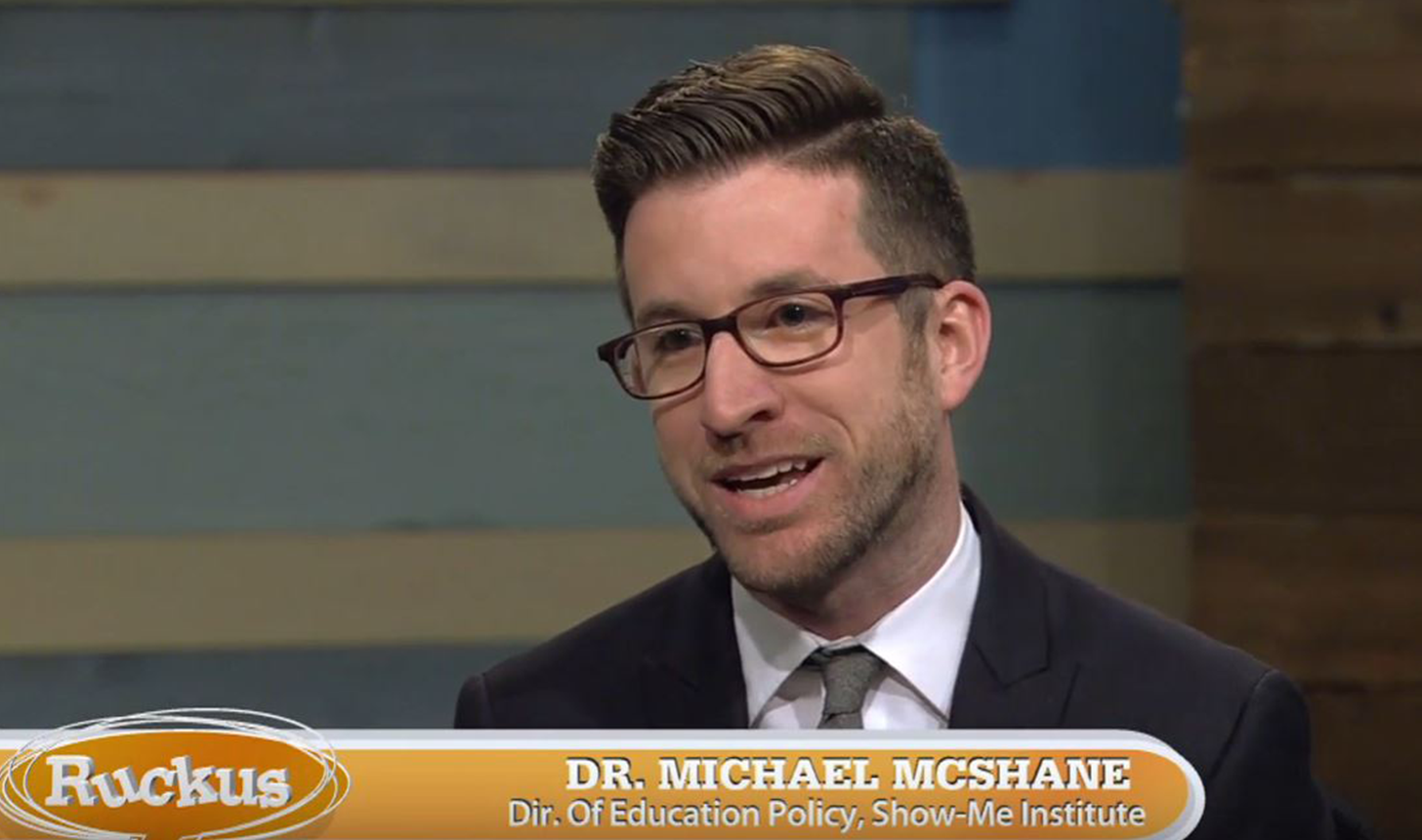
On Thursday December 15th, the Show-Me Institute's Mike McShane appeared on KCPT's Ruckus to discuss the new nominee for U.S. Secretary of Education.
Mike McShane on Pre-K Effectiveness

In a piece published on National Review Online today, Michael McShane casts a critical eye on a study that touts extraordinary benefits from two 1970's-era preschool programs for disadvantaged children. A small sample size, along with the prohibitively expensive per-pupil cost of the program studied, give us reason to be cautious before assuming that the study's findings could be replicated on a large scale. Click here to read the entire piece.
MCI and Privatization

For years now, city leaders have pushed for a $1.2 billion new airport terminal, first proposed by former Aviation Department administrator Mark VanLoh. Taxpayers, reluctant to risk the airport’s unparalleled convenience, have been unwilling to support the proposal. Though Mayor James has said that “doing nothing is not an option,” given the lack of public support and scant business interest in leading a campaign, nothing is exactly what the City is doing.
Mind you, doing nothing is not bad. The Aviation Department is getting on with normal maintenance and airlines have increased flights despite saying they could not or would not do so without a new terminal. A visit to the airport’s news web page shows notices of increased traffic and expanded service despite the lack of agreement on a new terminal. Yet City leaders are adamant about the VanLoh Plan and nothing else, barely even considering the less costly Crawford Plan for the terminals.
During the presidential campaign, Donald Trump included airports in his list of badly needed infrastructure improvements. He has suggested privatizing some roads and bridges, and recently the Cato Institute published a piece on privatizing U.S. airports, in which they wrote,
Airports should be self-funded by revenues from passengers, airlines, concessions, and other sources. Federal subsidies should be phased out, and state and local governments should privatize their airports to improve efficiency, competitiveness, and passenger benefits.
The entire piece is worth reading. After all, if the Aviation Department is as walled off from city finances as city leadership tells us (though not entirely), then what difference would it make if the airport was truly independent? If Kansas City business leaders want more and better amenities and the airlines share that desire, then maybe they should take on the task of running the airport themselves. Certainly, the discussion of privatization is upon us, and there is no reason Kansas Citians should not participate in it.
Show-Me Institute Looks Ahead in Wall Street Journal Article
In an article last week about the impact of the recent election on state policy, The Wall Street Journal came to Show-Me Institute CEO Brenda Talent for insight. The write-up for Missouri was as follows:
A new Republican governor, Eric Greitens, will replace term-limited Democrat Jay Nixon. “I think that we’re going to see bills that have been vetoed in the past, like right to work, go through quickly,” says Brenda Talent, the CEO of the Show-Me Institute. Last year the Republican House tried to override Gov. Nixon’s right-to-work veto but fell short by 13 votes.
Expanding charter schools, Ms. Talent predicts, will be an “easy lift,” and tackling corporate welfare is a possibility. “To give you an idea of the magnitude of the problem,” she says, “you could eliminate the corporate income tax in the state simply by eliminating economic development tax credits.”
Read the entire article here.
One Knot at a Time

When my mother was young, she decided to knit herself a sweater with her favorite flower, a daisy, on it. When she asked for some wool, my grandmother told her there was a bag of wool under the stairs. But when my mom opened the bag, all she found was a tangled mess of yarn from old scarves, sweaters, and blankets. In response to mom’s complaints, my grandmother said “All you need to do is to look for the easiest knot. When you undo that, the next knot will be easier. Keep going, and you’ll find all the wool unraveled.”
Sure enough, my mom started on the first knot, then the second and third, and once done, she started to knit. A pattern soon formed – a big, beautiful sweater with a daisy in the middle. At that point my grandmother turned to her and said “That sweater was in there the entire time—you just didn’t know where to look.”
Show-Me Institute writers regularly advocate eliminating or reducing the tangle of economic development credits that so often waste taxpayer money without providing the promised benefits. However, we also understand that such an endeavor can seem overwhelming, and that problems can easily become knotted together. To simplify such a convoluted mess, it can help to break the work into small chunks and work on it a bit at a time.
The Missouri Department of Economic Development’s 2015 Annual Report lists the amounts issued for every incentive issued in Missouri. Instead of looking at ways to eliminate such incentives or even cap the total amount issued, another option could be to tackle these incentives one at a time. Policymakers can start with the incentive with the smallest amount issued and work up, or they can tackle the largest ones, like the Historic Preservation Credit, and work their way down. The important thing is to focus on each issue separately before moving on to the next one.
In 2010, a state tax credit review commission considered ways to create greater efficiency and return on investment through tax credit programs. In its report, the commission listed 28 programs that do not create “a justifiable benefit in relation to their cost to taxpayers.” This recommendation could mark a good place to start unraveling. The state tax revenue recovered by eliminating ill-advised credits could allow for a proven economic growth plan: a broad and fair tax cut.
Riverview Gardens Students Lose the Right to Transfer
After nearly a decade of failing to achieve state accreditation, Riverview Gardens School District achieved provisionally accredited status, which will take effect in January 2017, leaving the Normandy Schools Collaborative as the only unaccredited district in the state.
This may be good news for the school district, but it could be bad news for students who have transferred out of the district over the past several years. According to Missouri law, unaccredited districts must pay for students’ tuition and transportation costs if they choose to transfer to a neighboring school district or charter school. Currently, 436 students from the Riverview Gardens district attend school outside of it. Now that the district is accredited, those students have lost the right to transfer at taxpayers’ expense to another public school district.
Participating school districts are working on an agreement to allow students to continue in their current schools after parents voiced concerns about disrupting their children’s education. According to assistant education commissioner Chris Neale, transferring students will be allowed to finish out at least this school year in their current school. Some students may be allowed to stay in their current schools until a “natural stopping point”—at the end of elementary or middle school for example—but no new students will be allowed to participate and Riverview Gardens will not provide transportation after June 2017.
Based on the scores below, it is easy to see why parents do not want to put their children back in the Riverview Gardens school system:
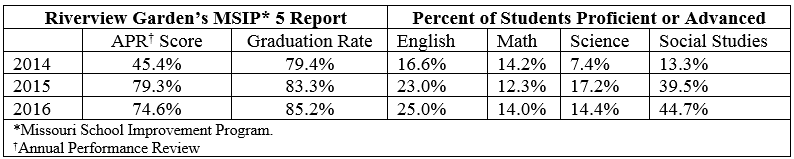
While test performance is not the only factor in the APR score—graduation rate, attendance rate, and college and career readiness are other factors—it is troublesome that a district with such low scores could become fully accredited as early as next year if they keep their APR score above 70%. To the school district’s credit, Riverview Gardens is working diligently to improve performance after years of academic and fiscal mismanagement. While these gains represent progress, the district still has fewer than 15% of students scoring proficient in Math and Science for the 2016 school year. Is it in the best interest of any child to be forced to attend a school with this kind of track record?
With such a low performance threshold, Missouri’s accreditation system and transfer law create a trap for students in districts just barely performing above the threshold—the schools perform too well for the students to be allowed to leave, but not well enough to prepare the students for work or college.
Missouri families deserve to make their own educational choices and shouldn’t be bound by fluctuating quality measures of the districts where they live. For the students in Riverview Gardens, continuing the current transfer program would help them in the short term. In addition, revising Missouri charter school laws and establishing tax credit scholarship programs or education savings accounts that are available to all students would help every child get the education that best fits their needs.
Are We Paying Some Developers to Develop Less?
Last week the Post-Dispatch reported on a proposed $130 million luxury tower in the Central West End, to be named "One Hundred," that if built would be among the tallest residential buildings in the state, vaulting 36 stories and touting a modern design that will certainly stand out as residents leave nearby Forest Park. But one thing sticks out in the story about the project: it's gotten larger, thanks to fewer tax incentives.
The story begins like so many tales of tax incentives. The building's developers had been expecting taxpayer help with the project, and indeed the project appears set to receive a 15-year tax abatement—a "95 percent tax abatement for 10 years and 50 percent tax abatement for five years." As reported, that subsidy will account for about 8% of the project, translating into a tax incentive of around $10 million. That's serious money.
That abatement, however, was actually less than what the developers asked for, which led to this remarkable revelation in the St. Louis Post-Dispatch's report on the building (emphasis mine):
Mac Properties initially sought 20 years of full tax abatement, officials said. Pushback by city officials prompted the developer to increase One Hundred’s height by seven floors to accommodate about 50 more apartments and spread out the project’s cost, Roddy said.
To repeat: the project is set to receive fewer incentives than planned, and to make the project work, the developer actually increased the size of the building.
We have often talked about the risk that's put on taxpayers when marginal development projects are underwritten by the public, but the story of the One Hundred building shows another risk we haven't talked about at length: that taxpayers could also be subsidizing the return on investment of private actors to the point that those actors settle on smaller, less risky projects. If a developer can make the same amount of money filling 250 rooms with a subsidy as 300 rooms with a smaller subsidy, a developer would do so. The former is less risky and the return is going to be about the same.
In practice, then, taxpayers may actually be paying some developers to develop less. Maybe it's time not only to emphasize the inequity of putting development risk on the public, but also to start talking about the potential of these subsidies to actively damage the state's growth potential.
