The Show-Me Institute’s Chairman Crosby Kemper III appeared on KCPT’s Ruckus on Thursday, March 2, to discuss the campaign for Kansas City’s GO Bond as well as other local and state issues.
Criminal Justice Reform: Expanding Parole

HB38, which would relax the requirements for prison time served before a person is eligible for parole, is a welcome reform to Missouri’s prison system. I hope it is the beginning of broader criminal justice reforms in Missouri.
Under current law, prison inmates must serve a minimum portion of their sentence before they are eligible for parole. Those percentages range from 40% for those with previous prison commitments to 85% for those with three previous prison commitments. Any inmate convicted of a dangerous felony must serve 85% of their sentence. HB 38 gives sentencing courts discretion over when an inmate is eligible for parole. Courts may still require prisoners to serve up to the current percentages set above—but judges would no longer be required to do so.
The bill also permits all Missouri inmates to be considered for parole if:
- Their crime did not include a particularly heinous motive or involve physical harm or a firearm.
- The inmate has been a model prisoner and demonstrated they are capable of rehabilitation.
HB38 offers the potential not only to reward good behavior and promote rehabilitation, but also to spare taxpayers the unnecessary cost of locking up potentially productive members of society.
Pernicious: St. Louis Goes Forward with Minimum Wage Hike

On Tuesday, February 28, 2017, the Missouri State Supreme Court upheld Saint Louis City’s right to raise its minimum wage. While the court’s decision may make legal sense, it is still bad economics. Enacting this ordinance will harm the poorest of workers. That’s why I describe it as pernicious.
The state minimum wage is currently $7.65. In 2015, the City of Saint Louis sought to raise the minimum wage on businesses within its borders. This initial attempt was struck down by a circuit court judge in 2015, but Tuesday’s ruling reversed that decision. As a result, the minimum wage that applies to businesses within Saint Louis proper (not the county or surrounding areas) will rise to $10 this year and $11 in 2018.
Saint Louis businesses will face higher labor costs, putting them at a competitive disadvantage against businesses located just across the city–county boundary. If I were an entrepreneur or business owner unsure of where to locate or expand, this minimum wage increase helped make the decision for me.
Show-Me Institute analysts have written many times about the effects of minimum wages hikes; see here and here for two examples. There are two main effects from this wrongheaded action.
First, and most obvious, raising the minimum wage imposes higher costs on businesses. Some of those businesses simply will not be able to maintain current operations: they will reduce the number of workers they employ, close up shop, or move. Why is it that supporters of the minimum wage hike have so much disdain for small business owners? After all, not every employer is McDonald’s.
Liberals and conservatives alike recognize that increases in the minimum wage will negatively affect exactly those workers for whom proponents claim to be champions; namely, the least skilled, entry level workers whom this higher wage will make even more unemployable. This is perhaps the most pernicious (there’s that word again) effect of all: Of the city’s estimated 69,000 individuals earning less than $11 an hour, how many will lose their jobs or face reduced hours? Can proponents claim success if the number of employed individuals declines by 6, or 600, or 6,000? It is bad policy that claims success on the backs of those made worse off.
And how many of those who are harmed by this latest minimum wage increase will we see interviewed so that the public understands how they were put out of a job by this unwise intervention? My guess is that the answer is zero. Out of sight, out of mind.
Lawmakers and union leaders will now sing their own praises and pat themselves on the back for the “good” they have done—no matter how much harm is done to workers and business owners.
School Choice for Those Who Can Afford It

An affordable home in a good school district is something of a holy grail for young families looking for a place to put down roots. In the Kansas City area, a KMBC News report pointed such families toward Blue Springs, which was rated as having the best combination of quality schools and affordable housing in the region. De Soto, Gardner, Kansas City North, Overland Park, Lenexa, Shawnee, and Prairie Village were also on the list.
This information is valuable for families who want to ensure their children are assigned to good schools. And it’s also an illustration of what is, unfortunately, the most common form of school choice: moving.
According to a survey conducted by the National Alliance for Public Charter Schools, 31 percent of parents said they moved to their current neighborhood so that their children could attend a specific school. Among families whose annual income was less than $50,000, however, only 25 percent of parents moved to a specific school district. For those making more than $150,000, it was 36 percent.
As lawmakers consider education savings accounts, charter schools, and course access this legislative session, many of their constituents have expressed doubts about these school choice initiatives. Certainly, we should consider such programs carefully; but we should also realize than many families in Missouri already practice school choice by moving out of one district and into another.
James Shuls, the Show-Me Institute Distinguished Fellow of Education Policy, called this “School Choice by Mortgage”:
Parents with the financial means can move their families to neighborhoods with good schools or they can afford private school tuition. The problem with our current system of school choice is that it leaves many parents with no options. The wealthier a family is, the more choices they have, while the most disadvantaged are left with little or no choice.
School choice programs like ESAs and charter schools are not meant to disrupt quality public schools where parent and student satisfaction is high. Rather, these programs are designed to provide opportunities to families who don’t have the means to buy a home in a good district or pay for private school tuition. Regardless of what neighborhood a family can afford to live in, shouldn’t their children have access to a quality education—whether it is at a public, charter, or private school?
Show-Me Now! Why Expand MetroLink?

Proponents of the multi-billion dollar MetroLink expansion proposal claim the system is underdeveloped, but is the opposite actually true?
Learn more about MetroLink:
Shaky Assumptions, Track Record Warrant Caution on GO Bond
Kansas City’s elected leaders have been speaking far and wide about the GO Bond before voters on April 4. Their presentations focus on what could be done with the money, and attendees often ask about the amounts that will be spent on sidewalks, streets, and an animal shelter. But often overlooked are two important points: the city’s assumptions about cost and how the city council spends money.
At a public meeting in Waldo, Finance Department Director Randy Landes said, “the average impact to the property tax owner . . . is an $8 increase each year.” The Mayor and other council members have said largely the same thing. A reasonable listener would conclude that the cost is only $8 per year. But that would be incorrect.
Using the city’s own numbers, the cost of the tax to a person with a $140,000 house and $15,000 car would be $13.68 the first year and would increase every subsequent year until it reached $206.13 in 2037. After that point, the payments each year would gradually decrease. After the last bond payment is made in 2056, this property owner would have paid $4,152.98. The owner of a $100,000 house and $15,000 car would pay $3,154.24.
Why city leaders chose the $8 “average annual increase” figure is puzzling, because that number is largely meaningless. Voters should know the annual cost, not the average annual increase in the cost. The city also reaches this number by doing two questionable things. First, the city includes in its estimates the existing GO bonds that will be paid off over the next 20 years and therefore reduce the overall tax levy. But those reductions will happen regardless of how people vote in April. This is money that taxpayers will no longer have to pay; to use it for purposes of calculating the cost of the GO bonds is taking money that would otherwise be in the taxpayers’ pockets. The city is thereby artificially lowering the cost of the GO bond by including unrelated items.
In order to get to the $8 figure, the Finance Department is also assuming that the city will not issue any more GO bonds for 40 years. This assumption borders on being intentionally misleading. Current city leaders have no idea what subsequent councils will do, but it’s difficult to imagine a scenario in which no new GO bonds are issued over the next four decades.
Another concern with the GO Bond is whether money will go to the stipulated projects, such as streets, sidewalks, and so on. City leaders are quick to point out that the money raised by these bonds is required to go to these purposes. But that isn’t the case with general fund money that currently funds these projects. Councilman Lucas admitted in the meeting, “If we spend important dollars on this bond obligation, we’re able to free up funds to attack other vital issues.” Money is fungible, and that means if the bonds are passed, the city will be able to reallocate general funds to projects that the voters have not vetted.
If city leaders want to be accountable, they should not ask taxpayers to commit to 40 years of increased taxes in a single vote. A more transparent approach would be to issue bonds over a much shorter period and be very explicit about where both bond and general fund money will go. As the period of each bond is completed, voters could assess how prudently their money had been spent before committing to handing over more money in a subsequent vote.
Kansas City desperately needs infrastructure maintenance, and public funds are the proper way to address those needs. But based on the city’s questionable assumptions on the cost of the GO bond and on future spending, voters would be well advised to follow the old adage, buyer beware.
Moody’s Issues Negative Outlook for Kansas CIty
We’ve written before about Kansas City’s debilitating level of debt (here and here and here). And it isn’t just us; the Mayor’s own Citizens Commission on Municipal Revenue 2012 report cites high debt as a problem and warned about the negative impact to the city’s credit rating. This warning, which appears to have been ignored, was prescient. As Kansas City leaders propose borrowing $800 million dollars via a general obligation bond, a major credit agency has weighed in.
Just two weeks ago, Moody’s Investor Services, one of the nation’s premier credit rating services, revised Kansas City’s credit outlook to “negative.”
The negative outlook reflects the growth of the city’s pension obligation and, when coupled with the elevated debt burden, the increase of fixed costs outpacing revenue growth. Continued leveraging of the tax base or unabated expansion of the pension obligation will place downward pressure on the rating.
This comes as Kansas City leaders are asking voters to approve another round of debt, backed by an increase in property taxes, to pay for the sort of maintenance that the city should be paying for with our already-high property, sales and income taxes.
The problem is that city leaders keep throwing money at things like subsidies for downtown development and large consulting contracts instead of dedicating funds to basic services. Frequent borrowing and an increasing debt load mean lower credit ratings and higher borrowing costs—the city seems locked in a payday loan–like cycle. Moody’s seems to recognize this even if policymakers don’t, and citizens may have to take matters into their own hands if this cycle is to be broken.
Checking the Fact-checkers
Politifact Missouri has a new “Fact Check” out on the Governor’s statement in his State of the State Address that over 200 districts in Missouri do not offer Physics. That data point comes from a research paper we published over a year ago (which we have since updated). After our corrections, our overall numbers align pretty closely with those from Politifact (the author found 178 districts with no students enrolled, 156 districts if you counted a course called “Physics First”).
But once the hard numbers were established, the article started to go off the rails.
First, the author makes the case that Physics First should be counted as “Physics” for the purpose of measuring course access. I disagree. Physics First is, by the author’s own admission, an “introductory science course.” There is absolutely nothing wrong with introductory courses, but if we allow Physics First to “count” as the only physics course offered in a district, we are defining our expectations down severely. Just like we would want a district that only offered Geometry or Algebra to step up its game, so too should we if it only offers Physics First.
The author then proceeds to use overall physics enrollment in the state to make the case that Missouri is not behind the rest of the nation when it comes to Physics. The problem is that overall enrollment numbers don’t have a lot to do with course access. Sure, Missouri might have one of the higher rates of Physics enrollment around the nation, but how is it distributed? Given the population patterns of the state, high enrollment in our cities and suburbs could mask the fact that rural students don’t have access to higher level courses. Given the author’s own findings that 178 districts don’t offer advanced Physics, this very well might be the case.
But perhaps most problematic is the blurred line between fact and opinion. Whether we should count Physics First is a judgment call on which reasonable people can disagree. The author assumes that the Governor was using the Physics course access statistic to buttress a point about Missouri being behind on academic indicators. I took it as a simple statement that not enough districts offer Physics. Again, reasonable people can disagree. When we look at the hard numbers (not counting Physics First) from 2014-15, the Governor was off by less than 5 percent. If we look at our updated 2015-16 numbers, he was off by less than 3 percent. That doesn’t strike me as being “mostly false,” but I’ll leave that for readers to decide.
That said, I don’t want to go too far down the rabbit hole of debating how many angels can dance on the head of a pin. We cannot lose sight of the fact that, whatever you think on the question of defining Physics courses, far too many school districts do not offer higher-level classes. This includes not only Physics, but Calculus and AP classes as well. And those are not just statistics, but real children’s lives that are being denied the opportunity to get the education they need. Let’s focus our energy on fixing that.
Was It Something We Said?
For many years, both Atlas Van Lines and United Van Lines have compiled data on the number of moves into and out of states. Over the past several years Missouri has seen more households moving out than moving in. Based on the van lines’ recent reports, that all-too-familiar story continued in 2016.
Between January 1 and December 31 of 2016, Atlas reports that 1,062 households left Missouri and 989 households moved in. A similar tale is told using the data from United Van Lines: Of the 4,362 total moves made in 2016, 2,256 were outbound and 2,106 were inbound. Although the numbers are close, it is still true that on net more Missouri households are deciding to leave the state.
The United study is valuable because it breaks down the total number of into reasons for moving, and they disaggregate the data by income and age. In terms of reasons for moving, not surprisingly the vast majority of households move because of jobs. Sixty-two percent of those moving out cited job-related reasons, and 60 percent of those moving into the state did so because of work. The second highest category was “family,” with about 20 percent inbound and outbound choosing that reason for the move.
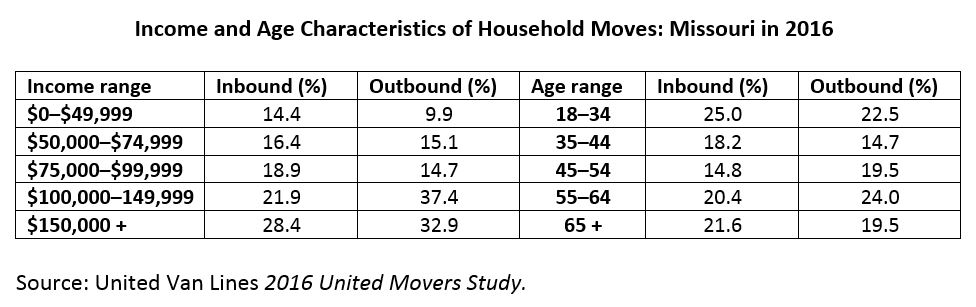
The income and age characteristics of those moving are more revealing. The table below breaks down of inbound and outbound moves by income (left-hand side of table) and age (right-hand side of table). The data suggest that those in the highest income ranks—incomes exceeding $100,000—were, in 2016, net out-migrants: more left Missouri than moved in. This accords with earlier results: Michael Rathbone and I found that, based on IRS data, those who moved out of Missouri tended to be higher income individuals.
When age is the common denominator, it appears that in-migration in 2016 is concentrated in the younger age groups (those younger than 44). Of those between the ages of 45 and 64, prime wage-earning years according to a New York Federal Reserve study, there was a net migration out of Missouri, however. And for the 65-plus age group, it is essentially a wash: just about as many moving out as moving in.
This 2016 data builds on the prevailing story that Missouri’s residents continue to reveal their preferences and, on net, seek other, more attractive economic environments.