

The Missouri Automobile Dealership Association has sued to force Tesla to sell their cars through independent dealerships instead of directly to customers. Why shouldn't Tesla be allowed to pursue the business model it believes will make it successful?
Millennials Love School Choice

Millennials often get a bad rap for selfishness and self-righteousness—Times Magazine labelled us the “Me Me Me Generation,” after all—but when it comes to school choice and education reform, we’re leading the way.
Earlier this month a polling report released by EdChoice demonstrated that support for school choice policies is stronger among millennials than among older generations. When surveyed about charter schools, voucher programs, education savings accounts, and tax-credit scholarships, millennials’ support for these programs was the strongest of any age group. The table below breaks down generational support for four different school choice policies.
| Charter Schools | Voucher Programs | ESAs | Tax-credit Scholarships | |
| Millennials | 63 | 61 | 57 | 63 |
| Generation X | 61 | 56 | 53 | 56 |
| Baby Boomers | 53 | 52 | 46 | 50 |
| National Average | 59 | 56 | 49 | 55 |
The margin of support for school choice grows even larger with millennial parents of school-age children. Over 70 percent of millennial parents support each of the four school choice programs.
It is not surprising that millennial parents support these policies so enthusiastically, considering that 61 percent of all millennial parents would choose a nontraditional public school for their child if they could.
Unfortunately, policy has not kept up with parental demand. Consider the following:
- 11 percent of parents would like to enroll their child in a charter school, but only 5 percent actually do so.
- 38 percent would like to enroll their children in private schools, but only 10 percent do so.
- 12 percent of families would like to homeschool their children, but only 3 percent of parents do so.
By contrast, even though traditional public schools are the first choice for only 30 percent of parents, 83 percent of parents send their children to public school.
Another interesting find in this report is the difference of opinion between white and nonwhite millennials. While both groups support school choice policies, nonwhite respondents held more favorable views of charter schools (69 percent compared to 60 percent of white millennials) and ESAs (65 percent versus 55 percent of whites). These results are especially relevant in light of the NAACP calling for a moratorium on charter school expansion recently, and the backlash from parents that followed.
Given that millennials are a growing portion of the adult population and make up most of the parents of school-age children, policymakers would be wise to listen to their opinions on education policy. Instead of limited educational opportunities, parents want to be empowered to provide their children with the best education possible through school choice.
ER Visits Spike With Obamacare’s Medicaid Expansion

I’ve written at length about the negative effects of expanding a broken Medicaid program under Obamacare. Poor health outcomes and limited care access rank high among the reasons to be wary of throwing more money at the program, but consider also this broken promise of the law: that by expanding the program, supposedly wasteful emergency room visits would fall, because more people would be “covered” by a government health plan. But fresh research from the New England Journal of Medicine shows that those ER claims have not been justified: rather than decrease unnecessary ER visits, Medicaid expansion actually appears to increase them.
The new study resulted from the Oregon Medicaid experiment, in which Oregon expanded Medicaid to a limited number of lower-income, non-disabled adults using a lottery. The expansion’s design, which involved random assignment, allowed researchers to draw more reliable conclusions about the impact of Medicaid eligibility than observational studies.
. . . Of crucial importance, the study also found that “[a]cross a variety of alternative specifications, we consistently find that Medicaid’s value to recipients is lower than the government’s costs of the program, and usually substantially below.” They estimated that the “benefit to recipients from Medicaid per dollar of government spending range from about $.2 to $.4.”
Cato director of health policy studies Michael Cannon has said that the Oregon Health Insurance Experiment (OHIE) “may be the most important study ever conducted on health insurance,” precisely because researchers were able to isolate the health effects of Medicaid coverage in ways that, under normal research circumstances, is very difficult to do. These findings, then, represent a gold standard by which claims about the Medicaid program can be fact checked in key respects, including emergency room usage.
In our direct primary care paper, published last year, we looked at emergency room usage and Medicaid as well, and we found plenty of evidence to support the OHIE research team’s findings.
Perhaps most startling is recent news from a survey of emergency room doctors, taken this year by the American College of Emergency Physicians [ACEP], suggesting that the expansion of Medicaid has actually increased—not decreased or kept flat—emergency room usage. As explained by Dr. Howard Mell of the ACEP in the Wall Street Journal, “Visits are going up despite the ACA, and in a lot of cases because of it.”
ACEP’s 2015 report was not the product of a once-off survey, either. In 2014, one-third of emergency departments reported seeing more Medicaid patients; in 2015, over half reported an increase.
With the failures of the Obamacare exchanges, it is more important than ever to ensure that Missourians are not exposed to more of the Obamacare disaster. That means continuing to reject a broken Medicaid expansion that doubles down on bad policy. Without reform, the Medicaid program will continue to imperil both the health of patients and the money of taxpayers, and unfortunately, expanding Medicaid would serve to aggravate the program’s long-standing problems.
Video: Opening Up Missouri’s Healthcare Market

The Affordable Care Act has transformed healthcare across the country. In Missouri and other states, there are steps that can be taken to open up healthcare to more market competition.
It Takes a Village to Raise a Subsidy

The Cardinals recently announced plans to move forward with a second phase of development at Ballpark Village, an entertainment district directly adjacent to Busch Stadium. This phase of development is seeking, just like the first phase sought and received, tens of millions of dollars in public subsidies.
The team is asking city officials to impose an additional 1% sales tax on Ballpark Village to help fund the second phase of development. This tax is estimated to generate $16 million. But why does a project like Ballpark Village, which by many accounts is doing quite well—albeit at the expense of other businesses—need yet another subsidy? Is there a good reason why ordinary Saint Louisans should cough up more of their cash just so a successful business can expand?
In short, no—there is no good reason. All the subsidy does is increase the profits of a hugely wealthy corporation. One of the biggest proponents of the subsidy, 7th Ward Alderman Jack Coatar, even admits the project would move forward (albeit on a “scaled-down” scale) without the subsidy. So why are city officials trying to put taxpayers on the hook for yet another development?
Proponents of the subsidy might object that the additional sales tax is self-imposed, and so only Ballpark Village costumers will actually pay the tax. While that’s true, we should ask ourselves why there should be an extra tax in the first place. That is, if the project is so great, why don’t the Cardinals just increase their prices by 1% instead of securing revenue via taxation?
And while the Cardinals promise the project will create 2,500 jobs, we shouldn’t get our hopes up (as the Business Journal cautions). Many of those jobs are temporary construction jobs, and the definition of a “new job” is somewhat slippery. New jobs could be jobs that moved in from just outside city limits, or jobs that a tenant at Ballpark Village claims would have left the city if not for the subsidies the project could receive. But moving jobs from, say, Clayton to downtown Saint Louis doesn’t help our regional economy, and there is so way to prove what a business tenant would have done if not for the subsidy. In short, the “Net New Jobs” clause touted by city officials as a way to protect taxpayers appears to be just a fig leaf that will not ensure that taxpayers actually get a return on their investment.
This project offers no real guarantees to the city or to taxpayers. The only guaranteed winner is a billion-dollar corporation. Does that sound fair to you?
Which Came First: the Investment Chicken or the Incentive Egg?
Saint Louis Mayor Francis Slay recently touted the amount of money—more than one billion dollars—that has been invested in the city this year. This investment, up 12% from last year, is good news. But here’s something the mayor isn’t touting: Nearly 80% of the investment has occurred in just 5 of the city’s 28 wards.
Comparing the two maps below shows that significant investments (top map) are clustered in areas where subsidies like tax increment financing (TIF—bottom map) are being granted to developers (primarily the central corridor).
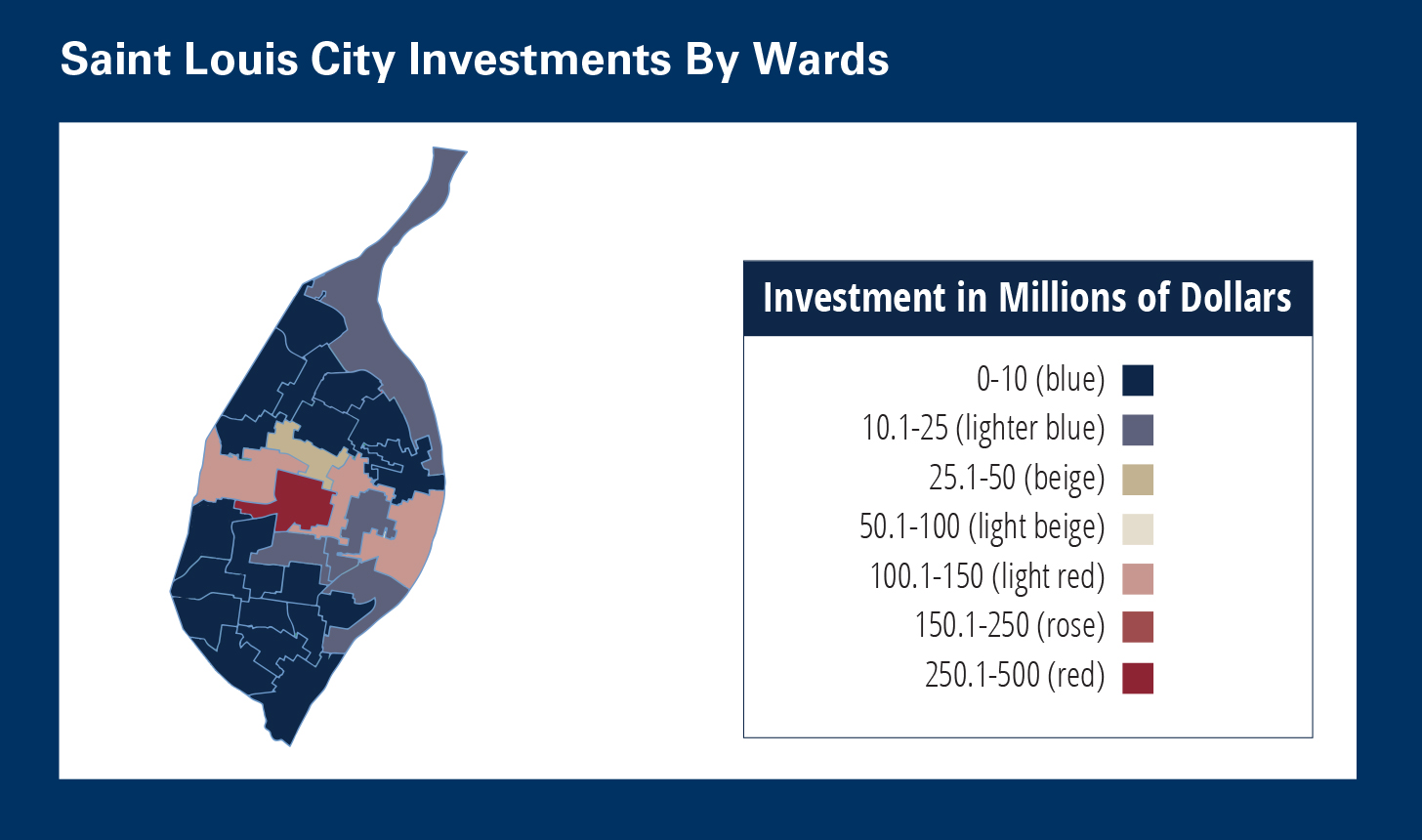

(Note: The active TIF project map reflects only subsidy dollars that have been awarded to date, not the total amount of subsidy authorized. For example, the Northside Regeneration TIF, on which work has not yet begun, is not included in the map.)
So one might ask: Are development subsidies like TIF responsible for these investments? Initially, it might look that way. After all, TIF is designed to spur development.
But although it may sound counterintuitive, overall real-estate investment has likely driven the use of TIF and other incentives in the central corridor. That is, TIF and other taxpayer handouts tend to follow investments, not the other way around.
A recent report on incentives in St. Louis suggests that TIFs get doled out in neighborhoods that are already doing well or are on the rise. If there is a cause–effect relationship between TIF and development, then strong markets appear to attract TIFs.
But for the sake of argument, let’s assume that I and other researchers are wrong, and that TIFs cause strong real estate markets. If that were the case, the city’s current incentive practices would be open to serious questioning. So few incentives are being used in genuinely depressed and blighted neighborhoods, and so many are being handed out in neighborhoods that are already thriving, that it’s hard to imagine any result other than a widening of the gap between wealthy and struggling areas. That is, the city’s current practices would go exactly against the original intent of development subsidies. Can this possibly be the intent of city leaders? I certainly hope not.
ESAs Can Help Missouri Students with Dyslexia
For years, Kelli Unnerstall wrestled with private and public schools to get her son with dyslexia the help he needed to succeed in school. Sharing her story with the St. Louis Post-Dispatch, she explained that her son started struggling in kindergarten but is only now receiving remedial services in high school.
Now Unnerstall, cofounder of Decoding Dyslexia Missouri, is helping other families by working with the Missouri Legislature. This summer, Governor Jay Nixon signed a bill mandating that public schools screen students for dyslexia by the 2018–2019 school year. The legislative task force responsible for implementing this new law met for the first time earlier this month.
The goal is to develop a more detailed plan for screening students and training teachers to help students with dyslexia. Rep. Kathy Swan, R-Cape Girardeau, is now heading the dyslexia task force. During the first meeting, she pointed to tests used by other states like Mississippi that have helped detect dyslexia and get children closer to the help they need.
But what is the plan for students after they are diagnosed with dyslexia? Will extra training for teachers and some classroom accommodations be enough for these students who often fall behind?
To best help these students, Rep. Swan and the task force should consider taking another cue from Mississippi.
The Mississippi Dyslexia Therapy Scholarship is the only program in the nation that is tailored to help children with dyslexia by offering families a voucher for their children to attend private schools that offer dyslexia therapy programs. Mississippi also established an education savings account (ESA) program for children with special needs.
Along with Mississippi, Arizona and Florida have taken the additional step of creating ESAs for students with dyslexia and other disabilities. Ten other states have made significant progress by establishing school choice programs designed specifically for special-needs students.
Mandatory screenings to help identify children with dyslexia are a good start, but only a first step. Vouchers, tax credit scholarships, and ESAs are working for students in other states by giving their parents more control over their education and providing the financial means for additional therapy and tutoring. What is Missouri waiting for?
Hair Braiders Continue Missouri Licensing Fight

Last month we published a paper on medical licensing and reforms that could make care more available to Missouri patients, but the lessons from that essay—unshackling supply to meet customer demand—are not exclusive to the medical profession. Indeed, licensing laws can act as unnecessary barriers not only to customers seeking medical services, but also to professionals in other fields who are ready and able to offer services to customers who need them.
That unnecessary inteference by government is the basis for a lawsuit filed in 2014 by the Institute for Justice against Missouri's Board of Cosmetology and Barber Examiners and on behalf of two St. Louis-based hair braiders. As IJ explains on its website,
If you want to braid hair for a living in Missouri, you must spend thousands of dollars on at least 1,500 hours of cosmetology training that teaches you nothing about African-style hair braiding. That’s far more time and money than it takes to become a licensed EMT in the state.
Joba Niang and Tameka Stigers have been braiding hair for much of their lives and each woman owns a successful hair braiding business. African hair braiding is a centuries-old natural hair care technique that uses no dyes or chemicals; it is safe for the braider to perform and does not hurt the person getting their hair braided. But Missouri wants to turn the two women into criminals.
First, the bad news. In September a federal judge ruled against the hair braiders, saying that the Board's licensing regime was acceptable "despite claims from braiders that the process is irrelevant to what they do, unnecessary and expensive." IJ plans to appeal.
But the good news is that along with the potential for relief on appeal, newly-minted Missouri state legislators could always simply revisit the issue of licensing in the next legislative session and, just reform the law for braiders and other professionals. Certainly there have been attempts at reforming licensure in the past, with some positive results, but as a general matter it's been slow going in this policy area.
That needs to change. It's clear that Missouri's licensing system is in need of a significant overhaul—for medical professionals, hair braiders, and other professionals. And regardless of what happens in the courts, I hope we see progress in licensure reform in the legislature in 2017. It would be good for workers, and for consumers.
Subsidies in St. Louis, Part 2: Economic Development Blunders
City officials, developers, and corporate welfare proponents have touted the benefits of development incentives like tax-increment financing (TIF) to taxpayers for years. These subsidies make investments like the construction of office towers and entertainment districts possible, helping to create jobs and rejuvenate neighborhoods. Or so we’ve been told.
The recently released St. Louis Development Corporation (SLDC) incentive report casts doubt on those claims. Incentives, the report concludes, provide little or no economic development benefits. They may help put up shiny new buildings, but they don’t genuinely boost Saint Louis’s economic health.
This is what the research tells us:
There is little or no connection between the use of incentives and job growth. Although proponents claim TIF will help bring jobs to the area, there is almost no connection between increased employment and TIF. For every $1 million of TIF invested, there are only seven associated jobs (p. 95). And the few construction-related jobs created by TIF have huge costs. In 2015, each job created by TIF in St. Louis cost taxpayers more than $53,000.
But it gets more disturbing. According to Missouri’s annual TIF report, even when controlling for developments less than 5 years old, less than 35% of projected jobs listed in developers’ proposals have actually been created or retained by TIF projects in St. Louis. And because TIF job creation figures are self-reported and unaudited—it’s possible that even the 35% number is overstated.
TIF does not help rejuvenate neighborhoods or spark further investment. When researchers looked at neighborhoods with incentive-driven development, they found that only the parcels that receive incentives increase in value. The SLDC report found zero evidence that a statistically significant increase in property values can be attributed to the effect of TIF-spurred development. The neighborhoods surrounding TIF projects are no more likely than unincentivized areas to see other large investments without incentives. In short, so-called “anchor developments” provide no real benefit to their neighborhoods.
The researchers concluded that, “[w]hile there may be disagreement about the value of some packages, it is clear that the City gains no net benefit from an extremely costly program with no real economic development impact” (p. 6, my emphasis). Along the most important measures of success—job creation and neighborhood revitalization—incentives appear to fail, making it hard to justify continuing to spend tens of millions of dollars each year subsidizing development projects.
(Read part 1 in the series here)
