Straight Talk on Kansas City’s Incentive Reform
In 2014, Mayor Sly James said that “Now is the time to start a conversation about the appropriate level of incentives we need to grant, especially considering the impact of declining property values felt by all taxing jurisdictions during the recent economic downturn.” At the time, he suggested that a 50% reduction in subsidies would be a “new normal”.
But very recently, when the City Council of Kansas City passed an incentive reform measure that lowers the level of subsidies that developers receive by 25%, the Mayor’s reaction was less than enthusiastic. He said that the reform could “once again put up a sign that says Kansas City is closed for business.” It’s disheartening that our leadership would reverse course on such an important issue, and it’s unfortunate that the Mayor would respond to sound policy changes with such overblown and misguided worries.
Councilman Quinton Lucas and others deserve credit for their efforts in passing reasonable and fair development incentive reform. Even the modest 25% reduction in subsidies can be waived if a project is determined to be “high-impact” or falls within an economically depressed area. The measure passed by the City Council is a first step in the right direction. The Mayor’s complaints—which defend the status-quo, crony-capitalist development scheme Kansas City has pushed for decades—seem to be a step backward.
The reform places a modest cap on development subsidies. Do developers truly need bigger tax breaks than the new cap allows for their projects to move forward? If so, then the real problem isn’t that the city is closed for business, but rather that its tax and regulatory climate make huge subsidies necessary. In any case, the bill contains provisions allowing high-impact projects to receive the pre-reform level of assistance, so any game-changing projects would be unaffected. In fact, some projects have already avoided the 75% cap.
In addition, proponents of development incentives like tax-increment financing (TIF) and tax abatements have been unable to provide solid evidence that such subsidies work; that is, they don’t create jobs or enliven our economy. Shiny new office towers and a handful of construction jobs are nice, but they won’t spark a new era of growth in one of Missouri’s slowest-growing cities. A comprehensive report on incentives in St. Louis, much like the one Kansas City officials intend to conduct, concluded that “[w]hile there may be disagreement about the value of some packages, it is clear that the City gains no net benefit from an extremely costly program with no real economic development impact.”
In short, we’re fooling ourselves if we think Kansas City’s economic engine is fueled solely or even substantially by incentives.
Over the past fifteen years, Kansas City’s tax base has been hollowed out by incentives like TIF and abatements. The schools, libraries, mental health funds, and local governments affected by Kansas City’s incentive policies have been shorted for the benefit of developers.
Incentive reforms like those championed by Councilman Lucas are welcome steps toward curbing incentive abuse, and toward restoring funding for essential government services—and with them, our faith in city government. Perhaps we wouldn’t need such reforms if local leaders would just say “No” to excessive taxpayer giveaways in the first place.
Wendell Cox and Crosby Kemper III on KCPT’s Ruckus
Wendell Cox discusses his recent essay on the competitive strengths and weaknesses of Kansas City. Crosby Kemper III also appears as a panelist and discusses budget shortfalls in Kansas and the wave of protests sweeping the nation since the presidential election.
Kansas City: Genuinely World Class
Today the Show-Me Institute is publishing Wendell Cox’s paper, “Kansas City—Genuinely World Class: A Competitive Analysis,” in which the author considers what makes Kansas City unique – and what makes it uniquely competitive. A link to the paper itself is available at the end of this post.
Cox comes to a number of very interesting conclusions.
For one, Kansas City’s housing is much more affordable relative to incomes than in any of the cities The Economist considers for their list of the 10 Most Livable Cities. The reason for this is that while cities were increasing land regulation through urban containment policies, Kansas City did not. For example, in 1990 Denver, Portland and Kansas City were all similar in the relation of housing prices to median income. Since then, due largely to excessive land use regulation, Denver and Portland housing prices have skyrocketed while incomes have not. Kansas City homes have remained as affordable as they were before.
Another one of Kansas City’s competitive advantages is commute times. Despite its sprawl, Kansas City has one of the shortest commute times in the world. Thanks to an impressive network of highways, traffic congestion is so slight that Kansas City had the least traffic congestion (tied with Richmond) in the 2015 Tom Tom Traffic Index. And lack of congestion isn’t due to public transit. Eighty-two percent of area residents commute to work alone in a car—including 76 percent of low-income workers. In fact, only 3 percent of low-income workers in Kansas City commute to work by transit. Kansas City (like virtually all US metropolitan areas) is an automobile-oriented city and doing just fine.
Understanding these advantages is imperative if Kansas City is going to build on our strengths. Policy makers are often lured into adopting programs based on the results in Portland, or Denver, or Dallas. But Kansas City is not any of those places, and there is little guarantee that such policies will work here. If we want Kansas City to succeed, we need to understand exactly what we have to offer. This paper seeks to start that discussion.
Funding the Foundry: Why Are Taxpayers Continually on the Hook?
When St. Louis public schools are underperforming and the water department is trying to get lead out of the water, one might think it isn’t the best time for public officials to grant tax subsidies to wealthy developers. After all, couldn’t the potential revenues from such taxes be spent in other, more effective ways—ways taxpayers might actually see a return on?
You might think so, but some city officials don’t see it that way. The Saint Louis City Tax-Increment Financing Commission, a public body that awards tax subsidies, recently granted $19.4 million to the developers of a mixed-use project in midtown St. Louis. The development, dubbed the “City Foundry”, would include office and retail space, residential buildings, and a food court. The Foundry would be a welcome addition to the area, but why should tax dollars go to fund it over, say, schools and basic infrastructure?
Officials haven’t addressed that question. And what’s worse is that even without the TIF subsidy, over 41% of the costs of the $134 million project will be shouldered by taxpayers. The chart below depicts the proposed funding sources for the project. Is the $19.4 million in tax increment financing, which represents forgone tax revenue, really necessary when so many other subsides are funding the project? Especially when the developers are also seeking tax abatement on top of all these other handouts!
|
City Foundry Funding by Source |
||
|
Funding Source |
Funding Amount |
% of Total Project Cost |
|
Federal Historic Tax Credit |
$14,917,000 |
11% |
|
State Historic Tax Credit |
$17,384,000 |
13% |
|
State Brownfields Tax Credit |
$5,075,000 |
4% |
|
CID/TDD Sales Tax Revenue |
$18,100,000 |
13.5% |
|
Tax-increment Financing (TIF) |
$19,400,000 |
14.5% |
|
Loan & Developer Fee |
$59,290,000 |
44% |
|
TOTAL FUNDING |
134,166,000 |
100% |
Source: City Foundry Application for Tax Increment Financing, assembled by author.
When our communities have so many needs but limited resources, leaders have an obligation to make every dollar count. Before the City signs off on this incentive package, they should think hard about whether this plan constitutes the most prudent use of public funds.
Kansas City Hires Fox to Watch Henhouse
According to the Kansas City Business Journal, the City of Kansas City has approved contracting with the Council of Development Finance Agencies (CDFA) to "conduct a comprehensive analysis of the city's historic use of incentives and the resulting impacts." Their report may be used to assess the effectiveness of economic development subsidies, but what do we know about this organization?
First of all, CDFA is not an accounting or financial auditing firm. According to their website, they are:
a national association dedicated to the advancement of development finance concerns and interests. CDFA is comprised of the nation’s leading and most knowledgeable members of the development finance community representing hundreds of public, private and non-profit development entities.
Their mission is “to promote the common interest of Development Finance Agencies with respect to public policies and programs,” which isn’t exactly what you’d expect from an independent, disinterested organization.
In short, we’ve agreed to pay up to $350,000 to an association that represents development financiers and their “interests” to evaluate the effectiveness of our development financing. How likely is it that CDFA will be critical and impartial? This is a legitimate concern, because Mayor James has already stated that “City Hall doesn’t do a good enough job of promoting how economic development benefits the city.” Are we paying for analysis, or for cheerleading?
To assess their own economic development programs, the Saint Louis Development Corporation hired The PFM Group, an independent public financing advisory company. Of themselves, PFM writes,
Founded April 11, 1975 on the principles of expert, unbiased advice, the PFM Group of companies also provides investment advisory and management/budget consulting services to clients across the country and are recognized as industry leaders.
For $180,000—roughly half of what Kansas City proposes to spend—PFM completed a substantive analysis of St. Louis economic programs and concluded that TIF and abatement are extremely costly and have little or no economic development impact. (We’ve reviewed their findings here.)
Other studies of economic development subsidies like TIF have been conducted by scholars at universities such as the University of North Carolina-Chapel Hill and Washburn University in Topeka. These studies, along with works published in the Journal of Urban Economics, and in Urban Studies have raised serious concerns regarding the impact of economic development subsidies. Other regions have found substantial costs associated with little economic benefit, so Kansas City should take its self-evaluation seriously.
States like California, which ended TIF in 2012, and cities like St. Louis should be applauded for facing the reality of their economic development policies. Not so in Kansas City. If our leaders are serious about promoting good policy, they need to be willing to seek out independent, disinterested research and make the appropriate changes.
Wendell Cox on KC Competitiveness
Subsidies in Saint Louis, Part 3: Where They’re Used
Supporters of economic development subsidies justify them on the basis that the subsidies will help boost economically depressed areas by increasing investment. The intention seems good; but in Saint Louis, incentives seem to be going to places where they aren’t needed, and they don’t seem to be going to the places that do need them.
A study commissioned by the Saint Louis Development Corporation (SLDC) looked at geographic distribution of incentive use in the city and found that roughly two-thirds of the total value of credits is concentrated in a handful of neighborhoods. This by itself may not be a problem—maybe those few areas are struggling disproportionately and need the help. But that’s not the case. To the contrary, the study showed that most incentives go toward neighborhoods that already have strong housing markets. In other words, well-off areas are receiving subsidies, while the economically depressed parts of St. Louis are ignored.
One potential cause of this inequitable distribution is the lack of rigor in the approval process for incentives. Tax increment financing (TIF) applications currently require land to be declared as “blighted,” or as “conservation” or “economic development” areas, but the legal definition of blight has become so watered-down that almost any piece of property can be declared blighted.
Additionally, the SLDC report found that some important requirements that other cities use when deciding to award tax abatement aren’t applied in Saint Louis:
As it relates to tax abatement, a significant number of the benchmarked cities require either (or both) a cost benefit analysis prior to award of the abatement and have job creation criteria as part of the decision to award. St. Louis does not require either for tax abatement. (p.3)
It seems that Saint Louis’s method of evaluating and approving tax incentives could stand some improvement, but the issues run deeper than the approval process. Part 4 of “Subsidies in Saint Louis” will discuss accountability measures regarding reporting and job creation.
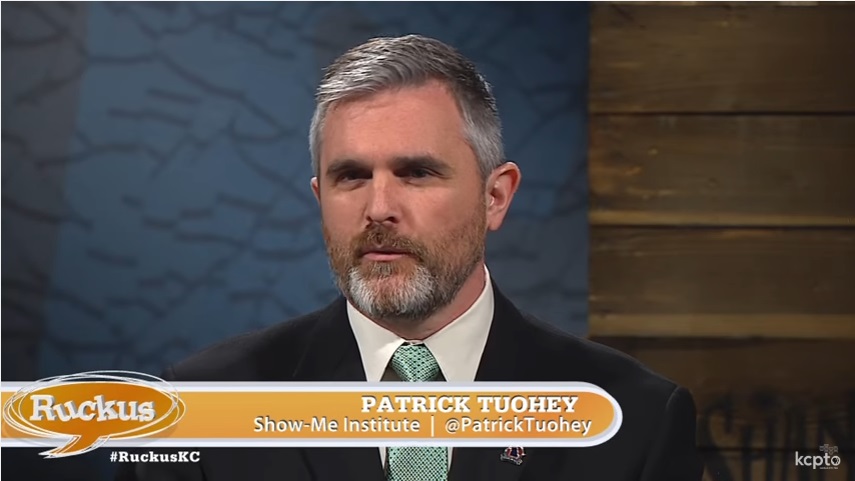
Patrick Tuohey Appears on KCPT’s Ruckus
On Thursday, November 10, the Show-Me Institute’s Patrick Tuohey appeared on Kansas City Public Television’s Ruckus to provide analysis of this week’s local and national election results and the effect this will have on Missouri public policy.