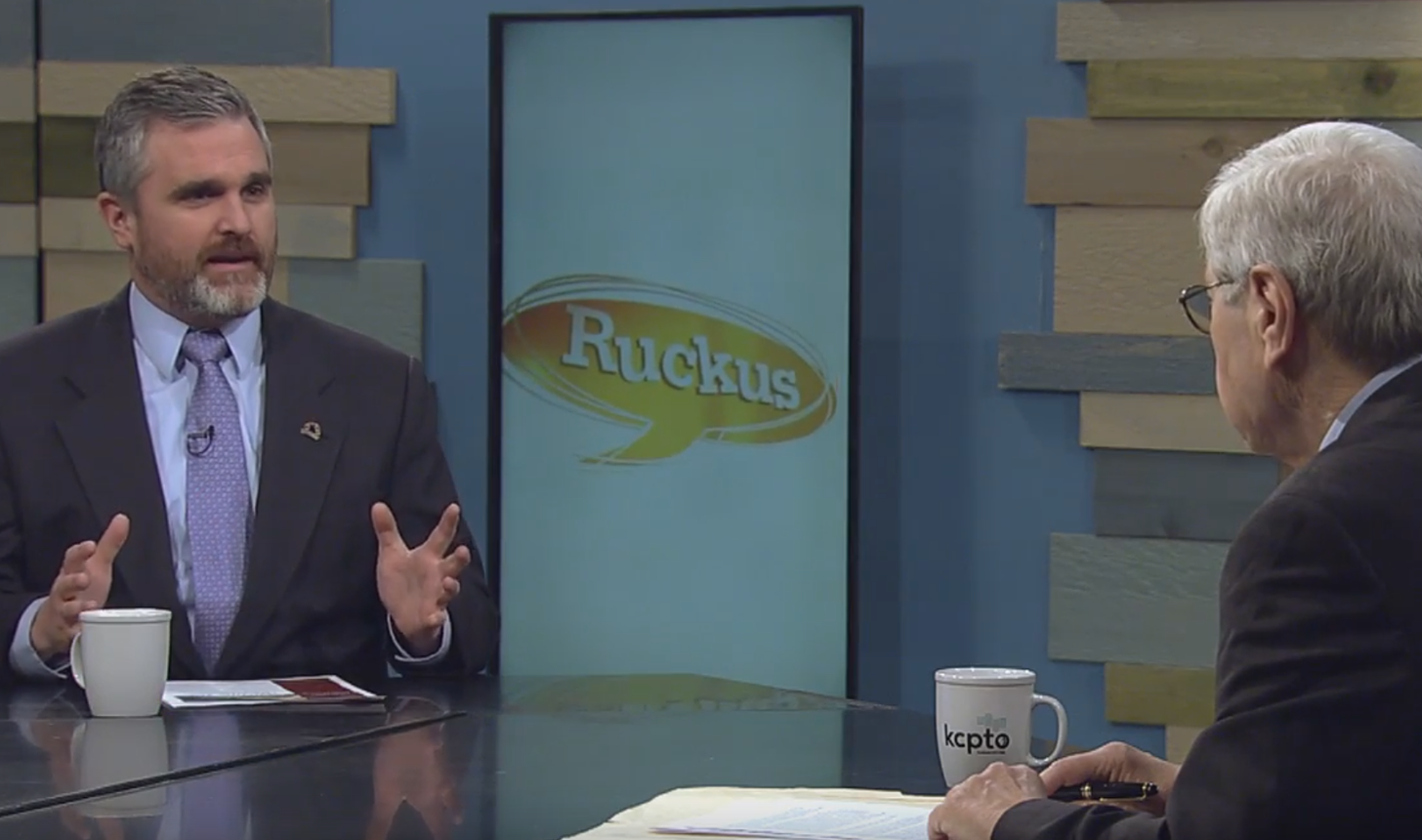
Retooling Missouri’s Economic Engines

Dave Helling at The Kansas City Star recently wrote a piece about how Kansas City and St. Louis might fare under Missouri’s new governor. Helling wrote,

Kansas City and St. Louis interests have been nervous about Jefferson City for years, of course. Rural Republican lawmakers have long looked askance at big-city projects and have turned back city efforts to raise the minimum wage or tighten gun control laws.

In January, Kansas City Mayor Sly James testified before the Missouri Senate Ways and Means Committee that the legislature should “leave us alone.” Conversely, Kansas City Councilwoman Jolie Justus, a former state senator, strikes a more diplomatic and productive tone when she told The Star, “I want to make sure we start off on a good foot with Gov.-elect Greitens, because I want to go down and explain to him … that frankly we’re the economic engines of the state, for the most part.”

Kansas City and St. Louis are the economic engines of Missouri; but recently those engines have been failing the state badly. Kansas City and St. Louis are more likely serving as obstacles to economic success, not engines. Consider the following:

If Kansas City and St. Louis are the economic engines of Missouri, they are either stuck in neutral or reverse. No state legislature should stand by idly while so much economic opportunity is wasted. Reformers in Jefferson City would do a great deal to improve things if they reined in cities’ abilities to levy taxes, reformed economic development incentives, and greatly increased transparency at every level. Cities can be a great economic engines, but not without occasional tune-ups.


Want to Improve Mizzou? Look East

Last fall, at the same time the University of Missouri announced the first decline in enrollment in 15 years, Purdue University in West Lafayette, Indiana, announced record-breaking enrollment. Tuition at Purdue has been frozen since 2012–13 and will remain unchanged through the 2017–18 school year. The cost of room and board has actually gone down since 2012–13.

T.S. Eliot said that “Immature poets imitate; mature poets steal.” The same can be true of universities. If Mizzou wants to be great, it can learn a lot from Purdue.

Under the leadership of President Mitch Daniels, Purdue has undertaken a series of projects designed to keep education affordable, research productive, and the college experience relevant in the 21st century. In addition to more traditional reforms like better budgeting and leveraging economies of scale to shave costs, Purdue continues to push the innovation envelope.

An easy way to lessen the burden of student debt is to reduce the amount of time that students must spend in the classroom altogether. Purdue has experimented with competency-based education (CBE) to achieve this. CBE is an accreditation system that grants students credit once they demonstrate mastery of a subject. Rather than waste time in the traditional 15-week classroom, students earn credit after demonstrating expertise in eight broadly defined primary competencies.

An expedited education can help more than just the student’s wallet, and Purdue’s Polytechnic Institute lets students work through a customized course of studies at their own pace. If they need to spend more time in a course that is especially challenging, they can. But if they can graduate faster, they face a smaller tuition bill and a quicker entrance into the workforce to earn income.

But that’s not all—Purdue is also experimenting with income share agreements (ISAs) to help students finance their education. Through the “Back a Boiler” program, students can commit a percentage of their income for a set amount of years to pay back their college costs instead of taking out a lump sum loan.

ISAs protect students who find themselves graduating but unable to secure a high-paying job. If their salary is lower than expected, they aren’t buried in unmanageable debt. Likewise, if students are more successful after graduation, then the school (i.e., the initial lender) will make back more money. Inherently, ISAs incentivize lenders to maximize the value a student gains from their degree, because both the school and graduates will benefit from post-graduation success

Third, Purdue embarked on an unprecedented partnership with Amazon to provide products at a much lower cost to its students. In fact, Amazon’s first-ever pickup store was launched on Purdue’s campus. Students are offered discounted products with expedited shipping, Purdue is given a percentage of the total profits to invest in scholarships, and Amazon is introduced to a fresh wave of users each year.

Eliot also said that “anxiety is the hand maiden of creativity.” As Mizzou reels from fears of enrollment decline and a tarnished reputation, it can redouble its efforts to innovate. 

When Bad Policy Won’t Stay Dead

We’re far from Halloween, but some really scary things are already rising from the dead—in particular, the effort to subsidize a Major League Soccer (MLS) stadium in downtown Saint Louis, which supposedly flat-lined just last week. Now, SC STL, the ownership group pushing for the subsidies, has put a new proposal before Alderwoman Christine Ingrassia, who’s sponsoring the deal. Instead of $80 million, SC STL is now asking the city for a ‘mere’ $60 million. Before we accept this as a genuine concession to overburdened taxpayers, a closer look is in order.

The chart below compares the old and new funding proposals.

Funding Proposals from SC STL
Costs
  New Old
Stadium design/construction $140,000,000 $150,000,000
Land/site work $45,000,000 $45,000,000
MLS expansion fee $150,000,000 $150,000,000
Other costs $0 $10,000,000
TOTAL COST $335,000,000 $355,000,000
Revenue
SC STL $245,000,000 $230,000,000
State of Missouri $30,000,000 $45,000,000
City of Saint Louis (via new, dedicated use tax) $60,000,000 $80,000,000
TOTAL REVENUE $335,000,000 $355,000,000
% Privately funded (expansion fee and stadium) 73% 65%
% Privately funded (stadium alone) 49% 39%

Note that the new funding proposal only modestly reduces the level of public funding. While the old proposal was set to be 65% privately-funded, the new proposal is only 73% privately-funded. And when we exclude the MLS expansion fee, the share of private funding has risen to just 49% from a previous 39%.

In short, while the new SC STL proposal has reduced the public cost of their project, it still calls for $90 million in subsidies. Just because spending $125 million in taxpayer money on a stadium was a bad idea, it doesn’t mean spending $90 million is somehow a good idea. Plus, the City’s Budget Director admits the deal as it’s currently crafted could require more money than the new use tax would provide, requiring the city to dip into the general fund.

Unfortunately, that isn’t the end of it. The new 50-page SC STL proposal was announced less than a week before the city’s Board of Aldermen needs to vote on whether or not to put it before voters. The proposal will be heard by an aldermanic committee once more next Monday morning.

Alderwoman Ingrassia, who’s sponsoring the deal, even admitted she isn’t clear on what’s in the new deal, or if it makes sense. But if our policymakers aren’t clear on legislation that would place a $90 million burden on taxpayers, should they be moving that legislation forward as quickly as the SC STL proposal appears to be?

Many public needs are competing for attention and dollars across the state and in the City of St. Louis especially. Shouldn’t we focus on addressing those needs before spending tens of millions more on corporate welfare?

Kansas City, King of Corporate Welfare

Good Jobs First, a “national policy resource center for grassroots groups and public officials,” publishes what it calls its Subsidy Tracker, a list of the companies that receive state local and federal subsidies. Missouri and Kansas City are high on their list of subsidizers, which is unsurprising given our politicians' continuing tendency to hand out corporate welfare.

The report indicates that the total value of all corporate welfare in Missouri is a whopping $5.8 billion. That makes the Show-Me state the 10th-most subsidized in the union. Missouri subsidizes business to a greater extent than all of its neighboring states except Kentucky. (We even beat out Illinois!)

Of the top five corporations in Missouri that receive corporate welfare money, three are headquartered in Kansas City: Cerner, H&R Block, and DST Systems. They account for $2.3 billion in subsidies, about 40 percent of Missouri’s total.

Little wonder, then, that Kansas City—a high tax city—must borrow money to provide basic services such as dangerous structure teardown or infrastructure maintenance—we’ve given boatloads of our tax revenue away to wealthy corporations. Perhaps it’s time policymakers change direction; after all, for all the business Missouri residents subsidize, we’re still one of the slowest-growing states in the union. 

Convention Center Renovations: Picking Winners and Losers with Taxpayers’ Money

Plans to renovate the Edward Jones Dome and America’s Center, which together serve as Saint Louis’s convention center, are resurfacing with debate about funding an MLS stadium and Scott Trade Center renovations in the air. Costs for the proposed renovations come in at $350 million, most or all of which would be covered by taxpayers. Boosters claim the price tag is justified by all the major conventions and exhibitions that will be drawn to a renovated convention center. However, a closer look at the data and history shows that the convention business isn’t exactly lucrative.

Let’s start with some uncontroversial data.

  • The hospitality industry constitutes a small fraction of the Saint Louis economy. Less than 4% of the city’s payroll comes from the hotel and restaurant industry.
  • Nearly all convention business in Saint Louis could be accommodated by existing hotel and event space. In 2015, only 9 conventions had more than 10,000 attendees. In 2016 that figure rose, modestly, to 11. For 2017, Saint Louis is currently slated to host only 10 events with 10,000 or more guests.
  • The Saint Louis Visitors Commission, which runs the convention center, loses some $16 million a year.

Now let’s review convention center history.

In short, empirical evidence suggests that the financial prospects for a major overhaul of the convention center are bleak. Perhaps that’s why no private developers are interested in funding the project. But if the private market indicates that the investment isn’t worthwhile, should taxpayers be saddled with the risk?

Convention-center boosters will object, insisting that a renovation will help the local economy, especially because a high percentage of convention spending comes from out-of-towners. This objection misses the mark in several ways. For one, demand for convention center space has remained flat over the last few decades. Is investing hundreds of millions of public dollars in a buyer’s market the best way to get windfall returns? Secondly, the tax revenue that would pay for a renovation could be used in myriad other ways that would have a much greater impact on the economy, regardless of whether that revenue came from outsiders. If we’re really interested in economic growth, why not spend the money on meaningful infrastructure or use it to provide tax relief to city residents and businesses?

The driving force behind massively expensive convention center renovations—much like sports stadiums, light rail expansions, and other “transformative projects”—appears to be a desire to rebuild the downtown core. But like most transformative projects dangled in front of taxpayers, the prospects for success are low and the costs dispersed; a small and well-connected few are given a sweetheart deal while taxpayers are left on the hook.

For what it’s worth, the economist Heywood Sanders, in his 2014 book, Convention Center Follies, devotes an entire 78-page chapter to the failures of Saint Louis’s convention center. Perhaps that, if anything, is an indication that we should be skeptical of proposals to reinvent the convention center with taxpayer dollars.

The ‘Price’ of Doing Business

As first appearing in the American Spectator:

As someone who ran his own business for many years, I am aware of the difference between cost and price, even if it is something that eludes many political leaders and more than a few businesspeople with their noses in the public trough.

Cost is the expense that a business incurs in making a product or performing a service. Price is the amount of money that a customer pays for the product or service. The difference between the two is the business’s profit or loss. In a competitive marketplace, profitability is the acid test that separates winners from losers.

In an article that appeared in the St. Louis Post-Dispatch on Dec. 24, Missouri Gov. Jay Nixon spoke in favor of awarding $120 million in subsidies to a group of wealthy businessmen who want to build a brand-new stadium and bring a Major League Soccer (MLS) franchise to downtown Saint Louis.

“It’s the price of doing business,” Nixon said, adding: “Folks may want to anguish a little bit” over the ladling out of such a large sum of public money to underwrite a private venture but not to worry — because, “quite frankly,” this is a necessary and “cost-effective” way of putting a new business (the MLS franchise) on its feet.


The suggestion here is that the city of St. Louis and the state of Missouri must be willing to part with $120 million — that being the price demanded by the group of businessmen (with the enthusiastic support of MLS Commissioner Don Garber) — in order to have a good chance of landing the soccer franchise.

But wait a minute.

If this was such a great business opportunity, why were these self-described businessmen and the MLS panhandling for public support? Why didn’t they think they could cover their costs — including the cost of building the stadium — through the sale of tickets, merchandise, and TV rights? And if they can’t cover their costs through their sales and still make a decent profit, why should anyone think that what they are trying to do is anything other than a foolhardy venture?

Running a business isn’t supposed to be easy. If misguided or self-interested political figures try to make it so (through public subsidies to private ventures), they inevitably divert scarce resources to less productive uses.

They make it possible for those without a solid business plan, and without any real appetite for innovation or risk, to enjoy an undeserved moment in the sun — at taxpayer expense.

At the same time, they encourage others to eschew enterprise for the seemingly easy but dead-end path of cronyism.

In short, they only poison the well that produces prosperity under the free market system.

What our outgoing governor called “the price of doing business” has nothing to do with business in any serious sense. Incoming Gov. Eric Greitens called it by its proper name.

It is “corporate welfare” for the idle rich.

Support Us

The work of the Show-Me Institute would not be possible without the generous support of people who are inspired by the vision of liberty and free enterprise. We hope you will join our efforts and become a Show-Me Institute sponsor.

Donate
Man on Horse Charging