The ‘Price’ of Doing Business

As first appearing in the American Spectator:

As someone who ran his own business for many years, I am aware of the difference between cost and price, even if it is something that eludes many political leaders and more than a few businesspeople with their noses in the public trough.

Cost is the expense that a business incurs in making a product or performing a service. Price is the amount of money that a customer pays for the product or service. The difference between the two is the business’s profit or loss. In a competitive marketplace, profitability is the acid test that separates winners from losers.

In an article that appeared in the St. Louis Post-Dispatch on Dec. 24, Missouri Gov. Jay Nixon spoke in favor of awarding $120 million in subsidies to a group of wealthy businessmen who want to build a brand-new stadium and bring a Major League Soccer (MLS) franchise to downtown Saint Louis.

“It’s the price of doing business,” Nixon said, adding: “Folks may want to anguish a little bit” over the ladling out of such a large sum of public money to underwrite a private venture but not to worry — because, “quite frankly,” this is a necessary and “cost-effective” way of putting a new business (the MLS franchise) on its feet.


The suggestion here is that the city of St. Louis and the state of Missouri must be willing to part with $120 million — that being the price demanded by the group of businessmen (with the enthusiastic support of MLS Commissioner Don Garber) — in order to have a good chance of landing the soccer franchise.

But wait a minute.

If this was such a great business opportunity, why were these self-described businessmen and the MLS panhandling for public support? Why didn’t they think they could cover their costs — including the cost of building the stadium — through the sale of tickets, merchandise, and TV rights? And if they can’t cover their costs through their sales and still make a decent profit, why should anyone think that what they are trying to do is anything other than a foolhardy venture?

Running a business isn’t supposed to be easy. If misguided or self-interested political figures try to make it so (through public subsidies to private ventures), they inevitably divert scarce resources to less productive uses.

They make it possible for those without a solid business plan, and without any real appetite for innovation or risk, to enjoy an undeserved moment in the sun — at taxpayer expense.

At the same time, they encourage others to eschew enterprise for the seemingly easy but dead-end path of cronyism.

In short, they only poison the well that produces prosperity under the free market system.

What our outgoing governor called “the price of doing business” has nothing to do with business in any serious sense. Incoming Gov. Eric Greitens called it by its proper name.

It is “corporate welfare” for the idle rich.

Is This What Full Accreditation Looks Like?

On Tuesday morning, the Missouri Board of Education voted unanimously to grant full accreditation to the St. Louis Public School district (SLPS). While there were applause and pats on the back for SLPS administrators, a closer look at the data raises questions about whether fully accrediting the district is appropriate.

The proponents of upgrading SLPS pointed to the district’s sustained score of over 70% on the Annual Performance Review (APR), along with more stable leadership, as evidence supporting accreditation.

Indeed, SLPS has improved in recent years; but does its progress warrant the state’s seal of approval? If we look at APR scores alone, we might think it does:

St. Louis Public Schools APR Scores

2013

2014

2015

2016

24.6

43.2

76.1

74.6

Data from Department of Elementary and Secondary Education (DESE) is available here.

Here’s the problem: with the transition from provisionally accredited to fully accredited status, we would expect substantial improvements in the academic performance of the district’s students. But a look at the next table suggests that in 2016, scoring 100% in the attendance and graduation rate categories made up for poor scores in academic and subgroup achievement.  Here is the full table:

2016 APR Score Breakdown-SLPS

Points Possible

Points Possible

Points Earned

Percent Earned

1. Academic achievement

56

32

57.10%

2. Subgroup achievement

14

8.5

60.70%

3. College and career ready (CCR)

30

24

80.00%

4. Attendance

10

10

100.00%

5. Graduation rate

30

30

100.00%

Total

140

104.5

74.60%

Data from DESE is available here.

Moreover, peculiarities in the formula that takes the raw data and puts it into a point system allows for districts to achieve scores that are disproportionally high compared to their actual improvements. In the following set of tables, you can see how SLPS has made, at best, modest progress in the five areas that are scored.

In the academic achievement category, the district falls far below the state’s goals. When you examine the data behind the achievement scores, the picture looks even worse. Below are the results of the Missouri Assessment Program (MAP) tests for SLPS for the past 3 years:

Percentage of Students Proficient or Advanced


Subject

2014

2015

2016

English

28.60%

33.70%

36.90%

Math

25.80%

22.00%

26.20%

Science

24.70%

28.60%

25.70%

Social studies

31.60%

40.10%

40.90%

Data from DESE is available here.

Despite the big increase between 2014 and 2015 in APR scores, there was little improvement in students’ test performance—let alone in other important areas. The following table includes SLPS’s graduation rates, attendance rates, and ACT scores over the last four years.

Selected Data from SLPS District Report Card


2013

2014

2015

2016

Graduation rate

68.47

72.10

72.69

71.45

Attendance rate

79.4

83.8

83.3

87.9


Percent of graduates taking the ACT

61.7

70.9

74.1

85.3

Composite ACT score

16.9

16.3

16.8

16.3

Data from DESE is available here.

SLPS’s recent performance is a mixed bag: attendance is close to the goal of 90% of students attending 90% of the time. The graduation rate and the percentage of students taking the ACT are also up, but these students still score very low on the ACT and are unlikely to be prepared for college.

SLPS has made headway in the last 10 years, and it deserves credit for doing so. But we’re still talking about a school district in which just over one-third of students score proficient or advanced in English, and just over one-quarter do so in math. Is that what we accept as sufficient? If we want to improve the quality of education in our state, shouldn’t Missourians set the bar higher?

Will Missouri Transportation Policy Catch up with the 21st Century?

Missouri is one of five states without comprehensive ridesharing legislation on the books or pending approval, which places the Show-Me state at a competitive disadvantage. While most of the country reaps the benefits of a burgeoning ridesharing economy, drivers and riders in Missouri must navigate a maze of burdensome regulations to operate and ride—if they can at all.

Transportation Network Companies (TNCs) are firms that use information technology to connect drivers and riders through a smartphone application. The most prominent TNCs nationwide and here in Missouri are Uber and Lyft. TNCs allow drivers to use their personal vehicles to provide prearranged rides to customers who agree to a set fare prior to engaging the driver. TNCs have proved popular, efficient, and affordable in major cities across the county and world. They also provide economic opportunity: Uber estimates it could have as many as 10,000 drivers in Missouri if statewide regulations are approved.  

Proposed legislation, in the form of House Bill 130 (HB130), could help Missouri get ahead of the transportation curve. It would streamline the administrative procedure for TNCs and TNC drivers. Rather than deal with a fragmented set of regulations throughout Missouri cities, under HB130 TNCs would need to comply with just a single law. HB130 also prevents local regulatory bodies from imposing anti-competitive and otherwise burdensome regulations on TNCs.

Missouri residents deserve affordable, convenient transportation options. They also deserve greater employment opportunities. HB130 can help achieve these goals by reducing barriers to market entry, streamlining regulations, and lowering the cost of doing business. Read the full testimony I submitted regarding TNCs to the Missouri House General Laws Committee here.

Kansas City and St. Louis in Bad Financial Shape

Marc Joffe, Director of Policy Research for the California Policy Center, has rated the largest 116 U.S. cities according to their financial health and published the ratings in The Fiscal Times website. Missouri’s appearances on the list are not a source of pride.

The study’s methodology rates five things: spending, long-term obligations, pension contributions, and changes in local unemployment and property values. Of the 116 cities, Irvine, California, performs the best. New York and Chicago come is 115th and 116th, respectively. Kansas City and St. Louis, with populations much smaller, rank 101st and 112th, respectively.

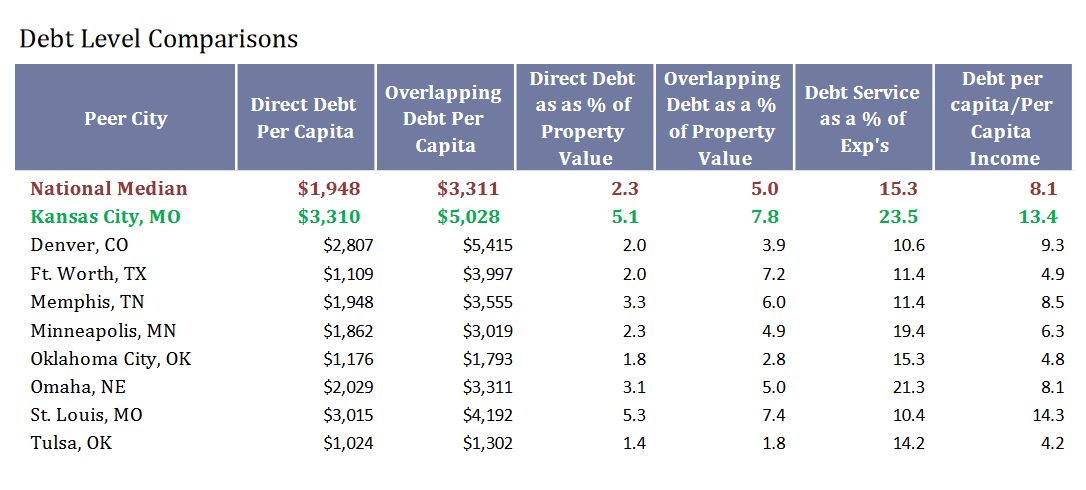
What really hurt Kansas City’s score were its long-term obligations, or debt, which stands at 170% of total revenues. In St. Louis the debt is over 200% of total revenues. According to a 2013 Show-Me Institute study (see Figure 9) Kansas City has $296.24 in debt per person while St. Louis has $328.16 per person—the most of our Midwest peer cities.

This is nothing new. In March 2015, WalletHub released a study in which Kansas City ranked 61st out of 65 cities in terms of spending efficiency. The Mayor’s own Citizens Commission on Municipal Revenue 2012 report cites high debt as a problem and offers, “Because current debt levels are high compared to peer cities, the impact on the City’s credit rating from issuing additional and significant levels of debt must be of primary concern.” The report showed that Kansas City had the highest debt per capita of ALL the peer cities they considered, including St. Louis, and well over the national average (see Page A-17).


A Moody’s Investor Services report from January 2016 indicates that Kansas City’s direct net debt per capita is $3,675. Not only is this higher than any of Kansas City’s peer cities, but it is $500 more per person than St. Louis and $1,400 more per person than Denver, the 2nd- and 3rd- highest indebted peer cities!

Despite this very high debt level, Kansas City leadership is seeking public support for $800 million in additional debt to provide for the infrastructure maintenance the city has neglected for years. This would only exacerbate the city’s financial challenges. The problem is not that the city brings in too little revenue—Kansas City is a high-tax city. The problem is that the city seems to waste this money on economic development schemes that do not accrue to its financial benefit, while neglecting basic services. The solution to this problem is not more of the same.

Prospects Bleak for MLS Proposal-and That’s a Good Thing

Public funding for a Major League Soccer (MLS) stadium has been a hot topic in Saint Louis over the past few months, and Show-Me Institute writers have made their position clear: side with the research.  Overwhelmingly, research shows that cities do not see positive returns on stadium financing investments. A potential $120 million in subsidies from Saint Louis and the State of Missouri for a sports stadium is not a wise investment.

Saint Louis appears to have gotten the memo.

Earlier today, Alderman Christine Ingrassia said that a bill that would raise $80 million for a stadium will not be moving forward. City officials have asked the ownership group to lower the amount of money they’re asking for.

And the city’s request is completely reasonable. If stadiums do little to boost local economies, then what is the rationale for using public funds to help build them?  This question took center stage last week when Gov. Eric Greitens completely ruled out state funding for stadiums. As a result, the prospect for public subsidies for SC STL does not appear to be good.

Time and again, stadiums fail to spur the economic growth that developers promise. Subsidies can help bring a beautiful new stadium to a city, and people may well attend the events held at the new venue.  But much (if not most) of the economic activity taking place at the stadium isn’t actually new; instead, it reflects spending reallocation.  In other words, if people purchase game tickets, they won’t eat out as often or spend money on other forms of entertainment.

With two weeks left before the Board of Aldermen’s deadline for approval, public funding for MLS is not completely off the table, but economists everywhere may rejoice to learn that people are acknowledging their research. 

Avoiding wasteful spending is definitely a step in the right direction, but we should keep in mind that Ballpark Village recently received $16 million in public funding, the Blues are asking for assistance with $138 million in renovations, and many, many, many non-sports–related projects are in line for similar subsidies.  The MLS discussion has engaged many citizens, but the issues with tax subsidies run far deeper than one project.  

Conservatives on Campus: A Vanishing Breed?

If I were to ask you to estimate the ratio of liberal to conservative professors on college campuses across the country, what would you guess? A 50/50 split? Two liberal professors to every one conservative? Three?

Nationwide there are six liberal professors for every conservative professor.

This data point was emphasized in a recent Boston Magazine article in which Chris Sweeny records stories of students and professors afraid to express their conservative viewpoints because of the threat of backlash. While there is no single cause behind this fear, the political composition of colleges’ faculties may be a significant factor.

The 6-to-1 ratio comes from the work of Dr. Samuel Abrams, professor at Sarah Lawrence College in New York. Interestingly, this ratio was not uniform nationwide. Of all the factors he examined—religious affiliations, departmental differences, size of college, etc.—the region in which the college is located had the biggest impact.

The West Coast matched the national average of 6 to 1 and the Plains and Southeast had the most balanced ratio, at 3 to 1. Far surpassing other regions, however, was New England—where liberal professors outnumbered their conservative colleagues 28 to 1.

While it is not surprising that university faculty in New England are more liberal than their counterparts in the Plains region, such a large disparity is disturbing. Moreover, it should concern Missourians that the University of Missouri is currently facing some problems that we might expect to see in New England schools, given their apparent lack of intellectual diversity.

In November, Mike McShane wrote about Mizzou being tied for last place on Heterodox Academy’s ranking of the top 150 universities for their policies on free speech and acceptance of different viewpoints. Since then, Mizzou has “improved,” and is now second to last according to the updated rankings. The University of Oregon, scoring 0 out of 100, is in sole possession of last place. Mizzou scored an underwhelming 6.25 out of 100 points, tying them with Georgetown, Harvard, New York University, and Rutgers.

While it is unlikely the ratio between liberal and conservative professors will become more balanced any time soon, universities can implement policies to protect the viewpoints of students and faculty. The University of Chicago’s commitment to Freedom of Expression is one such policy Mizzou should adopt.

In their recent paper, Mike McShane and Michael Highsmith wrote:

Freedom of speech and debate is at risk and can be protected. It seems that not a week of the school year goes by without some story emerging about efforts by a student council, residence hall, professor, or school administrator to stifle the speech of students. If we do not impress upon our students the importance of free speech and defend it vigorously, we risk creating a citizenry that does not value one of the foundational values upon which our nation was built. Luckily, institutions like the University of Chicago offer a great blueprint for fostering debate and protecting speech. Mizzou would be wise to study that blueprint carefully.

Even in an environment where conservative students and faculty are in the minority, their rights and contributions can be respected.

A Critical Review of the SC STL Proposal

“Game-changing” projects that require taxpayer assistance have become the norm in Saint Louis, as public subsidies are granted to wealthy developers despite opposition from local residents. The trend was set to continue for construction of a Major League Soccer (MLS) stadium until Governor Elect Eric Greitens voiced his objections.

Right now, because of reckless spending by career politicians, we can't even afford the core functions of government, let alone spend millions on soccer stadiums.

The project’s ownership group, SC STL, has taken Greitens’s words seriously and delayed a request for $40 million in tax incentives from the state. In addition to this $40 million are plans for Saint Louis City to pay $80 million, but before any public funds are awarded we should ask what return the city will see on its investment. Are there benefits to owning a stadium? Here are some claims that SC STL made in its written proposal to the state:

Claim 1: Publicly financing an MLS stadium will help make Saint Louis a “first-class city” and will “complete one of the great corridors of sports, culture, and entertainment in the nation.”

What being a “first-class” city means is ambiguous, and Saint Louis taxpayers have heard this song before. The $3 billion spent on MetroLink (thus far) was supposed to make the city first-class. Today, MetroLink trains carry less than 1% of metro-area commuters and have failed to spur significant economic development. In the 1990s, the Edward Jones Dome was pitched as a way to grow the economy and revitalize downtown; it failed on both fronts. Exactly how another professional sports team will help Saint Louis climb the urban ranks, and how that ascension justifies a massive subsidy, is unclear.

Claim 2: SC STL has made “significant effort to minimize the public financing component of the project.”

It is, at best, unclear what efforts SC STL has made to minimize the need for public subsidies. SC STL originally estimated that the expansion fee for joining MLS would be $200 million, but MLS recently announced that the fee would be only $150 million. One might expect that the $50-million cost reduction would be passed along to the city and the state, but SC STL made clear it would still ask for the full $120 million. Can SC STL really claim they have made “significant effort to minimize public financing?”


Claim 3: The recent departure of the NFL Rams reduced tax revenues for the city, and an MLS team would help recover some of those lost revenues.

This is a little like a doctor prescribing more of the same “medicine” that made the patient sick in the first place. Pushing for a stadium deal to help make up for revenue shortfalls caused by a previous stadium deal lies at the border of questionable and crazy. Of course, the proposed MLS stadium deal isn’t 100 percent identical to the deal city officials offered the Rams, but we won’t fix the outcomes of poor policy with more of the same bad policy.

Claim 4: Taxpayer subsidization is justified because a stadium will spur economic growth.

The Missouri Economic Research and Information Center (MERIC) conducted a study concluding that an MLS stadium would generate $24.5M in net state general revenue over 33 years, but this study deserves some scrutiny. Economists overwhelmingly agree that benefits from stadiums are overstated due to studies failing to take into account that spending is taken away from other businesses. Moreover, these studies rely on a controversial economic concept known as a “multiplier effect,” which is a measure of the overall impact of money in a local economy. In short, studies assume a multiplier effect far higher than most economists believe exists, and so, project rosy but unrealistic, outcomes. This is why, despite studies claiming stadiums will be boons for the economy, history and economics show promised economic benefits don’t pan out as projected.

The current proposal for publicly subsidizing an MLS stadium in Saint Louis is heavy on optimism, but that optimism isn’t justified by research or by past experience. Taxpayers should be wary of doubling down on a bet in hopes of paying off the debt we’re already stuck with.

Kansas City’s Intermodal Strength

The announcement a few months ago that Amazon would be opening a fulfillment center in Kansas City, Kansas was great news. But it wasn’t just an accident that Amazon chose the Heartland for its center. As Wendell Cox pointed out in his recent paper for the Show Me Institute, the Kansas City metropolitan area is well positioned for just this type of industry. Hopefully, regional leaders keep the area’s relative strengths in mind when setting policy. Cox writes,

Kansas City’s pivotal position in the national highway system and its strong rail hub enable it to be one of the nation’s leading intermodal markets. Intermodal freight transport refers to the transfer of shipping containers from one mode to another (such as truck to rail, or air to truck).

In addition, Cox writes that land costs in Kansas City are low because the city has avoided costly land use regulation policies. Affordable real estate at a desirable location seem to have appealed to Amazon. But the essay—and the reality of the new Amazon center—suggest that there are other, similar opportunities to be had. Kansas City leaders need to stop importing policies from far off cities and design economic policies that take advantage of Kansas City’s great strengths.

Support Us

The work of the Show-Me Institute would not be possible without the generous support of people who are inspired by the vision of liberty and free enterprise. We hope you will join our efforts and become a Show-Me Institute sponsor.

Donate
Man on Horse Charging