Taxpayers’ General Obligation Bond Gamble

With an $800 million infrastructure bond package likely to go before voters in April, Kansas City Mayor Sly James recently told KCUR that when he took office, the city had $6 billion in deferred maintenance. He told The Kansas City Star that, “Basic infrastructure has to be paramount. We have to take care of some immediate needs.” James has been in office for more than five years. Why has it taken so long to address these needs?

Mayor James resists making commitments on how a proposed $800 million bond issuance will be spent. In a December 16, 2016 radio interview, Mayor James said the following (starts at 17:34):

I don’t know how [the proposal is] a blank check when you can sit and look at the stuff that we’re planning to do. You can’t sit down and specify what’s going to happen in 2029. You can say, “we’re going to be fixing roads and here is a list of road that we’re going to be fixing.”

So there is a list of projects city leaders want to address; they just don’t want to commit to which projects will get first priority (18:10):

We can give them a list; we have the list. The list is available. But to sit around and say we want absolute specificity—that’s not going to happen; it’s an impossibility. And here’s the problem with it, because the same people that are complaining that it’s not specific enough–if we put it in a list and say, “we’re going to do this, it’s going to cost X number of dollars and we’re going to do it in 2018,” and then we have to come up with $50 million for the Buck O’Neil Bridge, then what we’re going to be hearing is, “Oh, the city broke its promise because they said they’re going to fix the road that near my house and they’re spending the money on this bridge.”

Kansas City voters can understand the need to address unforeseen circumstances. But what Mayor James and city leaders seem to want is a fixed, concrete commitment from voters for 20 years of tax revenue without providing a fixed, concrete commitment on how they’ll spend it. The recent debate in the Council about roads, sidewalks and animal shelters is evidence of this. (The companion resolution the Council has offered is nonbinding.) If the goal is to maintain flexibility given an uncertain future, why not ask for smaller, shorter-term tax increases to address the spending needs that can be specified?

Kansas Citians are very aware of how poorly the city has maintained infrastructure; they have reason to be skeptical of city promises of fiscal restraint. After all, the crisis we are in now occurred because leaders did not address immediate needs or make basic infrastructure maintenance paramount—including for the first five-plus years of Mayor James’ tenure. Why should voters now believe that that city leaders will act any more responsibly? Are taxpayers willing to gamble with another $800 million on the city's roulette wheel of debt?

A Sober Look at Development Subsidies

Marketing professionals and politicians alike will tell you that framing is everything. A half-carat diamond ring looks huge if you zoom in close enough. Tom Cruise looks tall on camera. And a public policy looks successful if you focus on the benefits but not the costs.

Things are no different when assessing the city’s massively expensive economic development programs.

A report released last year turned an objective and critical eye toward the city’s incentive practices and found that “[w]hile there may be disagreement about the value of some [incentive] packages, it is clear that the city gains no net benefit from an extremely costly program with no real economic development impact” (pg. 6). That’s about as damning as any finding could be. But, remember: framing is everything.

Otis Williams, Director of the city agency which administers development subsidies, wrote that the “study was conducted to show us what we’re doing well and where we can improve.” When framed this way, things don’t sound so grim.

But don’t be fooled. When the bigger picture shows that the city spends hundreds of millions of dollars—more than $700 million from 2000 to 2014—for naught, a bleak reality emerges. Incentive policies don’t need to be improved; they need to be jettisoned or comprehensively reformed.

When we look beyond the ribbon cuttings, temporary construction jobs, and consultant reports, we see that development subsidies like tax increment financing and tax abatement do not strengthen our economy. If they did, St. Louis would have a thriving downtown and there wouldn’t be a growing operating budget deficit. At worst, these subsidies are a flat-out waste of taxpayer dollars. At best, they meddle with the market, getting developers hooked on taxpayer handouts. When we see prime property at the busiest intersection in the Delmar Loop declared “blighted,” can’t we agree that our policies are missing the mark?

At their core, St. Louis’s incentive policies suffer from two fatal flaws. First, they assume politicians and bureaucrats know which investments are better than others. Second, the pols act as if they are spending “free money.” when in fact a dollar spent on quixotic economic development projects becomes one less dollar that is available for public safety and other purposes.

But how will St. Louis stay competitive when surrounding jurisdictions use incentives? Well, before policymakers worry about how to lure companies from just over the county line—which is about all that incentives accomplish—they might do well to focus on, say, improving schools and basic infrastructure, maybe even retiring the City’s debt and thereby improving its credit rating?

And if policymakers really want to attract business, why not incentivize everything—i.e., cut everyone’s taxes—instead of just the projects of politically-connected developers? If city officials and staff are right, and incentives truly grow the economy and boost tax revenue in the long run, just imagine what a broad-based tax cut for all residents would do!

From 2009 to 2016, the tax revenue annually handed back to developers has more than doubled from $17.9 million to $38.1 million. Yet, today, most of our economic, social, and governmental woes persist. The answer is not more of the same. It’s time to reframe the discussion on incentives.

MOSERS Wisely Reconsiders Past Assumptions

In elementary school I learned about the power of compounding from a book titled One Grain of Rice. The story is about a king who promises to give a girl one grain of rice, and to double his gift every day for thirty days. Initially the gifts seem small, but by the end of the month more than one billion grains of rice have changed hands.

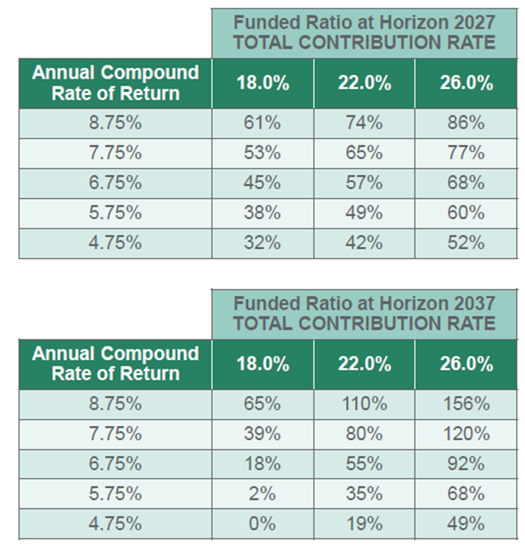
Similarly, an investment that initially seems negligible can go a long way given enough time to compound, and this lesson applies when saving for the future. In June, the Missouri State Employees’ Retirement System (MOSERS) decided to reduce its assumed return rate from 8% to 7.65%, meaning that altogether, the amount members will need to contribute next year will increase by almost $50 million. This extra cost today is hardly ideal, but in the long run it helps avoid a much larger bill.

Even though MOSERS made a mere 0.35% change to their expected return rate, the long-term impacts are huge. With a lower rate of return on its assets, a pension plan’s initial contributions must go up in order to keep benefits constant. In other words, a plan compensates for slower investment growth by putting more money in initially.

This change in funding highlights the risks associated with promising high investment returns. If a pension plan’s actual returns are lower than predicted, the result is a gap between available funds and the amount that has been promised to retirees. In the case of a guaranteed public employee retirement fund, taxpayers can be asked to cover this difference, and as the gap grows, so does the burden on taxpayers.

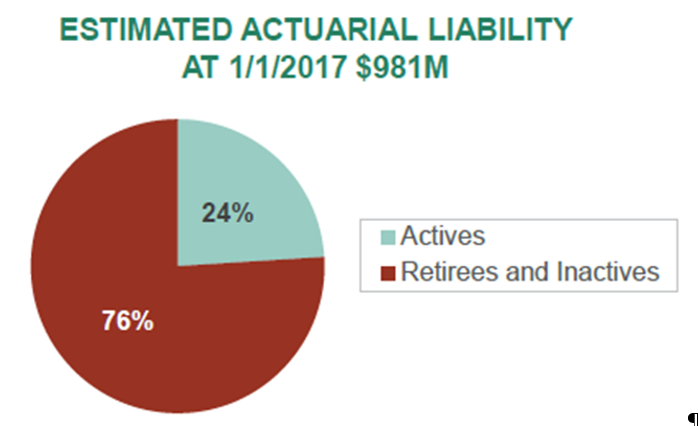
With a current funding ratio (current assets divided by the net present value of liabilities) of 67.8 percent, the plan (according to a Columbia Tribune report) will require $394.5 million this year to cover promised benefits.  But this contribution amount will only be sufficient if investment returns match the 7.65% expectation.  If investment growth is lower (in FY 2016 MOSERS generated a time-weighted return of only 0.3%), then the funding gap will widen over time. It’s easy to project high investment returns today, but making those predictions come true tomorrow is another story.

Slight adjustments in return assumptions can have tremendous impacts over an employee’s lifetime, so properly estimating investment returns is essential to a plan’s sustainability. (This essay by Andrew Biggs provides a comprehensive discussion of public employee pension funding for readers who want to explore this topic in more depth.) If pension benefits are guaranteed to employees, then the cost of these promised future benefits should be priced using returns on very low risk assets like government securities, which are currently far below 7.65 percent. Lowering the assumed return is a step toward greater transparency regarding the true costs of pension liabilities.

A Developer’s Market

The Delmar Loop is one of the most vibrant areas in the Saint Louis region. It’s even been listed as “one of 10 Great Streets in America.” On any given day or evening, sidewalks and storefronts bustle with activity in the popular University City neighborhood. Yet policymakers seem convinced that development won’t happen in the Loop without taxpayer subsidies.

As the St. Louis Post-Dispatch reports, a $26 million multi-use development planned for a busy intersection in the Loop was recently awarded some $4.4 million in tax increment financing (TIF). This means the developers will pay $4.4 million less in taxes over the next few decades because, apparently, the project isn’t financially feasible without tax breaks.

As with all subsidies, there is a question regarding the prudence of funneling taxpayer dollars to specific projects on the grounds that they could not be profitable on their own. I also can’t help wondering why incentives are still “needed” in the Loop when the $51 million trolley is supposed to spur economic growth. But I don’t want to focus on these issues here. Instead, I want to focus on a much larger lesson we can learn from the widespread use of development subsidies in Saint Louis and elsewhere.

The handing out of subsidies in one of the most lucrative Saint Louis is evidence that policymakers have created a “developer’s market.” In short, subsidy-granting agencies have given away so much in taxpayer money that developers are rarely willing to invest without public help. And not because their projects aren’t financially viable, but because they know policymakers will grant their requests for subsidies. Incentives are no longer about eliminating blight, or making tough projects feasible. Instead, incentives are an ordinary part of doing business, because policymakers have repeatedly shown developers that subsidy dollars are there for the taking. The use of incentives has transformed the real estate market—and not for the better.

Despite spending hundreds of millions of taxpayer dollars on developments, Kansas City and St. Louis continue down bleak economic paths. In fact, there’s evidence that incentives have reduced private investment in Missouri cities. It’s time policymakers enact meaningful incentive reforms to ensure that taxpayer money isn’t wasted and that development occurs according to the free market principles that grow the economic pie for everyone. 

Retooling Missouri’s Economic Engines

Dave Helling at The Kansas City Star recently wrote a piece about how Kansas City and St. Louis might fare under Missouri’s new governor. Helling wrote,

Kansas City and St. Louis interests have been nervous about Jefferson City for years, of course. Rural Republican lawmakers have long looked askance at big-city projects and have turned back city efforts to raise the minimum wage or tighten gun control laws.

In January, Kansas City Mayor Sly James testified before the Missouri Senate Ways and Means Committee that the legislature should “leave us alone.” Conversely, Kansas City Councilwoman Jolie Justus, a former state senator, strikes a more diplomatic and productive tone when she told The Star, “I want to make sure we start off on a good foot with Gov.-elect Greitens, because I want to go down and explain to him … that frankly we’re the economic engines of the state, for the most part.”

Kansas City and St. Louis are the economic engines of Missouri; but recently those engines have been failing the state badly. Kansas City and St. Louis are more likely serving as obstacles to economic success, not engines. Consider the following:

If Kansas City and St. Louis are the economic engines of Missouri, they are either stuck in neutral or reverse. No state legislature should stand by idly while so much economic opportunity is wasted. Reformers in Jefferson City would do a great deal to improve things if they reined in cities’ abilities to levy taxes, reformed economic development incentives, and greatly increased transparency at every level. Cities can be a great economic engines, but not without occasional tune-ups.

Want to Improve Mizzou? Look East

Last fall, at the same time the University of Missouri announced the first decline in enrollment in 15 years, Purdue University in West Lafayette, Indiana, announced record-breaking enrollment. Tuition at Purdue has been frozen since 2012–13 and will remain unchanged through the 2017–18 school year. The cost of room and board has actually gone down since 2012–13.

T.S. Eliot said that “Immature poets imitate; mature poets steal.” The same can be true of universities. If Mizzou wants to be great, it can learn a lot from Purdue.

Under the leadership of President Mitch Daniels, Purdue has undertaken a series of projects designed to keep education affordable, research productive, and the college experience relevant in the 21st century. In addition to more traditional reforms like better budgeting and leveraging economies of scale to shave costs, Purdue continues to push the innovation envelope.

An easy way to lessen the burden of student debt is to reduce the amount of time that students must spend in the classroom altogether. Purdue has experimented with competency-based education (CBE) to achieve this. CBE is an accreditation system that grants students credit once they demonstrate mastery of a subject. Rather than waste time in the traditional 15-week classroom, students earn credit after demonstrating expertise in eight broadly defined primary competencies.

An expedited education can help more than just the student’s wallet, and Purdue’s Polytechnic Institute lets students work through a customized course of studies at their own pace. If they need to spend more time in a course that is especially challenging, they can. But if they can graduate faster, they face a smaller tuition bill and a quicker entrance into the workforce to earn income.

But that’s not all—Purdue is also experimenting with income share agreements (ISAs) to help students finance their education. Through the “Back a Boiler” program, students can commit a percentage of their income for a set amount of years to pay back their college costs instead of taking out a lump sum loan.

ISAs protect students who find themselves graduating but unable to secure a high-paying job. If their salary is lower than expected, they aren’t buried in unmanageable debt. Likewise, if students are more successful after graduation, then the school (i.e., the initial lender) will make back more money. Inherently, ISAs incentivize lenders to maximize the value a student gains from their degree, because both the school and graduates will benefit from post-graduation success

Third, Purdue embarked on an unprecedented partnership with Amazon to provide products at a much lower cost to its students. In fact, Amazon’s first-ever pickup store was launched on Purdue’s campus. Students are offered discounted products with expedited shipping, Purdue is given a percentage of the total profits to invest in scholarships, and Amazon is introduced to a fresh wave of users each year.

Eliot also said that “anxiety is the hand maiden of creativity.” As Mizzou reels from fears of enrollment decline and a tarnished reputation, it can redouble its efforts to innovate. 

When Bad Policy Won’t Stay Dead

We’re far from Halloween, but some really scary things are already rising from the dead—in particular, the effort to subsidize a Major League Soccer (MLS) stadium in downtown Saint Louis, which supposedly flat-lined just last week. Now, SC STL, the ownership group pushing for the subsidies, has put a new proposal before Alderwoman Christine Ingrassia, who’s sponsoring the deal. Instead of $80 million, SC STL is now asking the city for a ‘mere’ $60 million. Before we accept this as a genuine concession to overburdened taxpayers, a closer look is in order.

The chart below compares the old and new funding proposals.

Funding Proposals from SC STL
Costs
  New Old
Stadium design/construction $140,000,000 $150,000,000
Land/site work $45,000,000 $45,000,000
MLS expansion fee $150,000,000 $150,000,000
Other costs $0 $10,000,000
TOTAL COST $335,000,000 $355,000,000
Revenue
SC STL $245,000,000 $230,000,000
State of Missouri $30,000,000 $45,000,000
City of Saint Louis (via new, dedicated use tax) $60,000,000 $80,000,000
TOTAL REVENUE $335,000,000 $355,000,000
% Privately funded (expansion fee and stadium) 73% 65%
% Privately funded (stadium alone) 49% 39%

Note that the new funding proposal only modestly reduces the level of public funding. While the old proposal was set to be 65% privately-funded, the new proposal is only 73% privately-funded. And when we exclude the MLS expansion fee, the share of private funding has risen to just 49% from a previous 39%.

In short, while the new SC STL proposal has reduced the public cost of their project, it still calls for $90 million in subsidies. Just because spending $125 million in taxpayer money on a stadium was a bad idea, it doesn’t mean spending $90 million is somehow a good idea. Plus, the City’s Budget Director admits the deal as it’s currently crafted could require more money than the new use tax would provide, requiring the city to dip into the general fund.

Unfortunately, that isn’t the end of it. The new 50-page SC STL proposal was announced less than a week before the city’s Board of Aldermen needs to vote on whether or not to put it before voters. The proposal will be heard by an aldermanic committee once more next Monday morning.

Alderwoman Ingrassia, who’s sponsoring the deal, even admitted she isn’t clear on what’s in the new deal, or if it makes sense. But if our policymakers aren’t clear on legislation that would place a $90 million burden on taxpayers, should they be moving that legislation forward as quickly as the SC STL proposal appears to be?

Many public needs are competing for attention and dollars across the state and in the City of St. Louis especially. Shouldn’t we focus on addressing those needs before spending tens of millions more on corporate welfare?

Kansas City, King of Corporate Welfare

Good Jobs First, a “national policy resource center for grassroots groups and public officials,” publishes what it calls its Subsidy Tracker, a list of the companies that receive state local and federal subsidies. Missouri and Kansas City are high on their list of subsidizers, which is unsurprising given our politicians' continuing tendency to hand out corporate welfare.

The report indicates that the total value of all corporate welfare in Missouri is a whopping $5.8 billion. That makes the Show-Me state the 10th-most subsidized in the union. Missouri subsidizes business to a greater extent than all of its neighboring states except Kentucky. (We even beat out Illinois!)

Of the top five corporations in Missouri that receive corporate welfare money, three are headquartered in Kansas City: Cerner, H&R Block, and DST Systems. They account for $2.3 billion in subsidies, about 40 percent of Missouri’s total.

Little wonder, then, that Kansas City—a high tax city—must borrow money to provide basic services such as dangerous structure teardown or infrastructure maintenance—we’ve given boatloads of our tax revenue away to wealthy corporations. Perhaps it’s time policymakers change direction; after all, for all the business Missouri residents subsidize, we’re still one of the slowest-growing states in the union. 

Support Us

The work of the Show-Me Institute would not be possible without the generous support of people who are inspired by the vision of liberty and free enterprise. We hope you will join our efforts and become a Show-Me Institute sponsor.

Donate
Man on Horse Charging