The GO Bond Bait and Switch

The general obligation (GO) bond being considered in April would raise property taxes to pay off a series of 20-year bonds, twenty of them in total, targeted toward maintenance and infrastructure. These are legitimate city expenses that have been deferred for decades.

Despite the need, there is concern that political leaders will fall back on old practices of moving money around. Fearing this, a neighbor of mine in south Kansas City wrote some members of the City Council with a very salient concern:

What becomes of the existing general fund budget allocated to Public Works for street preservation and sidewalk repair? Does it continue to be used for street preservation or is it siphoned off to another area?

According to Kansas City’s Comprehensive Annual Financial Report (CAFR) for fiscal year 2015, the budget for the Public Works Department was almost $183 million. (The budget was $187 million in FY 2014 and $212 million in FY2012.) The Council is free to allocate the general fund as they see fit. It is, after all, what we elect them to do. The response my neighbor received was not promising:

The City’s Public Works Department confirms that the funding policy for Public Works street maintenance is set by ordinance. GO Bonds will dramatically expand revenue available for street reconstruction, maintenance, and repair. By law, GO Bond proceeds can only be used for GO Bond projects and cannot be diverted.

This answer plays right into my neighbor’s worry. Yes, the GO Bond proceeds may be restricted to public works projects. The concern is that the addition of new money from the GO bond will simply allow the Council to redirect discretionary spending from the general fun elsewhere. For example, imagine telling your child that any proceeds from her summer job will be dedicated to her college fund—then reducing your own contribution to the fund by the amount that she contributes to it. She may agree to make an additional contribution, but it won’t have the impact she is expecting. Similarly, voters may approve Question 1 giving $600 million in bonds for street and sidewalk repairs, only to find that the totality of money spent on street and sidewalk repairs does not increase by $600 million.

The fear is compounded by the Mayor’s refusal to commit to specific projects and timelines. He tells us that he doesn’t know what the city will be faced with in 20 years, yet he is fine with asking voters to commit to raising their taxes for 40 years. And as stated above, the reason Kansas City faces this problem in the first place is that previous councils did not fund needed maintenance.

The ballot questions at hand ask voters to ignore decades of experience with politicians’ bait and switch.

Kansas Citians would be wise to demand more explicit and binding commitments from City Hall, and smaller, shorter-term bonds. That way they have more opportunities to hold politicians accountable.

Show-Me Now! Three ideas for Reform at Mizzou

After the unrest at Mizzou in 2015, and with enrollment plummeting, Mizzou has struggled to regain its footing. Is there a way for Mizzou to bounce back? Our new paper highlights reforms from universities around the country that may offer fresh ideas. Click above to watch a video introduction to a new essay by Mike McShane and Michael Highsmith, or read the entire essay by clicking here.


Missouri’s Troubling Sales Tax Mosaic

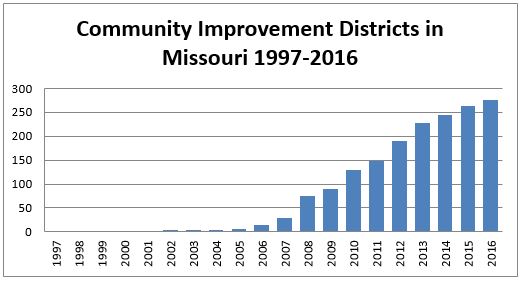
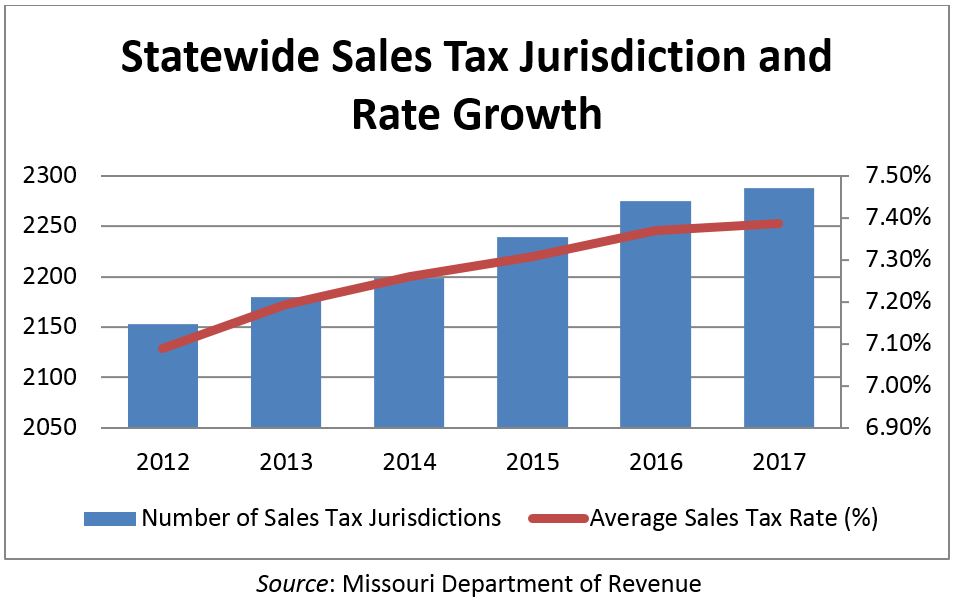
What do owners of the luxurious Intercontinental Hotel in Kansas City and the St. Louis Cardinals have in common? They’re both leveraging special sales tax districts to subsidize their private ventures. The number of sales tax jurisdictions in Missouri has ballooned by 33% over the past 20 years.  As the chart below shows, this growth correlates with rising sales tax rates. In short: the more districts, the higher the taxes.

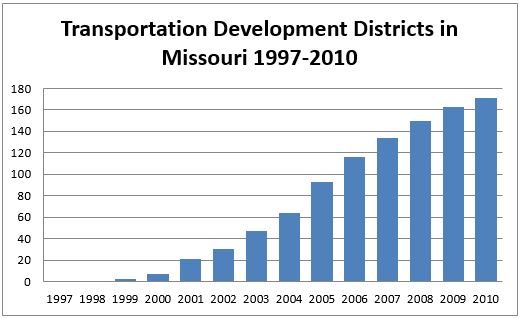
Almost all of these new taxing districts are community improvement districts (CIDs) or transportation development districts (TDDs). These CIDs and TDDs are quasi-governmental districts formed through questionable processes that allow for even just a single voter to authorize millions in spending. What’s worse is that taxpayers often have no clue these districts exist, or that they’re paying into them. The charts below depict CID and TDD growth over the past 20 and 14 years, respectively. 

Both CIDs and TDDs have bad track records in Missouri. Despite collecting and spending billions in taxpayer dollars, they often lack transparency, accountability, and other basic principles of good government. Of the 34 TDD audits the State Auditor’s office has completed over the past 10 years, a third concluded the TDDs under consideration were in bad financial shape.  And nearly all audits indicated other issues, ranging from conflicts of interest, uncompetitive bidding practices, to a failure to comply with basic accounting standards. Some CIDs have even filed for bankruptcy.

Isn’t it time policymakers in the Show-Me state rein in the growth of these taxing districts? Increasing taxes on ordinary consumers like you and I, often to pay for privately-owned projects we’ll see no return on (e.g., the proposed Chesterfield Ice Complex, City Foundry project, or over-budget Loop Trolley), is not sound economic or fiscal policy. When it comes to taxes and taxing districts, often, less is more. 

Essay: Expanding Charter Schooling in Missouri

Charter school expansion is just one of several school choice initiatives lawmakers in Jefferson City have proposed this legislative session. The first charter schools opened in Kansas City and Saint Louis in 1999, but many Missourians still have questions and concerns about charter schools and the quality of education they offer. A new Show-Me Institute essay addresses many of these questions by examining studies on charter school performance in Missouri. In addition, the essay describes barriers that are preventing charter schools from serving more children throughout the state. Click on the link below to read more. 

Missouri’s Private Sector Expanding

According to the most recently released data from the Bureau of Economic Analysis’s (BEA), (https://www.bea.gov/newsreleases/regional/gdp_state/qgsp_newsrelease.htm) Missouri’s output of goods and services (real GDP) grew at a 3.8 percent rate in the third quarter of 2016. Between the third quarter of 2015 and the same period in 2016, the economy expanded at a 2.0 percent rate.   

When the BEA announces its real GDP growth rates for states, it uses an “all-industry” value.  This includes both private industries (all economic enterprises owned by individuals or groups) and also the government (which encompasses the purchases of goods and services at all levels/branches of government).  Because the private and public sectors both contribute to total (all-industry) output, this total measure can provide misleading signals on how well the private sector of the economy is doing.  After all, the private sector of the economy is the growth engine for future economic well-being. 

The table below illustrates how total measures don’t always paint the full picture. The table shows the growth rates for three categories: All Industry; Private Industry, and Government.  The data cover the most recent four quarters for which information is available. All growth rates are based on year-over-year comparisons to smooth short-term wiggles in the data. In other words, the growth rate for 2016Q3 is the growth rate from 2015Q3 to 2016Q3, etc.

The data show that government “output” grew in the third quarter but declined in the previous three. This resulted in an all-industry output growth that was lower than that of the private sector, which actually expanded in every quarter shown.  While the all-industry growth rate averaged 1.6 percent over these four quarters, private industry output—excluding government—increased at a faster average rate of 1.9 percent. 

You might be thinking, “But such small differences in growth rates are trivial.”  They are small, but they are not trivial:  Using the average all-industry growth rate, it would take 45 years for the state’s output to double.  The private industry values, in contrast, indicate that income would double in 38 years, a 16 percent reduction.  Surely most of us would prefer our income to grow faster. 

After separating out the effects of government, it appears that the private sector’s output of goods and services expanded at a faster pace than is suggested by the commonly used all-industry measure.  This example shows that including government’s activity can affect our perception of how well the economy is actually doing.

Compound Annual Growth Rate of Real GDP (%)
Period* All Industry Private Industry Government
2016 Q3 2.0 2.2 0.6
2016 Q2 2.1 2.4 -0.2
2016 Q1 2.1 2.4 -0.4
2015 Q4 0.8 1.0 -0.4


Taxes for Thee, But Not For Me

A recent Kansas City Star story on the proposed Kansas City general obligation bonds, (GO Bonds) contained the following:

This year’s campaign is dubbed Progress KC. So far, the biggest contributors include Burns & McDonnell, JE Dunn, Mark One Electric, and several development and law firms.

Supporters are counting on the Heavy Constructors to help fund the campaign. That group, whose members stand to benefit from the infrastructure jobs, won’t officially decide until later this month.

It was nice to see the Star make a point of mentioning that financial backers of the 40-year property tax increase such as Burns & McDonnell, JE Dunn, and the Heavy Constructors have a bottom-line interest in the matter. They will likely get a lot of the money that they are asking taxpayers part with. But at least two of the biggest donors have something else in common.

Both Burns & McDonnell and JE Dunn do not pay the full property tax on their respective headquarters buildings. Or rather, thanks to Kansas City’s generous tax subsidy programs such as tax increment financing (TIF), much of their property, sales, and earnings taxes are returned to them to offset the costs of their impressive corporate pleasure domes. Readers of The Pitch may recall that Burns & McDonnell contributed heavily to convince voters to keep the earnings tax, and then lobbied the city to have a portion of its own earnings tax returned to it to build that same headquarters.

Walter Johnson, a professor of African American Studies at Harvard University recently spoke at the Kansas City library and referred to this sort of practice as “a fundamentally feudal model of corporate citizenship.” Rather than pay taxes to support institutions that are vitally important to the community—such as schools, libraries and the like—these corporations seek to avoid taxes and instead give charitably to the causes they themselves deem worthy. Johnson concludes:

Corporations shouldn’t have to keep their communities afloat through charitable giving. That’s what taxes are for, and that’s why paying them is typically considered a civic obligation, not an act of generosity.

That Kansas City is suffering from years of infrastructure mismanagement is a cold, hard fact. And it won’t surprise anyone to learn that those most eager to enact the tax will profit from its adoption. Yet it is a civic shame that those same corporations calling for an increase in others’ property taxes have spent so much effort trying not to pay their own taxes. Burns & McDonnell and JE Dunn should accept their own civic obligation before passing it on to others.

Kansas City, Economic Development, and Homicide

Kansas City desperately wants to grow, and we’re spending or diverting tens of millions of dollars of taxpayer money each year on economic development, mostly downtown, in order to attract tourists and residents. When pitching the streetcar expansion, the $800 million general obligation bond, or a convention hotel, the Mayor tells us we have to build the city for the next 75 years.

But the Kansas City of right now is floundering. Our population growth is flat and our economic growth is weak. We’re in the midst of a years-long spike in the homicide rate, which is one of the nation’s highest. As The Sentinel pointed out in a recent article, “in Kansas City you were seven times more likely to be murdered than you were in New York City.” Though Chicago grabs headlines for having had an almost-unfathomable 762 homicides in 2016, The Sentinel points out, “Chicago is only 4 percent more lethal. There is no solace in that.”

How did we get where we are? The question seems unanswerable. One answer may be police resources.  The Sentinel tells us that New York has “more than twenty times as many police officers to handle those killings. In sum, the NYPD had seven times more officers per homicide than the KCPD.” Meanwhile, the Kansas City police department annual reports show that there are fewer officers in uniform today then there were in 2009. While the new city budget includes an increase for public safety, it is not clear if this would allow for new officers to be hired, or if the police and fire departments are spending efficiently.

To no one’s surprise, The New York Times reports that high crime hinders economic and population growth. New research indicates that:

when violent crime falls sharply, wealthier and educated people are more likely to move into lower-income and predominantly minority urban neighborhoods….

 “When cities feel safer, that opens people’s eyes,” Ms. Ellen said of the willingness of new groups to consider these neighborhoods.

All the subsidized coffee shops and condominiums will be for nothing if the city is unable to deal with runaway crime. And tax increases to spur development will likely fail if the basic safety needs of a community are neglected. What Kansas City needs is not more wide-eyed development schemes, but more effort delivering basic services efficiently and effectively, if we are to have any hope at growth.

MetroLink Underperforms, but It Is Not Underdeveloped

The Post-Dispatch’s Tony Messenger claims that MetroLink, Saint Louis’s light rail system, is “underperforming and underdeveloped.” He’s half right. Today, MetroLink carries roughly as many passengers as it did in 2005, prior to the last expansion. In fact, all modes of transit underperform in Saint Louis. A lower percentage of Saint Louisans ride the entire rail and bus system today than rode the pre-MetroLink, bus-only system. Even some transit activists admit the system has been underperforming for years.

But is MetroLink underdeveloped? One way to answer that question is to ask whether the existing supply of light rail meets demand. Based on ridership trends, the existing supply of light rail may actually exceed demand. Ridership plummeted during and shortly after the recession in 2008 and has failed to pick back up even while economic conditions have improved in Saint Louis.

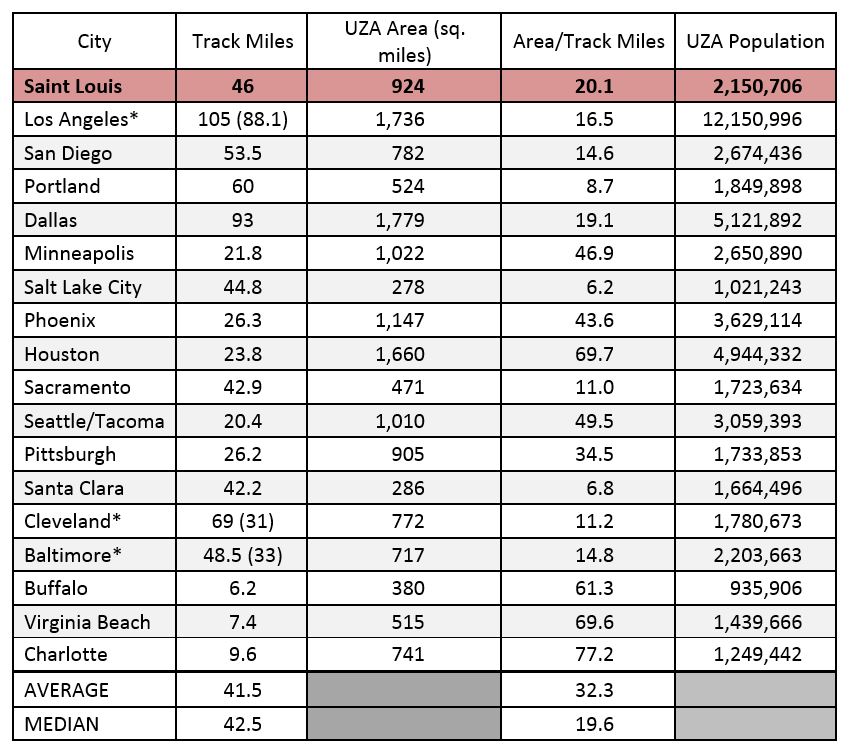
Another way of determining if MetroLink is underdeveloped is to compare it to other light rail systems. The table below lists light rail systems from across the country, and looks specifically at the length of each system, as well as the population and geographic size of the urbanized area (UZA) where the system is located.

table

Note: Track miles are compared to UZA and not ‘Service Area’ (SA) because SA includes modes besides light rail (e.g., buses) and is a direct correlate of track miles. Thus, SA is simply a function of track miles, and not a measure of the metropolitan area a system serves.  See National Transit Database Glossary for more.  
Source: Track miles from agency websites, and UZA data from National Transit Database.

Given this perspective, we can see that in terms of track miles, Saint Louis has a rather robust light rail system compared to other cities. While there is variation across systems, Saint Louis has more miles of track than the average and the median system. In fact, of these 18 systems, Saint Louis is the 7th-largest (and if we excluded systems with heavy rail, the 5th-largest). MetroLink is even larger than some heavy rail systems, such as Metrorail in Miami-Dade County (24.4 miles), and is just about as large as Atlanta’s system (47.6 miles).

However, what matters is not just the length of a system but also the length of a system relative to the size of the area it serves. To measure this, we divide the size of an area by the miles of track its system has—the figures in the fourth column. (For a more complete picture, I’ve also included population as the last column.) In short, the lower the number in the fourth column, the more miles of track per square mile of land, and so, the more developed a system is. By this measure, Saint Louis has one of the more developed systems in the country and compares well to many cities, with a system that is far more developed than the average. Saint Louis even compares favorably to Los Angeles!

Based on this analysis, Saint Louis’s light rail system does not appear underdeveloped. It may even be overdeveloped (or, perhaps, it developed too quickly or along poorly chosen routes). Before pushing for another expensive MetroLink extension, shouldn’t officials ask if we already have more than we need (and can afford)?

Support Us

The work of the Show-Me Institute would not be possible without the generous support of people who are inspired by the vision of liberty and free enterprise. We hope you will join our efforts and become a Show-Me Institute sponsor.

Donate
Man on Horse Charging