Yes, the Soccer Stadium Proposal Will Cost City Residents

We have covered the rollercoaster ride of bringing a Major League Soccer team to Saint Louis for a few months now. The turbulent trip culminated in a proposal to raise the city’s use tax—essentially a sales tax on businesses—to provide $60 million in public funding for a soccer-specific stadium near Union Station. You can read Show-Me Institute analysts’ concerns regarding public support for sports stadiums here, here, and here.

In this post I’d like to address something besides the economic issues with subsidizing stadiums. And that’s the claim (see page 13 here) that “if you aren’t a business paying the Use Tax or don’t go to the stadium, your money will NOT be used for this project.” This claim is simply incorrect.

To understand why, we need to look at how the stadium proposal is connected with another proposed tax-hike. There is a proposal to increase the city’s sales tax rate by 0.5%, with the new revenue dedicated to MetroLink expansion and other “economic development” projects. If approved, this increase in the sales tax (on goods purchased in the city) will trigger an increase in the use tax (a tax paid by businesses on goods purchased outside of the state but used in the city). The money that would be generated by an increased use tax isn’t dedicated to a specific purpose—at least not yet. Funding for the soccer stadium would tap into this new use-tax revenue. But that new use tax revenue will only exist if the sales tax hike is first approved. So, in short, to dedicate use tax revenue for the stadium, taxpayers would have to approve a sales tax hike. And to increase the city’s sales tax rate is to make city residents pay for the stadium, whether they visit it or not. 

In addition, the use tax increase will ultimately be paid by consumers—again, city residents included—through higher prices. Businesses in the city will initially pay the higher use tax, and while they may try to absorb some of the cost, it is nearly inevitable that they will pass some of it on to consumers. And when city residents buy goods and services from city businesses, they will end up paying the increased use tax (in the form of higher prices). Again, city residents will pay for the stadium, just not directly.  

The claim that city residents will not pay for the stadium unless they visit it is specious. Taxpayers deserve straight-talk where their money is concerned, and in this case, they don’t appear to be getting it.


First Responders Have Rights, Too

When it comes to labor reforms, the dance card is filling up fast in the Missouri legislature. First the Legislature passed Right to Work, protecting the rights of workers to join, or not join, a union. Hot on its heels came project labor agreement (PLA) and prevailing wage reform legislation, which would protect taxpayers as well as countless workers in the construction industry. Missouri is now racing Wisconsin to be the first to pass such a reform package this calendar year.


Also coursing through the state House and Senate, however, are two important measures that would protect government employees as well. My former colleague John Wright wrote at length about the substance of the first measure, dealing with recertification votes and transparency in government unions. That basket of reforms will likely also include common-sense financial transparency requirements for government unions as well, consistent with disclosures private unions already file. Taken in total, that worker empowerment proposal is a game changer on its own.


The second measure, Paycheck Protection, also deserves attention from good governance supporters. Rather than forcing workers to opt out of a union, Paycheck Protection flips the presumption by allowing employees to opt-in to a union instead. It’s sort of like a mini-recertification vote; if an employee wants the union to represent her, she can confirm her support and continue the representation, or do nothing and keep her money. Either way, it’s the employee that’s empowered, not organized labor.


This year’s government union reform proposals are superior to versions that were proposed in previous years, in no small part because they don’t carve the rights of first responders from the bill. Why those rights have been carved away in the past is a subject of debate, but dealing strictly with the policy itself, passing a government reform bill that doesn’t protect first responders would be disappointing. First responders should be able to see what their union is spending money on, to keep or drop a union that represents them, and to retain or give the money in their paychecks that may currently underwrite a union’s activities. That this year’s law includes these workers deserves praise. I never understood why first responders would be deserving of fewer rights.


If these reforms are enacted, Missouri workers will have a lot to be excited about in the months and years ahead.

Hairbraiding Bill Advances in the House

Over the last year we’ve talked a lot about the fight to liberalize licensing requirements for a host of professions, including hair braiding. The problem, is that onerous state regulations make it very difficult for qualified individuals to deliver a variety of services to consumers, and that is especially true of professional hair braiders. Litigation is ongoing for the requirements currently imposed on braiding practitioners, and the result of those fights remains unclear.

Fortunately Missouri’s Legislature isn’t letting the licenscing fights just play out in the courts; rather, it’s taking a proactive stance to these issues and is already considering legislation to resolve the hair braiding question once and for all.

Rep. Shamed Dogan, the lone African-American lawmaker on the Republican side of the aisle, said his plan to lift state regulations on African-style hair braiders could trigger the creation of jobs in minority communities if those businesses take the opportunity to expand.
 
Under current state law, a person needs to go through a cosmetology school and complete 1,500 hours of training in order to obtain a license to legally braid hair.
 
Dogan’s measure would not require hair braiders to obtain a license. Instead, they would need to register with a board and receive a brochure including information about infections and disease control.
 
As my colleagues and I have reiterated time and again, licensing laws should not unduly burden qualified practitioners in a field or otherwise prevent consumers from easily accessing services and care that, but for government, they could readily receive. That argument is especially easy to make when it comes to hair braiding. Incumbent interests in the cosmetology industry should not be empowered to lock out professionals who are fully qualified to serve their fellow Missourians, and for too long that has not been the case.
 
Kudos to the supporters of reforms like this one; hopefully we’ll see some progress in this area by session’s end.

The Race is On: Wisconsin Pushes to End Project Labor Agreements and Prevailing Wage

Earlier this year three states were competing to become the next Right to Work (RTW) state. Missouri ended up being the second of the three states considering RTW to pass the law; Kentucky enacted RTW early in January, and New Hampshire is currently battling it out in its legislature.

But RTW isn’t the only labor reform where states are scrambling to beat their peers to the finish line. Indeed, states are also looking to reform their project labor agreement (PLA) laws, which circumscribe who can work on some public projects, and their prevailing wage laws, which can affect the price taxpayers pay for public projects.

And as in Missouri, the policy pairing of PLAs and prevailing wage has hit the top of the reform list in Wisconsin.

Prevailing wage requirements and project labor agreements would be prohibited under a proposal in Wisconsin’s 2017-19 biennial executive budget and tandem legislation speeding through the state legislature.

Gov. Scott Walker (R), already recognized for his tough stands against organized labor, included a single sentence in his 644-page budget proposal Feb. 8. The language repeals the state’s prevailing wage requirements and bans “any unit of government in the state from requiring or considering the use or lack of use of a project labor agreement by a contractor as a condition of bidding on a public works project.”

The state legislature could beat Walker to the punch under separate bills that would prohibit state and local units of government from requiring project labor agreements as part of public works programs. The Senate passed its version of the PLA bill, Senate Bill 3, by a vote of 19-13 on Feb. 8. The Assembly’s Committee on Labor approved nearly identical legislation, Assembly Bill 24, on a party-line vote Feb. 9.

Not only is Wisconsin racing against Missouri to become the next PLA and prevailing wage reform state, but there is actually competition among its own branches of government to see who will get it done first for the state.
To be clear, the point here isn’t to rush legislation, and to their credit Missouri legislators have done a good job of fully debating and improving the PLA and prevailing wage bills as they move through the Legislature. What Wisconsin reaffirms, though, is that the cutting edge of reform can often be a crowded space, and as Missouri works to improve its climate for workers, employers, and taxpayers, other states are not standing still.

Right to Try Becomes a National Issue

In 2014, Missouri became the third state to enact a Right to Try law. The legislation, pioneered by the Goldwater Institute in Arizona, empowered terminally ill patients to take control over their care options by allowing them access to experimental medications without undue interference from state government. As I wrote in Forbes at the time, “Right to Try does not attempt to supersede or nullify federal laws in this area. It only clears the way from the state’s perspective for RTT treatments to move forward.” It was a common-sense law that we testified in support of and were delighted to see passed.

Well, the RTT movement has expanded since then. Today over thirty states have already enacted the law, and it looks like federal officials may be following suit very soon.

More than a year after his wife, Trickett Wendler, died from amyotrophic lateral sclerosis (ALS), [Tim Wendler] is giving voice to a congressional bill in her name.
 
The Trickett Wendler Right to Try Act, authored by Republican U.S. Sen. Ron Johnson, would allow terminally ill patients to receive experimental drugs — which have not been approved by the Food and Drug Administration — and where no alternative exists. There is a companion bill in the House.
 
With 40 Republicans and two Democrats co-sponsoring the legislation, Johnson plans to try to get the measure passed by unanimous consent, perhaps as early as Wednesday. The parliamentary maneuver is unlikely to succeed, since a single senator can block the request. But the issue probably won’t fade away.
 

Indeed it hasn’t. With a new Congress, bipartisan support, and a potentially supportive President, the prospects for a federal RTT statute passing are as good as they have ever been. If it does pass, it will be a win for patients across the country seeking greater control in the most precarious health situations imaginable. As we’ve said many times before, government should let people help their fellow Americans on terms largely or entirely unencumbered by state or federal bureaucracies. Right to Try laws are fundamentally designed to advance that end — and to offer hope to the most vulnerable among us. 

It isn’t clear when the federal Right to Try law is going to be debated and voted on this year. We’ll update you as the legislation goes through the process.

Questions for the Chesterfield Valley TDD

The unconstrained growth and abuse of special taxing districts in Missouri marches (or better, skates) on.

This evening, the Chesterfield City Council will hear details on a proposed ice complex in the valley retail area. Show-Me Institute researchers have followed and testified on the proposal for several months now, and we look forward to learning more tonight. What interests us about the proposal, and what might concern taxpayers in Chesterfield, is that it calls for $7 million in public handouts.

The subsidy, which would cover nearly a third of the project’s costs, would require authorization from voters within a special taxing district, known as a transportation development district (TDD). That district, the Chesterfield Valley TDD, was authorized in 2005 to collect a 3/8 cent sales tax to fund a variety of transportation projects, not all of which have been completed. But TDD voters might be asked to extend and redirect the 3/8 cent sales tax to subsidize infrastructure and parking improvements for the ice complex.

There are far too many questions about the proposal to ask in a single blog post, but below are a few that anyone who lives or shops in the Chesterfield valley area might want to think about.

  • A recent market analysis concluded that “current demand for ice time has not exceeded the supply which has resulted in creating a ‘buyer’s market.’” Given this, and the fact the existing ice facility in Chesterfield, the Hardee’s Ice Arena, is going out of business, should policymakers invest taxpayer dollars in a new ice complex?
  • The Chesterfield Valley TDD collects sales tax on the entire retail area south of I-64. Why should shoppers in the valley help subsidize a privately-owned facility they may never use? That is, why should shoppers buying groceries at Walmart or craft materials at Michael’s have to pick up the tab? Shouldn’t those who use the facility be the ones who pay for it?
  • Is subsidizing a private ice complex appropriate business for a TDD? TDDs are meant to finance transportation improvements that benefit the entire public. How does paying for infrastructure for a private facility benefit the public?
  • If Chesterfield is, as some argue, a “Hockey Town,” why must the public pick up the tab for an ice facility? If there is so much demand for ice time in Chesterfield, why does the public have to subsidize a new ice facility?

We encourage taxpayers across the state, and those in the Saint Louis region especially, to think about these questions. Even if you don’t live or shop in the Chesterfield valley, you may very well patronize businesses located in special taxing districts like the Chesterfield Valley TDD. And that means you could be subsidizing an ice facility—or who knows what else—of your own sooner or later.

The KC GO Bonds: Where Will the Money Go?

As Kansas City voters head to the polls in April, one issue they will be voting on is whether or not the city should issue more general obligation bonds. Unfortunately, city leaders have not identified how the money raised with the new bonds will be spent. Click above to watch the video, or see these other posts regarding the GO bonds:

The GO Bond Bait and Switch

The GO Bonds Will Cost You Much More Than You’re Being Told

The GO Bond Doesn’t Risk Your Home – Just Your Wallet 

Taxpayer’s General Obligation Bond Gamble 

“Right to Shop” Idea Promotes Health Care Shopping

Opportunities for health care reform these days seem nearly boundless. Over the last few years Missouri has led the country with direct primary care, volunteer care, and right-to-try reforms, yet there is still much that the state can do to make health care better here in the Show-Me State. We’ve talked about a few possible reforms already, including Medicaid block grants & waivers, physician licensing reciprocity and certificate of need reforms, but another opportunity for lawmakers to reform the state’s health care system is an idea called “Right to Shop.”

Like the Medicaid reform we proposed three years ago, Right to Shop realigns incentives for health care consumers by rewarding them for seeking out cost-effective care. In a Right-to-Shop state, patients would be able to receive a portion of the savings an insurer would realize if the patient went to a lower-cost provider rather than a higher-cost provider. Rather than reinforce the paradigm where the ever-increasing prices we pay for a service go straight toward driving up our respective premiums, Right to Shop shifts the paradigm by empowering consumers in the private market to save themselves—and their risk pools—money that can be used toward other life needs they might have. That means more money can go toward health care spending, but also toward rent, car payments, or whatever else a patient might need, health-related or not.

Here’s how Josh Archambault of the Foundation for Government Accountability, the chief proponents of the idea, explained the concept in Forbes last year:

Right To Shop empowers patients with the knowledge they need to make smart choices about how and where they consume health care. They’re given tools to find the best value providers and, when they choose those options, they get a share of the savings – in cash.

It’s so easy, even a caveman can use it.

“Caveman” is probably a good image here, given that health care shopping was stuck in the Stone Age for much of the last few decades. For most Americans, the price actually charged for our health care when we received it was less of a gripe than the price paid in deductibles, premiums, and copays throughout the year—even though they’re all inextricably connected.

Right to Shop takes us another step in a better policy direction, toward transparency in pricing, competition for our care, and gentle reform of the third-party payer system we’ve come to expect. If Missouri policymakers haven’t considered the idea yet, now would be a good time.

Humana Announces 2018 Departure from Exchanges

Last year the state health insurance exchanges lost a host of providers as the companies providing the plans continued to hemhorrage money. Importantly, both Aetna and United left because the exchange market was so unprofitable, leaving patients with even fewer coverage options in 2017. Now we have more bad news, according to guidance issued by another company on Tuesday: Humana is leaving the exchanges, too, starting in 2018.

Regarding the company’s individual commercial medical coverage (Individual Commercial), substantially all of which is offered on-exchange through the federal Marketplaces, Humana has worked over the past several years to address market and programmatic challenges in order to keep coverage options available wherever it could offer a viable product. This has included pursuing business changes, such as modifying networks, restructuring product offerings, reducing the company’s geographic footprint and increasing premiums.

All of these actions were taken with the expectation that the company’s Individual Commercial business would stabilize to the point where the company could continue to participate in the program. However, based on its initial analysis of data associated with the company’s healthcare exchange membership following the 2017 open enrollment period, Humana is seeing further signs of an unbalanced risk pool. Therefore, the company has decided that it cannot continue to offer this coverage for 2018. [emphasis mine]

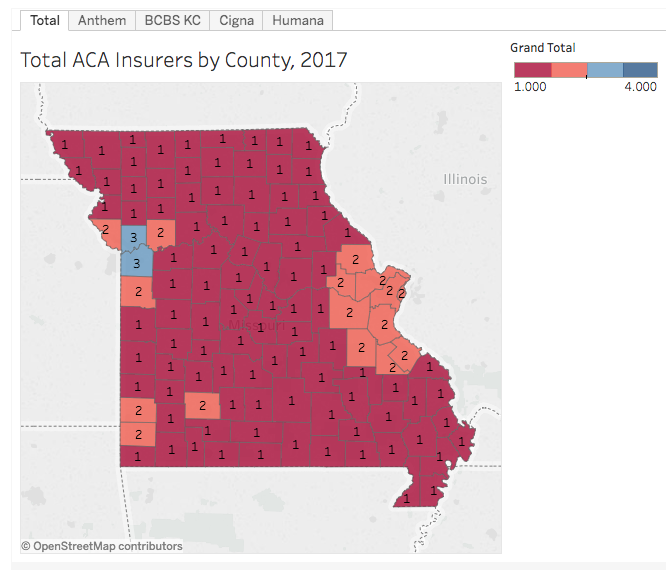
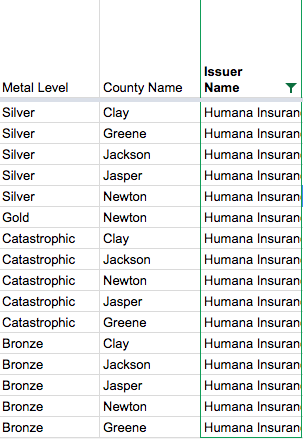
What does Humana’s decision mean for Missouri? Well for starters, in 2018, Jasper, Greene, and Newton counties will likely have only one insurance provider on the exchange, assuming Anthem doesn’t leave (as they’ve hinted they might do) and make that number zero. Options in Jackson and Clay counties in the Kansas City area will also be reduced, from three insurers to only two. To be clear, Humana wasn’t the largest provider of exchange plans by a long shot, but its departure suggests its suboptimal risk pool will migrate to the remaining plans in the state’s exchange, threatening those business models, as well. If, as Humana suggests, the company’s risk pool was too sick to be sustainable as a business model in 2017, it’s reasonable to believe that the remaining exchange providers will see their pools become sicker in 2018, and thus their business models less profitable. In other words, it’s an insurance death spiral.

Below is the insurer count map that I published earlier this year. The difference in 2018? The southwest corner of the state has only one inurer, and in the Kansas City area, all the 3 insurer counties become 2 insurer counties.

Assuming the accuracy of Humana’s release, the plans listed below will not exist on the Missouri insurance exchange next year. 

The failure of the exchanges only serves to reaffirm that the misnamed Affordable Care Act needs to be repealed and replaced with a plan that empowers people and leverages the market to make care more affordable and accessible. We have a few ideas about how to make that happen. It’s time to finally make progress for patients.

Support Us

The work of the Show-Me Institute would not be possible without the generous support of people who are inspired by the vision of liberty and free enterprise. We hope you will join our efforts and become a Show-Me Institute sponsor.

Donate
Man on Horse Charging