We Need to Make Missouri More Attractive to Charter Management Organizations

Earlier this week, the Center for Research on Education Outcomes (CREDO) at Stanford University released a new study of Charter Management Organizations.  The study included more than 3.6 million student records from 26 states, including Missouri. A total of 5,715 charter schools were included in the study.

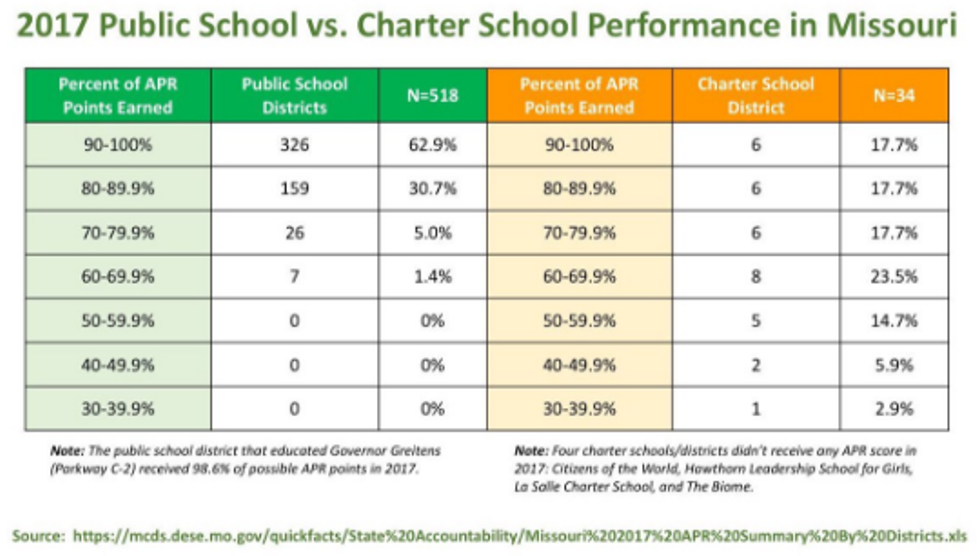
On average, charter schools improve test scores in English Language Arts and Mathematics at a higher rate than comparable traditional public schools. There is variation, though. Notably, the authors of the report found charter schools that belong to a network, (known as a charter management organization, or CMO), tend to perform higher than independent charter schools.  Missouri’s charter schools didn’t fit this trend, as non-CMO schools performed relatively well. Nevertheless, the findings of this report have some important implications for Missouri.

Currently, there are relatively few large, successful charter management organizations operating in our state. There are a few reasons why this is so: 

Limited Locations

For many years, charter schools could only open in Saint Louis and Kansas City.  For a network of schools to thrive, it needs to be able to enroll a large number of students. The limited markets of Saint Louis and Kansas City make it difficult for this to happen.

Limited Enrollments

Charter schools can now operate in unaccredited school districts, but they still face problems with enrollment. Missouri’s charter school law does not allow students to enroll in charter schools across district boundaries, and Missouri has relatively small school districts. A charter must attract a large percentage of students in a small school district in order to be viable. This has prevented charters from opening in the perennially struggling school districts of Normandy and Riverview Gardens, as well as other places. 

Making it easier for charters to open statewide and allowing them to recruit students from across district boundaries might entice more charter operators to open schools in other districts or on the borders of Saint Louis and Kansas City. Current law makes it difficult for charters to operate outside of the two cities.

Pension Barriers

An added difficulty is Missouri’s teacher pension system. Currently, there are three separate systems which do not have reciprocity between them, meaning that years of service do not carry from one system to another. Charter networks may wish to move teachers or administrators between schools, but if this means moving between pension systems, those individuals would lose money.

Funding Parity

Charters in Missouri do not receive local tax support for facilities and debt. An analysis by researchers at the University of Arkansas shows that charters in Missouri receive approximately 26 percent less funding that their district counterparts. This is a difference of more than $4,600 per pupil. Many states are trying to attract high quality CMOs and can offer them more support than Missouri can.

If Missouri wants to improve educational outcomes for students, the legislature should enact polices that make the Show-Me State more attractive to CMOs. For starters, the legislature could address the problems listed here by removing geographic limitations, opening enrollment policies, reforming pension policy, and improving funding parity. 

KC Convention Hotel: Lack of Transparency Undermines Confidence

For years, a development group led by former Kansas City politico Mike Burke has been trying to close a convention hotel deal downtown. It’s tough to know exactly what is going on, but recent news stories do not inspire confidence. Eight months ago, we wrote that the group still did not have financing in place, despite saying a year earlier that they did. As of June 7, 2017, they still don’t. It’s one more missed deadline in a project beset with delays—before ground has even been broken.

They do, finally—maybe—have a guaranteed maximum price (GMP) from project general contractor JE Dunn. According to The Kansas City Business Journal, JE Dunn “provided the final GMP proposal two weeks ago.” Burke described the number as “preliminary,” making it reasonable to wonder if the price is actually guaranteed.

The Star now says that Hyatt has pulled out of the convention hotel project. This news wasn’t made public weeks ago when it happened, nor has the development group revealed how much the new hotel company, Loews, is investing in the project. This is no surprise; Burke’s group has previously refused to provide information about the hotel. When asked by The Pitch in 2015 to share information about the project, he said,

There’s some sensitivity to releasing anything that’s old or anything that causes us grief with the bond buyers,” Burke tells The Pitch. “The minute we put it out, somebody with the Show-Me Institute will say it’s unrealistic.”

Not only are we left wondering how much the hotel company is investing, but we also don’t know who the other investors are. Those who watched the Planning and Zoning Committee hearing on June 7 saw conflicting testimony. Development team member Steve Rattner now tells the committee, “the financing is in place; we’re ready to go.” Mind you, it was supposed to wrapped up by March or April, and Rattner said it was in place back in October 2015. But the project attorney, Roxsen Koch, said that drafting the bond documents will take months and only after that—in early August—will the financing be in place. How confident should we be that deadline will be met?

Those aren’t the only examples of information from the hotel’s development team being hard to come by or subject to change. Two months ago, Burke promised a summer groundbreaking. Now, he says groundbreaking has been moved to October. Before that it was spring 2017; and before that early 2016.   

Even members of the committee were hesitant to endorse predictions from the development team. Chairman Taylor called for a motion to advance the matter to the full Council and the committee members sat in silence for 9 seconds before Councilwoman Katheryn Shields laughed and offered the motion herself. (See here.) That delay likely represents a well-founded lack of confidence that this project will deliver as promised.

On KCI, Process Is Important

The City of Kansas City has issued a new, new request for proposals to build a new airport terminal or perhaps even renovate the structures there now. This is good news; the process up to this point has moved in fits and starts, and according to one councilman, was “really weird.”

Process matters in public policy. Moving past a fast-track no-bid contract to an open and transparent bidding process is necessary for good decision-making. As a city-wide vote is required, there will be a public campaign on what to do. The public has been wary of the proposal up to this point.

That may be changing. Steve Vockrodt at the Star has authored a piece about a public opinion survey conducted by Remington Research and paid for by Burns & McDonnell, the firm that was to be awarded the no-bid contract before the City Council got involved.  Vockrodt wrote:

The latest poll by Remington said 40 percent opposed the single-terminal idea, while 22 percent were unsure.

Those results ticked upward by double-digit percentage points when respondents were told about a Burns & McDonnell plan to privately finance, design and build a new single terminal. Support on that basis grew to 55 percent favoring the proposal, compared to 23 percent against and 22 percent unsure. The polling suggests that respondents warm to a local firm’s involvement in the project as well as a private financing model.

Unfortunately, neither Remington nor Burns & Mac have released the full survey. This is important as surveys can be subject to bias—both intentional and not. Having worked in public and corporate polling for 15 years, I know that opinion research can not only measure public opinion, but be used to influence it. That is why the American Association for Public Opinion Research’s (AAPOR) Code of Ethics requires researchers to release, among other things:

The exact wording and presentation of questions and response options whose results are reported. This includes preceding interviewer or respondent instructions and any preceding questions that might reasonably be expected to influence responses to the reported results.

Vockrodt quoted Councilwoman Katheryn Shields as being skeptical of a poll sponsored by a firm that had so much to gain from the debate. She offered, “I’m astonished that a company with the reputation of Burns & McDonnell would continue to needlessly interfere with the bid practices of this city.”

The public has been engaged in the discussion of a new terminal at MCI for at least 4 years. The debate has been less than transparent, and many of the arguments in favor of a new terminal have been proved false. Councilwoman Shields is right: For the sake of good public policy, it is incumbent on all the participants, including Burns & Mac and other applicants, to respect the process.

Putting the APPP in Perspective

The City of St. Louis is exploring the privatization of Lambert International Airport through the federal Airport Pilot Privatization Program (APPP). The APPP allows a limited number of publicly owned and operated airports to exchange the right to operate and manage their facilities (and so, pursue profits) with private firms in return for major up-front cash payments, a share of future revenues, and major capital investments.

Privatizing Lambert could be a win–win–win proposition for St. Louis. The city could get an infusion of cash; private firms could get the opportunity to pursue profits; and the traveling public could get an improved and more efficient airport. But skeptics point out that a limited number of airports have gone through the APPP, implying that privatization is rarely successful, if not unrealistic.

So, is privatization realistic? Why hasn’t it taken off in the US?

The answers: “Absolutely” and “It’s complicated,” respectively.

Privatization is becoming more common abroad. As of 2016, 41% of European airports were partially or fully privatized, and the Canadian National Airport System (comprising Canada’s 26 largest airports) has been successfully operated by the private sector for decades. According to Airports Council International, the private, market-based approach in Europe has led to “significant volumes of investment in necessary infrastructure, higher service quality levels, and a commercial acumen which allows airport operators to diversify revenue streams and minimize the costs that users have to pay” (p. 1). Privatization has also led to greater competition, which has “pushed airports of all sizes to fight for route development and traffic growth, to become leaner and more efficient… and to find the optimal means of financing investments “(ibid). In short, privatization works; in fact, it works really well.

But European and Canadian airports weren’t privatized through the APPP, which might be why privatization has been faster and smoother abroad. While the APPP is promising, it can take years to finish the application process, and time is money. For perspective, Henry County Airglades Airport had its preliminary application approved in 2010 and has yet to receive final approval from the Federal Aviation Administration (FAA).

The APPP also imposes restrictions that can make crafting a privatization deal challenging. For instance, a 65% majority of airlines need to approve a lease agreement for privatization to go forward. And if the city wants to use proceeds from the agreement on projects outside the airport, it’ll require that same 65% approval. Moreover, private operators must assume any public debt held for the airport unless the FAA waives the responsibility. On top of all this, the passenger facility charge (PFC) airports levy on travelers is capped at $4.50 by Congress, which limits revenue for private operators. (Read this recent Congressional report on the APPP for a more detailed account of the program and its challenges.)

The question isn’t “Should we privatize?” but “How should we privatize?” The FAA has discussed the benefits of privatization and increased competition for decades, and the APPP gives St. Louis a chance to capitalize on those benefits. And while few airports have been privatized through the APPP (note that most simply withdrew their applications), policymakers can work to craft a deal that works for all involved: the city, the airport, airlines, and the traveling public. Look for more soon on what a privatization deal could include to offer the best outcomes for all parties.

Show-Me Now! Chesterfield’s $500,000+ Wall

Fancy bricks and big bucks: Chesterfield’s half-million dollar wall is getting a lot of attention and not for the right reasons. Transportation development districts are supposed to fund community improvements like roads and bridges…But are some of these districts wasting your tax dollars on “beautification” projects?

 To learn more about transportation development districts (TDDs), visit showmeinstitute.org

On Special Sessions, Public Service, and “Real Jobs”

This week the Missouri Senate returned to the Capitol for its second special session of the summer—an enterprise for which a handful of Senators have themselves to thank. After all, when you waste half of a Legislative session filibustering and singing Kumbaya, you may have to finish the People’s work on your own time. In the world of real jobs, that’s called earning your salary.

And it’s the “real job” debate that percolated during the first special session that I want to address here, since it’s now come back up in the second. During the first special session it appeared that a handful of senators might already have been looking ahead to the Memorial Day weekend, which I don’t begrudge them. But a common refrain during the session’s debates was that a few senators were put out by having to come back to the Capitol—that being a senator wasn’t a “real job.” At least one senator even threatened to try and close down future special sessions because his “real job,” whatever it is, was more important than finishing his work as a senator.

Are senators the victims here? They don’t donate their time to be senators. They’re paid. They’re aware that special sessions can be called. They weren’t tricked into this line of work.

And can you imagine U.S. Senators behaving like this when talking about their public service? Constituents aren’t honored by electing a senator to public office. Senators are, in fact, given the honor of representing their constituents. 

So when I hear a senator complaining on the People’s floor about his pay, the burden of his office, and the inconvenience of doing the job he sought and received, I am left to wonder why he is standing there to begin with.

And now, as would happen in a real job, some of these senators are going to have to earn their cash advance. They were happy to walk away with their salaries during the regular session as bill after bill was buried by their filibusters and foot-dragging. Now they’re being paid per diems to do jobs that should already be done.

Maybe next year these senators will treat their real jobs—doing the People’s business—more seriously; otherwise, I suspect the summer of special sessions will evolve into an annual tradition. Let’s hope that won’t be necessary.

Ready-Fire-Aim Approach Yields Predictable Results at KCI

The rush to build something—anything—at Kansas City International Airport is calling into question the ability and even the seriousness of Kansas City leadership.

Consider a recent story in The Kansas City Star, which states that Burns & McDonnell would be given “the opportunity to equal other proposals if it chooses, since it brought the idea to a municipality to begin with.” The Star called this “nuance,” though apparently some thought it was a serious problem. Seven days later, the Star reported that:

City Manager Troy Schulte said Monday that the city’s lawyers had advised that the right of first refusal could potentially be subjected to a legal challenge, so it was eliminated.

How did a proposal outside the city’s municipal procurement code provisions, and possibly even fodder for a lawsuit, get past the corporate attorneys at Burns & Mac and all the attorneys on the City Council, including Mayor Sly James himself? Why did the City Manager announce the decision to allow Burns & Mac the right of first refusal without consulting with the city’s attorneys beforehand? If he did consult with them, how did they initially miss it? And how did The Kansas City Star, the city’s paper of record, unquestioningly describe a potentially unlawful bidding practice as mere “nuance?”

Could it be that this policy proposal—if it can be called that—is being rushed through? That may be an odd question to raise about a matter that has been under discussion in Kansas City for years, but it appears to be what is happening.

The public wasn’t convinced of the need for a new single terminal before this latest political fiasco kicked off. The deadline of a public vote in November has created a false sense of urgency—resulting in the kind of mistakes you’d expect from people more concerned with getting something done fast than with getting it done right.

The airport is an important and valuable asset. The consequences of a mistake in the planning or implementation of its development will reverberate throughout the region for decades. There is no reason to rush this decision—good policy is not served by hurried half-measures. The Starand the airlines themselvesought to suspend their calls for a November election, and the Council ought to ignore false deadlines. 

Support Us

The work of the Show-Me Institute would not be possible without the generous support of people who are inspired by the vision of liberty and free enterprise. We hope you will join our efforts and become a Show-Me Institute sponsor.

Donate
Man on Horse Charging