
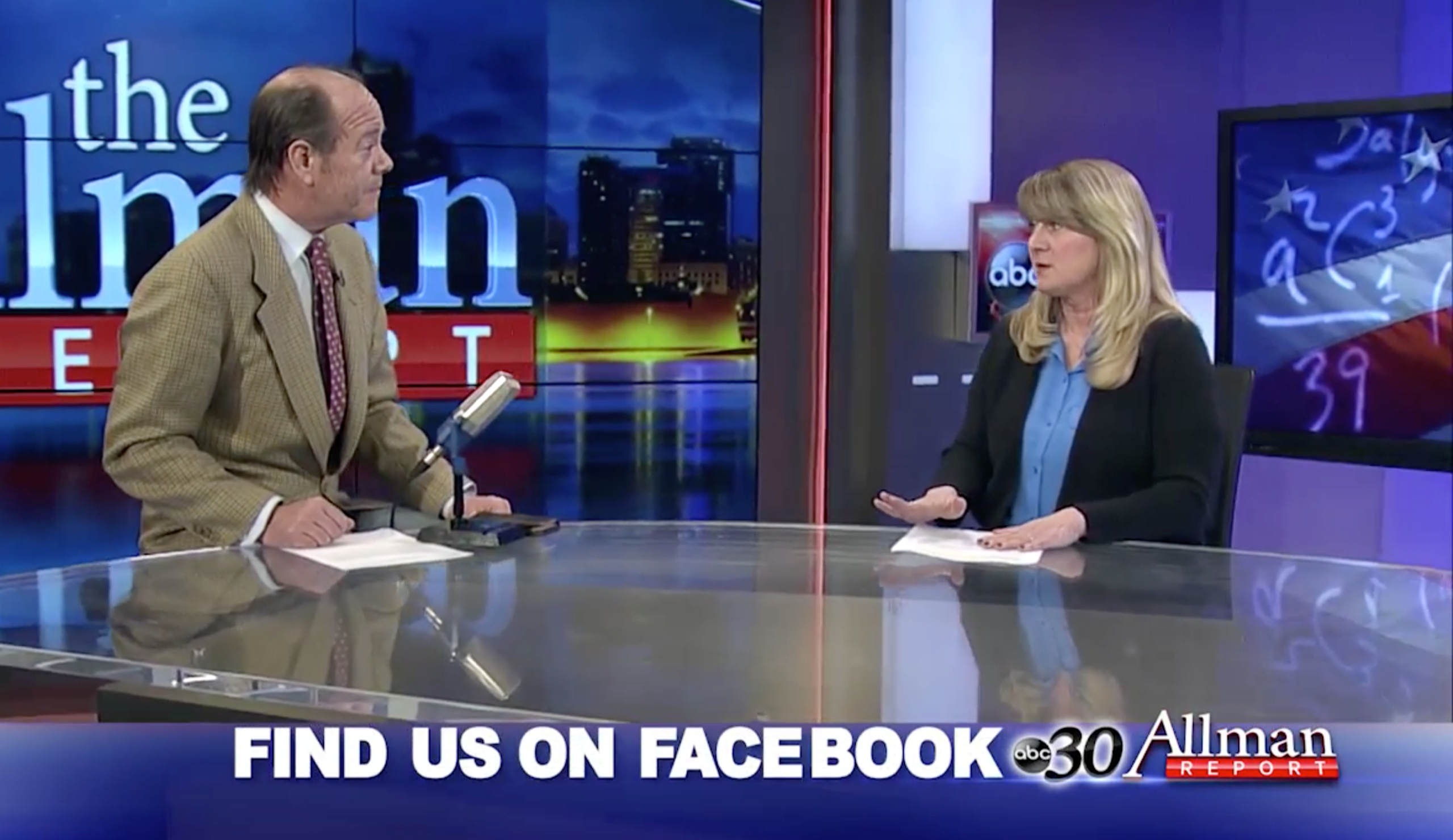
On January 25, Show-Me Institute Director of Education Policy Susan Pendergrass appeared on ABC30’s The Allman Report and discussed school choice initiatives.
What Rural Parents Want

Nearly half of Missouri’s K-12 students live in rural areas. Accordingly, education reform efforts in Missouri should be aimed at helping urban, suburban, and rural families alike. A survey conducted by EdChoice last November could be helpful in this regard; it highlights the opinions of people living in small towns and rural communities about what kinds of school choice policies they favor.
One key finding is the difference between where most children attend school and their parents’ preferred type of school:
The vast majority of small town/rural residents taking our survey have had children in public district schools for at least one school year (87%), while much smaller proportions said the same of private schools (15%), homeschooling (11%), and charter schools (8%).
The table below shows the preferences of rural parents (and, for context, all parents) regarding the kind of schools they would like their children to attend:
| Public | Private | Homeschool | Charter | |
| First preference: rural parents | 28% | 35% | 14% | 15% |
| First preference: all parents | 33% | 42% | 7% | 15% |
| Source: EdChoice, “2017 Schooling in America.” | ||||
Like parents in the rest of the nation, small-town/rural parents chose private school as their first option most often; interestingly, a larger proportion of these parents also chose homeschooling as their first option as compared to urban or suburban parents.
It is no wonder, then, that small-town/rural parents are overwhelmingly in support of education savings accounts (ESAs) at 74 percent responding favorably. ESAs are publicly funded accounts that are controlled by parents so they access a variety of approved educational services for their children. Depending on a child’s needs, parents can use the ESA to pay for things like private school tuition, online learning programs, or different types of therapy. Because the money in an ESA can be used essentially like a debit card, it allows parents to tailor their child’s education. Compared to other school choice programs like vouchers and charter schools—which were still popular—ESAs were the favorite.
The survey should help correct the perception that school-choice policies would mostly benefit urban students. In fact, a study from the Brookings Institute found that 73 percent of students in Missouri live within five miles of one or more private schools. In many cases, distance is not the primary obstacle keeping rural students from private schools.
ESAs would allow families to customize their children’s education. That could mean sending kids to a private school, purchasing supplies for homeschooling, or getting tutoring help for a child with special needs. As more and more evidence suggests that school choice—particularly ESAs—resonates with a majority of parents no matter where they live, shouldn’t we shape our education policy accordingly?
Education Savings Accounts: A Path To Student Success

Only 22 percent of Missouri ACT test-takers scored “college-ready” in 2016, so it’s clear that we have a problem. That’s why Missouri should look at new ways to reform its education system. One solution could be education savings accounts (ESAs). ESA’s are flexible-use savings accounts used solely for education purposes such as school supplies, tutoring, or even private school tuition. Shouldn’t parents have the flexibility to decide what’s best for their kids?
Does Banning the Box Work?

WDAF TV in Kansas City recently reported that City Councilmember Jermaine Reed is seeking to expand the city’s ban-the-box initiative that currently prevents the city from including a box on job applications asking if the applicant has had a felony conviction. Approval of Reed’s proposal would mean that private companies and landlords would be subject to the same restriction in their applications. However, despite good intentions, research tells us that ban-the-box policies hurt minorities.
The WDAF story goes on to point out:
The city has “banned the box” since 2013 and said it’s been a big success. Employers can still do background checks, which could prevent someone from getting hired. But getting rid of the check box can help eliminate the stigma [that would] prevent qualified candidates from getting hired just because of their criminal history.
That is certainly a noble goal. But research from respected universities and public policy organizations casts doubt on the effort’s effectiveness. According to The Atlantic magazine,
. . . banning the box may actually be hurting some of the exact groups of people it was designed to help, according to a few new studies. In a recent paper from the National Bureau of Economic Research, Jennifer L. Doleac of the University of Virginia’s Frank Batten School of Leadership and Public Policy and Benjamin Hansen of the University of Oregon looked at how the implementation of ban-the-box policies affected the probability of employment for young, low-skilled, black and Hispanic men. They found that ban-the-box policies decreased the probability of being employed by 5.1 percent for young, low-skilled black men, and 2.9 percent for young, low-skilled Hispanic men.
The left-leaning Brookings Institution found the same, detailing what happens when the felony conviction disclosure is removed:
Employers are forced to use other information that is even less perfect to guess who has a criminal record. The likelihood of having a criminal record varies substantially with demographic characteristics like race and gender. Specifically, black and Hispanic men are more likely than others to have been convicted of a crime: the most recent data suggest that a black man born in 2001 has a 32% chance of serving time in prison at some point during his lifetime, compared with 17% for Hispanic men and just 6% for white men. Employers will guess that black and Hispanic men are more likely to have been in prison, and therefore less likely to be job-ready.
In short, ban-the-box policies are likely hurting minorities. Hiring discrimination is a thorny problem, but not all such problems have easy or obvious solutions. If your proposed solution is hurting the people it is intended to help, it’s probably time to think about a new approach.
Education Savings Accounts and Available Seats in Private Schools

Missouri has a lot of private schools—more than 600. Most of these schools, like their public school counterparts, are operating below capacity; that is, they have space to serve more students. Using data from the National Center for Education Statistics’ Private School Universe Survey, I calculated approximately how many available seats there are in these schools. To do this, I simply subtracted a school’s current enrollment from its highest enrollment over the past 10 years (In the coming months we’ll release a full report on this). Suffice it to say, there are a lot of available seats in existing private schools—more than 28,000. To put this into perspective, Missouri’s largest school district had fewer than 26,000 students in 2017.
While many of the existing private schools are located in St. Louis City, St. Louis County, and Jackson County, there are many throughout the state. Last year researchers at the Brookings Institution calculated that 73 percent of Missouri students have a private school within five miles of them, while just 65 percent have another public school within their district and 54 percent have a public school outside their district that is within five miles. The point here is that a private school choice program could expand educational options for students throughout the state, possibly more than any intra-or inter-district choice program could. This session, Missouri lawmakers will consider such a program.
Empowerment Scholarship Accounts, or education savings accounts (ESAs) as they are often called, enable students to receive support to attend the school of their choice. Unlike a voucher, which sends state funds directly to a private school, an ESA is like a debit card. The student and her parents can use the card to purchase school supplies, pay for tutoring, or even to pay for private school tuition. An ESA program currently under consideration in Missouri would be funded by tax-deductible donations made by individuals or businesses. While the donor receives a credit towards his or her taxes, Missouri students receive much more—opportunity. In essays for the Show-Me Institute, I’ve written about how these programs function and how they could save the state a significant amount of money.
Currently, 18 states have scholarship tax credit programs and 6 have ESA programs. By passing an ESA program, lawmakers can tap into the wonderful resource we have throughout the state—private schools. They can equip parents to take ownership of their children’s education and allow them to decide where their children will be educated. And, importantly, an ESA program can generate savings for the state.
Telephone Town Hall – January 18, 2018
This town hall discussion was held the evening of January 18, 2018. The call featured policy directors of the Show-Me Institute discussing our 2018 Missouri Blueprint and policy changes that would advance the interests of all Missourians.
It’s Not Food Deserts, It’s Food Swamps!

Does how close you live to a grocery store influence your diet? Advocates claim that it does, but research has failed to establish a connection. Nor does the research show a correlation between an area’s obesity rate and access to healthy foods. A new study suggests the real problem is not lack of access to healthy food, but rather an abundance of access to unhealthy food options, like corner markets and fast food.
Researchers at the University of Connecticut’s Rudd Center for Food Policy and Obesity have a name for places where unhealthy food is especially easy to find. They call such areas “food swamps,” and they define them as “areas with a high-density of establishments selling high-calorie fast food and junk food, relative to healthier food options.” The abstract from a recent Rudd Center study suggests there are policy implications:
Based on these findings, local government policies such as zoning laws simultaneously restricting access to unhealthy food outlets and incentivizing healthy food retailers to locate in underserved neighborhoods warrant consideration as strategies to increase health equity.
Just as with food deserts, the narrative surrounding food swamps sounds reasonable: If unhealthy food is more convenient and accessible than healthy food, then unhealthy food is what people will eat. But creating policy to address such a situation isn’t simple, nor is it without potential problems. One can imagine municipal leaders rushing off to draft all sorts of new feel-good legislation restricting restaurateurs’ property rights through zoning. The result could be nothing at all, or a raft of unintended consequences.
Ultimately, demand drives markets. Making healthy food more easily available will only help if people want healthy food. That might be why Rollin’ Grocer, whose mission was “to provide affordable, fresh food to customers living in food deserts and underserved neighborhoods through mobile grocery stores,” ceased operation in July 2017. Kansas City is spending upwards of $17 million to subsidize a Sun Fresh grocery store at the Linwood Shopping Center. Also at that center are a thriving Popeye’s Louisiana Kitchen, Linwood Chinese Express, and Pizza Hut.
If demand for healthy food does not increase, expect the Sun Fresh to face the same fate as its predecessor at that shopping center (it closed in 2007) while the fast-food restaurants nearby continue to flourish. The only thing that will change is a faster depletion of public funds.
Missouri’s Checkbook: 2000-2017
What does the state of Missouri spend your money on, and who is getting that money? You could always look at the state budget to give you a general idea of the state’s priorities, but unless you know where to look and have the time and money to complete the requests for the information, it would be pretty difficult to get your hands on Missouri’s “checkbook registers.”
Thanks to the hard work of many Show-Me staff, over the last few months the Institute has slowly accumulated a host of spending data—not only from the state, but from local governments as well—about how government officials are spending your money. Late last week, the state data set went live; expect to see a lot more in the days, weeks, and months ahead as we make more spending data available to the public.
If officials can spend your money, they can tell you what they’re buying and who is selling to them. We hope the public, researchers, stat geeks, and journalists find the information interesting and useful.
Course Access: Preparing Missouri’s Students for the Future

Missouri students are falling behind because not all schools can offer critical courses necessary for college and career readiness. But there is a solution. It’s called Course Access, and it allows students to take advanced courses such as physics and calculus. Isn’t it time Missouri invests in our students’ future?