Essay: Taxing Business in Missouri

As the U.S. Congress turns the national conversation toward reforming the tax code, one aspect they are discussing is the corporate income tax. Missourians would also do well to have a discussion regarding our own corporate income tax and how it affects—or in this case hinders—our state’s economic growth.  

You might assume that as a red state, Missouri’s corporate income taxes would be low. Since 1993, the top corporate income tax rate for Missouri has been 6.25 percent, currently the fifteenth-lowest in the country. However, a new essay by R.W. Hafer and Howard J. Wall argues that categorizing Missouri as a low-business-tax state isn’t quite that simple.

Drawing on data from the Tax Foundation, Hafer and Wall examine the total tax burden facing businesses, including income, property, sales, and unemployment taxes. They find that the tax burden on a business depends heavily on the type of industry the company is in. Because of different incentives and tax breaks offered to businesses in different industries, the effective tax rates paid by some firms are much higher than what others pay. For example, manufacturers enjoy a relatively hospitable tax environment; retail establishments and distribution centers, not so much.

This uneven distribution of tax burdens might not be harmful if the firms that were taxed the least were those that have the most beneficial effects on the economy. Unfortunately, the opposite seems to be the case. It turns out that the industry Missouri favors (manufacturing) seems to be the one in which low taxes are not related to higher state growth.

It seems (again) as if policymakers are trying to pick winners and losers—and finding out how hard it is to make the right call.

The essay, available at the link below, also explores the different tax burdens faced by companies in the same industry depending on whether they are new or established firms. Hafer and Wall’s findings help explain why our allegedly low-business-tax state has experienced such anemic growth in recent years.

School Choice for Me, But not for Thee

Parents want the best for their children. This is especially true when it comes to educational options. Each year, parents of means pay thousands of dollars in tuition at private schools, choose to send their kids to charters or other schools of choice, or even move to be in a better neighborhood or school district—all in order to give their children the benefit of a better education. Low-income parents lack these options. Too often, we tell them that they need to stay in their schools and try to make them better, even while more privileged families leave for greener pastures.

 In a recently published paper in the Journal of School Choice: International Research and Reform, “School Choice: The Personal and the Political,” I explore the question of whether parents who support school choice for their children would be willing to support programs that extend the same opportunities to other families. To find out, I convened five focus groups with parents in Kansas City and Saint Louis. A total of 35 parents of school-aged children attended these discussions. My findings were interesting, but not that surprising.

 The parents I spoke with strongly supported choice for their own children. In fact, most of their children attended schools of choice. More than 75 percent of the parents in the study either homeschooled or sent their kids to a school outside their traditional public school district. Of the remaining quarter, several sent their children to magnet schools within the traditional school district.

 Would they be willing to extend options to other children by supporting a private school choice program? As I write in the paper, “the responses were decidedly mixed.” Many parents who themselves expressed choice—including some who even sent their children to private schools—were not thrilled at the prospect of the government providing financial support for other children to attend those same schools.

 The parents in my focus groups expressed four main concerns when it came to private school choice programs. Over the next few days, I’ll take a look at each of these reservations and offer suggestions as to how school choice supporters might bridge the gap with parents like these.

 You can find the journal article here (paywall) or an earlier working version here

Education’s Problem Isn’t Too Many Bad Schools; It’s Too Few Great Ones

Often when I participate in hearings and discussions about education policy, I notice a narrow focus on one aspect of the problems confronting reformers: Many people who are dissatisfied with the status quo tend to focus too much on schools that are failing, and not enough on the reasons why there are so few high-quality education options for students. I explored this issue in a post for the EdChoice website. You can read it here.

Criminal Justice Reform Panel in Columbia

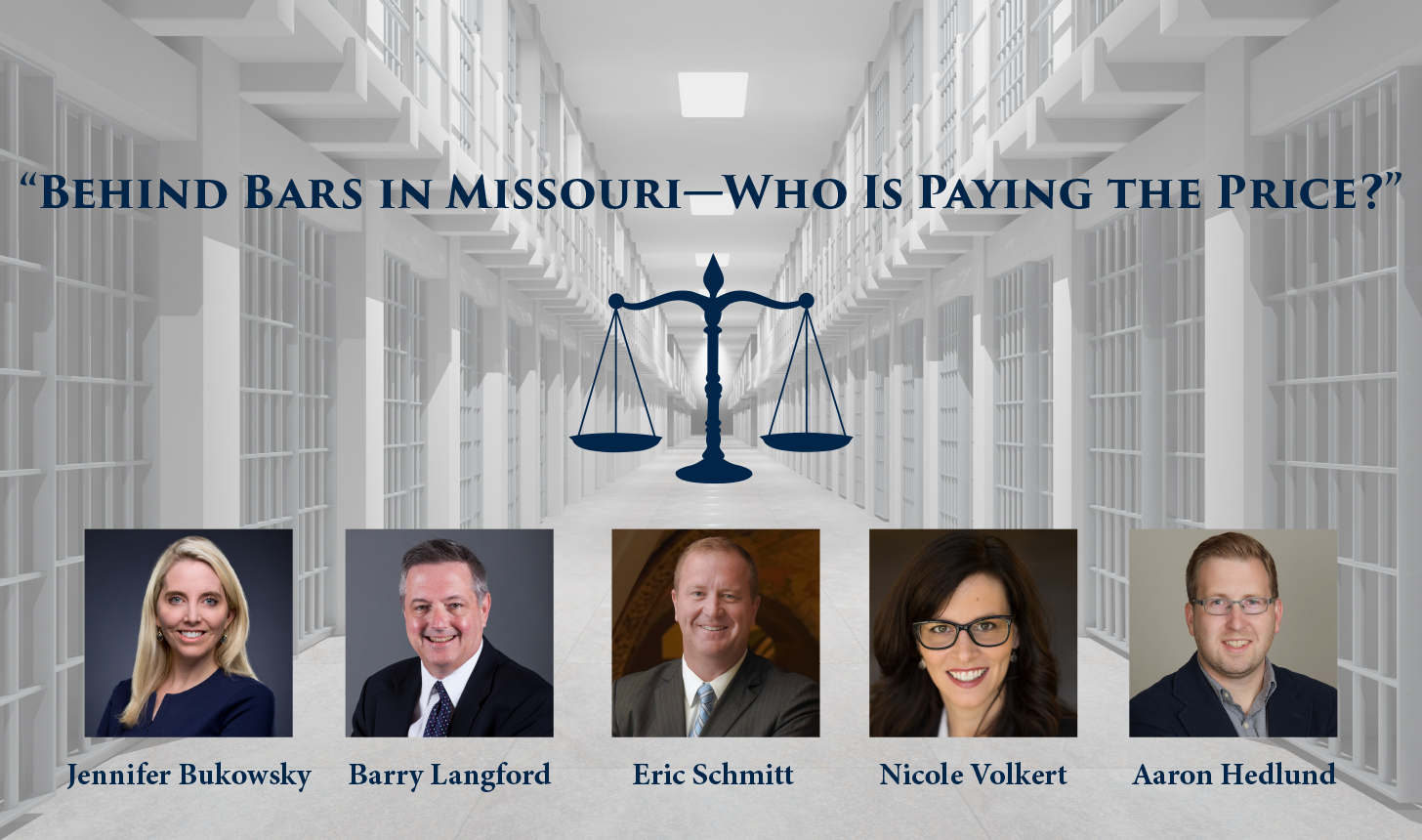
On Tuesday, September 26, Columbia College hosted the Show-Me Institute’s panel discussion on criminal justice reform, “Behind Bars in Missouri — Who is Paying the Price?” Panelists presented their thoughts on the state of affairs in Missouri and what reforms might address them. Panelists included:

  • Barry Langford, Chair of the Columbia College Criminal Justice program. Langford has taught at the school since 1994.
  • Aaron Hedlund,  economics professor at the University of Missouri and visiting scholar at the Federal Reserve Bank of Saint Louis.
  • Nicole Volkert, former prosecutor and municipal judge. Volkert has served both Monroe and Montgomery Counties and a legal advisor to the Columbia Police Department
  • Jennifer Bukowski, a criminal defense attorney with over ten years of experience. Nicole founded the Bukowsky Law Firm seven years ago after serving as a public defender for three years.
  • Eric Schmitt, Treasurer of the State of Missouri, elected in 2016. Previously, Eric served in the Missouri State Senate

The 90-minute presentation was packed with information. Panelists discussed criminal justice theory, the process and players from arrest to parole, over-criminalization, and the deleterious role of fees and fines, along with possible reforms. Some of the latter the Show-Me Institute has discussed before, including the cost of incarceration overall and reforms such as Raise the Age and reducing mandatory minimums. Panelists even pointed out the positive effects that education choice can have on incarceration likelihood.

The entire presentation is now available online (click above). The Show-Me Institute is grateful to everyone who participated.

The Costs of Subsidies

We’ve written for years about the costs of development subsidies. Both how they hollow out the tax base and rob the city and schools of funds necessary for basic services. We pointed out that the recent levy increase for the Mid-Continent Library system was in fact a TIF tax.

Now comes a story about the real costs of subsidies to the Walmart in Raytown. According to The Kansas City Star,

In a city of about 10 square miles officers made more than 500 arrests last year at the Walmart store at 10300 E. U.S. 350. The store is the scene of about 30 percent of Raytown’s reported serious crimes.

Meanwhile, Walmart does not contribute taxes for police services. The TIF deal that built the store a decade ago diverts about $300,000 in tax dollars away from public safety every year.

There is no such thing as a free lunch, and politicians who think there is no cost for diverting tax revenue to developers should think again. Walmart often makes for a convenient bad guy, but this same story is being played out with many different businesses. Kansas City, Raytown, and all of Missouri are bearing the burden of these sweetheart deals.

Policy Breakfast: Simple, Fair, and Low Taxes

This year, Governor Eric Greitens created the Committee on Simple, Fair and Low Taxes to evaluate Missouri’s tax policies and tax credit programs and make detailed recommendations for reform. On September 14, the Show-Me Institute welcomed Joel Walters and Mark Siettmann to Saint Louis for a Policy Breakfast at which they presented a first-hand account of the committee’s work and what it means for Missourians. Click above to watch the discussion.

A Linked Summary of the KCI Terminal Saga

In April 2013, Kansas City Mayor Sly James called for an “adult discussion about the facts” regarding the proposal to build a new single-terminal airport. Reach your own conclusion about whether that has happened. The Kansas City Star editorial board has rightfully derided the airport single-terminal bidding process as a “disruptive mess” “marked by distrust, misinformation, unnecessary secrecy and conflict.” But the process has been chaotic for years—at least since the Mayor opened up the issue in 2013. Here are some of the dispiriting details in the continuing new terminal saga:

It should be noted that members of the City Council did not appear to be welcoming of public input since the very beginning. Recall that back in late 2011, then-City Councilman Ed Ford said that Kansas City was going to get a new terminal regardless of what voters think. Then, after calling it a “wasted effort,” Mayor James and the City Council yielded to a petition requiring a public vote on the airport regardless of funding. More recently, Mayor James sought non-disclosure agreements from other Council members to avoid information becoming public.

Former Aviation Director Mark VanLoh has accepted much of the blame for the new terminal mess. As the Star’s Steve Vockrodt wrote, he simply did not know about Missouri’s requirement that a vote be held in order for airport bonds to be issued. Recall too, that:

  • While developing plans for a new single terminal, the Aviation Department  did not consult with the airlines.
  • The new terminal campaign was so disorganized that former Star editorialist Yael Abouhalkah called for VanLoh to be removed, writing that he did not “have the public credibility to lead on this extremely crucial project.” It was more than two years before VanLoh was finally forced out.
  •  A year before being replaced, VanLoh made a startling admission to a northland chamber of commerce, saying he just wanted a new terminal regardless of facts.

During all of this, Mayor James appointed an Airport Terminal Advisory Group (ATAG) which itself became a source of mistrust and unnecessary secrecy:

In addition, many of the arguments used to support the need for a new terminal just collapsed under examination,

  • Despite initial claims made by the Aviation Department, there were no EPA or energy needs for a new terminal. In fact, the initial claim about the EPA was bogus.
  • Likewise, security concerns about the existing terminals were overhyped. More recent claims that KCI has a long security wait proved to be just as baseless.
  • VanLoh once asserted that “KCI now has more airport screeners than all three New York airports combined.” That statement was clearly and unambiguously untrue.
  • Suggestions that the airlines won’t expand services with the current configuration have been shown to be unfounded. During the debate over a new terminal, new airlines have come to the airport and existing airlines have expanded service.
  • We were told the airlines agreed to pay for a new terminal. This claim was never true and thankfully has been abandoned.
  • Despite being strapped for cash, it was even suggested that Kansas may build an airport if Kansas City does not.
  • Advocates for a new terminal still claim that if we build a new terminal we will get more traffic, more direct flights to Europe, and new business in Kansas City. They even say we cannot win a bid for Amazon without a new single terminal. This is all speculative, and none of it is founded in any commitments from businesses or airlines.
  • In the last few months, we were told that a secretive, no-bid deal was the best option for a new terminal in Kansas City. This was demonstrably untrue, as the Council chose a different vendor once other bids were considered.

Throughout this debate, the conversation shifted from whether or not we need a new terminal to who was going to pay for it, and then again to who was going to build it. We’ve never satisfactorily answered the initial question, which is probably why voters remain skeptical.

Process is important in public policy, and while the Star editorial board and others may be relieved that Kansas City finally has a vendor and we’re cleared for a November vote, ultimately it appears voters are left choosing fruit from a poisoned tree. While it may be true that this proposal is better than what City leaders originally advocated, that is not saying much. We can only guess what other companies would have bid on the project if the bidding process had not appeared to be fixed, if the project did not require private financing, or if the project had not been limited to a single terminal rather than a mere renovation. To advocate for this plan simply because the process is over amounts to letting policymakers off the hook for years of bad behavior. Kansas City deserves much, much better. 

Corporate Welfare: A Curse, Not a Cure

I could only groan when I read the headline: “Saint Louis unifies to win Amazon HQ2: A Successful Bid Would Bring 50,000 Jobs to Region.”

Here we go again, I thought – another episode in the long-running story of local and state political figures being played for suckers in offering special tax breaks and subsidies to a major corporation with a much-ballyhooed plan for moving work to another city and state.

In 2013, Boeing decided to shop the production of a new airliner (the 777X) to other states after the local International Machinists Union in Washington state voted 2-to-1 to reject Boeing’s offer of an eight-year contract. Keen to wrest this piece of work away from Boeing’s giant facility in Everett, Washington, then-Missouri Gov. Jay Nixon and Saint Louis County officials were gung-ho participants in the bidding war, which involved 22 states and about twice as many cities.

They quickly put together a package that would award $3.5 billion in tax cuts and tax credits to Boeing, mostly over a 10-year period. A substantial portion of those tax credits would have been transferrable – meaning that Boeing could have sold them for cash to other companies wanting to shelter income in Missouri.

Boeing was promising up to 8,500 high-paying jobs. Though that may sound like a lot, it amounted to just 0.3 percent of total employment in Missouri. Where was the fairness (or the economic logic) in lavishing so much public assistance on one company – and less than half of one percent of the workforce – while implicitly increasing the tax burden on thousands of other companies and millions of other workers? In the end, Boeing decided to keep production in Everett – but only after the Washington state legislature approved $8.5 billion in tax breaks and subsidies for Boeing. The Seattle Times called it “the largest state-tax subsidy to one company in American history.”

History repeats itself – with Amazon replacing Boeing in what promises to be another bidding war for high-paying jobs. Once again when asked to jump into the game with tax breaks and subsidies, local and state officials – here in Missouri and pretty much across the nation – are all too ready to oblige. They do not question whether they should be in the game; they only ask: How high do you (Amazon) want us to jump?

Wherever it goes with its second headquarters, Amazon is plainly looking for a ton of corporate welfare – almost certainly in the many billions of dollars. Its request for proposals states:

A stable and business-friendly environment and tax structure will be high-priority considerations for the project. Incentives offered by the state/province and local communities to offset the initial capital outlay and ongoing operational cost will be significant factors in the decision-making process . . . Outline the type of incentive (i.e., land, site preparation, tax credits/exemptions, relocation grants, utility incentives/grants, permitting, and fee reductions) and the amount. The initial cost and ongoing cost of doing business are critical decision drivers.

In this case, what is good for Amazon is not good for the country – or for the state of Missouri. Let Amazon pay the “initial cost and ongoing cost of doing business” out of its pocket, just as other businesses do. Corporate welfare is a curse, not a cure.

Ballparks of the Ozarks Land Foreclosed On After Two Year Odyssey

Back in 2015, we wrote about (and Salvy-splashed some cold water on) an Ozarks project that aimed to build a baseball resort in one of the state’s most popular tourism regions. Our concern wasn’t the nature of the project itself; I love baseball and would probably enjoy a baseball-themed vacation. The problem was that the project developers were trying to get taxpayers to shell out millions to defray the costs of their private endeavor.

Now, two years on, the land the project was supposed to be built on just got foreclosed on and sold off. Cue ironic “Field of Dreams” reference.

The property was sold last Thursday in a foreclosure sale after several months of speculation about the project.

The sale included two parcels of land totaling 293 acres on Camping Paradise Road in Macks Creek under development with original plans that developers described as the “ultimate experience” for youth baseball. Long range plans called for facilities for lacrosse, football, field hockey and soccer.

That 293-acre sale appears to capture every last inch of the Ballparks of the Ozarks development plan, which contemplated the project sitting on—you guessed it—293 acres. Maybe the developers will try to repurchase the land from the buyer. Maybe they’ll move the project. And maybe the project is simply dead. Per our friends at KRMS

according to Presiding Commissioner Greg Hasty, funding for the grandiose project has apparently dried up effectively killing it and taking with it an expected 100 jobs that were to be created to operate the complex.

Yet in the months leading up to the foreclosure of the property, the Ballparks of the Ozarks developers were still seeking tax money. The county had even signed off on at least some of those local incentive proposals as recently as this year. According to the Kirksville Daily Express,

A Community Improvement District had been approved for the venue in January of [2017] by the Camden County Commission. Developers announced in June they would be looking at the formation of a Transportation Development District.

It’s a multi-layered, stinky onion of tax incentive attempts. Tax credits. A CID. A TDD. And yet apparently none of it was enough to attract the private investment required to keep the project sound and solvent.

I think a baseball resort could succeed in the Ozarks, but if it was going to work, it should have always been at the risk of private investors, not taxpayers.

Support Us

The work of the Show-Me Institute would not be possible without the generous support of people who are inspired by the vision of liberty and free enterprise. We hope you will join our efforts and become a Show-Me Institute sponsor.

Donate
Man on Horse Charging